Kindness, blessing, and the eyes of Jesus

From Ash Wednesday to Easter. A journey, a transformation, and one of the most intentional and richest parts of our liturgical calendar.

Our Lenten e-mail prompt and discussion of John O’Donohue’s book, “To Bless the Space Between Us,” was rich, meaningful, and eye-opening. It was a continuing and deepening conversation with 20 people which included the Eastern Shore, Vermont, and even photos and stories sent from Finland.

One of the purposes of the book for O’Donohue was/is to get us thinking about “blessing” differently, and that blessings can take many forms, not always something that we would wish, ask for, or even want. Sometimes blessings can be the sun and sometimes the silver lining.

The last section of the book is “To Retrieve the Lost Art of Blessing.” It is an intentional walk through a way of seeing. Here are a few early quotes:

“Something deep in the human soul seems to depend on the presence of kindness; something instinctive in us expects it, and once we sense it, we are able to trust and open ourselves.”

“Kindness has gracious eyes; it is not small-minded or competitive; it wants nothing back for itself. Kindness strikes a resonance with the depths of your own heart; it also suggests that your vulnerability, though somehow exposed, is not taken advantage of; rather it has become an occasion for dignity and empathy.

“Despite all the darkness, human hope is based on the instinct that at the deepest level of reality some intimate kindness holds sway. This is the heart of blessing. To believe in blessing is to believe that our being here, our very presence in the world, is itself the first gift, the primal blessing.”

That last paragraph especially: to see life itself as the first gift, the most basic blessing. Despite all the darkness.

We’ve just gone through an entire liturgical season that sees light overcome what seemed like the ultimate darkness. When faced with what seemed like the end, death, God shows us more, that new life overcomes death. That hope is not in vain, but intrinsic and ever-present, if we will see it.

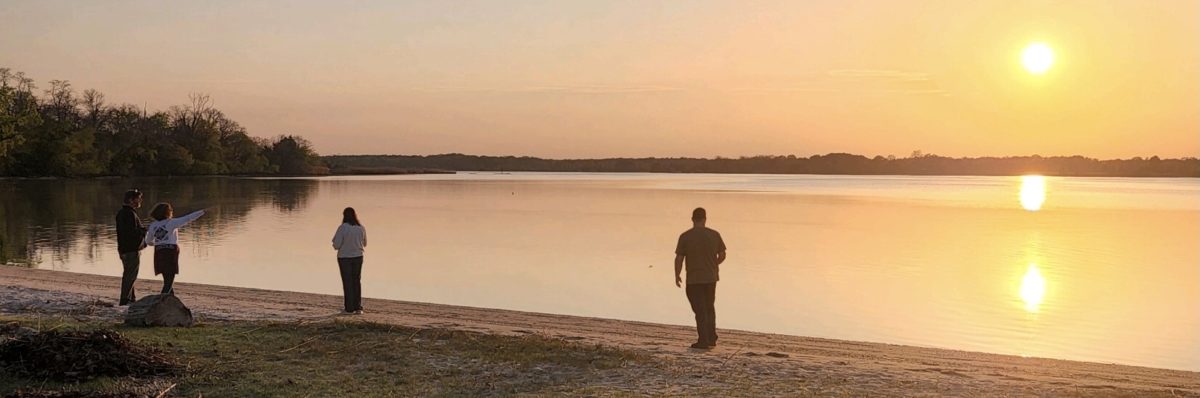
Over the course of our group discussion, participants responded with pictures of the Northern Lights in Finland and an Assateague camping sunrise.


The Resurrection is nuanced and layered in its meanings. One of the things it did was give credibility to Jesus being who he said he was. And it made the disciples for the next few generations, reflect back on what Jesus said and did, to the point of writing it down so that it could be passed down.

Many writers and theologians point out that Jesus’s words to his disciples were “follow me,” not “worship me.” It’s really a both-and situation, we can do both; and worship is a perfect response to God. But a problem over the years has been and continues to be that many Christians are content with worshipping ( and “believing” without living or living into any of that belief) and have dropped the following aspect of our faith.

Following Jesus means living like he did, loving like he did, doing our best to emulate his example. In John’s Gospel, Jesus gives the disciples (and us) the new commandment of “loving each other as I have loved you.” which he says knowing he is about to be arrested and put to death. That’s what his love looks like–sacrificing himself for the love of his friends and for humanity.

When we look at kindness through the example and eyes of Jesus, we have a sense of what we are called to do and who we are called to be.

O’Donohue closes his book with the poem, “The Eyes of Jesus”–

I imagine the eyes of Jesus
Were harvest brown,
The light of their gazing
Suffused with the seasons:

The shadow of winter.
The mind of spring,
The bues of summer,
And amber of harvest.

A gaze that is perfect sister
to the kindness that dwells
In his beautiful hands.

The eyes of Jesus gaze on us,
Stirring in the heart’s clay
The confidence of seasons
That never lose their way to harvest.

This gaze knows the signature
Of our heartbeat, the first glimmer
From the dawn that dreamed our minds,

The crevices where thoughts grow
Long before the longing in the bone
Sends them toward the mind’s eye,

The artistry of the emptiness
That knows to slow the hunger
Of outside things until they weave
Into the twilight side of the heart.

A gaze full of all that is still future
Looking out for us to glimpse
The jeweled light in winter stone,

Quickening the eyes that look at us
To see through to where words
Are blind to say what we would love,

Forever falling softly on our faces,
His first gaze plies the soul with light,
Laying down a luminous layer

Beneath our brief and brittle days
Until the appointed dawn comes
Assured and harvest deft

To unravel the last black knot
And we are back home in the house
That we have never left.

The eyes of Jesus are a way of seeing and a way of being, in terms of how we see and treat each other. O’Donohue talks about the way Jesus sees us, his gaze, and describes it in a way that should make us feel like we are loved before we do or say anything. Our souls are loved, as well as our bodies and minds. Do we allow ourselves to feel seen and loved that way?

Following Jesus means to try to look at ourselves, each other, and Creation with these eyes and this love.

Why do we take a journey through Lent? Why do we try to take in, reflect on, pray on, the Passion/suffering of Jesus over Holy Week? Why do we celebrate Jesus’s Resurrection?

I hope that at least part of the reason is to allow ourselves to be transformed, to become more Christ-like, to live and love like Jesus, which is to experience the kingdom of God and to do our part to help bring that kingdom, that love, to others, and play whatever role we can in bringing the kingdom here.

May we feel the eyes of Jesus gazing on us.
May we be the eyes of Jesus gazing on others.

May we know the love of Jesus, who became one of us, showed us how to live and how to love, gave his life for us, and then showed us that his love, God’s love, is greater than death, overcomes death and brings us to eternal life.

May we be the love of Jesus for everyone we encounter. And echoing Fr. Gregory Boyle, everyone: no exceptions.

An Afternoon

A town out of time.

A lane that unpacks whatever you carry with you.

A sliver of beach that looks across Eastern Bay.

Treasure is time plus experience yielding gratitude and wonder. Finding sea glass is the same as skipping shells.

If your mind and body are tuned to a task, you are the moment.


“You were made and set here to give voice to this, your own astonishment.” I carry that Annie Dillard quote in my soul, the reminder of a feeling that has always been there.

Unplugged.

Astonished.

Around the world in a 20-minute drive
and a short walk across the cosmos.

Holly reads Mary Oliver out loud:

“I have become older, and, cherishing what I have learned,
I have become younger.”

An afternoon out of time.

Ageless.

Priceless.

An afternoon.

Any afternoon.

Writing as reckoning

Jim Harrison writes like he is reckoning with life, death, love, God–you name it. He writes like his life is on the line, his soul is trying to come out through language–that’s how much is at stake.

His “Essential Poems” book frequently travels with me. This morning it was:

“The stillness of this earth
which we pass through
with the precise speed of our dreams.”

that washed over me, from Harrison’s poem, “Returning to Earth.”

“I Believe” is a manifesto of things in the world that he puts faith in.


Steep drop-offs, empty swimming pools, raw garlic, used tires, abandoned farmhouses, leaky wooden boats, turbulent rivers, the primrose growing out of a cow skull. What a list! These are things I know I believe in as I read his list because each thing comes powerfully to mind–smells, pictures, feelings. This is a list of beliefs that come from experience and hard-nosed reflection. Everything on it has passed the test.

Reading Harrison calls me to write things that absolutely have to be said–something relevant, something that is working on me and that has to come out or risk burning my soul, not an academic or intellectual game, not something that sounds nice or clever–something that comes out of an ongoing wrestling match or dance or conversation with the Spirit.

This a Mark year for the prescribed church readings–most of the Gospel readings this year come from Mark’s account of the good news. For Palm Sunday our in-person services did a dramatic reading of Mark’s account of the Passion (Last Supper, betrayal, arrest, crucifixion, death and burial–the suffering) of Jesus, with readers playing different parts. On our Zoom service, we divided up the reading between a few of us. Mark’s Gospel is the shortest of the four, the writer doesn’t add fluff or niceties, there is no birth narrative, no Christmas, and the account ends with women running bewildered from an empty tomb. Reading Mark’s Passion account, he doesn’t stop to answer questions, he leaves those up to us to ask, wrestle with, and answer.

I think the writer of Mark and Jim Harrison would get along. Both of them had stories they had to tell. Holy Week, the week leading up to Easter, is full of those kind of Jesus stories. It moves me more than any other week of the church calendar. This Friday evening, Good Friday, we will have a service built around the seven different last words/phrases attributed to Jesus in the different Gospel accounts of his death. Then someone will respond–something spoken, read, sung–hopefully pulling those in attendance into the story.

The Gospel writers chose to write down a story that was being told orally, for fear of losing it. They knew it was too big to risk letting it go. And each of them went about it a bit differently, each giving something of themselves and their reckoning with the good news and the Spirit.

When I read Harrison’s poetry, I know that what he is saying is vital to who he was. It conveys what he loved, what he struggled with, what he laughed at, what he cried over, and what lit up his sense of wonder; the curiosity that was in his bones. He was a rough outdoorsman who lived on a farm in Michigan near where he was born. He fished, he ate, he drank, he traveled–he lived.

I hope I can find the words, the pictures, the moments in my life where I connect to love, to wonder, to Creation, to God and to the story of God and humanity that is unfolding through all of us and transform and transmute it all through the right words.

I hope you find your own moments and experiences and transform them into your own art–whether dance, song, painting, poem, carving, or your life itself as a work of art. God is a creator and we, in God’s image, are also meant to create.

One of my favorite lines of writing comes from the beginning of a Harrison poem called “Tomorrow,” where he talks about being blindsided by a new kind of wonder, the kind we haven’t experienced before. He writes:

“I’m hoping to be astonished tomorrow
by I don’t know what”

The stars or the sunrise or sunset reflecting off the river; the smell and feeling of earned sweat; how excited your dog is when you walk in the door; a book you can’t put down or stop thinking about; the first sip of coffee or tea in the morning; jumping in the river, lake, or ocean when it’s colder than you expect; the memory of someone who shaped you; a conversation with someone you love when you don’t know what either of you will say next; an answered prayer; exploring somewhere you’ve never been; sacrificing something important for someone else–someone else sacrificing something important for you; knowing in your heart, soul, and bones that you are loved.

I’m hoping to be astonished tomorrow by I don’t. know. what. And I believe.

Listen to the Overlooked

Background: Last Sunday’s Gospel reading was Matthew 21:33-46, known as The Parable of the Wicked Tenants. It’s the second of three parables Jesus presents to the Temple priests, elders, and Pharisees, painting a harsh picture of how Israel is not living up to their name in their disobedience to God. This is the text of a homily I presented to the Christ Church Easton Zoom prayer service. Since our time with the Gospel is also a discussion, questions and answers people had changed and shaped things somewhat differently than what is written here.

“Listen to the Overlooked”

This conversation between Jesus and the chief priests and Pharisees began last week for us, when Jesus entered the Temple and was grilled by the priests and the elders about who he thought he was and where he gets his authority. And Jesus gave them a parable about a father asking two sons to go work in the vineyard, the first said he wouldn’t go, but then did, the second said that he would go and then didn’t. And Jesus made sure they caught onto the chief priests and the Temple leadership being the second son, who talks a big game, but then doesn’t do what they said they would.

And now Jesus takes it further. He relates the parable of the wicked tenants to them. This isn’t about saying one thing and then failing to deliver. This reaches another level. It’s outright disobedience and being self-serving despite all they’ve been given.

Michael Green in his book, “The Message of Matthew,” says:

“This parable unveils the flagrant disloyalty of the leaders of Israel. God had given them a wonderful vineyard to cultivate; he had given them all the necessary equipment to do the job (a winepress, a watchtower for shelter and burglar patrol, a wall to keep out the wild pigs and other trespassers). He had put his trust in them. And what did they do? The history of Israel tells the story starkly. In brief, they appropriated his goods, rejected his prophets, denied his rightful claims on them and killed his Son. They were given freedom as well as trust, but the day of reckoning is at hand: they will be held accountable for the way they have exercised that freedom.”

This is helpful to know how Jesus felt about the priests and Pharisees. In a reading we haven’t discussed in this part of the lectionary, the start of Jesus entering the Temple here is him driving out all who were selling and buying and overturning the tables of the money changers. This is the time of table-flipping Jesus. And now he is telling it like it is.

Jesus is calling out those who have been charged with doing God’s work, but who instead are looking after their own assumed power. But let’s not tell ourselves that what we are reading is simply supposed to point out and remind us of the disobedience of past people and generations—is it possible that church today, that we might also sometimes be the wicked tenants who tried to act like the vineyard was theirs and ignore the will of the owner?

Jesus then goes into quoting Psalm 118 verbatim when he says:

“The stone that the builders rejected
has become the chief cornerstone.
This is the Lord’s doing;
it is marvelous in our eyes.”

In this case, the SON and the STONE can be thought of as the same. Where they are ignoring and casting off John and Jesus, a new movement will begin that will have them as the main cornerstone, the foundation.

Let’s take a step back and look at some reasons why Jesus might be so upset with the chief priests and the Pharisees. What do you think?

  • They are putting the letter of the law over the intent.
  • They have ignored John the Baptist and now Jesus.
  • They are more worried about maintaining their own power than they are about the welfare of their people.
  • They are being exclusive rather than inclusive.
  • They are ignoring their responsibility to the poor, the sick, the downcast.

And what is it that Jesus is doing that is different? What do we see when we look at Jesus’s ministry?

  • He includes those who have been excluded—tax collectors, prostitutes, sinners, and when called upon, Gentiles.
  • He is healing the sick and caring for the poor.
  • He isn’t concerned about status or worldly power.
  • When it comes to things like the Sabbath, Jesus is following the intent of the law, not the letter of the law when it comes to helping people who are hurting.
  • Jesus views himself as a servant first, he is there to help, and to lead by serving.

Let’s fast forward to our time. Even though we wear his logo and worship his name, are we still ignoring Jesus? What would it look like for the church to be obedient, to follow him and live as he did now?

Talking about the rejected stone, the rejected Son, Fr. James Martin, a Jesuit priest and writer who we are studying, says:

“Jesus reminds us that sometimes it is the overlooked person who is the one we need to pay attention to.”

Who are the overlooked people now who we might want to pay attention to?


I doubt anyone can hear the things that Jesus taught and look at the life he lived and say, “no, that’s just a bad idea.” I wonder if part of what happened to the Pharisees and to the world today is that our hearts are out of step with God and that gets in the way of our following.

I’ve been reading Meister Eckhart lately, who lived from 1260 to 1328. He was a German Catholic theologian, mystic, and a part of the Dominican Order of Preachers. He is someone who seems to help me get out of my own way and do a better job of being open and listening for what God might want to say to me.

Let’s try a couple of his sayings and see if there is something helpful:

“Breaking Through”

Too often I decide what my
life should be and whether

there is from in it for You
while You sit in a deeper

place within me, wondering
what it will take for me to

make more of all the things
in my life—the good and

the bad—and so to learn to
break through to find You

in all that is and let You
take form in me in all that

I was and am and will be.

I wonder if too often our own ideas of what we should do push out any room in our hearts for God to operate. Did the Pharisees and chief priests have such fixed ideas of who God was and how he would speak to them, that it prevented them from stepping out in faith to trust the new direction John and Jesus offered?

On top of that, I wonder if what Jesus was modeling, what he was showing those in power was too radical, too much of a change for them when they came to enjoy so much the power and the status they had.

Here is one more from Meister Eckhart on what it looks like to follow Jesus:


“You Rise by Stooping Down”

With You everything
is upside down

and inside out,
for You rise by

stooping down,
and call me

to follow in
the footsteps

of your descent,
where I find

that You and
I are one

In being and
even in power.

Jesus rises by stooping down. He became incarnate, he humbled himself, and he called and showed himself to be a servant. Where we are in Matthew’s Gospel is Jesus on his way to the cross, to his death. He is trying to get everything he can across to his disciples, as well as being critical of the Pharisees, giving them another chance to repent and obey.

We have seven Sundays left in the lectionary year. Something to consider in the way these readings are presented to us. We read and reflected on Matthew’s telling of Jesus being arrested, crucified, and resurrected earlier this year, in Lent, Holy Week, and Easter.

We finish the church’s year with this series of teachings, warnings, and parables, and then November 26 is “Christ the King” Sunday, and the last reading we will get from Matthew before moving into Advent and the new year for the church, will be Matthew 25:31-46. Those will be the words we hear and reflect on to close this Gospel and then begin our Mark year.

Does anyone know the story?

Here is a key takeaway:

“Truly I tell you, just as you did (or did not do) it to one of the least of these brothers and sisters of mine, you did (or did not do) it to me.”

The wonder of being here

Sometimes I’m drawn forward and sometimes I am turned to circle back, usually so I can pick something up I need to go forward. That’s an eyebrow-raising, quizzical-look statement, I know. Let’s try this:

This past weekend, I went for a run–my first run since early April. It was slow, but it didn’t matter–the smile on my face running through John Ford Park, saying good morning to folks I encountered, feeling air in my lungs and my feet in motion, even if stumbling slowly, was something I have been missing.

Running, skateboarding, and writing are three life-giving activities I discovered in my early teens that sustain and stoke me in my early 50s. There is a thread that connects them.


I’ve been reading Mark Nepo’s book, “Drinking from the River of Light: the Life of Expression,” which I take in small bites, so I can savor it and let is wash over me. Nepo circled me back to one of my favorite writers, poet William Stafford, by sharing and talking about Stafford’s poem, “The Way It Is”–

There’s a thread you follow. It goes among
things that change. But it doesn’t change.
People wonder about what you are pursuing.
You have to explain about the thread.
But it is hard for others to see.
While you hold it you can’t get lost.
Tragedies happen; people get hurt
or die; and you suffer and get old.
Nothing you do can stop time’s unfolding.
You don’t ever let go of the thread.

Nepo writes, “To discover the thread that goes through everything is the main reason to listen, express, and write… I began to realize that listening, expressing, and writing are the means by which we stay clear, the inner practices by which we realize our connection to other souls and a living Universe.” Then he invites us to think about, write about, and try to discern what that thread is for us, individually. What is the constant that is with you, through joy, pain, sadness, lows, highs, that makes you, you?

As I sat there, coffee, sunlight, and summer-breeze-fueled, scratching out a few notes, the thing that hit me was: a sense of wonder. That’s the thread. From marveling at honeysuckle and marsh grasses in the neighborhood as a kid, to Morning Glories and Great Blue Herons as an adult, a childlike sense of wonder has underpinned it all.

Nepo is a writer I’ve just found. He circled me back to Stafford and a poem I’ve been reading for years–something I needed to pick back up to move forward with new eyes.

Running, skateboarding, and writing have been wonder-stokers for me all along. Somehow they have distilled over time to where the wonder is there now as soon as I step on a board, pick up a pen, or put running shoe to pavement.


Yesterday morning, Landy Cook and I met at the Oxford Conservation Park to start the week off with a sunrise longboarding adventure. The sun was smiling with us and lent its rays to every moment and every photo. It was a morning to catch up, to laugh, to skate, to enjoy the moments, to breathe in the day. It’s a place we skate frequently, it’s not new scenery, but every morning is its own, there is always something new or different to catch, to appreciate, to be grateful for.

For me, part of those experiences, those moments, of being given a gift, is wanting to communicate it, to share it, maybe if I am lucky to wake something up for someone else, to connect in some way.

Nepo says it: “listening, expressing, and writing are the means by which we stay clear, the inner practices by which we realize our connection to other souls and a living Universe.” That’s what writing brings to my aesthetic and Spirit-filled table. Even rolling on a skateboard, I make sure to have a pocket notebook and pen to try to catch something of the wonder of the experience.


A couple weeks ago I was sent back to another favorite writer, John O’Donohue. Last summer we led a small group discussing his book, “Anam Cara.” A friend from church continues to read and reflect on it regularly and he wanted to pass along a copy to someone who is going through profound loss, hoping it might give them something to latch onto–perspective, compassion, care, connection, hope.

The class last summer was right around this time of year and a memory, a quote from “Anam Cara” circled its way back in front of me. It’s a thought that struck me as something Holly has been working through after coming back from a 12-day mission trip to Amazon river villages in Peru, where the life of the villagers was deliberate, present, and connected to the days and nights, the land, and each other. O’Donohue wrote:

“It is a strange and magical fact to be here, walking around in a body, to have a whole world within you and a world at your fingertips outside you. It is an immense privilege, and it is incredible that humans manage to forget the miracle of being here.”

The miracle, the wonder, of being here. That’s our connection to each other, other living souls, to God, to the living Universe; whether we are in Peru, the backyard, or skateboarding with the sunrise.

cataloging gratitude: half dirge, half disco

“Unabashed” is a word we might get to know better. It’s defined different places as “not embarrassed, disconcerted, or ashamed,” and “undisguised, unapologetic.” It’s a word that is tough to live into for thoughtful, humble people who are concerned how people might take what they think or feel. Unfortunately, the flipside is that there are plenty of thoughtless people for whom being unabashed comes easily.

I am grateful when I get reminders to pick up favorite books of my shelf and re-read them. Dorchester County Public Library gave me my most recent reminder when they promoted a program for Ross Gay’s book “Catalog of Unabashed Gratitude” (really such a great title, without even reading the book).

DCPL is working with the National Endowment for the Arts #BigRead program for an event at the Dorchester Center for the Arts on Tuesday, July 18 at 6:00pm. Here’s the blurb for “Catalog” that they pulled from Google Books:

“Catalog of Unabashed Gratitude is a sustained meditation on that which goes away—loved ones, the seasons, the earth as we know it—that tries to find solace in the processes of the garden and the orchard. That is, this is a book that studies the wisdom of the garden and orchard, those places where all—death, sorrow, loss—is converted into what might, with patience, nourish us.”


A community orchard in Bloomington, Indiana, informs Gay’s take on gratitude, together with his experience gardening.

“…In this neck of the woods you have to prune
a peach tree if you don’t want the fruit to rot, if you don’t want
all that fragrant grandstanding to be for naught.”

He mourns the life cycle and necessary work to a tree in his poem “the opening” and continues:

“…This is how, every spring,
I promise the fruit will swell with sugar: by bringing in the air and light–
until, like the old-timers say, the tree is open enough
for a bird to fly through.”

And he talks about two cardinals and a blue jay flying through and a little grayish bird that sings a song “half dirge, half disco.” There is maybe one of the best and most memorable descriptions for a life fully felt and fully lived, “half dirge, half disco.”

I’m a fan of sunrises and sunsets. I will stop what I am doing, turn away from a conversation (though generally I am still listening) to take in those fleeting moments. The fact that they are only there for a few minutes is what makes them beautiful. You have to catch them as they happen–you can’t tell a sunset you’ll get back to it, or ask it to hold on. You’ve got to give it your full attention. Appreciate the whole scene and everything going on around it. Drink it in.


Life is that way. It is full of moments and if we want to live it to the fullest, we have to pay attention to all the moments we can.

In the title poem, “Catalog of Unabashed Gratitude,” Gay says:

“Thank you to the woman barefoot in a gaudy dress
for stopping her car in the middle of the road
and the tractor trailer behind her, and the van behind it,
whisking a turtle off the road.”

And I think of so many of my friends who do that and fill the social media feed with turtle rescue photos and every single one of them gives me a little hope for humanity. Even though after we stopped to move a turtle on the way to Hoopers Island a couple weeks ago, the truck going by didn’t much appreciate the effort. It’s all part of it.

I have so many lines and parts and images from Gay’s catalog underlined and tucked into my heart, I hardly know what to share. But I like this notion of community:

“we dreamt an orchard that way,
furrowing our brows,
and hauling our wheelbarrows,
and sweating through our shirts,
and less than a year later there was a party
at which trees were sunk into the well-fed earth”

Dreaming together, thinking together, cultivating together, working together, celebrating together. I just finished re-reading Gay’s catalog. If you want to get a different, deeper, more inclusive picture of what we can be grateful for, give it a read. DCPL can help you to that end. And maybe come out for the program at the Dorchester Center for the Arts–I have found that my appreciation and perspective for every book I have read and been moved by has deepened from discussing and sharing and listening to what others have taken from the same book.

In the meantime, I am going to pick back up Gay’s “Book of Delights,” his record of small joys that are so easy for us to overlook. And I’m going to continue to try to bring gratitude to each day, unabashedly, sharing as much as I can, one sunset, one moment, at a time.

Sitting by the river

Solitude is a gift.

Silence is a gift.

Sunlight is a gift.

Sitting by the river with a strong breeze moving the water and blowing against one side of my face while the sun warms the other.

I woke up in a warm house, while it was still dark and made coffee. Made a to-go breakfast for my older daughter for her drive to work. I laughed with my younger daughter taking her to school.

Now I am sitting in the sun and the wind by the water praying, reading, writing, listening, smiling.

Behind me is a cemetery where my grandparents, family members, and friends rest peacefully. Memories and love dance between us and connect us.

The books in front of me are titled “Pilgrim” and “Gold.”

Talking to God, Rumi writes:

“Today you arrived beaming with laughter–
that swinging key that unlocks prison doors.

You are hope’s beating heart.
You are a doorway to the sun.
You are the one I seek and the one who seeks me.
Beginning and end.

You greet need with generous hands.
You flood us with spirit,

ringing from the heart,
lifting thought.”

Reading this, he and I say it together. I like to think God smiles in the sunlight.

Across the cove the sun and the wind dress a weeping willow tree. Geese float tucked away from the tide.

When I am fully here, in this moment, with a full heart and an open mind, and time alone with God, what more can I ask for? I am not alone.

Thank you for this view.
Thank you for this day.
Thank you for this life.
Thank you for your love.

Amen.

* My practice/devotion for Lent this year is to write a “proem” (prayer-poem-prose) in the spirit of Brian Doyle each day of the season. I will share some of them. This is day #3.

A Salty Reminder

Life is a pendulum swinging between remembering and forgetting. Often I find myself on the forgetting end of the swing.

The poet Rita Dove described something that goes on in my mind in her poem “Lucille, Post-Operative Years”–

Most often she couldn’t
think–which is to say she thought of
everything, and at once–


Then, sudden as a wince,
she couldn’t remember a thing.


What bothered her: the gaps
between.

(Those are connected excerpts from three different stanzas)

I can have what feels like so much spinning around in my head that I can’t think of the name of the person standing in front of me, who I’ve known for years and I can tell you everything about them, but their name is missing. Or I can be talking along towards a point and have it fly out of my head and leave me looking for a direction to catch up to it.

Meanwhile I have memories from the first 20 years of my life that are crystal clear and in context like they just happened. Oh, but the gaps in between. The mind is a marvelous thing, particularly when it cooperates or shows us things we had forgotten we knew.

Sometimes I wonder if our collective memory works like that as well. There are things we forget that are critical to who we are or who we are called to be.

That’s where my mind has wandered with this weekend’s lectionary Gospel reading, Matthew 5:13-20 (quoting 13-16, “Salt and Light”)


“You are the salt of the earth; but if salt has lost its taste, how can its saltiness be restored? It is no longer good for anything, but is thrown out and trampled under foot.

You are the light of the world. A city built on a hill cannot be hid.

No one after lighting a lamp puts it under the bushel basket, but on the lampstand, and it gives light to all in the house.

In the same way, let your light shine before others, so that they may see your good works and give glory to your Father in heaven.”

What if we forgot what it is to be salt and light? What if we lost what that means? Maybe being light in the darkness makes sense, but what is it to be salt?

I am going to stick with Debie Thomas, who I have quoted a good bit lately from her book “Into the Mess & Other Jesus Stories.” She says when Jesus calls his listeners ‘salt of the earth’ he is saying something profound that is easy for our to miss in our time:

“First of all, he is telling us who we are. We are salt. We are not ‘supposed to be’ salt, or ‘encouraged to become’ salt, or promised that ‘if we become’ salt, God will love us more. The language Jesus uses is 100 percent descriptive. It’s a statement of our identity. We are the salt of the earth. We are that which enhances or embitters, soothes or irritates, melts or stings, preserves or ruins. For better or worse, we are the salt of the earth, and what we do with our saltiness matters.

Salt by itself doesn’t do much. And too much of it can ruin things. But the right amount of salt (which was in Jesus’s time a precious commodity) can enhance and make things better. Salt’s value is in its being spread around, added to other things–but not in a way that dominates or takes over.

If we forget that we are salt of the earth and keep ourselves separate and distant or try to take things over, we are not being true to who we are called to be.

Thomas’s essay, “Salty” looks deeply at what is to be salt–something that was precious, something that “does its best work when it’s poured around”, something that doesn’t exist to preserve itself; a calling that is not meant “to make us proud; it’s meant to to humble and awe us.”

What an honor to be asked to help, to be of service. Thomas continues:

“Our vocation in these times and places is not to lose our saltiness. That’s the temptation–to retreat. To choose blandness over boldness and keep our love for Jesus an embarrassed secret… But that kind of salt, Jesus tells his listeners, is useless. It is untrue to its essence… Salt at its best sustains and enriches life. It pours itself out with discretion so that God’s kingdom might be known on the earth–a kingdom of spice and zest, a kingdom of health and wholeness, a kingdom of varied depth, flavor, and complexity.

I’m really looking forward to discussing Thomas’s reflections on the life of Christ. We’ll see how salty and balanced we can become during our Lent small groups .


These are some of the books that are pouring ideas and prayers and sentences and questions and wonder and inspiration into my heart and mind at the moment.

Next weekend (February 11-12), I preach at Christ Church Easton. What that looks like walking around and how to process it is a different kind of thing. Barbara Brown Taylor in her book, “The Preaching Life,” points towards it:

“I do not want to pass on knowledge from the pulpit; I want to take part in an experience of God’s living word, and that calls for a different kind of research. It is time to tuck the text into the pocket of my heart and walk around with it inside me. It is time to turn its words and images loose on the events of my everyday life and see how they mix. It is time to daydream, whittle, whistle, pray.”

The more often I tuck God’s Word into the pocket of my heart and walk around with it inside me, the more it helps shape who I am and how I see the world. If I hope to take part in an experience of God’s living word, I need to remind myself that I am salt and light–my role is to enhance, sooth, melt, preserve, to add some flavor that might bring it into our world in a fresh way.

Back to Thomas:

“We are the salt of the earth. That is what we are, for better or for worse. May it be for the better. May your pouring out–and mine–be for the life of the world.”

To be a human being among human beings

Life has felt large and open and raw of late, where prayers, feelings, experiences and thoughts are all super charged.

There are plenty of reasons: Ava’s stereotactic neurosurgery is on Monday; Anna turns 21 on Tuesday and Ava turns 18 in mid-February; we’ve past the half-way point in our Romans Bible studies; seminary is stirring good things up and Kelsey Spiker and I just became postulants, the next designation in the path to ordination to the priesthood; even occasional preaching is a full-body experience; gearing up for Lent small groups; and the girls had their first ever snow skiing experiences, which was a trip with Holly and her kids as well as many teen and twenty-something friends.

Life has an open feeling, which is both filling and fulfilling and taxing and shaky sometimes.

Studying for a Saturday seminary day retreat, Rev. Susie Leight has us reading and thinking about the spirituality of the priesthood, which included excerpts from Barbara Brown Taylor’s “The Preaching Life” and Gordon W. Lathrop’s “The Pastor: A Spirituality.” Lathrop recalls an experience in a Swiss airport where he read a quote on a poster from Antoine de Saint-Exupery, written in French. Lathrop translated it literally to say:

“As a profound thirst: the desire to be a human being among human beings.”

A deep and profound desire to be a human being–someone who lives and feels, who is flawed and who needs others–among human beings. To be in community and to be allowed to be fully ourselves. This is what it is to be open, to be honest, to be vulnerable, which is not instantly a comfortable place to be.

Thursday we had a class discussing Tracy K. Smith’s Pulitzer Prize-winning book, “Life on Mars,” which is one of my favorite books. The discussion was about space and time, love, loss, grief, dancing, intimacy, language–it was flung like stars around the minds and hearts of those there. The last poem read was titled, “The Weather in Space”–

Is God being or pure force? The wind

Or what commands it? When our lives slow

And we can hold all that we love, it sprawls

In our laps like a gangly doll. When the storm

Kicks up and nothing is ours, we go chasing

After all we’re certain to lose, so alive–

Faces radiant with panic.

That is part of the challenge of being human, loss and fear are always in the mix with us. It’s a lot and sometimes we want to–I want to–shut the faucet off. But that’s not why we’re here. That’s not why I am here.

On Tuesday morning, I was thinking ahead to this weekend’s Gospel reading, which is Matthew 5:1-12, commonly known as the Beatitudes:

When Jesus saw the crowds, he went up the mountain, and after he sat down, his disciples came to him. And he began to speak and taught them, saying:

“Blessed are the poor in spirit, for theirs is the kingdom of heaven.
“Blessed are those who mourn, for they will be comforted.
“Blessed are the meek, for they will inherit the earth.
“Blessed are those who hunger and thirst for righteousness, for they will be filled.
“Blessed are the merciful, for they will receive mercy.
“Blessed are the pure in heart, for they will see God.
“Blessed are the peacemakers, for they will be called children of God.
“Blessed are those who are persecuted for the sake of righteousness, for theirs is the kingdom of heaven.
“Blessed are you when people revile you and persecute you and utter all kinds of evil against you falsely on my account. Rejoice and be glad, for your reward is great in heaven, for in the same way they persecuted the prophets who were before you.


I’ve been in a habit of looking to see if Debie Thomas has anything to say about a particular Bible passage in her book “Into the Mess & Other Jesus Stories.” And reading her take on the Beatitudes, it hit me that her book would make an incredible Lent study, looking at and discussing different aspects of Jesus’s life. Here is a bit of her take on the reading:

“What Jesus bears witness to in the Beatitudes is God’s unwavering proximity to pain, suffering, sorrow, and loss. God is nearest to those who are lowly, oppressed, unwanted and broken. God isn’t obsessed with the shiny and the impressive; God is too busy sticking close to what’s messy, chaotic, unruly, and unattractive.”

She goes further:

“I think what Jesus is saying in the Beatitudes is that I have something to learn about discipleship that my privileged life circumstances will not teach me. Something to grasp about the beauty, glory, and freedom of the Christian life that I will never grasp until God becomes my all, my go-to, my starting and ending place. Something to recognize about the radical counter-intuitiveness of God’s priorities and promises. Something to notice about the obfuscating power of plenty to blind me to my own emptiness. Something to gain from the humility that says, ‘The people I think I am superior to have everything to teach me. Maybe it’s time to pay attention.'”

If I want to be a human being among human beings, I have to be open to, to learn from, to love, those whom God loves: everyone. More than that, if as followers of Christ, we look to do God’s work in the world, we have to be, we have to show, we have to act out in faith the love that God makes real here and now, especially to those who feel alienated or shut off from it.

In teaching the Beatitudes, Jesus is turning the world and what we think we know about it, on its head. This is something he does frequently in his teachings and his parables. We should ask why.

Next week we will discuss poet Joy Harjo’s book “Conflict Resolution for Holy Beings.” In “Talking with the Sun,” she writes:

After dancing all night in a circle we realize that we are a
part of a larger sense of stars and planets dancing with us
overhead.
When the sun rises at the apex of the ceremony, we are
renewed.
There is no mistaking this connection, though Walmart
might be just down the road.
Humans are vulnerable and rely on the kindnesses of the
earth and the sun; we exist together in a sacred field of
meaning.

To be a human being among human beings is also to be human in and as a part of God’s Creation. Which He asks us to be stewards of, to take care of.

Humans are vulnerable and rely on kindnesses. When I try to live with my heart open, I have a greater sense of, and gratitude for these kindnesses–kindnesses that can come from anywhere and anyone. Any one of us. Even me.

The world we return to

Thankfully, life rarely comes down to desert island preferences. You know the scenarios: if you were stranded on a desert island and could only have five albums, or if you could only eat one kind of food, or if you had to watch one movie, and on and on. But they make for great conversation scenarios. You get to know someone by cutting through all the white noise and cocktail party chatter and learn something about what is important to that person. And those questions often circle back to things like music, food, books–things that open up something about what we love.

Here is one for me: if I could only read one genre of writing for the rest of my life, it would be poetry. I don’t have to think about it, I don’t need the Final Jeopardy music playing, I can say that instantly. Poetry fills my soul, speaks to my heart, and expands my mind in ways that no other kind of writing can.

This time last year, John Miller and I led a course through Chesapeake Forum: An Academy for Lifelong Learning, on how poetry connected us to and helped us understand what it is to be human. The class was held on Zoom, had close to 30 participants from multiple states including Georgia and Florida, and it was a fantastic experience, with insightful and searching questions and comments from those taking the class. I wrote about our time together in Tidewater Times Magazine.

When John and I thought about what poets to discuss for that class, we went with some of the well-known writers; it’s maybe a stretch to say that a poet other than Shakespeare can be a household name, but Milton, Blake, and Wordsworth are close. Talking about a class for this winter and what poets read and talk about, we had a different approach.

Poetry often seems to be the realm of old, dead white guys. What if for a follow up, we let people know that poetry is as meaningful, powerful, and relevant today, that poetry matters and has a much broader range of accomplished writers than those from the past. Let’s look at three living women of color who are carrying on the mantel.

Tracy K. Smith, Joy Harjo, and Rita Dove have won Pulitzer Prizes, National Book Awards, and just about any other recognition you can think of for their writing. And they have each served as Poet Laureates of the United States.

Smith’s book, “Life on Mars,” Harjo’s “Conflict Resolution for Holy Beings,” and Dove’s “Playlist for the Apocalypse,” have come out in 2011, 2015, and 2022: they are recent, relevant, and are evidence that these writers, these women, are wrestling with and trying to make sense out of life, experience, and so many of the alienating forces at work in the world. These are writers, and books, that belong on our bookshelves and in our hearts and minds as we try to walk through life doing the same.

Our class, “Poetry Matters!” will meet on Zoom, Thursdays January 26, February 2, and February 9, from 10:00 to 11:30am. If it sounds like something you are interested in, you can register by clicking on the link.

I go back to Robin Williams’ line from the movie Dead Poets Society frequently because I think it says it so powerfully:

“We don’t read and write poetry because it’s cute. We read and write poetry because we are members of the human race. And the human race is filled with passion. And medicine, law, business, engineering, these are noble pursuits and necessary to sustain life. But poetry, beauty, romance, love, these are what we stay alive for.”

Or maybe we give the floor to Tracy K. Smith, the first poet we will read and discuss in our class. “Life on Mars” is a book that took a hold of me from the first time I picked it up. Smith’s father was an engineer on the Hubble Telescope, which is something that comes out in her searching and brilliant poem, “My God, It’s Full of Stars.” You can read more about Smith and hear her read from that poem at the link.

Smith talks about why she loves poetry:


That’s a lofty but worthwhile goal. It’s part of the hope of a class like this: that the world we return to after reading and discussing Smith, Harjo, and Dove might seem fuller and more comprehensible as a result.