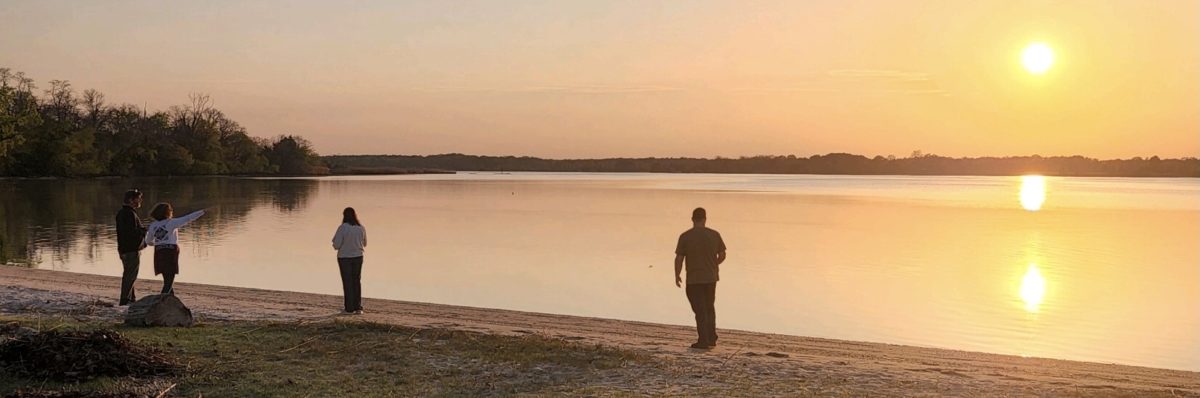
The world we return to

Thankfully, life rarely comes down to desert island preferences. You know the scenarios: if you were stranded on a desert island and could only have five albums, or if you could only eat one kind of food, or if you had to watch one movie, and on and on. But they make for great conversation scenarios. You get to know someone by cutting through all the white noise and cocktail party chatter and learn something about what is important to that person. And those questions often circle back to things like music, food, books–things that open up something about what we love.

Here is one for me: if I could only read one genre of writing for the rest of my life, it would be poetry. I don’t have to think about it, I don’t need the Final Jeopardy music playing, I can say that instantly. Poetry fills my soul, speaks to my heart, and expands my mind in ways that no other kind of writing can.

This time last year, John Miller and I led a course through Chesapeake Forum: An Academy for Lifelong Learning, on how poetry connected us to and helped us understand what it is to be human. The class was held on Zoom, had close to 30 participants from multiple states including Georgia and Florida, and it was a fantastic experience, with insightful and searching questions and comments from those taking the class. I wrote about our time together in Tidewater Times Magazine.

When John and I thought about what poets to discuss for that class, we went with some of the well-known writers; it’s maybe a stretch to say that a poet other than Shakespeare can be a household name, but Milton, Blake, and Wordsworth are close. Talking about a class for this winter and what poets read and talk about, we had a different approach.

Poetry often seems to be the realm of old, dead white guys. What if for a follow up, we let people know that poetry is as meaningful, powerful, and relevant today, that poetry matters and has a much broader range of accomplished writers than those from the past. Let’s look at three living women of color who are carrying on the mantel.

Tracy K. Smith, Joy Harjo, and Rita Dove have won Pulitzer Prizes, National Book Awards, and just about any other recognition you can think of for their writing. And they have each served as Poet Laureates of the United States.

Smith’s book, “Life on Mars,” Harjo’s “Conflict Resolution for Holy Beings,” and Dove’s “Playlist for the Apocalypse,” have come out in 2011, 2015, and 2022: they are recent, relevant, and are evidence that these writers, these women, are wrestling with and trying to make sense out of life, experience, and so many of the alienating forces at work in the world. These are writers, and books, that belong on our bookshelves and in our hearts and minds as we try to walk through life doing the same.

Our class, “Poetry Matters!” will meet on Zoom, Thursdays January 26, February 2, and February 9, from 10:00 to 11:30am. If it sounds like something you are interested in, you can register by clicking on the link.

I go back to Robin Williams’ line from the movie Dead Poets Society frequently because I think it says it so powerfully:

“We don’t read and write poetry because it’s cute. We read and write poetry because we are members of the human race. And the human race is filled with passion. And medicine, law, business, engineering, these are noble pursuits and necessary to sustain life. But poetry, beauty, romance, love, these are what we stay alive for.”

Or maybe we give the floor to Tracy K. Smith, the first poet we will read and discuss in our class. “Life on Mars” is a book that took a hold of me from the first time I picked it up. Smith’s father was an engineer on the Hubble Telescope, which is something that comes out in her searching and brilliant poem, “My God, It’s Full of Stars.” You can read more about Smith and hear her read from that poem at the link.

Smith talks about why she loves poetry:


That’s a lofty but worthwhile goal. It’s part of the hope of a class like this: that the world we return to after reading and discussing Smith, Harjo, and Dove might seem fuller and more comprehensible as a result.

Let Love Become a Reality

This week, I was asked to lead our Wednesday morning healing prayer service. It’s a small, wonderful, heartfelt and Spirit-led service, which is held every Wednesday at 10:00am. The Gospel reading for the morning was Matthew 22:34-40, which is Jesus answering the question, which is the greatest commandment. I’m including the reading below and then the homily I gave in response to it:

Matthew 22:34-40 NRSV

When the Pharisees heard that he had silenced the Sadducees, they gathered together, and one of them, a lawyer, asked him a question to test him. “Teacher, which commandment in the law is the greatest?” He said to him, “ ‘You shall love the Lord your God with all your heart, and with all your soul, and with all your mind.’ This is the greatest and first commandment. And a second is like it: ‘You shall love your neighbor as yourself.’ On these two commandments hang all the law and the prophets.”

“Let Love Become a Reality”

I love when people asked Jesus questions. Depending on who was asking, they didn’t always love his responses, or the questions he asked back to them.

But I think Jesus also had in mind the spirit in which the questions were asked. Thinking of John’s Gospel—both Nikodemus and the woman at the well were trying to understand. And Jesus encouraged them. Here and elsewhere, when the Pharisees, Sadducees, and lawyers asked questions, it was often to try to trip him up, to trick him into saying the wrong thing so they could discredit him or have him arrested.

Here we have an expert in the law asking him which commandment is the greatest?

So Jesus goes to Scripture, he pulls from Deuteronomy 6:5, part of the Shema, the creed of Judaism, for “Love the Lord your God,” and to Leviticus 19:18 for “Love your neighbor as yourself.”

On these two commandments, hang all the Law and the Prophets. He’s given a perfect legal answer. And he’s done something even more to confound the law expert.

Michael Green in his book “The Message of Matthew,” points out that “For people who, like this expert in the law, were strong on ethics and weak on relationships, this strongly relational teaching was a revealing mirror of the heart.”

Strong on ethics, weak on relationships. A mirror of the heart. When I think about a lot of people today—we are strong on ideas, maybe strong on convictions, but not so great on relationships. We want to label people as different from us and say therefore they are wrong. Our tendency is to distance ourselves rather than drawing closer, rather than trying to understand or to love.

When we think of God and our neighbors in terms of relationships, in terms of beings who we are called to love, we have to get off of our high horses. If we try to love God with everything we have, we also have to love his creation, and the people he created.

Green writes:

“If there is real love for God, there will inevitably be real love for neighbor; God’s overflowing love is infectious. The criterion of whether love for God is real is whether or not it is reflected in our relationships with others. And it will not do to say, as many do, ‘I don’t do any harm to anyone.’ That is not only negative, but it neglects the first and great commandment, to put God as number one in our lives. With God first and neighbor second, all else in the law is commentary.”

To make a go at loving, we have to have softer hearts, our hearts need to be renewed—we can’t just be following orders (the law).

How do we do this? It doesn’t happen all at once. It takes time.

Our friend and brother John Coleman points out that as a police officer, he responds differently to situations today than he did 25 years ago. He always did his job and responded according to law, but now his first response is based much more in love and understanding, then when he was newer at the job. He credits both God and time with working on him.

I can tell you from my own experience that I think and feel and respond differently now to things than I did five years ago. And that has been five years of studying Scripture, of prayer and worship, of spiritual friendships and encouragement. When we use the term Christian formation, we are hoping, working to be formed in a more Christ-like way.

I hope I continue to grow and learn and improve how I love God and love my neighbor.

Reflecting on this passage in Matthew, N.T. Wright (in his book “Matthew for Everyone”) says:

“The heart doesn’t seem to get renewed all in one go. Many, many bits of darkness and impurity still lurk in its depths, and sometimes take a lot of work, prayer, and counsel to dig out and replace with the love which we all agree should really be there.”

I’m thinking of Paul writing in Romans where he says, “I do not understand my own actions. For I do not do what I want, but I do the very thing that I hate.” I think we all can relate to Paul’s dilemma sometimes.

Given the fact that we are standing here together at a healing service on Wednesday morning, I think we all know it is right and a good thing to love God and love our neighbor. We can agree both that that is what we are supposed to do and that it is what we are commanded to do.

But it has to be more than a command, it has to be more than instructions to follow.

Wright says:

Commandments “come into their own when they are seen not as orders to be obeyed in our own strength, but as invitations and promises to a new way of life in which, bit by bit, hatred and pride can be left behind and love can become a reality.”

There it is: an invitation, a promise to a new way of life where we leave behind hatred and pride and love becomes our reality. Let’s make that our prayer, let’s make that our guiding star.

If we go back to the scene, this encounter that Matthew gives us: Jesus is answering the question posed to him by a legal expert, and he gives a brilliant answer.

If we love God with all our heart, mind, and soul—we’re not going to put idols above him, we’re not going to have other gods before him, we’re not going to take his name in vain, and on down the list.

And if we truly love our neighbor as ourselves, that should take care of murder, stealing, coveting, adultery, bearing false witness.

Jesus gives us the Cliff Notes, the summary, the thing we can memorize or a cheat sheet we can put in our pockets and refer to when we need it—you know, for when we don’t have our Bibles with us or don’t have the time to look up the answers about the law.

But it’s so much more than that. It can be a basis for a new way of life, a better way of life.

The poet Pablo Neruda wrote in his love sonnets:

“I love you without knowing how, or when, or from where. I love you simply, without problems or pride: I love you in this way because I do not know any other way of loving but this, in which there is no I or you, so intimate that your hand upon my chest is my hand, so intimate that when I fall asleep your eyes close.”

What if we think about knowing and loving God that intimately. What if we have God’s love so much in our hearts and in our lives that we become that love when we think, when we feel, when we pray, and when we act. What if we know no other way of loving, than as God loves.

What if it didn’t matter that love was a commandment, because love was simply our reality.

Amen.

*Graphic at the top from Scripture Type, Treasure the Word.

It never doesn’t take a village: an Ava update

The expression, “It takes a village to raise a child” is incomplete. The thing is, as we go through life, it never doesn’t take a village. The more I have opened myself up, welcomed friendships, been with family, worked at the church–there is never an age we don’t need a village around us. We lose people we love, we go through illnesses, life gives us things we don’t expect and aren’t ready for, and we need people. And we can be there for people.

One of the places I have seen that most clearly in my life is with our daughter Ava. I have written about her story here and there (this Tidewater Times story is maybe the best summary), Ava developing epilepsy at age 10 after brain swelling has become a defining part of her life in a way no one wants.

The village around us has included people from the Oxford Community Center and Oxford Fire Department, people from Christ Church Easton, people from Caroline and Talbot County Schools, family, friends, churches, social media, prayer lists, and goes further than I came name or be grateful enough for.

As we enter into a next phase of Ava’s care and world, I want to give an update and background for those newer to the village.

Since 2014, a range of medications have not been able to control her seizures in a way that doctors, Ava, or any of us are good with. But since moving her care to Nemours A.I. DuPont Hospital a few years back, there has been progress and some hope.

Late this past fall, we found out that Ava is a strong candidate for epilepsy ( resective brain) surgery. It comes down to what part of her brain is causing her seizures and what other cognitive functions that part of the brain is responsible for. After a number of tests, it seems likely that the seizures are coming from her left temporal lobe. They were originally worried that they were coming from her frontal lobe, which would have ruled out surgery.

The goal is for her not to have seizures any more, or total seizure freedom as the neurologists like to say. Given Ava’s case and how things have progressed, resective surgery is the best chance for her not to have any more seizures. But there are other options if that isn’t a possibility. Her neurosurgeon told us that from where Ava is right now based on test results, studies, etc., 95 percent of patients have some form of surgery available to them.

In December and January she had a contrast MRI and an angiogram, both of which are to help map where important things are so that on January 30 they can do a “stereotactic implantation of depth electrodes” to then do a long-term monitor of her seizures. Simply put, they are going to drill small holes through her skull and put monitors on her brain, then pull back her medicine and watch her having seizures.

Her neurosurgeon gave a solid analogy: when they monitor seizures on the outside of her skull, it’s like listening to a conversation through a wall; they need to step into the same room to really hear what’s being said. Because they need to know exactly where her seizures are happening and what part of her brain it is to know whether they can remove it.

This is incredibly exciting and hopeful news. It is not experimental surgery, it is something neurologists have been doing and feel is her best chance to live without seizures. And we know a young man in our community who has had the surgery and has been seizure free and thriving since.

It’s also a lot to take in, process, and sit with, both as a parent and for Ava. Excited, hopeful, nervous, and scared are all words that are tossed around regularly.

For Ava’s part, she is a rock star. She knows what she wants and she sits through medical procedures like she is eating lunch. This past year, a tattoo artist friend was ready to do a big cherry blossom tattoo on her shoulder. He asked how she did with pain/needles. She didn’t flinch or seem at all bothered through two-plus hours of drawing, coloring, and shading.

As a parent, and as a family, there are small things that make you sad. We will be in the hospital for Anna’s 21st birthday, and depending on how long they keep her (one to two weeks), Ava may be in the hospital for her 18th birthday.

If she is a candidate for resective surgery, recovery would be three to six months. Ava is scheduled to graduate from high school in the spring and is especially looking forward to senior week after graduation. So surgery would be in the middle of the summer.

But one procedure at a time, one day at a time. January 30 and the stereotactic testing is coming up. Before that, and before having to be in the hospital for two weeks, both Ava and Anna will try skiing for the first time. There are experiences to be had and memories to be made every day.

“Thank you” isn’t enough for all the love, all the prayers, all the reaching out, all the positive energy, all the good vibes and thoughts, that have come from so many people. I am, we are, so grateful.

At no point in life does it ever not take a village surrounding any of us to get us through.

Faith, Life, and Messiness

Faith, like life, is messy. This has been on my mind a lot, after thinking about Matthew’s Gospel (1:18-25) where he talks about Joseph and the birth of Jesus. Fr. Bill Ortt’s sermon stirred me up and Debie Thomas‘s essay on the same passage in her book, “Into the Mess & Other Jesus Stories” sent me into overdrive.

In the Gospel, Joseph finds out his fiancé Mary is pregnant, not with his child, and plans to send her away quietly. What the law required is that he should publicly shame her and that she might be stoned to death. But Joseph’s heart demanded something different of him. Send her away quietly.

And then, in a dream, an angel tells Joseph not to worry, to stay with Mary, whose child was conceived by the Holy Spirit, and to help raise her son, who they are to name Jesus. He learned this in a dream.

Fr. Bill, describing what Joseph decided to do said, “Instead of following the letter of the law, displayed the heart of God.”

And there is the thing–look at the “law” over centuries–the law changes with the times. The loving heart of God is unchanging, constant, eternal. But that doesn’t make it easy to follow or live into.

Debie Thomas in her essay, “Into the Mess,” says:

“It is the humble carpenter’s willingness to abandon his notions of holiness and embrace the scandalous that allows the miracle of Christ’s arrival to unfold.”

This is not to dismiss Mary’s role and the need for her willingness to be the mother of Jesus. Luke’s Gospel looks at the birth story from Mary’s perspective, and has an angel speaking to Mary. Matthew looks at Joseph.

Saying yes was the first step, the same as it is with us today. But this is going to lead for an entirely different life for Joseph than he could have possibly pictured for himself. He has to let go of everything. Thomas writes:

“In choosing Joseph to be Jesus’s earthly father, God leads a righteous man with an impeccable reputation straight into doubt, shame, scandal, and controversy. God’s call requires Joseph to reorder everything he thinks he knows about fairness, justice, goodness, and purity.”

Think about that. Based on a dream, would you say yes to God’s calling in that situation? Joseph had to let go of his notion of all these things, to live a completely different life than he dreamed for himself–saying yes to God had a cost for him. It also had a reward, but in order to see it, he had to let go of what he thought he knew.

Fr. Bill, in thinking about the character of Joseph, said he must have been a young man. Why?

“The young dream, the old remember.”

As we get older, we are less likely to listen to our dreams. We are more inclined to look back and discern things by comparison, by whatever logic we can discern from our lives; we are less open to the new and the strange.

What if we could stay open? What if we could continue to dream as we get older? What if we could find a way to keep or develop soft hearts?

“The young dream, the old remember.”

Fr. Bill picked up another thread in his sermon that I want to weave in here. In talking about Christ’s birth, he said, “God himself became vulnerably present in the world.”

God as vulnerable. Both in the person of Jesus, but also in the way he deals with us. He asks, we can say yes or no. And this comes back to the idea of God as Love.

I recently picked up C.S. Lewis’s “The Four Loves” from my bookshelf and started reading it, based on coming across this quote online:

“To love at all is to be vulnerable. Love anything and your heart will be wrung and possibly broken. If you want to make sure of keeping it intact you must give it to no one, not even an animal. Wrap it carefully round with hobbies and little luxuries; avoid all entanglements. Lock it up safe in the casket or coffin of your selfishness. But in that casket, safe, dark, motionless, airless, it will change. It will not be broken; it will become unbreakable, impenetrable, irredeemable. To love is to be vulnerable.”

To love is to be vulnerable. What normally happens to us as we get older, in response to the pain, suffering, and heartbreak that happens by living, we seal ourselves off. We harden. We build walls in self-defense. And this is what the world has largely come to look and feel like.

But we can choose a different way to be. It takes courage, it takes heart, it takes being vulnerable.


In his book “Consolations,” David Whyte writes about “Touch.” He says:

“Touch is what we desire in one form or another, even if we find it through being alone, through the agency of silence or through the felt need to walk at a distance: the meeting with something or someone other than ourselves, the light brush of grass on the skin, the ruffling breeze, the actual touch of another’s hand; even the gentle first touch of an understanding, which, until now, we were formerly afraid to hold.”

Even the most introverted want to feel deeply. We want to experience connection. We want to touch and be touched. To touch, to feel, we have to be open. And being open isn’t just to the good stuff, the stuff we want, but also to that which can wreck us. Whyte continues:

“Being alive in the world means being found by [the] world and sometimes touched to the core in ways we would rather not experience.”

Maybe that is along the lines of what Joseph experienced before his dream. This isn’t what he had signed up for. This isn’t the life he had mapped out. But he was open. And through and after his dream, he said yes to a life, a calling, that none of us can fathom.

Because he was open. Because he was willing to let go of what he thought he wanted. Because he said yes.

Whyte finishes his thoughts on touch looking at being untouchable:

“To forge an untouchable, invulnerable identity is actually a sign of retreat from this world; of weakness; a sign of fear rather than of strength, and betrays a strange misunderstanding of an abiding, foundational, and necessary reality: that untouched, we disappear.”

To wall up and go numb is a cop out. It deprives us of really living.

Life, like faith, is messy. In order to experience those things we all want–love, joy, happiness–we have to open and vulnerable to those things we want with everything to avoid, heartbreak, pain, suffering. That’s the mess of it.

Joseph and Mary became the earth parents of Jesus. Their saying yes changed everything for all of us. We don’t hear much more about Joseph in the story–it wasn’t about him, ultimately. And Mary watched Jesus being killed. Again with the mess.

Scripture tells us, Jesus tells us, God tells us, it’s worth it. Love is worth it. Life is worth it. The mess is part of it. And not just part of it, but an important part of it.

I love how Debie Thomas thinks about the mess. And invites us to do the same:

“Do not be afraid of the mess. Embrace it. The mess is where God enters the world.”

To live, to love, to be open. To have the heart of God and to become vulnerably present in the world.

Amen.

What should a king know?

If you had a chance to educate a future king (or queen), what would you want him/her to know? Let’s say that key things we would want them to have include kindness, justice, empathy, humility, compassion, courage, love. I mean, if we have a chance to help form someone to rule the right way, wouldn’t we want to go all in?

In T.H. White’s novel, “The Once and Future King,” we meet the character who is to become King Arthur, first as a boy, who knows nothing about his parents, who has been taken in by a kind nobleman, Sir Ector, and raised side-by-side with Ector’s son Kay. It is expected that Kay will grow up to be a knight, and Arthur, who everyone knows as “Wart,” will be his squire/servant.

The Wart believes himself to be of lowly, common descent. He feels like a second-rate citizen without much control over his own destiny. Out on an adventure, Wart meets the wizard Merlyn, who becomes his tutor. Merlyn lives forwards and backwards in time and knows who Arthur is and that he will be the King of England. Merlyn does not tell the boy this and as he directs his education, one of the bits of learning Wart likes best is when Merlyn turns him into different creatures–a fish, a hawk, an ant, a goose, a badger–and the boy has to talk to others of the species and experience life from their perspective.

This is empathy in action and not just with humanity. With all of Creation.

In broader form, Arthur experiences moments. And not just moments, but moments as other creatures.

Here he takes flight with other geese in the reverie of flying at first light:

“The dawn, the sea-dawn and the mastery of ordered flight, were of such intense beauty that the boy was moved to sing. He wanted to cry a chorus to life, and since a thousand geese were on the wing about him, he had not long to wait. The lines of these creatures, wavering like smoke upon the sky as they breasted the sunrise, were all at once in music and in laughter. Each squadron of them was in different voice, some larking, some triumphant, some in sentiment or glee. The vault of daybreak filled itself with heralds…”

T. H. White, “The Once and Future King”

Imagine experiencing (and thus acknowledging) epiphanies, transcendent moments from other, non-human viewpoints. Of course Wart/Arthur and any of us would have to relate it from our own vocabulary and ways of thinking. But imagine people in power making decisions who consider the wider world, not just our human interests. Because if we don’t consider the wider world, we won’t have anywhere left for our human interests.

There are other things that are critical to Arthur’s ongoing education, had by different adventures, experiences, and learning, but I want to stick to these moments as that is the thread that started my mind moving.

Moments give our own lives meaning.

Red-Breasted Nuthatch in Worchester County, 2016. Photo by Bill Hubick at Maryland Biodiversity Project.

The magnolia tree in my front yard has become a home and stomping grounds for nuthatches. Lately when I fill my birdfeeders, they come visit and chat. Saturday afternoon, Holly and I stood and watched a few feet from four Red-Breasted Nuthatches circling from branches to cylinder feeder, in chirp-and-song conversation, sounding precisely like a group of Woodstocks from Peanuts/Charlie Brown. They didn’t mind that we were there and they let us into a frenzy that I can still glimpse in my mind, something bigger than me or us, something we were able to be a part of.

It’s not like Wart’s experience of being among geese flying at dawn, but at the same time, it lights up that these experiences are out there to be had, to be a part of, in a way that connects us to Creation.

Later, as Saturday moved into evening, I was walking from the parking lot behind Christ Church Easton to go to our Saturday worship service. The sun was beginning to set and was casting an incredible light on the steeple of the church and as I watched a “V” of Canadian Geese flying in formation flew over, like the light was shining specifically on them, and the low point of the V came directly overtop the point of the steeple. It was another transcendent moment, there for only a few seconds, but showing something so much more.

All it took to experience these two separate moments, in one afternoon, was to pay attention.

I was looking through photos on my phone, in search of moments. It seems natural to try to capture and share the moments we have. I couldn’t catch either of them from Saturday with a picture, so I try to communicate them in words, in a similar way to White in his novel.

Bubbles and sunsets.

A few years back we were at The Claggett Center on an Alpha Retreat. A handful of us were coming back from a walk through the woods and there was a woman blowing huge bubbles that had the youth group mesmerized. Our friend Dave, who might be the most youthful person you will ever meet, jumped in with the kids chasing bubbles around the yard. It was a happened-upon moment, easy enough just to walk right by, but seizing it, embracing it, enjoying it, colored everything in a way that could have been missed.

Going back further, an evening we were at the yacht club in Oxford for dinner and my daughter Ava, my father and I walked out onto the dock as the sun was setting. I remember it being a beautiful scene, but I can’t tell you anything about that particular sunset. What I remember, what the moment was for me, was looking over and seeing my Dad trying to catch it, trying to capture something of what he saw. In addition to being an accountant, my Dad has always taken pictures–from getting slides developed when my sister and I were little, of ice storms and sailboats, to grandkids’ sports games in the digital camera era, to now having our cameras on our phones; looking over to see my father pulled into a moment was my moment.

These moments, by themselves, don’t make for a complete education. But without moments that make life, that give life depth and feeling, what good is an education?

There is a scene in “The Once and Future King” where the young Arthur first encounters the sword that he will pull out of the stone, which will show him to be the king. Upon touching the sword, he sees more deeply into life:

“I feel strange when I have hold of this sword, and I notice everything much more clearly. Look at the beautiful gargoyles of the church, and of the monastery which it belongs to. See how splendidly all the famous banners in the aisle are waving. How nobly that yew holds up the red flakes on its timbers to worship God. How clean the snow is. I can smell something like fetherfew and sweet briar–and is it music that I hear?”

Arthur’s adventures and experiences, his being changed and living in different perspectives, has given him a deeper soul to experience this moment of his destiny.

He is not able to pull the sword out of the stone immediately. But because he is intimately connected with so much of Creation, something happens:

“All round the churchyard there were hundreds of old friends. They rose over the church wall all together… there were badgers and nightingales and vulgar crows and hares and wild geese and falcons and fishes and dogs and dainty unicorns and solitary wasps and corkindrills and hedgehogs and griffins and the thousand other animals he had met. They loomed round the church wall, the lovers and helpers of the Wart, and they all spoke solemnly in turn. Some of them had come from the banners in the church, where they were painted in heraldry, some from the waters and the sky and the fields about–but all, down to the smallest shrew mouse, had come to help on account of love. Wart felt his power grow.”

There it is. Part of Arthur’s education was to gain insight and understanding and appreciation for creatures and history and all of Creation. And what happened in turn is that Creation embraced and had a love for Arthur.

That isn’t all we might want a king to know in order to rule justly and compassionately. But it’s certainly something we would want on the list.

When we can experience and appreciate moments; when we can see that life and the world is bigger than we are; when we can acknowledge and understand that other people are open to experience these transcendent moments just like we are; when we can learn that every living thing can be part of the moments that we have; when we can look into the eyes of someone or something and see something reflected back to us that causes love to grow in us, for others and for all Creation… those are things that would make a king, and a kingdom, worthwhile.

Do unto others

The world can break our heart every single day. We can wake up grateful and things beyond our control can devastate us and leave us asking questions and feeling shattered.

The world can also show us love, connection, friendship, laughter, warmth, and spark our sense of wonder.

For all the times we don’t get to choose what happens, how do we make the most of the time that we have? How do we cultivate and appreciate moments? How can we lean into connection rather than withdraw into isolation?

As the sun comes up through the trees, I have coffee in my mug. I have a dog next to me who wonders what we’ll do today and for whom whatever the day brings is enough. I have books at my elbow that inspire and provoke me. I have pen and paper to help me record and communicate life from where I sit.

There are birds coming and going at the backyard feeders—Woodpeckers, Tufted Titmice, Chickadees, Wrens.

Whatever the day brings is enough. Because that is what will be. And at the same time, there are days when we get to decide something of what the day will be.

Jesus tells us, at the end of the Sermon on the Plain in Luke’s Gospel, “Do to others as you would have them do to you.” (Luke 6:31)

If we want to spread joy that will last, let’s think first about the heartbreaking days that crush us. What if on those days, someone reaches out to you; someone checks in on you; someone lets you know you are not alone—that you matter.

Let’s say that is how we want to be treated. What is stopping us from treating other people that way—today, now. If you have anyone in your life who you are thankful for, or concerned about, or who is on your heart or your mind, reach out. Say hello, say thank you, say I am thinking of you, say I appreciate you, say I love you.

Not because you will get something back, but because it is how you want to be treated. Because that is a gift that we can each give. And when we are more concerned with giving than with getting, we find we need less.

Maybe that is the beginning of gratitude.

Life in Three Books

Books are time travel devices on their own. But when you take a book off your shelf that you have read, all kinds of associated memories come rolling back. Re-reading three books this week, weaving in and out of time, life comes up.

I first learned about T.H. White’s novel “The Once and Future King” from one of the X-Men movies where Patrick Stewart as Professor Xavier has his students reading it (that was X2 in 2003). I’ve loved King Arthur stories and legends since I was a kid–when I was 9 years old I named our new Golden Retriever “Morgan” after King Arthur’s devious half-sister Morgan Le Fay. So it didn’t take much prompting, finding out White’s novel was a modern, moving, funny re-telling of the Arthur story, I was all in. My brother-in-law mentioned he’s given more copies of that book to people than any other book and he named a bearded dragon King Pellinore after White’s version of the character.

Merlyn is phenomenal, from his physical introduction in the story, to his life philosophies:

“The best thing for being sad,” replied Merlyn, beginning to puff and blow, “is to learn something. That’s the only thing that never fails. You may grow old and trembling in your anatomies, you may lie awake at night listening to the disorder of your veins, you may miss your only love, you may see the world about you devastated by evil lunatics, or know your honour trampled in the sewers of baser minds. There is only one thing for it then — to learn. Learn why the world wags and what wags it. That is the only thing which the mind can never exhaust, never alienate, never be tortured by, never fear or distrust, and never dream of regretting. Learning is the only thing for you. Look what a lot of things there are to learn.”

Learn why the world wags and what wags it.

I’ve started the book maybe three times over the years, read 100+ or 200+ pages and life has happened in a way that has made me put it down, despite being drawn in.

2018 was the last time I tried to make time to read “The Once and Future King.” I found a note I left myself on page 154–that is where I stopped. This past week, studying the Pre-Reformation Church in England for seminary, Sir Thomas Malory’s “Morte D’Arthur” was discussed and a quick line about White’s updated telling. That was enough to motivate me. I started again and knocked out 30 pages this morning, making a goal to finish it before the end of the year.

Photo from Smith reading from “Life on Mars” at “The Universe in Verse” with Maria Popova.

Sitting on the campus of the National War College in DC 10 years ago, I read Tracy K. Smith’s “Life on Mars” on my lunch breaks. It won the Pulitzer Prize for Poetry. My mind was thrown open and my jaw was frequently dropped while reading.

My friend John Miller and I are going to lead a discussion on Smith’s book in January and February for Chesapeake Forum. I grabbed my copy from the bookshelf in my bedroom and the bookmark I had in the book was my ordering receipt from Barnes and Noble, May 2012. I have lived in three houses since the house it was delivered to.

This morning I read this, from the poem, “My God, It’s Full of Stars”–

I want to be
One notch below bedlam, like a radio without a dial.
Wide open, so everything floods at once.
And sealed tight, so nothing escapes. Not even time,
Which should curl in on itself and loop around like smoke.


Reading today, what I read 10 years ago, finding the receipt with an old address on it from what feels like a different life, time did curl in on itself.

“My God, It’s Full of Stars” is how I feel every time I look up at a clear night sky.

The last book doesn’t go back so far, but it washes over me in new ways each time I read it. I found Rowan Williams’ “Being Christian” in 2019 and have led three classes using it for perspective on what the things we do as Christians are all about. This fall we have 20 people in our newcomers class at Christ Church Easton, a new group of folks wading through Williams. Last week, we talked about baptism, but the former Archbishop of Canterbury goes deeper than most of us go. He talks about how we have lost our identities, we have let go of them. Our default settings aren’t the way they should be. Enter Jesus.

“And when Jesus arrives on the scene he restores humanity to where it should be. But that in itself means that Jesus, as he restores humanity ‘from within’ (so to speak), has come down into the chaos of our human world. Jesus had to come down fully to our level, where things are shapeless and meaningless, in a state of vulnerability and unprotectedness, if real humanity is to come to birth.

“This suggests that the new humanity that is created around Jesus is not a humanity that is always going to be successful and in control of things, but a humanity that can reach out its hand from the depths of chaos, to be touched by the hand of God.”

Baptism is going down into the chaos and coming up as new people, in a new relationship with God in Christ. Not as perfect or flawless, but one where we can reach out to be touched by God. That’s not generally what we think about when we attend a baptism, though it’s all right there in the vows.

Williams has this wonderful way of looking at the kind of life that is begun anew through baptism:

A life that gives us resources and strength to ask questions; a life that reconciles and builds bridges and repairs broken relationships–a life that reflects God’s wisdom and order. That sounds like a life worth living.

My mind moves forwards and backwards in time re-reading books, wandering through memories, and leaning into both goals and daydreams. “Once and Future,” stands out as a phrase that touches on something about that.

For those of us who have been in and around Easton for any time, Waterfowl Festival is an event that moves in both directions as well. As a kid, I watched my mom cut greens and decorate buildings and saw my dad cooking and serving food with the Kiwanis Club in town. Over the years, it’s been a fun reason to either walk through town as a spectacle, or avoid town altogether.

For the past six years (of my life, the church has been doing it much longer), Waterfowl Festival has meant Christ Church coming together to decorate, to serve food, to be together, to raise funds that go back out into the community, where they are needed. That points to Williams’ idea of a communal life that “looks toward reconciliation, building bridges, repairing shattered relationships.” It’s a step in the right direction. It’s among the work we are sent out to do.

Falling Forward

Fall is a time of change, a time of incredible colors, crisp air, clear skies, and fire-pit warmth. My bones know when fall hits. It’s also always been a time of renewal, energy, and new beginnings.

This year, fall is the beginning of year two of seminary through Iona Eastern Shore for seven of us aspirants and postulants. Our studies this year are focused on the history of the Christianity (what happened between the Acts of the Apostles and today) and heavily on homiletics–preaching. I’m especially appreciating lectures, essays, and books by Tom Long, who makes me think that preaching is something that can be taught, even to those of us to whom it doesn’t come naturally.

To borrow a few aspirational sentences from Long’s book “The Witness of Preaching”–

“To have our own lives, our own work, our own words, our own struggles and fears gathered up in some way into that event (preaching) is an occasion of rich and joyful grace… To be a preacher is to be a midwife of the word… we do not establish the time of its arriving; we cannot eliminate the labor pains that surround it; but we serve with gratitude at its coming and exclaim with joy at its birth.”

And:

“Faithful preaching requires such gifts as sensitivity to human need, a discerning eye for the connections between faith and life, an ear attuned to hearing the voice of Scripture, compassion, a growing personal faith, and the courage to tell the truth.”

I have such a long way to go, but I am inspired and encouraged and am becoming a student of the art and event of preaching.

I’ve also been helped along the way this fall by a discernment group who have gathered multiple times to help me discern, distill, and clarify my calling as part of the canonical process toward ordination. The way is each and every step and I am grateful beyond words for the questions, love, and encouragement from these friends.

Small Groups

At Christ Church Easton, new small groups are gathering to wrestle with Paul’s Letter to the Romans; a group of men are two weeks into discussing Richard Rohr’s “From Wild Man to Wise Man”; and we’re looking forward to our next newcomers class, where Brenda Wood and I will help orient folks to the ministries and work of our church, while looking at how baptism, Bible study, Communion, and prayer help define our faith in Rowan Williams’ book “Being Christian.”

Romans has given me a particular focus and opportunity for the fall/winter. In the same way that I wrote each week about our small group study of John O’Donohue’s book “Anam Cara,” I’ll be writing about Romans–thoughts from different scholars, snippets from our group discussions, and I am hoping to do some video segments and interviews with folks talking Romans.

I think for many church-goers, Paul’s Letter to the Romans is something experienced piecemeal, here and there, in lectionary readings. People know it’s a big deal, but they never take the time to read it and reckon with it. And that’s understandable–it’s daunting! But it’s also beautiful and potentially transformative. I love this thought by Rev. Jay Sidebotham, in “Conversations with Scripture: Romans,” when he says:

“The expression of trust in God’s grace, a theme of the Letter to the Romans, has the power to change individual lives. It also has the power to change communities, which is why it matters that we enter into this conversation. Such a conversation does not mean that we will like or understand everything in the letter… In the spirit of conversation, a word that suggests companionship on the journey, we hope that faithful attention to this ancient letter may open the door for new insights into the expansiveness of the grace of God.”

Romans has a history of changing lives and communities. Would that our studies might increase our trust in God’s grace.

To Live Prayerfully

Last weekend, Fr. Bill Ortt preached on Luke 18:1-8, the Parable of the Widow and the Unjust Judge. The text starts out by saying, “Jesus told his disciples a parable about their need to pray always and not to lose hope.” This is advice you give people who are going through tough times; people who might reach a point in their lives and their faith where they want to give up.

If we are going to be people for God, who is love, and so people for love, we need to lean in, not give up. We need to live prayerfully. Prayer is not simply asking for things–prayer is our connection to God. Prayer requires listening as much, if not more than talking.

That’s part of the reason why we use Rowan Williams’ book “Being Christian” in our newcomer class. It ends with prayer. And Williams describes three things that are essential for prayer:

  1. First, and most importantly, prayer is God’s work in us… It is the opening of our minds and hearts to the Father…
  2. Second, there is the deep connection… between praying and living justly in the world… Prayer is the life of Jesus coming alive in you, so it is hardly surprising if it is absolutely bound up with a certain way of being human which is about reconciliation, mercy, and freely extending the welcome and the love of God to others.
  3. Third, prayer from our point of view is about fidelity, faithfulness, sticking to it… Just stay there and if in doubt say, ‘O God, make speed to save me.’ Prayer is your promise and pledge to be there for the God who is there for you.

To live a prayerful life is to open our hearts, minds, and lives to God. It’s about praying and living in a way that shows reconciliation, mercy, welcome, and love. And it’s about sticking with it.

It’s a lot to take in. It’s a lot to try. We won’t always get it right. We will stumble and fall. And none of us can do it alone. But with God’s help, and with each other, we can get back up, try again, and keep forward on the way.

I come back to the Thomas Merton Prayer regularly. We prayed it together at the first meeting of our discernment group. And it feels like a good time to offer it here:

Music for Our Souls

“When you are lonely, you become acutely conscious of your own separation. Solitude can be a homecoming to your own deepest belonging.”

John O’Donohue, “Anam Cara”

Loneliness and solitude are not the same. When we feel alone, we feel cut off, isolated, disconnected. Solitude gives us a chance to go beneath the surface noise of our lives and spend time getting to know our souls. Solitude can help us feel connected.

This week I was talking to a friend who is reading “Anam Cara” alongside our study at Christ Church Easton, though his schedule doesn’t allow him to make the classes. Our brief conversation meandered all over the place and as we went our separate ways I said that I hoped he was enjoying and getting something out of the book.

“You know what it gives me: music for my soul.”

Amen. May we all find music for our souls each day, and for those reading “Anam Cara,” may it add soul music to your days.

Section 3, “Solitude is Luminous,” is the halfway point in our study. John O’Donohue has contemplated the mystery of friendship (Section 1), and pointed out the infinity of our interiority and how our senses are our gateways to the world around us and to each other (Section 2). And now he shows us the need for us to go inside, to embrace solitude so that we can know our true selves, our gifts, what makes us who we are, so that we can be of benefit to others and to the world.

If all we do is follow the world and go wherever the figurative wind blows us, and we never get to know our passions, desires, gifts–our best selves, who God created us to be–what can we really offer anyone else in friendship?

“It is in the depths of your life that you will discover the invisible necessity that brought you here. When you begin to decipher this, your gift and giftedness come alive. Your heart quickens and the urgency of living rekindles your creativity.”

I am going to string a series of connected quotes here, one leading to another, because O’Donohue makes his points beautifully:

“When you acknowledge the integrity of your solitude and settle into its mystery, your relationships with others take on a new warmth, adventure, and wonder.”

Spending time in solitude is not some navel gazing, narcissistic indulgence, it actually helps us be better friends, partners, parents, better people.

“There is such an intimate connection between the way we look at things and what we actually discover. If you can learn to look at yourself and your life in a gentle, creative, and adventurous way, you will be eternally surprised at what you find.”

This is such an important thing to get across: how we look at things determines what we see. The lens, the eyes we use to look at the world shape/color what we see. And the same goes with how we look at ourselves. We are here in this life for the time that we have, treating ourselves gently and creatively and getting to know our souls and what we bring to the table is so important to what we make of our lives.

If you follow the idea that loving our neighbors as ourselves should be one of the top priorities of our lives, then it matters how we relate to ourselves. If we are miserable people who don’t know ourselves, where does that leave us with our neighbors?

O’Donohue goes on to warn us of the danger of “the unlived life.” He says, “We are sent into the world to live to the full everything that awakens within us and everything that comes toward us.”

If you come to “Anam Cara” with a lens to Scripture, you might hear echoes of the Gospel of John:

“The thief comes to kill and destroy, I have come that they may have life and have it to the full.”

John 10:10 (NIV)

If we live our lives to the full, we help others to do the same. That’s what God wants for us, for humanity, for all of Creation. That’s what we should be working towards, hoping for, searching for, praying for.

This week, Rev. Susie Leight shared the following photo and connected reflection from O’Donohue:

I arise today

In the name of Silence
Womb of the Word,
In the name of Stillness
Home of Belonging,
In the name of the Solitude
Of the Soul and the Earth.

I arise today

From Matins, by John O’Donohue

As we rise today, as we arise, may we look inside so that we can be the best versions of ourselves for those we encounter.

As we go through our days, may we find and appreciate music for our souls, and may we help provide and encourage soul music in others.

Through the noise and stress and worry of the world going on around us, may we make time to look deeper and see that “there is something beautiful, good, and eternal happening.”

Beginning today with the “Blessing of Solitude” with which O’Donohue closes his chapter, may we recognize, realize, and learn to see ourselves like this.

It is Strange to Be Here

John O’Donohue’s book, “Anam Cara,” begins: “It is strange to be here. The mystery never leaves you.”

And that’s maybe as true a statement as we will ever encounter. Take our consciousness, the fact that we are thinking, feeling beings inhabiting bodies, add science, add faith, add civilization, observations–when you sit and think about it, it is strange to be here. There is no way around it.

At Christ Church Easton, we’ve just begun a six-week study of “Anam Cara.” Rev. Susie Leight and I and 20+ curious and daring friends embarked this week on the first section of the book, “The Mystery of Friendship,” and a power-packed prologue to help set the tone.

O’Donohue was a poet, theologian, philosopher, and former Catholic Priest. When I read about him and his life, I am jealous, thinking–that’s it, that’s how I want to live my life. His way of bringing together Celtic spirituality and Christianity infuses life and sacredness into everything we encounter–God, each other, Creation and the landscape we are a part of–in ways that mainstream western Christianity could do well to remember and to look more closely at. Which is part of what we are doing.

“Anam Cara” is a Gaelic expression translatable as “soul friend.” And O’Donohue lets us know that what he hopes to do with his book is to explore friendship in a “lyrical-speculative” form. His writing is a meandering, meditative way through beauty, friendship, the senses, that can leave me stunned and spinning at times.

It is strange to be here. And given that, friendship, reaching out to an other, another person, is maybe the only sensible thing to do, to find other people to walk through life with.

O’Donohue says that:

“Human presence is a creative and turbulent sacrament, a visible sign of invisible grace. Nowhere is there such intimate and frightening access to the mysterium. Friendship is the sweet grace that liberates us to approach, recognize, and inhabit this adventure.”

Thinking of friendship as a grace, as sacramental, puts us in an open frame of mind. In this strange, lonely world putting ourselves out there, finding friendships with other people, is a courageous and necessary act.

As he wanders through the first section of the book, O’Donohue focuses on light.

“Light is the secret presence of the divine. It keeps life awake. Light is a nurturing presence, which calls forth warmth and color in nature. The soul awakens and lives in light. It helps us to glimpse the sacred depths within us. Once human beings began to search for a meaning to life, light became one of the most powerful metaphors to express the eternity and depth of life.”

This week, reflecting on some of our “Anam Cara” reading, Susie used some of O’Donohue’s thoughts on light and darkness in her own musings. She writes:

“Inspired by JOD’s words, I decided to wake up just before dawn a few mornings a week, to watch “how the darkness breaks” and observe how “light can coax the dark” while pondering & praying the question, “I wonder what this will be?”

Many changes are on the horizon (all very good & exciting, but there is anxiety too) & so rather than placing all sorts of expectations around what is next (which is my tendency) I have decided to sit, watch and listen, trying to separate the artificial from the real, what is of God and the Spirit, of the world or my own. the question seems large enough to hold what is and what may be… ‘just as darkness brings rest and release, so the dawn brings awakening and renewal. In our mediocrity and distraction, we forget each day that we are privileged to live in a wondrous universe. Each day, the dawn unveils the mystery of this universe…’

sometimes my camera does stuff without me trying, thought this was a cool shot. more to come.”

That is wonderful. When we read something challenging, we should let it challenge us, inspire us, help us think. If it doesn’t seep into our everyday lives, our hopes, our dreams, our friendships, then why are we studying it together and discussing it?

In “Anam Cara” we are talking about friendship, we are talking about light, and we are talking about love. Anytime we are talking about God, we should be talking about love. God is love, and love is what unites us in friendship. O’Donohue writes:

“Love is the nature of the soul. When we love and allow ourselves to be loved, we begin more and more to inhabit the kingdom of the eternal. Fear changes into courage, emptiness becomes plenitude, and distance becomes intimate.”

Love is what brings us together, what unites us. And coming together as friends to discuss, to be opened up by, a book about the nature of and need for friendship stands out as significant, in and of itself.

O’Donohue closes the section on “The Mystery of Friendship” with a friendship blessing, which is beautiful, profound, and inspiring. I read it out loud to close our first class. I would encourage you to read it out loud as you read it, and I hope that its words and sentiments bless you today and every day. The photo after it is one of Rev. Susie at her ordination to the deaconate earlier this year, along with our dear friend, the deacon Rev. Barbara Coleman. Soul friends in action.

“A Friendship Blessing”
By John O’Donohue

May you be blessed with good friends.
May you learn to be a good friend to yourself.
May you be able to journey to that place in your soul where there is great love, warmth, feeling, and forgiveness.
May this change you.
May it transfigure that which is negative, distant, or cold in you.
May you be brought in to the real passion, kinship, and affinity of belonging.
May you treasure your friends.
May you be good to them and may you be there for them;
may they bring you all the blessings, challenges, truth, and light that you need for your journey.
May you never be isolated.
May you always be in the gentle nest of belonging with your anam cara.