Being Part of the Miracle

Background: I had an unexpected preaching weekend last weekend when our Rector came down sick. The Gospel for the lectionary was Matthew 14:13-21, which is the story of Jesus feeding 5,000 people. Following is the text of the sermon I preached.

Being Part of the Miracle

The story of Jesus feeding the 5,000 is a well-known and often-cited story. Of the various Jesus stories that were available to the Gospel writers, this is one that each of the four Gospels made sure to include.

As Matthew tells it, Jesus has just learned about the execution, the beheading of John the Baptist, and Jesus goes off in a boat to be by himself to grieve. But the crowds get wind of where he has gone and they follow him.

Have you ever tried to take some quiet time for yourself, even for something small, and had someone interrupt that time? I’m not always as generous or as hospitable as I want to be when that happens.

Jesus is mourning the death of his mentor, cousin, and friend, the guy who baptized him. Crowds of people Jesus doesn’t even know follow him from the nearby towns. And what is Jesus’s reaction?

He had compassion for them and cured their sick. That’s something we could probably all work on—treating people with compassion regardless of the mood we are in. Jesus becoming human and feeling the full range of human emotions increased his empathy and compassion, it didn’t give him a sense that his feelings were central or more important than anyone else’s.

In the story, it gets to be towards evening, and the disciples come up to Jesus and they are worried, “We are in the middle of nowhere, it’s getting late, there’s no food around here, let’s send these crowds away so they can go to the villages and buy some food.”

Jesus’s response to the disciples is a key to this whole story. He says, “They need not go away; you give them something to eat.” 

Let’s notice what Jesus DOESN’T say. He doesn’t say, “Have a seat, I’ve got this.” He doesn’t say, “Watch this, you won’t believe this.”

He says, “You give them something to eat.”

We know this is a miracle story. We know that Jesus performs signs and wonders. When he calls on the disciples, he gives them a role in what is going to happen. They are part of the miracle.

Jesus turned water into wine, he healed the sick, he raised Lazarus from the dead. It’s not like he couldn’t feed the crowds by himself.

But Jesus was also a teacher, preparing his disciples to continue his ministry after he leaves his physical body. The disciples need to learn how to be a part of Jesus’s work. We need to learn how to be a part of Jesus’s work.

The disciples come back with an answer that might sound familiar to us: “We have nothing here but five loaves and two fish.”

We don’t have enough.

Jesus, I’d love to help, but I don’t have enough time.

Jesus, I’d love to help, but I barely have enough money for my own family.

Jesus, I’d love to help, but I’m just one person. I can’t possibly be enough to help. I can’t make a difference.

To this answer—we don’t have enough, we only have a few loaves and a couple fish—Jesus says, “Bring them here to me.”

I know you don’t have much. Bring me what you’ve got. It will be enough.

Jesus tells the crowds to sit down on the grass. He takes the loaves and the fish and he looks up to heaven, and blesses and breaks the loaves, gives them to the disciples, and the disciples give them to the crowds. And everyone eats and is filled.

It sounds so simple, you almost miss the miracle.

In January 2017, Christ Church decided to start up a program called the Alpha Course. Specifically for the youth group.

Rev. Kelsey and I had both just been hired part-time. And it was decided that Saturday evening would be when they would meet. So Youth Group was going to start meeting on Saturdays after the Alive @ 5 service.

We thought, hey, maybe parents of the youth group kids would want something to do while their kids were here, so we said, we’ll offer Alpha for adults at the same time.

Food is a big part of Alpha. You sit and break bread together and get to know each other at the table over the course of several weeks. If you don’t have food, you don’t have Alpha.

Our contemporary music leader, Jana Leslie, knew that parishioner Colin Edgell was a chef and that his two sons were active in youth group. She asked Colin if he would head up the kitchen and handle the food. There might be 30 people or so. Colin said yes.

We promoted the class a bit, opened registrations and more than 90 people, youth and adults signed up.

What do we do now?

Jana put out a call for volunteers. We had a parishioner who owned a restaurant who said he could help us get the food to prepare. From February through May, every Saturday night, almost 100 people, youth and adults, from all walks of life, a number of people in recovery, all gathered in the Parish Hall after the Saturday service, and all sat down at tables and were served salads, dinner, and desserts.

Alpha was designed to be a free program, where anyone could come. As people in our congregation heard about the program, some donated money to help cover the costs.

Everyone brought what they had: their time to volunteer, their money if they wanted to donate, themselves if they wanted to participate.

One of the miracles that happened through Alpha was that people who might not have given each other the time of day on the sidewalk became close friends who ate together, prayed for each other, and took an interest in each other’s lives. There were 11-year-old kids who would search the pews or the Parish Hall for big, scary-looking tattooed guys, who became for one another, part of what it meant to be a church.

A few loaves and a couple fish. More people coming out than we thought we could feed.

Jesus, what are we supposed to do? You give them something to eat.

We don’t have enough. Bring me what you have. It will be enough.

Our Alpha Retreat at the Claggett Center from the winter/spring 2017 Alpha Course.


Our tendency as a church and as a society is to seek our induvial and collective comfort. To do a little bit until we find that sweet, comfortable space and then stay there.

Picture the disciples: “Well, this has been a great day. Big crowds of people came out, Jesus cured the people who were sick. It’s getting to be dinner time. We’ve got enough food for the 12 of us, but certainly not all these people. Jesus, send the people away to go get something to eat.”

We fill the church for Christmas and Easter and special occasions. Have you seen how many people we feed and how much money we raise for the community during Waterfowl Festival?

Do we really need to run an Alpha Course? Or start a food ministry? Or train more Stephen Ministers? Or have a concert with five church choirs? We’re doing good work in the community, I see my friends each weekend at church. Do we need to try new ideas and feed more people?

Earlier this summer, we did a small group study of J.I. Packer’s book, “Keep in Step with the Spirit,” which is about how to align our lives and open our eyes to see and experience the Holy Spirit at work.

Packer talks about revival in the church, restoring life, and fellowship with God. He says the Holy Spirit is the architect and agent of that work, which is not just an individual experience, but a social and corporate thing, which touches and transforms communities.

He writes: “God revives his church, and then new life overflows from the church for the conversion of outsiders and the renovation of society.”

The loaves and fish come from the church and go to the crowds.

“Revival is God stirring the hearts of his people.

“Times of revival bring deep sense of being always in God’s sight; spiritual things become overwhelmingly real, and God’s truth becomes overwhelmingly powerful, both to wound and to heal; conviction of sin becomes intolerable; repentance goes deep; faith springs up strong and assured; spiritual understanding grows quick and keen; and converts mature in a very short time. Christians become fearless in witness and tireless in their Savior’s service. They recognize their new experience as a real forestate of the life of heaven, where Christ will disclose himself to them so fully that they will never be able to rest day or night from singing his praises and doing his will. Joy overflows and loving generosity abounds.”


That’s what it feels like to have the Holy Spirit working in and through us, the Advocate Jesus sent us. What would it feel like to be a part of the miracle of feeding 5,000 people? To have your hands on and in the work that Jesus was doing? It was work the disciples didn’t see coming or think they could do. Would it help you trust God and encourage you to offer what you have?

The Holy Spirit moves us out of our comfort zone. It nudges us to say that sitting on the sidelines, or in the pews of the church isn’t the goal, it’s how we recharge and restore ourselves. The Spirit has been working in people this way since the Book of Acts.

Continuing the work that Jesus did, pushing new disciples, changing our lives and our expectations.

Miracles come from God, through Jesus in the story, and through the Spirit within us and around us. As disciples, we are asked to be a part of these miracles.

As with the disciples and Jesus feeding 5,000 people, the miracles that unfold before us and around us, that we get to be a part of, might not be miracles that we prayed for, or expected, or in some cases even wanted. The disciples may have wanted to put their feet up after a long day.

God’s primary way of operating in the world is through people, through those who open their lives to the Spirit. Miracles aren’t meant to let us off the hook, to say God’s got this, but to encourage in our faith, so that we can help.

We begin by bringing what we have to Jesus. Whatever you have, however much, it may not seem like enough, but it’s enough to start.

Bring your loaves, bring your fish, bring your time, bring your compassion, bring your heart, bring your gifts. And don’t be surprised when Jesus breaks and blesses what you bring, and the Spirit multiplies it and blesses you and those around you.

* The featured image at the top of the page is “The Church of the Multiplication” by Alfred Muller licensed under Creative Commons.

No labels, just love: the woman at the well

“I want to love like Jesus”—that’s a goal that’s thrown around by both fans of Jesus and maybe even doubters. Most people agree that Jesus knew something about love. And that that was and is a good thing.

How many people can tell us more about what that kind of love looks like? Is it just a hopeful thing to say without any real substance behind it? Or are we willing to look closer as to what it might mean to love like Jesus.

John’s Gospel story about the woman at the well is a great model for what that kind of love looks like in action.

Throughout each of the Gospels, Jesus makes a point of reaching across cultural, social, and religious boundaries and barriers to include people who were cast out or left out.

True to that form, the woman at the well, per culture and circumstance, is someone Jesus should not have been talking to.

Going through Samaria, Jesus was in a region and among a people the Jewish people didn’t look kindly on.

It’s the middle of the day, incredibly hot, a time when no one would have been at the well. And here comes a woman to get water.

Bible scholar N.T. Wright spells it out:

“In that culture, many devout Jewish men would not have allowed themselves to be alone with a woman. If it was unavoidable that they should be, they certainly would not have entered into conversation with her. The risk, they would have thought, was too high to risk impurity, risk of gossip, risk ultimately of being drawn into immorality. And yet Jesus is talking to this woman.”

If her being a woman wasn’t bad enough, on top of that she is a Samaritan. The Jewish people and the Samaritans didn’t mix. The Jews wanted nothing to do with the Samaritans. And no way in the world would they have considered sharing food or drink with them, much less sharing a drinking vessel.

Jesus reaches out to the woman by asking for a drink. He puts himself out there. Asks for hospitality. He makes himself vulnerable.

And who does he do this to? A woman who is coming to the well in the middle of the day to avoid having to deal with people, someone who has a stigma on her, a shame.

Debie Thomas in her book, “Into the Mess & Other Jesus Stories” makes the point perfectly:

“The Samaritan woman is the Other, the alien, the outsider, the heretic, the stranger. Jesus breaks all the boundaries he is not supposed to break to reach out to her.

What Jesus does when he enters into conversation with a Samaritan woman is radical and risky; it stuns his own disciples because it asks them to dream of a different kind of social and religious order. A different kind of kingdom.”

Maybe that’s a clue for us. Loving like Jesus asks us to envision a different kind of social order, a different kind of kingdom.

I picture this woman and the gossip about her, the things said to her, the looks, the scorn, the judgment. And here is Jesus, a Jewish teacher, and how does he talk to her? Without judgment, without shaming, without looking down on her, and at the same time fully engaging with her and fully seeing her for who she is.

John, as the writer, packs a lot into this story:

  • This conversation is the longest conversation Jesus has with anyone in any of the Gospels.
  • In John’s Gospel, this woman at the well is the first person to whom Jesus reveals his identity as the Messiah.
  • She is the first believer in any of the Gospels to become an evangelist and bring her entire city to a saving experience of Jesus.

All this for a Samaritan woman. This encounter was a big deal to John for him to give it so much space and meaning, and it was a big deal to Jesus.

So how does Jesus go about revealing his identity to the woman? Does he prove himself by healing the sick? Does he feed 5,000 people? Does he raise anyone from the dead or turn water into wine? No. He has a conversation with her.

He offers her “living water,” which she doesn’t understand. But he sits with her, listens to her, speaks to her, and reveals who he is.

Cynthia Kittredge in her book, “Conversations with Scripture: The Gospel of John points out:

“That Jesus’ revelation and the woman’s realization of him come through dialogue is an important feature to notice… Jesus does no sign here. There is no miracle.” He makes a claim which then takes a dialogue, a back and forth to make sense of.

“This is a type of dialogue in John’s Gospel which reflects a way individuals and people come to faith—through a process of effort and discussion.”

Jesus reveals himself with no miracles or signs, simply with conversation, insight, and presence. He hears her, he sees her, he doesn’t dismiss her—he shares with her.

How did the woman respond? She goes running off to her town and tells absolutely everyone there. And Jesus stuck around and confirmed her testimony for people. She went from scorned outsider to credible witness.

Jesus restores her and transforms her.

Is this what it looks like to love like Jesus? Is this something Jesus still offers us today?

Here’s where Debie Thomas asks questions that we need to ask:

“Just as he does for the Samaritan woman, Jesus invites us to see ourselves and each other through the eyes of love, not judgment. Can we, like Jesus, become soft landing places for people who are alone, carrying stories of humiliation too heavy to bear? Can we see and name the world’s brokenness without shaming? Can we tell the truth and honor each other’s dignity at the same time?”


In the six-plus years I have been at Christ Church Easton, being a part of small groups has been a revelation for me in witnessing what becoming this kind of soft landing place can do.

For several years we ran the Alpha Course after our Saturday evening service, and we had between 90 and 100 people who would meet in the Parish Hall for dinner. Our youth group and leaders were a part of that number as well. Our Parish Hall was packed with food, laughter, and new relationships forming. Everyone sat and ate together before breaking into small groups, and over the course of 11 weeks we also went on a weekend retreat together.

That program became a landing place for people in recovery. In many cases these were people who were getting clean through Narcotics Anonymous. And it was a huge leap of faith for them to walk through the door of a church. Repeatedly we heard, “I didn’t think a church would want someone like me here.” People named and worked through shame they carried. They shared stories of why they started using; of their low points, in some cases being in prison; and they shared hopes and dreams—things like being able to be present, to be a parent in the lives of their children.

They went deep when they shared. And that gave permission for everyone else to go deep with their own struggles and failures. We had a congregation of people come to know by name someone who they might have dismissed, labeled, and judged. Which would have been the congregation’s loss.

Middle schoolers in our youth group would find and sit with—both in church and at dinner—the friends they made, in some cases big dudes covered with tattoos, who came to absolutely love these kids. There were no labels, just love. There were no more outsiders or outcasts, just a community of people, a group of friends. It has a holy thing and a holy time.

It looked a lot like Jesus with the woman at the well.

Fr. Gregory Boyle in his book, “Tattoos on the Heart,” tells a story about a former gang member who lived near their church and who liked to hang out his window to talk to people on their way by. One day Boyle was walking by and the guy yelled out, “Hey G, I love you,” and waved him by like he was blessing him. Boyle thanked him, and the guy’s reply was, “Of course, you’re in my jurisdiction.”

Boyle uses the idea of “jurisdiction” to talk about the area of our love, and he talks about God’s jurisdiction, the area of His love, which is all-inclusive.

When thinking about how to love like Jesus, we need to expand our jurisdiction to be as inclusive, as expansive, as Jesus’s. In the story of the woman at the well, he gives us the example of what it looks like to expand our love and compassion to include someone who had been left out.

We don’t need miracles or signs to accomplish this—it is something any of us can do. And we do it with presence, vulnerability, empathy, dialogue, listening, and seeing.

I want to leave you with some of Fr. Gregory Boyle’s words about expanding the jurisdiction of our love:

“Close both eyes; see with (eyes of your heart). Then, we are no longer saddled by the burden of our persistent judgments, our ceaseless withholding, our constant exclusion. Our sphere has widened, and we find ourselves quite unexpectantly, in a new, expansive location, in a place of endless acceptance and infinite love.

We’ve wandered into God’s own jurisdiction.”

That’s how we love like Jesus.

Amen.


* On Saturday, March 11, I preached at our Iona Eastern Shore seminary class (at Old Trinity Church in Church Creek, MD) on John 4:5-42, the story of the Samaritan woman at the well. The text above is the sermon that I gave.

Sediment, Tents, Hot Dogs and the Holy Spirit

Shake a snow globe full of sediment and you’ll have to wait a while for the sediment to settle. Only then can you see through it. Clarity comes from letting the sediment settle. Now think of the sediment as all the demands and distractions in our daily lives–and there is always something or someone shaking our snow globes.

The weekend retreat during The Alpha Course is designed to help us settle, unwind, and unplug so we can plug into something that will recharge us. It’s a time to connect with the Holy Spirit and with each other.

Five years to the weekend after Christ Church Easton‘s first Alpha retreat, we took a group of more than 20 people to Pecometh’s Riverside Retreat Center outside Centreville, MD, for a weekend to reconnect. The weather was in the 70s during the days, the night skies were starry and clear, and the waterfront campus is full of trails, woods, and structures to get you dialed-in to creation.

Saturday morning, we had a group gathered on benches outside by the river for morning prayer. We read from Padraig O’Tuama‘s “Daily Prayers,” in which we pray, in part:

We resolve to live life in its fullness:
We will welcome the people who’ll be a part of this day.
We will greet God in the ordinary and hidden moments.
We will live the life we are living.

We set our intention to be present, open, and to appreciate one another and our lives.

Weekends like this are about moments; they are about relationships; they are about laughter and tears from being overfilled; they are made up of sharing meals, of taking hikes and walks or going skateboarding; they are built around small group discussions and big questions and shared experiences and being vulnerable.

The Alpha Weekend five years ago is the first time I reflected on advice that St. Paul gave in his letter to the Romans where he said:

“Do not be conformed to the pattern of this world, but be transformed by the renewing of your mind.”

Romans 12:2 (NIV)

In a world that wants us to conform, we are encouraged to live differently. In a series of videos over the weekend, we meet Jackie Pullinger, a missionary who went from England to Hong Kong more than 50 years ago, who has worked to help prostitutes, gang members, and the poor. She has done amazing work and points out that what we need to spread God’s love in the world are “soft hearts and hard feet.” And she says that maybe the only way our hearts soften is by being broken.

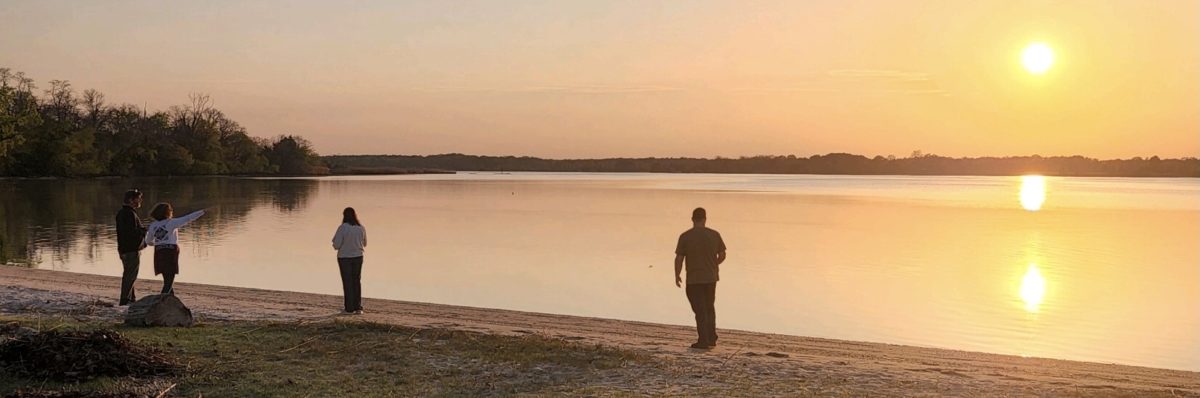
An Alpha Weekend is about relationships and downtime and making memories, including the debut of a non-existent band called “Skater Dads.” It’s skipping stones at sunset and exploring the campus for the camp’s famed outdoor chapel.

The Alpha Weekend is about sitting around a campfire singing songs, roasting marshmallows and hot dogs and being awestruck when someone reaches their hand into the fire to successfully rescue a fallen hot dog and comes out unburned (don’t try this at home or around a youth director) ; it’s about feeling seen simply by someone noticing that you are almost done cooking your hot dog and being asking if you want a bun.

It’s what happens when a group of people gather in a beautiful place for the sacred purpose of being together, worshipping God, and being open to the Holy Spirit.

Sunday morning, the ending of such a powerful and peaceful weekend, the big feelings were about not wanting the weekend to end. A conversation made me think about the transfiguration of Jesus on the mountaintop, this absolutely incredible experience of Jesus, Elijah, and Moses, and Peter’s immediate response is to build tents–“Master, it is good for us to be here; let us make three dwellings” (Luke 9:33)–he wants to stay in that moment, he wants to keep it going, just like each of us wanted the weekend to keep going. But Jesus knew differently. He knew that as incredible as those experiences are, it is not about building tents and trying to hold the moment–it is about carrying the moment back into the real world, because we have work to do. We have to spread that Holy Spirit experience. I mentioned all this to our collected groups. Which gave Rev. Susie Leight an idea.

Susie expounded on the theme of leaving, going back to the world, by opening our Sunday morning worship service with a blessing/prayer from Jan Richardson:

Dazzling

A Blessing for Transfiguration Sunday

“Believe me, I know how tempting it is to remain inside this blessing, to linger where everything is dazzling and clear. We could build walls around this blessing, put a roof over it. We could bring in a table, chairs, have the most amazing meals. We could make a home. We could stay. But this blessing is built for leaving. This blessing is made for coming down the mountain. This blessing wants to be in motion, to travel with you as you return to level ground. It will seem strange how quiet this blessing becomes when it returns to earth. It is not shy. It is not afraid. It simply knows how to bide its time, to watch and wait, to discern and pray until the moment comes when it will reveal everything it knows, when it will shine forth with all it has seen, when it will dazzle with the unforgettable light you have carried all this way.”

This weekend was a blessing made for coming down the mountain, back into the world; it was an experience, it was moments, it was deepened relationships. It is a blessing for us to share with those we meet, with those who are a part of our days.