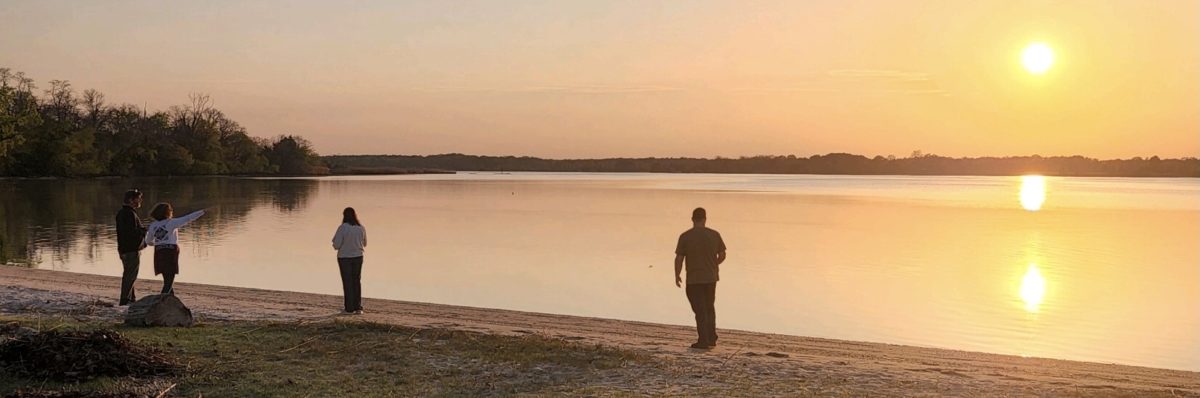
Why Ascend? And then what?

Context: The first Sunday in June was a preaching weekend for me at Christ Church Easton. We celebrated and talked about Jesus’s Ascension into heaven, marking the end of the Easter season, moving the church calendar to Pentecost and the coming of the Holy Spirit. This is the text of the sermon I gave.

Why Ascend? And then what?

A couple years ago, I saw a comic strip about Jesus’s Ascension that sticks with me.

It’s Jesus and three disciples standing around. Jesus says, “Gotta go guys. Don’t forget what I taught you.” And then it shows Jesus’s feet as he ascends out off the page and the disciples say, “Bye, boss.”

They are standing around together and one asks, “So what have we learned?”

“Pretty much it’s love God and love your neighbor.”

“Well, that seems pretty simple, I don’t see how we can mess this…”

It shows a group is coming over the hill in their vestments and robes, with their hats and staffs, books, and scrolls. And the disciple says, “Uh-oh… Here come the theologians.”

And it sticks with me both because it strikes me as funny and that it’s on to something.

Jesus didn’t come to confuse us or complicate us. He came to set things right, so that we could get off the hamster wheel of sin and that instead we might have life in all its abundance.

We don’t have these stories and teachings in Scripture to vex us, but to help us.

In today’s reading, as he is about to leave the disciples, Jesus says:

“These are my words that I spoke to you while I was still with you– that everything written about me in the law of Moses, the prophets, and the psalms must be fulfilled… Thus it is written, that the Messiah is to suffer and to rise from the dead on the third day, and that repentance and forgiveness of sins is to be proclaimed in his name to all nations, beginning from Jerusalem. You are witnesses of these things.”

Jesus has done what he came to do. The Word became flesh, lived among us, taught us, performed signs, died for us, conquered death, came back and showed us and told us all about it. As he is leaving, he is connecting all the dots and making sure the disciples get it.

He’s not giving them new information or teaching, he’s just recapping, reminding them. This is all part of the plan.

Jesus has to go so that he can send the Holy Spirit to do things that he couldn’t do in his bodily form. He could only be in one place at a time. There is more to do.

Jesus becoming incarnate: good news.
Jesus dying for us: tragic and horrible, but still part of the good news.
Jesus overcoming death: good news.
Jesus ascending and sending the Holy Spirit: all part of the same good news.

We talked a bit last week on Zoom and at the Healing Service about how things are going in the world with the Holy Spirit and the church and whether we might not prefer to have Jesus back in the flesh. Sometimes it might be nice to be able to ask Jesus something directly and have him settle the debate right then and there.

Two things come to mind with that: Jesus has already given us everything we need, to know what he would do, how he would answer questions, what we are supposed to do. Those answers aren’t going to change.

The fact that we, as people, aren’t loving God and loving our neighbor, the fact that we aren’t loving each other as Jesus loved us, isn’t because we don’t understand or we don’t know how.

It’s because we don’t want to.

It’s because it’s hard. It’s because it costs us—we have to sacrifice in order to do it. It’s because while we are living in the ways of the world, it’s not popular—people might think we’re weird or soft or whatever word you want to use.

There are stories that have been written that suppose that Jesus comes back just as he was before, preaching the same love, doing the same good works, and what ends up happening is that either the church or the government kills him because his message is a threat to their power.

Does that sound familiar? We just read that story a month or so ago.

Our world hasn’t changed so much since then. But it’s supposed to. And that’s up to us.

Jesus ascended into heaven because his work was done, and he was giving the ball back to his followers to move things forward.

I’ve shown you everything. Now it’s your turn.

The Ascension of Jesus Christ, gold mosaic; in Neamt Monastery, Rom.

If we look at the disciples during the two or three years Jesus was with them, Jesus did all the work. He was teaching them and showing them what to do, but they depended on him to do everything.

Here is what the SALT Project says about Jesus having to go away in their commentary:

“The fact that Jesus departs at all is worthy of reflection. Many founders of movements — or companies or political parties — stay around as long as they can (often staying too long!), and according to the Gospels, the risen Jesus is presumably impervious to death, and so could have remained indefinitely. From this angle, the fact that he leaves reveals what sort of movement he has in mind: a community not standing around admiring him (“Why do you stand looking up toward heaven?—as we heard in Acts), but rather active and present in the world, carrying on his work of kindness, justice, humility, and proclaiming the dawn of God’s joyous Jubilee. In the end, the Ascension itself is meant to invite and empower the church to be all the more down-to-earth. Into the world, for the love of the world!

For Jesus, it wasn’t about his ego, his pride, or any accolades. He leaves so that even more amazing things can happen with the Holy Spirit dwelling with and within us.

This is what spiritual maturity asks of us and looks like. Peter and the other apostles do not look and sound the same in the Book of Acts as they sound in the gospels. They carry on. They put in the work. They wait for the Holy Spirit, just as Jesus told them to. And after Pentecost, they are lit on fire with the Spirit and the early church is born.

The apostles accept that they are Jesus’s “witnesses in Jerusalem, in all Judea and Samaria, and to the ends of the earth.”

There are no “thoughts and prayers” in the apostles action plan, their response to Jesus, as ours is in our Baptismal Covenant, was:

“We will, with God’s help.”

As we remember and celebrate Jesus’s Ascension; as we look to Pentecost next week and the coming of the Holy Spirit; and as we move into Ordinary Time, the Season After Pentecost—it’s the same Holy Spirit with and within us now as came to Peter and the apostles. It’s the same Holy Spirit that has inspired and guided the community of saints over the ages. It’s the same Holy Spirit that has used ordinary people and their ordinary lives to do extraordinary things for God’s kingdom.

The church has moved in fits and starts and stalls and sputters over the last couple thousand years. There have been miracles and signs and there have been tragedies and disgrace. When the church falls away from the Holy Spirit and from Jesus, it loses its way.

It’s during those times that we need to regroup, refocus, remember who we are and WHOSE we are and allow the Spirit to move through us to be the body of Christ, the church, Jesus’s hands and feet and love in the world.

This is our time. We can’t look around and expect someone else to do it. WE are why Jesus came. WE are why Jesus died. WE are why Jesus overcame death. And WE are why Jesus ascended and gave the world the gift of the Holy Spirit.

What will we do with it? What does it look like to have the Spirit in us?

Here is the SALT Project:

(changed to present tense)

“It looks like Jesus, and at the same time, it looks like us — that is, it looks like us being true to ourselves, the people God made us to be. In a word, it looks like love: incarnate, tangible, down-to-earth love. And from another angle, it looks like peace: not just any peace, but what Jesus calls “my peace,” the shalom of God, a buzzing, blooming, fruitful community, coming and going, alive with the Spirit, healthy and whole.”

We look to the characters in the Bible for our answers, as if their lives were more spiritually significant than ours. Here’s the thing:

When they were living out all these experiences, their stories hadn’t been written down. They were figuring it out, reading the stories they had, just like we are.

We have Scripture for our learning, so that we can continue these stories, live spiritually significant lives, be a part of God’s love story in its unfolding.

We have a chance to write the next chapters—to inspire, connect, and allow God to use us just as he used the first apostles. That’s what “apostolic” is all about—being sent out.

Jesus wants our stories and our time to matter just as much as the apostles in Acts. We have same Holy Spirit and we are proclaiming the same good news.

WE can be that community. That’s who we are called to be. It’s who we were made to be.

Will we? Our best answer:

We will, with God’s help.

Kindness, blessing, and the eyes of Jesus

From Ash Wednesday to Easter. A journey, a transformation, and one of the most intentional and richest parts of our liturgical calendar.

Our Lenten e-mail prompt and discussion of John O’Donohue’s book, “To Bless the Space Between Us,” was rich, meaningful, and eye-opening. It was a continuing and deepening conversation with 20 people which included the Eastern Shore, Vermont, and even photos and stories sent from Finland.

One of the purposes of the book for O’Donohue was/is to get us thinking about “blessing” differently, and that blessings can take many forms, not always something that we would wish, ask for, or even want. Sometimes blessings can be the sun and sometimes the silver lining.

The last section of the book is “To Retrieve the Lost Art of Blessing.” It is an intentional walk through a way of seeing. Here are a few early quotes:

“Something deep in the human soul seems to depend on the presence of kindness; something instinctive in us expects it, and once we sense it, we are able to trust and open ourselves.”

“Kindness has gracious eyes; it is not small-minded or competitive; it wants nothing back for itself. Kindness strikes a resonance with the depths of your own heart; it also suggests that your vulnerability, though somehow exposed, is not taken advantage of; rather it has become an occasion for dignity and empathy.

“Despite all the darkness, human hope is based on the instinct that at the deepest level of reality some intimate kindness holds sway. This is the heart of blessing. To believe in blessing is to believe that our being here, our very presence in the world, is itself the first gift, the primal blessing.”

That last paragraph especially: to see life itself as the first gift, the most basic blessing. Despite all the darkness.

We’ve just gone through an entire liturgical season that sees light overcome what seemed like the ultimate darkness. When faced with what seemed like the end, death, God shows us more, that new life overcomes death. That hope is not in vain, but intrinsic and ever-present, if we will see it.

Over the course of our group discussion, participants responded with pictures of the Northern Lights in Finland and an Assateague camping sunrise.


The Resurrection is nuanced and layered in its meanings. One of the things it did was give credibility to Jesus being who he said he was. And it made the disciples for the next few generations, reflect back on what Jesus said and did, to the point of writing it down so that it could be passed down.

Many writers and theologians point out that Jesus’s words to his disciples were “follow me,” not “worship me.” It’s really a both-and situation, we can do both; and worship is a perfect response to God. But a problem over the years has been and continues to be that many Christians are content with worshipping ( and “believing” without living or living into any of that belief) and have dropped the following aspect of our faith.

Following Jesus means living like he did, loving like he did, doing our best to emulate his example. In John’s Gospel, Jesus gives the disciples (and us) the new commandment of “loving each other as I have loved you.” which he says knowing he is about to be arrested and put to death. That’s what his love looks like–sacrificing himself for the love of his friends and for humanity.

When we look at kindness through the example and eyes of Jesus, we have a sense of what we are called to do and who we are called to be.

O’Donohue closes his book with the poem, “The Eyes of Jesus”–

I imagine the eyes of Jesus
Were harvest brown,
The light of their gazing
Suffused with the seasons:

The shadow of winter.
The mind of spring,
The bues of summer,
And amber of harvest.

A gaze that is perfect sister
to the kindness that dwells
In his beautiful hands.

The eyes of Jesus gaze on us,
Stirring in the heart’s clay
The confidence of seasons
That never lose their way to harvest.

This gaze knows the signature
Of our heartbeat, the first glimmer
From the dawn that dreamed our minds,

The crevices where thoughts grow
Long before the longing in the bone
Sends them toward the mind’s eye,

The artistry of the emptiness
That knows to slow the hunger
Of outside things until they weave
Into the twilight side of the heart.

A gaze full of all that is still future
Looking out for us to glimpse
The jeweled light in winter stone,

Quickening the eyes that look at us
To see through to where words
Are blind to say what we would love,

Forever falling softly on our faces,
His first gaze plies the soul with light,
Laying down a luminous layer

Beneath our brief and brittle days
Until the appointed dawn comes
Assured and harvest deft

To unravel the last black knot
And we are back home in the house
That we have never left.

The eyes of Jesus are a way of seeing and a way of being, in terms of how we see and treat each other. O’Donohue talks about the way Jesus sees us, his gaze, and describes it in a way that should make us feel like we are loved before we do or say anything. Our souls are loved, as well as our bodies and minds. Do we allow ourselves to feel seen and loved that way?

Following Jesus means to try to look at ourselves, each other, and Creation with these eyes and this love.

Why do we take a journey through Lent? Why do we try to take in, reflect on, pray on, the Passion/suffering of Jesus over Holy Week? Why do we celebrate Jesus’s Resurrection?

I hope that at least part of the reason is to allow ourselves to be transformed, to become more Christ-like, to live and love like Jesus, which is to experience the kingdom of God and to do our part to help bring that kingdom, that love, to others, and play whatever role we can in bringing the kingdom here.

May we feel the eyes of Jesus gazing on us.
May we be the eyes of Jesus gazing on others.

May we know the love of Jesus, who became one of us, showed us how to live and how to love, gave his life for us, and then showed us that his love, God’s love, is greater than death, overcomes death and brings us to eternal life.

May we be the love of Jesus for everyone we encounter. And echoing Fr. Gregory Boyle, everyone: no exceptions.

Homecomings

“A home is a subtle, implicit laboratory of spirit. It is here that human beings are made; here that their minds open to discover others and come to know who they might be themselves.” – John O’Donohue, “To Bless The Space Between Us”

That is a way of looking at “home” that I hadn’t thought to articulate. Home is a laboratory of spirit, in that it gives us the comfort and the foundation to experiment, grow, change, find ourselves.

In our morning e-mail discussion of John O’Donohue’s book, “To Bless the Space Between Us,” this week’s theme is homecomings. One of the points he makes is that “home” should be a place that prepares us to go out and create a new home and ultimately that we also “develop the capacity to be at home in themselves.” He goes on to say:

“When one is at home in oneself, one is integrated and enjoys a sense of balance and poise. In a sense that is exactly what spirituality is: the art of homecoming.”

Spirituality as homecoming. As a coming back to something that we knew, or know, or that at least feels familiar. We recognize it. And it is something we recognize inside of us. If God is home, the Holy Spirit is the home within us. Mystical, or direct experience of something like that can help us feel at home in the universe and in ourselves.

But what if you’ve never known the safety of home, been able to open your mind, explore?

This past week, we had a Zoom conversation with Fr. Gregory Boyle. At Christ Church Easton, we’ve done studies of three different books that Fr. Greg has written–“Tattoos on the Heart,” “Barking to the Choir,” and “Cherished Belonging.” I’ve quoted and written about him frequently and I think that organization that Fr. Greg has founded, run, and been a spokesman for, Homeboy Industries, is the best example I can point to of what a community built around Christ-like love looks like today. Their community shows people in the toughest Los Angeles gangs what being loved and cherished can do, and it has changed the city and the world.


Fr. Greg mentioned that he sees tons of kids who have become adults and who have never been soothed at home, or anywhere. Between parents who themselves have never been soothed, or who weren’t there–were in prison or just left–or who were the opposite of soothing, imagine a childhood with no reassurance, no soothing. It immediately casts out any hope of HOME or this sense of home that O’Donohue is communicating. Homeboy Industries is the first sense of home they may know, and then once someone has experienced it, they can help offer a sense of homecoming to others.

Fr. Greg talks about a guy named Sergio, who Boyle calls his spiritual director. They write/text back and forth every morning reflecting on Scripture. The other day, Sergio ended his reflection saying, “Today, I will surrender into the arms of God, then choose to be those arms.” Boyle later made a similar point, that when we receive the tender glance, either from God, or from someone we encounter, we can then become that tender glance for someone else. Knowing that we are loved and cherished, then loving others from that knowledge, that belonging.

Let’s circle back to homecomings: if we have a sense of home, a sense of being loved, a sense of safety, we can be or offer that to someone who hasn’t had that experience of home before.

We develop or nurture our own sense of home, within us. And then we reach out to someone who could benefit from that feeling. Maybe that seems like a good idea, something you’d be game to try. You go through your day, you get to the evening, or maybe a quiet time before you go to bed.

John O’Donohue suggests, in his blessing, “At the End of the Day: A Mirror of Questions,” that we ask ourselves:

What dreams did I create last night?
Where did my eyes linger today?
Where was I blind?
Where was I hurt without anyone noticing?
What did I learn today?
What did I read?
What new thoughts visited me?
What differences did I notice in those closest to me?
Whom did I neglect?
Where did I neglect myself?
What did I begin today that might endure?
How were my conversations?
What did I do today for the poor and the excluded?
Did I remember the dead today?
Where could I have exposed myself to the risk of something different?
Where did I allow myself to receive love?
With whom today did I feel most myself?
What reached me today? How deep did it imprint?
Who saw me today?
What visitations had I from the past and from the future?
What did I avoid today?
From the evidence–why was I given this day?

That’s a lot of questions–almost like a spiritually inquisitive kid who has been slamming Pixie Stix and then gives us an existential 20 Questions. Maybe focus on a few each evening–the ones that resonate or open something up. Watch what happens when you start asking yourself questions like this at the end of the day.

It’s akin to the Jesuit concept of the “Daily Examen,” where at the end of the day, you look back at the day you’ve just had and look where you saw, felt, heard, or experienced God’s presence or touch. And by doing that, you are also preparing yourself to look for it the next day.

O’Donohue’s questions are like that. If you get to the end of your day and reflect back with questions like this, you can be more mindful of looking for these things–keeping our eyes, minds, and hearts open to them–as they happen.

So what happens when looking back on our day with questions informs our coming days, that become our present days? Maybe we see, or hear, something we wouldn’t have.

It is so easy to stumble through our days without seeing, hearing, feeling. When we do that, there are so many things we miss out on. Let O’Donohue’s questions be a mirror. Let us be open to things that might be going on all around us, that we haven’t noticed before.

When we experience something new and profound, we can take it with us, and share it with others.

Helped Are the Lonely

Background: This month at Christ Church Easton, we are offering Blue December services on Wednesday evenings leading up to Christmas. These services recognize that people have a difficult time leading up to Christmas for any number of reasons–loneliness, grief, depression, anxiety, or just feeling out of step and out of place in a commercially-consumed culture. These services include lighting of candles, prayers, quiet music and singing, Scripture readings and reflections, some silence, Communion with previously sanctified elements (often called a Deacon’s Mass), and they are for are for anyone going through something this time of year who might want to come together for a quiet worship service in the evening in the middle of the week, and have some fellowship and discussion after. Our hope is that people will feel God’s presence and love and experience the company, care, and fellowship of other people.

The Gospel reading for the service on December 4 was Matthew 5:1-12, often called the Beatitudes from Jesus’s Sermon on the Mount.

“Helped Are the Lonely”

The cards are stacked against us if we are going through a hard time in December. It’s getting colder, it’s basically dark after lunch, Christmas movies and music are streaming 24-7, and we feel like we are supposed to act like we are happy, even when we are the farthest thing from it.

States of being that include loneliness, grief, depression, and anxiety are all connected, we can move back and forth between them. And I say states of being because these aren’t things we can just change our mind about and decide, “I am not going to be lonely or sad,” “I am not going to grieve anymore,” or “I am tired of being depressed.”

But we can reach out. We can show up. We can give ourselves permission, allow ourselves to be low or hurting, or questioning. It may be counter to what we see when we look around this time of year, but it’s honest. Let’s start where we actually are.

How’s it going? Fine. How are you doing? Good. Granted, when someone asks us that when we run into them at the grocery store, that may not be the time and place to bare our souls. But we need to have some place we can do that.

Different people have different ways of coping with life. I don’t know where I would be without distance running and reading, two things that have helped me keep going through some of my darkest times. Reading, in part, because I find people who are describing the same thing I am feeling—someone who helps me give words to something I feel but can’t describe.

There is a poet named David Whyte. In his book “Consolations,” he talks about loneliness.

“Loneliness can be a prison, a place from which we look out at a world we cannot inhabit; loneliness can be a bodily ache and a penance, but loneliness fully inhabited also becomes a voice that asks and calls for that great unknown someone or something we want to call our own.”

One of the questions that led me to searching and to the journey I am on now was wondering in my bones and in my soul, “am I really and ultimately alone—are we only ever truly alone in the Universe?” It’s a question I came back to often enough, and one of the times that it had legs and kicked me in the gut was when my marriage was ending. I knew that even together, I felt alone, I knew that even among friends, I felt alone, like no one was out there, or really understood who I was.

But I wanted there to be. The fact that I didn’t want to be and feel alone, sent me both inside myself and out into the world.

This is David Whyte again:

“Loneliness is the very state that births the courage to continue calling, and when fully lived can undergo its own beautiful reversal.

“Loneliness is the place from which we pay real attention to voices other than our own; being alone allows us to find the healing power.”


Lonely human beings are lonely because we are made to belong. Feeling alone is hard because we aren’t made to be alone. As many times as I feel like living as a hermit would be a lifestyle-change I would embrace—even for an introvert, there are times I need connection.

In one of the most counter-intuitive sermons in the Bible, Jesus says that these low times we experience have a purpose. We call this section of Matthew’s Gospel, the Beatitudes, for its use of the word “blessed.” This is one of the key parts of Jesus’s Sermon on the Mount. He tells us:

“Blessed are the poor in spirit,
“Blessed are those who mourn,
“Blessed are the meek,
“Blessed are those who hunger and thirst for righteousness…”

Ummm… Jesus, what are you talking about? I’ve felt those things, and no offense, but I’d like to be done with all that.

In her book, “Into the Mess & Other Jesus Stories,” Debie Thomas writes:

“What Jesus bears witness to in the Beatitudes is God’s unwavering proximity to pain, suffering, sorrow, and loss. God is nearest to those who are lowly, oppressed, unwanted, and broken. God isn’t obsessed with the shiny and the impressive. God is too busy sticking close to what’s messy, chaotic, and unruly.”

What our faith tells us, what Jesus showed again and again with his teaching, his healing, his life, is that it was the outcast, the low, the hurting, the people no one wanted to think about or deal with, who were his people.

Self-reliance and independence are very American values. I can take care of myself, I got this, I don’t need anyone’s help. Those ideas are NOT Christian values. They are not love-centered values.

One of the biggest Christian values we hold is surrendering. Realizing that we don’t control the Universe; that there are so many things in our own lives that we don’t have control of and that we are helped when we surrender our need to be in control to a higher power, to God.

It often happens that we don’t experience a need for God, a need to accept that we aren’t always in control, until things start to fall apart.

And it’s those times that God is closest to us. It’s those times when what we’ve been fed by society—that if we have the right house, the right family, the right job, the right car—then we ‘ll be happy. When that turns out not to give us what we are looking for, or pursuing those things stops making sense, and we are looking for something more substantial, then we are open to another way of thinking about life.

One of the most useful things I’ve run into in thinking about the Beatitudes is the novelist Alice Walker, who wrote “The Color Purple,” in coming up with a similar list for a character of hers, changed the word “blessed” to “helped.” Listen to Jesus’s teaching like this:

“Helped are the poor in spirit, for theirs is the kingdom of heaven.
“Helped are those who mourn, for they will be comforted.
“Helped are the meek, for they will inherit the earth.
“Helped are those who hunger and thirst for righteousness, for they will be filled.
“Helped are the merciful, for they will receive mercy.
“Helped are the pure in heart, for they will see God.
“Helped are the peacemakers, for they will be called children of God.”

The world wants us to be hard, tough, to put our heads down and be productive. To be good, to be fine, to be surface level.

Jesus wants us to have soft hearts. To go deep. To care for one another, to help one another, to love one another. Our ability to do these things is part of what constitutes the Kingdom of Heaven.

We are not meant to go through life alone. We need each other. We need to be there for each other.

To have soft hearts, to be able to be there for someone, we are helped by knowing what they are going through.

Brene Brown describes herself as a storyteller and social worker. This is how she talks about empathy:

“Empathy is feeling WITH people. I always think of empathy as this kind of sacred space. When someone’s in a deep hole and they shout from the bottom and they say “I’m stuck. It’s dark. I’m overwhelmed.” and we look and we say “Hey” and climb down and say “I know what it’s like down here, and you’re not alone… Empathy is a choice and it’s a vulnerable choice. In order to connect with you, I have to connect with something in myself that knows that feeling.”

Helped are the lonely.

Helped are those who struggle.

Helped are those who feel lost.

Because they are closer to God. And God can help.

And we can help each other.

Interdependence (It Takes Three)

Background: July 6-7 was a preaching weekend for me and the lectionary Gospel reading was Mark 6:1-16, where Jesus goes back to his hometown and is not accepted as a prophet and then sends out the 12 apostles with the bare minimum of possessions.

I’m going to throw a word out here at the beginning that is our word and theme of the day: interdependence. We need God and we need each other. That is always the case. Anytime we try to deny it or get around it, we are deluding ourselves. With that in the back of our minds, let’s dig into today’s Gospel.

There are two parts to the reading. First, Jesus comes back to his hometown, where he faced doubts and criticisms; where they weren’t willing to see him as anything special, certainly not a prophet.

I don’t and will never claim to be a prophet. But I have had a very different experience becoming a preacher and going into ministry in my hometown. People who have known me for all or most of my life have been accepting and enthusiastic of what likely on the outside looks like two different lives.

I grew up hard-headed and rebellious in a small town that has a good memory. At 42 years old, after working for the government in Washington, DC, for the previous four years, I became the director of the Oxford Community Center. This was a building where my father had gone to grade school and my sister had gone to summer camp. I had kind of shunned it, thinking I was too cool for it.

I remember on one of my first days at work there, seeing Jennifer Stanley, one of the people who had saved the building from being torn down and founded the community center. Jenny is an Oxford icon, riding her bike through town with curly red hair and a trail of kids behind her.

I said, “Hi Miss Jenny, I don’t know if you remember me…” To which she said, “Oh Michael, I remember you… everybody remembers you on your skateboard, with your hair—you were frightening!”

Those who remembered were excited that someone could grow up, change, and find some sort of a calling in the place where they are from. It’s been the same here at church where people who remember my “lost years” have each said something to the effect of, “Huh. Wow. Okay, go for it!”

If the outcome of casting a new light in your hometown is going to be positive, it takes a receptive and open-minded community. That’s something Jesus didn’t have.

They took offense that Jesus claimed to have something to teach them or show them that they didn’t know. And Jesus felt it.

He said to them, “Prophets are not without honor, except in their hometown, and among their own kin, and in their own house.” He wasn’t able to do much with them or for them. Mark tells us that Jesus was “amazed at their unbelief.”

In Jesus’s hometown, they knew his family. They knew his siblings, they knew his background, they watched him grow up. They remembered Jesus as a kid and a teenager, Joseph and Mary’s son, the carpenter.

Why in the world would God use this lower-class family, this unremarkable person, to be a prophet? Surely, if there was a prophet coming out of Nazareth, it would be someone from a better family, or with a better education—someone who they could look at and feel better about God using to tell them about His will for the world.

They thought that God’s prophets should look a certain way, be formed a certain way, and come from a particular background. Or more specifically, they thought that there were some people God wouldn’t use.

The people in Jesus’s hometown let their biases get in the way of seeing and hearing God.

It’s fair to say we still have this problem today. In “Feasting on the Word,” a series of books on our lectionary readings, the authors ask a couple of great questions from this reading that we should ask ourselves:

“Whom do we take for granted? What wisdom, what deeds of power are missing because we make judgments about who and through whom God’s work can be done?”

How many people do we encounter in a day who we might dismiss while we are on our way to see someone whose views or knowledge we are seeking out. People working in restaurants, gas stations, coffee shops, grocery stores, road crews.

I’ll tell you a quick story. In the summer of 2020, a few months into the COVID-19 pandemic, Tidewater Times Magazine asked me to write a story about the Palestinian family that runs Four Sisters Kabob, Curry and Halal Market. The mother’s name is Shahida Perveen, and her four daughters are: Andleeb, Shanza, Areej, and Bushra. Four years ago, they were taking meals to the staff at the emergency room at the hospital, giving food away to anyone who came to them hungry, and taking food home to make sure people in their neighborhood didn’t go without.

As I got talking to them, Andleeb, who is the oldest, mentioned that her sister Shanza received a full scholarship to University of Maryland, where she had graduated with honors with a degree in public health; Areej was on a full scholarship at Washington College, where she was studying political science; Bushra, the youngest was a student in Queen Anne’s County Schools; and Andleeb felt responsible for making sure that all her sisters were going to school and to help their mother run the restaurant. But in her spare time, Andleeb graduated with honors and her liberal arts degree from Chesapeake College and was enrolling in their nursing program.

If you had made any assumptions about who these women were based on their accents, skin color, or how they dressed, you were missing out on five brilliant people that certainly knew more than I did about so many things. And whose sense of charity, hospitality, and community, we could all learn from.

When we judge who God might use and who God wouldn’t use to deliver a message to the world, or to us, we make ourselves poorer.

Here is another thought from “Feasting on the Word”—

“Jesus’s powerlessness is not primarily about him but about us: about those who are unwilling to believe the great things God can do.”

God is frequently waiting on us. If I dismiss Jesus as not my thing, or I say maybe 2,000 years ago, but that kind of stuff doesn’t happen today, I’m cutting off the lifeline to love, peace, healing, and the grace I need to live every day. I love the quote often attributed to Einstein that says, “There are two ways to look at the world: that either nothing is a miracle or everything is a miracle.”

Imagine waking up in the morning open to the possibilities of the great things that God might do today and not limiting our thoughts as to how or through whom He might do them.

The second part of today’s Gospel is Jesus preparing his disciples and sending them out as “apostles.”

He sends them out two-by-two and gives them authority over unclean spirits. He tells them they can take a staff, but no bread, no bag, no money in their belts; they can wear sandals, but they can’t take two tunics. I picture apostle action figures, staff and sandals included, but nothing else. Collect all 12.

Jesus says: whenever you enter a house, stay there (be present with them) until you leave. If anyone won’t welcome you, if they refuse to hear you, shake off the dust and move on.

Why does Jesus send them out with so little? Why are they traveling so light?

Without money or food, the apostles have to rely on the hospitality of others. They may feel like they know something and have authority that other people don’t. With the nature of the work they do, they may feel special, like a big deal.

Jesus wants to make sure they are also humble. The apostles need those they are speaking to and visiting as much as people need to hear the good news. Without the hospitality of those they are calling on, the apostles will perish. Without the good news they bring the people, the people will perish.

Establishing a relationship based on mutual need and hospitality isn’t a bad foundation.

Back to our word of the day: “interdependence.”

In order for Jesus’s words and works to be effective, those who hear or witness them need to be receptive and open to them. They have to be willing to believe.

For the apostles being sent out, they are being equipped with exactly what they need to understand the relationship they need to have with those they are sent to. The apostles don’t hold all the cards, they need the people in the community. And those in the community have to be open and receptive, or the apostles are to shake off the dust and move on.

It’s not helpful, effective, or true, that those in the know, those in the Word, have all the answers and are God’s sole gift to the rest of the world. If we are fortunate enough to be on the inside when it comes to faith, we still need everyone else. And how we carry ourselves, and what we carry with us, matters.


The other part of that interdependence, besides being dependent on the community they are serving, the apostles have to rely on and depend on God. They are not self-sufficient, and the healing and casting out demons, that power doesn’t come from the apostles. It comes from God. And Jesus sends them out in a way that will help them come to learn that. Without God, nothing the apostles are sent out to do will work.

As we go out today, let’s ask ourselves a few questions:

Do we make judgments about who we think can do God’s work? What or who are we overlooking or missing out on?

Do we believe that God can do great and powerful things in the world? Will we let Him? Will we help Him?

And are we willing and able to be sent out into the mission field with the bare minimum so that we can learn to depend on God and not just on ourselves?

Commencing

In 2013 I got the strong feeling I was supposed to go to seminary. It didn’t make sense–I couldn’t put it anywhere, church wasn’t even a part of my daily life. But life was at a crossroads, and the nudge was there. In 2017, when I started working for Christ Church Easton, I was pulled in that direction, but it still didn’t feel like a real possibility; I couldn’t stop working and go off to seminary for three years.

The Iona Eastern Shore seminary program came to the Episcopal Diocese of Easton (the Eastern Shore of Maryland) in 2021. The program was created specifically for those who couldn’t attend a traditional residential seminary, but who discerned a calling to ordination. Seven of us from around the Shore signed on with the intent to become priests, and another would later join to become a vocational deacon.

On June 15, the inaugural class of Iona Eastern Shore graduated in a ceremony at Christ Church Easton. A couple quick takeaways: 1) there was no other way I could have done something like this–I am grateful beyond words; and 2) I am ruined for any potential future graduations.

Background/Context

Iona Eastern Shore is a part of an international partnership between the Iona Collaborative and the Seminary of the Southwest in Austin, Texas. Bishop Santosh Marray brought the program to the Diocese of Easton in 2021 and Fr. Dan Dunlap, Rector of Old Trinity Church in Church Creek, and St. John’s Cornersville, who was a seminary professor at Seminary of the Southwest became the lead instructor/professor/dean for Iona Eastern Shore.

Students in the Iona Eastern Shore program on the priesthood track went through three years of academic study with a combination of weekly Zoom classes to review and discuss the weekly reading assignments, and monthly day retreats, where in addition to academic discussion, homiletics and liturgy were practiced and discussed. Classes were focused on Bible study, history of the church, theology and ethics. We had guest lecturers in the form of clergy from throughout the Eastern Shore, including Dr. Tom Long, renowned author, preacher, and teacher of preachers. We took the General Ordination Exams this past winter and are working through our Clinical Pastoral Education requirements on our way to ordination as priests.

Graduation Day

I’m giving you my lens on the day. We had a full church of family and friends of the seven of us who were at the ceremony, clergy from all over the Shore, and a big turn out from our Christ Church Easton congregation.

Welcoming everyone at the beginning of the service, Bishop San touched on the “why” for the program:

“The church is called to be adaptive and creative in the time it lives in,” the Bishop said. “This is one of those initiatives that speaks to the adaptability and the creativity of the church so that God’s kingdom is proclaimed among God’s people.”

Rev. Greg Harbaugh, a long-time Lutheran minister, who now serves at St. Peter’s Episcopal Church in Salisbury, was the preacher for the day.

Here are some highlights/takeaways from his sermon, writing out a few of them because they are full of such great concern and advice for us moving forward :

  • “Ministry, like life, is difficult. I suspect you already know this. Nevertheless, as clergy we are adept at thinking it should be otherwise. Truth be told, ministry has always been difficult: remember (what happened to) Jesus… Paul, Peter, and all the rest.”
  • “When you enter your call, do so with repentance and humility. Turn first to the Lord in prayer.  Consult with the Bishop and colleagues. Talk and mostly listen to your lay leadership. Visit your people to get to know them. And let them know you.”
  • “Ministry can be difficult. Humility and patience matter, lead by example of your piety and your own faithfulness. There will be joys along the way; there will be fecundity and peace; there will be shortfalls and successes.”
  • “My final injunction, prayer really, is to continually experience Jesus both more broadly and more deeply. His cruciforming love and grace will continue to open you… experience his breath as spirit of life, his Word as truth, his Gospel as the Way.
  • Through prayer and study of Scripture and holy writings, the deep breath of Holy Spirit will turn you inside out—to recognize yourself in Jesus as a child of the Heavenly Father.”
  • “In your ministry, continue the lifeway that allows you to know and experience Jesus through prayer and service; know him through study and the listening to his Word; receiving his grace; this is your deepest service and will hold you fast during the buffeting winds of ministry. Then, too, he will surprise you in your own preaching, as you will surprise your people with Jesus’s good news—in such moments you and they will know who and whose you are in beloved community.”
Adding my part to the prayers of the people during the service, Concerns for the Local Community: “Lord, you minister to the whole world and you have called us to serve here on the Eastern Shore. Help us to discern the changing needs of our communities, to go where people are hurting, feel lost, and feel far from you. Give us compassion, empathy, and wisdom as we go out into the towns, into the counties, and working together as your hands and feet on the grassroots level, help us to be your love here where we serve you and your people.”

Supported and Seen

In the weeks leading up to graduation, people asked if I was excited for the day. I’d answer, “Of course, looking forward to it,” or something along those lines. But it wasn’t registering. Until the first note of the first song, once we were seated and the service was beginning. That’s when the tears of gratitude began and didn’t stop.

Fr. Dan Dunlap, our professor and dean, gave personal remarks about each of us before he gave us our certificates and the Bishop put our tippets on us. Fr. Dan’s comments were so specific and communicated so much about who we are. This is what he said about me:

“Michael, our contemplative. No matter how hectic life gets, no matter what’s going on out there in the world, we have people like Michael. Michael, who reminds us that there is always time to stop and smell the roses, or sit on the dock and take a picture. Or write a journal entry. And that’s the one thing, the best part about his contemplativeness is that he communicates it to others so that even if we don’t think we have time to be contemplatives, he’s made the time and shares it with us. Thank you, Michael, for that.”

Going to school around the edges of working, of being a Dad, of being a partner, of being a part of a church community, is out of the sight of others. And that’s okay, ministry is about serving, not being seen. But every now and then, through comments like Fr. Dan’s, or the turn out from the congregation, I feel some nods of affirmation in a way that inspires me , motivates me, and pushes me on.

Another of those moments came after our class had each been announced, the Bishop had us turn to face the congregation. Gratitude came out of my eyes and lungs, that’s the only way I can say it.

Commencing

“What’s past is prologue; what to come, in yours and my discharge.”

William Shakespeare, from “The Tempest”

“What’s past is prologue” is the part of that quote that Fr. Bill Ortt, our long-time rector and mentor liked to use. The idea is that what’s happened before is just a lead up to the present moment. It’s a foundation for what’s to come, but it doesn’t determine what’s to come, we do (with God’s help).

Our class of seminarians went back to school and finished our course of study in our 40s, 50s, and 60s. That speaks to our natures as lifelong learners. Our prescribed program for this particular time has come to an end. But it serves as a beginning for what’s next.

Studying to prepare for sermons, developing a deeper understanding of the liturgy, being with people going through difficult times, celebrating milestones, being shaped by grief, difficulties, and empathy for what others are going through, as well as sharing joy and small and large victories with others. Learning never stops.

For a number of us, we will next learn to be deacons. Ordination for classmates Joanne Fisher, Kelsey Spiker, Jessica Stehle, and I will be on Saturday, September 14 at Trinity Cathedral in Easton. Bishop San let Kelsey and I know that with our full-time staff positions at Christ Church Easton that our diaconal placement will also be Christ Church.

Graduation marked a moment in time. It was a coming together of our class for the last time in a culmination of our studies. I don’t take graduation ceremonies lightly: the last time I graduated was from Washington College when I was 26. Now at 52, that was half my life ago. I hope to continue my education, both formally and informally. But I don’t think any graduation ceremony will touch what happened on June 15. With seven of us there (we were missing one classmate), our home traditional choir and contemporary band, a service with and by friends and colleagues, it was personal, Holy Spirit-filled, and a perfect commencement, sending us out to do the work God has given us to do.

I am grateful to a Diocese and Bishop for thinking outside the box, embracing creative approaches to education, ministry, and ordination; to our professors, instructors, and lecturers; to our classmates; and to our congregation and families. It takes a village, and a diocese, to facilitate a calling.

Bearing With Each Other

Background: Last Saturday evening there was a wedding on Saturday evening at Christ Church Easton, so we moved our Alive @ 5 contemporary music service into the Parish Hall and served dinner at the end of the service. The band was in the style of MTV Unplugged and the Parish Hall was full of good food and fellowship. The Gospel from the lectionary last weekend was Matthew 18:15-20, where Jesus outlines how to deal with conflict/sin between people in the community. With our Rector/Pastor officiating the wedding, I preached at our Saturday evening service.

“Bearing With Each Other”

“Christian conflict resolution” is not a class that would have a waiting list to get into. It comes off a bit like a root canal—necessary, but not something to look forward to.

But when you look around society and how we deal with feeling wronged, we do need some guidance. These days there are a lot of passive-aggressive outlets out there. What are some notable passive-aggressive ways to not actually deal with conflict?

If your neighbor has done something to you, you might go through the neighborhood association, or contact the town. When a friend makes us angry, we might defriend or block them on social media, or write huffy, angry comments under something we disagree with. Politically these days, when someone slights or disagrees with someone, the goal is to discredit, belittle, shame, and have others pile on. Nothing is resolved. And resentment becomes more deeply rooted.

When someone wrongs us, when someone sins against us, we want things to be made right, for us. Our self-righteousness demands satisfaction.

That’s not what’s going on in today’s reading. Jesus is looking at this earliest church community, not society at large. And he is giving instructions for the benefit of the sinner, whose actions are pulling him/her/them outside of the community. Jesus is giving the disciples steps to restore that person, to keep the community together.

What an unmodern concept—to care about the sinner, and about the community, more than our own sense of justice.

This is a teaching about reconciliation, and it’s reconciliation based on love and forgiveness.

It’s not easy. It’s counter-cultural. It doesn’t make sense with how our laws are written.

But community can’t be built on the law. Legalism won’t save us. If you look at most laws, including those in Scripture, they’re drawn up around doing no harm. And that’s not bad—those kinds of laws help keep us safe.

When it comes to a faith community, safety isn’t enough.

Jesus doesn’t summarize the commandments by saying, “don’t harm God and don’t harm your neighbors.”

We’re called to love.


God doesn’t want us to coexist (though the sentiment on those blue bumper stickers is better than the alternative of wiping each other completely out of existence).

God wants us to thrive. To help one another. To be there for each other. To love one another.

Both Paul, writing today’s New Testament reading, and Jesus, speaking in today’s Gospel, want to make sure we get the message loud and clear.

When we love, we more than fulfill the law. And Jesus looks at conflict within the church community through love.

When there is conflict, where someone is going astray: deal with it, fix it, work it out. This is where things get hard for us, especially in a church. Historically, churches have publicly fallen on their faces with conflict resolution on big issues. Look at how many scandals and atrocities have been dealt with by the church, by transferring an offending clergyperson somewhere else—out of sight, out of mind, not our problem. That’s conflict, that’s crime, and that’s reconciliation on a different scale, but it’s real and something the church has to deal with in order to be the example it needs to be in the world.

As parishioners, on a much lesser scale, when it comes to having an issue with someone in the congregation, we might find it easier to find another church rather than work through something difficult when someone has wronged us.

Avoidance is an easier path than reconciling. And there is a cost to that.

Best-selling author, theologian and Bishop N.T. Wright says:

“Reconciliation is a huge issue today. We can see the results of not doing it: suicide bombs, campaigns of terror, heavy-handed repression by occupying forces. That’s on the large scale. On the small scale, we see broken marriages, shattered families, feuds between neighbors, divided churches.”

Jesus knows how hard it is going to be for the early church to stick together in community, especially once he is gone. And he goes straight at things, right up front.

He says, first, try to work it out between the two of you. If that doesn’t work, take a couple people with you. Expand that circle slowly. Allow the person to save face as much as possible.

Jesus doesn’t say—talk about that person, gossip, try to get everyone on your side. Instead, deal with it quickly and between the two of you.

Let’s remember the goal: bringing the sinner back into the fold, keeping the community together. All while dealing with what happened.

Here is N.T. Wright again:

“Forgiveness doesn’t mean saying “it didn’t really happen” or “it didn’t really matter.” Forgiveness is when it did happen and it did matter, and you’re going to deal with it and end up loving and accepting one another again anyway.”

We are sinners, all of us. We all mess up. We all fall off the path we are trying to walk. Forgiveness, grace, love—how God deals with us, is how we are to deal with each other.

What does the church need? Reconciliation (that’s our word of the night). The mission of the church is to reconcile the world to God. To do that, we have to model it in our midst. Not in some abstract way, but right down into the details of our lives and how we treat each other.

There’s a part of this reading that is easy to miss. Jesus tells the disciples that when an offender refuses to listen even to the church, “let such a one be to you as a Gentile and a tax collector.”

Let them go, as outsiders.

What do we know about Matthew from the text a few weeks ago? He’s a tax collector. And Jesus still loved and restored him. Even in continued disagreement and going separate ways, the goal is still restoration.


Dietrich Bonhoeffer has a little book called “Life Together,” where he looks at Christian community. He says that when it comes to ministry in a community, listening, active helpfulness, and bearing with others are foundational. He says it is hard to bear the sin of another person because it breaks fellowship with God and with his brother.

“It is only in bearing with him that the great grace of God becomes wholly plain. To cherish no contempt for the sinner but rather to prize the privilege of bearing him means not to have to give him up as lost, to be able to accept him, to preserve fellowship with him through forgiveness… As Christ bore and received us as sinners so we in fellowship may bear and receive sinners into the fellowship of Jesus Christ through the forgiving of sins.”

And Bonhoeffer ties it together saying that “where ministry of listening, active helpfulness, and bearing with others is faithfully performed, the ultimate and highest service can also be rendered, namely, the ministry of the Word of God.”

If as a community, we aren’t oriented towards listening, actively helping, and bearing with others, we are going to have a hard time ministering the Word of God to others. Because where would it be found in our lives and our community?

And then we get to these incredible last lines of the reading: “For where two or three are gathered in my name, I am there among them.”

How many people have heard that line before? How many have used it in the context of gathering together? And how many realized that Matthew includes those words from Jesus, here, when he is talking about sin, disagreement, and reconciliation—not at the Last Supper, or the Sermon on the Mount, or some hopeful healing or miracle. It’s here, where or when we are struggling, maybe even divided, that we need to remember and call on his presence among us.

If we as the church are going to reconcile the world to God, we aren’t going to do it on our own. We need God’s help. Thankfully, God has already done the work, in and through Jesus, who is with us, always.

And if we are going to call on his name, and continue his work, we’ve got to work through the tough stuff, not brush it under the rug and pretend it didn’t happen.

We’ve got to listen, we’ve got to help, we’ve got to bear with each other. That’s what love and forgiveness look like.

Amen.

Bonus quote, which we used in our Zoom discussion about the Gospel reading on Sunday morning. The quote comes from Padraig O’Tuama’s book, “Daily Prayer With the Corrymeela Community”–

“Listening is a sacrament when the topic is important, and when strife divides people in small places, the sacrament of listening is vital. So many people and so many places in the world have difficult relationships with difference. We seek to practice the art of hospitality in the places of hostility, and in so doing practice kindness in places the most in need of kindness.”

Beware of Mustard Seeds

Background: this is the text of the sermon I gave on July 29 and 30 in response to the reading in Matthew’s Gospel of the parable of the mustard seed and other parables that are grouped together and more so in response to Fr. Bill Ortt, the rector/priest at Christ Church Easton for the last 24 years announcing that he will be retiring later this year. He then left for an already-scheduled vacation.

“Beware of Mustard Seeds”

Looking at a mustard seed, there is nothing that tells you or hints at the growth it is capable of. The tiniest of seeds, it can grow to a height of eight to ten feet. But you wouldn’t know it at first sight.

I came to Christ Church in August 2016, looking for a church home. I walked in to the 9:15am contemporary service, sat about halfway up the pews (on the left side when entering the church) on the window side. The greeters that day were Matt and Kelsey Spiker, who I’d never met. I came here because I was going through a kind of spiritual awakening, I had been attending Real Life Chapel across town for a year, had started studying and writing about the Bible—I was getting stirred up and I wasn’t sure what to do with it all. I knew A.K. and Susie Leight were members here, and I had always thought highly of them, so I gave it a try.

I could tell from that first service that I had found my home. Then I went over to Rise Up Coffee afterwards and got in line right behind Kelsey and Matt and got talking to them.

I think I can speak for the Spikers when I say that none of us came to Christ Church thinking this was going to be somewhere we were going to work or that both Kelsey and I would discern calls to the priesthood.

Those things came from a combination of Fr. Bill Ortt and the Holy Spirit, both waking up something we had that was latent inside us. Something probably about the size of a mustard seed.

Beware of mustard seeds.

Neither of us felt a call to work at “a” church or for “the” church, we felt called to work for THIS church, and at the chance to work for Fr. Bill. We weren’t the first or the last to feel that. Carol Callaghan became a deacon while working here; Barbara Coleman was ordained a deacon here in 2020 after being a part of our congregation; Susie Leight discerned her call to the priesthood during her 20 years here; along with Kelsey and I—Joanne Fisher and Jessica Stehle are fellow postulants and seminarians working toward the priesthood who have come through Christ Church and Fr. Bill; and Kimberly Cox leaves for Virginia Theological Seminary four days after she gets back from the Peru Mission Trip.


That’s more than a notion. That’s the Holy Spirit coming through this place in waves, and Fr. Bill has been casually handing out surfboards, with a smile.

And that doesn’t even begin to touch on the music ministries or the lay ministries that have sprung up and the people along the way who have blossomed in their callings and become instrumental to the life and community of this church and the broader community. We could be here for a couple hours if we started listing names.

Beware of mustard seeds.

This is not a church for the casual observer. If you open yourself to it, you are likely to get caught up in a call. And for 24 years, Fr. Bill has helped create those opportunities and encouraged people on their paths.

There is a common thread to the parables in today’s reading:

  • The mustard seed that someone took and sowed in a field
  • The yeast that a woman took and mixed in
  • A treasure hidden in a field that someone found and hid and sold everything he owned and went and bought the field
  • A merchant finds a pearl of great value, sold everything he had and bought it
  • A net that was thrown into the sea, drawn ashore full of fish and sorted.

Every one of these things involves taking action. It asks the person in the story to do something. God doesn’t just do it for us, He wants us to be active participants in His work. In another well-known Gospel story, when it comes to feeding the 5,000, Jesus doesn’t do it all by himself, he uses the disciples to help.

If you’ve been around Fr. Bill, you know he likes things to be done to a certain high standard. He jokes around that that standard is mediocrity. We all know better. The thing about it though, if you look at the different ministries that have grown during his time here—Stephen Ministry, Food Ministry, Outreach ministries, Youth Ministry, Adult Education, Contemporary Music, the list goes on—none of them have his fingerprints heavily on them. In those ministries you will find the hands, and the sweat, and the tears, and the joy of those who have done the work, with his encouragement.

You’ll hear him say that life, and faith, are about the questions we ask—and that we should try to ask the right questions. I can’t count the number of times I’ve been in a meeting with Fr. Bill, thinking I have a good idea, and he’ll ask a few questions, that will send me back to the drawing board, to either scrap something, or to help it go from being a good idea, to a great idea.

His questions can serve as both sunshine and rain to seeds looking to grow.

Beware of mustard seeds.

I think about the phrase, “going to church.” Do you go to church?—someone may ask us or we might ask someone else. That sounds very nice. Something you do for an hour a week and it sounds like a fine thing to tell other people. “Yes, I go to church.”

One of the reasons I was drawn further and further into Christ Church is that there are so many opportunities to do so much more than “going to church.” Anyone who wants to can jump in with two feet—Bible studies, small groups, bands, choirs, youth ministry, hospitality. All it takes is the willingness to try. But like in our parables today, it may change everything.

Dietrich Bonhoeffer distinguishes between cheap grace and costly grace. He says:

“Costly grace is the treasure hidden in the field; for the sake of it a man will go and sell all that he has. It is the pearl of great price for which the merchant will sell all his goods… it is the call of Jesus Christ at which the disciple leaves his nets and follows him.”

“Costly grace is the gospel which must be sought again and again and again, the gift which must be asked for, the door at which a person must knock. Such grace is costly because it calls us to follow, and it is grace because it calls us to follow Jesus Christ. It is costly because it costs a [person] their life, and it is grace because it gives a [person] the only true life.

For 24 years, Fr. Bill has talked about and tried to model costly grace for Christ Church. The kind of grace that changes lives. That can change our lives. What a gift that is.

Last week when he told the staff he was retiring, after the stun-gun effect wore off, we all asked how we could walk beside him through these next few months, how we could support him. I think as a congregation, we have an opportunity to make these next few months an incredibly special time in the life of the congregation, and in the life of the Ortt family.


This is part of the gift that Fr. Bill has given us, and it is in character and in keeping with how he has always done things. We are entering into a process that this church hasn’t gone through in a quarter century. The majority of the congregation who are here now have only known Fr. Bill as the rector.

The process of sending him off with our gratitude, of finding an interim clergyperson or people to come in for the next year, of putting together a search committee, and finding the next rector of St. Peter’s Parish is something that can bring us together and connect us in ways we can’t even imagine yet.

We’ve had a number of small groups read Fr. Gregory Boyle’s book, “Tattoos on the Heart.” It’s an incredible story about a Jesuit priest’s calling to help love and rehabilitate Los Angeles gang members and it has changed the world there. And it has grown into a community that will continue after Fr. Greg is gone.

That’s a bit of the gift Fr. Bill is giving us. Now it’s our turn. Now it’s our time.

We are a community who puts our trust in God. I am going to drop a couple of Frederick Buechner quotes on you here. Buechner wrote:

“Wherever people love each other and are true to each other and take risks for each other, God is with them and they are doing God’s will.”

I believe that describes who we are as a community and how God has been and continues to be with us.

We are entering into a time of prayer and of gratitude, which really is an amazing way to spend all our time. In this case, it is gratitude for the gifts, the time, the friendship, and the leadership that we’ve been given. And for what is to come. And the hope is that prayer and gratitude will lead us into discernment for the way forward.

Today, and every day is unique. This time we find ourselves in, “for the time that we have,”—as Fr. Bill likes to quote Tolkien’s Gandalf—is a time we can bring special attention to relationships; to who and what we are grateful for; and who and how we want to be both individually and collectively.

As we walk forward together, I’ll let Buechner touch on how special this is:

“In the entire history of the universe, let alone in your own history, there has never been another day just like today, and there will never be another just like it again. Today is the point to which all your yesterdays have been leading since the hour of your birth. It is the point from which all your tomorrows will proceed until the hour of your death. If you were aware of how precious today is, you could hardly live through it. Unless you are aware of how precious it is, you can hardly be said to be living at all.”

Today is precious. This time–these next few months are precious. And we get to live it and be grateful for it, together.

cataloging gratitude: half dirge, half disco

“Unabashed” is a word we might get to know better. It’s defined different places as “not embarrassed, disconcerted, or ashamed,” and “undisguised, unapologetic.” It’s a word that is tough to live into for thoughtful, humble people who are concerned how people might take what they think or feel. Unfortunately, the flipside is that there are plenty of thoughtless people for whom being unabashed comes easily.

I am grateful when I get reminders to pick up favorite books of my shelf and re-read them. Dorchester County Public Library gave me my most recent reminder when they promoted a program for Ross Gay’s book “Catalog of Unabashed Gratitude” (really such a great title, without even reading the book).

DCPL is working with the National Endowment for the Arts #BigRead program for an event at the Dorchester Center for the Arts on Tuesday, July 18 at 6:00pm. Here’s the blurb for “Catalog” that they pulled from Google Books:

“Catalog of Unabashed Gratitude is a sustained meditation on that which goes away—loved ones, the seasons, the earth as we know it—that tries to find solace in the processes of the garden and the orchard. That is, this is a book that studies the wisdom of the garden and orchard, those places where all—death, sorrow, loss—is converted into what might, with patience, nourish us.”


A community orchard in Bloomington, Indiana, informs Gay’s take on gratitude, together with his experience gardening.

“…In this neck of the woods you have to prune
a peach tree if you don’t want the fruit to rot, if you don’t want
all that fragrant grandstanding to be for naught.”

He mourns the life cycle and necessary work to a tree in his poem “the opening” and continues:

“…This is how, every spring,
I promise the fruit will swell with sugar: by bringing in the air and light–
until, like the old-timers say, the tree is open enough
for a bird to fly through.”

And he talks about two cardinals and a blue jay flying through and a little grayish bird that sings a song “half dirge, half disco.” There is maybe one of the best and most memorable descriptions for a life fully felt and fully lived, “half dirge, half disco.”

I’m a fan of sunrises and sunsets. I will stop what I am doing, turn away from a conversation (though generally I am still listening) to take in those fleeting moments. The fact that they are only there for a few minutes is what makes them beautiful. You have to catch them as they happen–you can’t tell a sunset you’ll get back to it, or ask it to hold on. You’ve got to give it your full attention. Appreciate the whole scene and everything going on around it. Drink it in.


Life is that way. It is full of moments and if we want to live it to the fullest, we have to pay attention to all the moments we can.

In the title poem, “Catalog of Unabashed Gratitude,” Gay says:

“Thank you to the woman barefoot in a gaudy dress
for stopping her car in the middle of the road
and the tractor trailer behind her, and the van behind it,
whisking a turtle off the road.”

And I think of so many of my friends who do that and fill the social media feed with turtle rescue photos and every single one of them gives me a little hope for humanity. Even though after we stopped to move a turtle on the way to Hoopers Island a couple weeks ago, the truck going by didn’t much appreciate the effort. It’s all part of it.

I have so many lines and parts and images from Gay’s catalog underlined and tucked into my heart, I hardly know what to share. But I like this notion of community:

“we dreamt an orchard that way,
furrowing our brows,
and hauling our wheelbarrows,
and sweating through our shirts,
and less than a year later there was a party
at which trees were sunk into the well-fed earth”

Dreaming together, thinking together, cultivating together, working together, celebrating together. I just finished re-reading Gay’s catalog. If you want to get a different, deeper, more inclusive picture of what we can be grateful for, give it a read. DCPL can help you to that end. And maybe come out for the program at the Dorchester Center for the Arts–I have found that my appreciation and perspective for every book I have read and been moved by has deepened from discussing and sharing and listening to what others have taken from the same book.

In the meantime, I am going to pick back up Gay’s “Book of Delights,” his record of small joys that are so easy for us to overlook. And I’m going to continue to try to bring gratitude to each day, unabashedly, sharing as much as I can, one sunset, one moment, at a time.

No labels, just love: the woman at the well

“I want to love like Jesus”—that’s a goal that’s thrown around by both fans of Jesus and maybe even doubters. Most people agree that Jesus knew something about love. And that that was and is a good thing.

How many people can tell us more about what that kind of love looks like? Is it just a hopeful thing to say without any real substance behind it? Or are we willing to look closer as to what it might mean to love like Jesus.

John’s Gospel story about the woman at the well is a great model for what that kind of love looks like in action.

Throughout each of the Gospels, Jesus makes a point of reaching across cultural, social, and religious boundaries and barriers to include people who were cast out or left out.

True to that form, the woman at the well, per culture and circumstance, is someone Jesus should not have been talking to.

Going through Samaria, Jesus was in a region and among a people the Jewish people didn’t look kindly on.

It’s the middle of the day, incredibly hot, a time when no one would have been at the well. And here comes a woman to get water.

Bible scholar N.T. Wright spells it out:

“In that culture, many devout Jewish men would not have allowed themselves to be alone with a woman. If it was unavoidable that they should be, they certainly would not have entered into conversation with her. The risk, they would have thought, was too high to risk impurity, risk of gossip, risk ultimately of being drawn into immorality. And yet Jesus is talking to this woman.”

If her being a woman wasn’t bad enough, on top of that she is a Samaritan. The Jewish people and the Samaritans didn’t mix. The Jews wanted nothing to do with the Samaritans. And no way in the world would they have considered sharing food or drink with them, much less sharing a drinking vessel.

Jesus reaches out to the woman by asking for a drink. He puts himself out there. Asks for hospitality. He makes himself vulnerable.

And who does he do this to? A woman who is coming to the well in the middle of the day to avoid having to deal with people, someone who has a stigma on her, a shame.

Debie Thomas in her book, “Into the Mess & Other Jesus Stories” makes the point perfectly:

“The Samaritan woman is the Other, the alien, the outsider, the heretic, the stranger. Jesus breaks all the boundaries he is not supposed to break to reach out to her.

What Jesus does when he enters into conversation with a Samaritan woman is radical and risky; it stuns his own disciples because it asks them to dream of a different kind of social and religious order. A different kind of kingdom.”

Maybe that’s a clue for us. Loving like Jesus asks us to envision a different kind of social order, a different kind of kingdom.

I picture this woman and the gossip about her, the things said to her, the looks, the scorn, the judgment. And here is Jesus, a Jewish teacher, and how does he talk to her? Without judgment, without shaming, without looking down on her, and at the same time fully engaging with her and fully seeing her for who she is.

John, as the writer, packs a lot into this story:

  • This conversation is the longest conversation Jesus has with anyone in any of the Gospels.
  • In John’s Gospel, this woman at the well is the first person to whom Jesus reveals his identity as the Messiah.
  • She is the first believer in any of the Gospels to become an evangelist and bring her entire city to a saving experience of Jesus.

All this for a Samaritan woman. This encounter was a big deal to John for him to give it so much space and meaning, and it was a big deal to Jesus.

So how does Jesus go about revealing his identity to the woman? Does he prove himself by healing the sick? Does he feed 5,000 people? Does he raise anyone from the dead or turn water into wine? No. He has a conversation with her.

He offers her “living water,” which she doesn’t understand. But he sits with her, listens to her, speaks to her, and reveals who he is.

Cynthia Kittredge in her book, “Conversations with Scripture: The Gospel of John points out:

“That Jesus’ revelation and the woman’s realization of him come through dialogue is an important feature to notice… Jesus does no sign here. There is no miracle.” He makes a claim which then takes a dialogue, a back and forth to make sense of.

“This is a type of dialogue in John’s Gospel which reflects a way individuals and people come to faith—through a process of effort and discussion.”

Jesus reveals himself with no miracles or signs, simply with conversation, insight, and presence. He hears her, he sees her, he doesn’t dismiss her—he shares with her.

How did the woman respond? She goes running off to her town and tells absolutely everyone there. And Jesus stuck around and confirmed her testimony for people. She went from scorned outsider to credible witness.

Jesus restores her and transforms her.

Is this what it looks like to love like Jesus? Is this something Jesus still offers us today?

Here’s where Debie Thomas asks questions that we need to ask:

“Just as he does for the Samaritan woman, Jesus invites us to see ourselves and each other through the eyes of love, not judgment. Can we, like Jesus, become soft landing places for people who are alone, carrying stories of humiliation too heavy to bear? Can we see and name the world’s brokenness without shaming? Can we tell the truth and honor each other’s dignity at the same time?”


In the six-plus years I have been at Christ Church Easton, being a part of small groups has been a revelation for me in witnessing what becoming this kind of soft landing place can do.

For several years we ran the Alpha Course after our Saturday evening service, and we had between 90 and 100 people who would meet in the Parish Hall for dinner. Our youth group and leaders were a part of that number as well. Our Parish Hall was packed with food, laughter, and new relationships forming. Everyone sat and ate together before breaking into small groups, and over the course of 11 weeks we also went on a weekend retreat together.

That program became a landing place for people in recovery. In many cases these were people who were getting clean through Narcotics Anonymous. And it was a huge leap of faith for them to walk through the door of a church. Repeatedly we heard, “I didn’t think a church would want someone like me here.” People named and worked through shame they carried. They shared stories of why they started using; of their low points, in some cases being in prison; and they shared hopes and dreams—things like being able to be present, to be a parent in the lives of their children.

They went deep when they shared. And that gave permission for everyone else to go deep with their own struggles and failures. We had a congregation of people come to know by name someone who they might have dismissed, labeled, and judged. Which would have been the congregation’s loss.

Middle schoolers in our youth group would find and sit with—both in church and at dinner—the friends they made, in some cases big dudes covered with tattoos, who came to absolutely love these kids. There were no labels, just love. There were no more outsiders or outcasts, just a community of people, a group of friends. It has a holy thing and a holy time.

It looked a lot like Jesus with the woman at the well.

Fr. Gregory Boyle in his book, “Tattoos on the Heart,” tells a story about a former gang member who lived near their church and who liked to hang out his window to talk to people on their way by. One day Boyle was walking by and the guy yelled out, “Hey G, I love you,” and waved him by like he was blessing him. Boyle thanked him, and the guy’s reply was, “Of course, you’re in my jurisdiction.”

Boyle uses the idea of “jurisdiction” to talk about the area of our love, and he talks about God’s jurisdiction, the area of His love, which is all-inclusive.

When thinking about how to love like Jesus, we need to expand our jurisdiction to be as inclusive, as expansive, as Jesus’s. In the story of the woman at the well, he gives us the example of what it looks like to expand our love and compassion to include someone who had been left out.

We don’t need miracles or signs to accomplish this—it is something any of us can do. And we do it with presence, vulnerability, empathy, dialogue, listening, and seeing.

I want to leave you with some of Fr. Gregory Boyle’s words about expanding the jurisdiction of our love:

“Close both eyes; see with (eyes of your heart). Then, we are no longer saddled by the burden of our persistent judgments, our ceaseless withholding, our constant exclusion. Our sphere has widened, and we find ourselves quite unexpectantly, in a new, expansive location, in a place of endless acceptance and infinite love.

We’ve wandered into God’s own jurisdiction.”

That’s how we love like Jesus.

Amen.


* On Saturday, March 11, I preached at our Iona Eastern Shore seminary class (at Old Trinity Church in Church Creek, MD) on John 4:5-42, the story of the Samaritan woman at the well. The text above is the sermon that I gave.