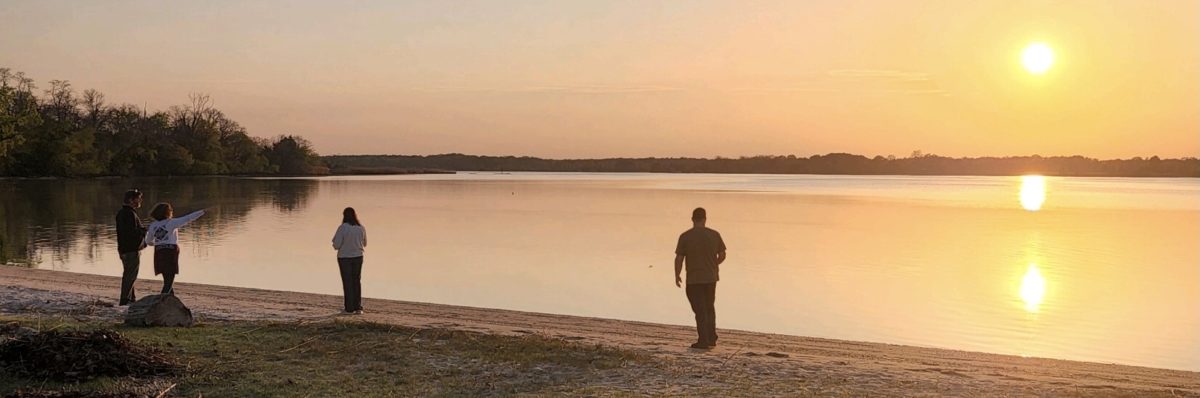
This slow morning time, unrushed with coffee and reading and writing and prayer and wonder and gratitude, is important enough for me to get up before everyone else; to find and carve out a spot in the still dark; to turn on a light like a starting gun—sitting down to begin, but not a race, permission, time, a gift.
Sometimes it is something I see: hummingbirds and Cardinals, butterflies, cats jumping fences or lounging on the porch, the dog curled on the tile floor.
Sometimes it is something I hear: I have learned the Indigo Bunting’s song, the snorting of deer on their path beyond the fence, the fish pond’s filter, peepers or bullfrogs, cicadas in the trees.
Sometimes it is something I read: a poem, Scripture, commentary, a story, an essay, a question.
Sometimes it’s writing: spinning a thought into a sentence, finding new words for something I have felt my whole life or just felt for the first time, lending voice to compassion or wonder, the beginning of a sermon, an epiphany small or large.
Sometimes it comes in prayer: a word, a question, a connection, a feeling, a name, a calling, a passion, tears, laughter, a smile.
From Ash Wednesday to Easter. A journey, a transformation, and one of the most intentional and richest parts of our liturgical calendar.
Our Lenten e-mail prompt and discussion of John O’Donohue’s book, “To Bless the Space Between Us,” was rich, meaningful, and eye-opening. It was a continuing and deepening conversation with 20 people which included the Eastern Shore, Vermont, and even photos and stories sent from Finland.
One of the purposes of the book for O’Donohue was/is to get us thinking about “blessing” differently, and that blessings can take many forms, not always something that we would wish, ask for, or even want. Sometimes blessings can be the sun and sometimes the silver lining.
The last section of the book is “To Retrieve the Lost Art of Blessing.” It is an intentional walk through a way of seeing. Here are a few early quotes:
“Something deep in the human soul seems to depend on the presence of kindness; something instinctive in us expects it, and once we sense it, we are able to trust and open ourselves.”
“Kindness has gracious eyes; it is not small-minded or competitive; it wants nothing back for itself. Kindness strikes a resonance with the depths of your own heart; it also suggests that your vulnerability, though somehow exposed, is not taken advantage of; rather it has become an occasion for dignity and empathy.
“Despite all the darkness, human hope is based on the instinct that at the deepest level of reality some intimate kindness holds sway. This is the heart of blessing. To believe in blessing is to believe that our being here, our very presence in the world, is itself the first gift, the primal blessing.”
That last paragraph especially: to see life itself as the first gift, the most basic blessing. Despite all the darkness.
We’ve just gone through an entire liturgical season that sees light overcome what seemed like the ultimate darkness. When faced with what seemed like the end, death, God shows us more, that new life overcomes death. That hope is not in vain, but intrinsic and ever-present, if we will see it.
Over the course of our group discussion, participants responded with pictures of the Northern Lights in Finland and an Assateague camping sunrise.
The Resurrection is nuanced and layered in its meanings. One of the things it did was give credibility to Jesus being who he said he was. And it made the disciples for the next few generations, reflect back on what Jesus said and did, to the point of writing it down so that it could be passed down.
Many writers and theologians point out that Jesus’s words to his disciples were “follow me,” not “worship me.” It’s really a both-and situation, we can do both; and worship is a perfect response to God. But a problem over the years has been and continues to be that many Christians are content with worshipping ( and “believing” without living or living into any of that belief) and have dropped the following aspect of our faith.
Following Jesus means living like he did, loving like he did, doing our best to emulate his example. In John’s Gospel, Jesus gives the disciples (and us) the new commandment of “loving each other as I have loved you.” which he says knowing he is about to be arrested and put to death. That’s what his love looks like–sacrificing himself for the love of his friends and for humanity.
When we look at kindness through the example and eyes of Jesus, we have a sense of what we are called to do and who we are called to be.
O’Donohue closes his book with the poem, “The Eyes of Jesus”–
I imagine the eyes of Jesus Were harvest brown, The light of their gazing Suffused with the seasons:
The shadow of winter. The mind of spring, The bues of summer, And amber of harvest.
A gaze that is perfect sister to the kindness that dwells In his beautiful hands.
The eyes of Jesus gaze on us, Stirring in the heart’s clay The confidence of seasons That never lose their way to harvest.
This gaze knows the signature Of our heartbeat, the first glimmer From the dawn that dreamed our minds,
The crevices where thoughts grow Long before the longing in the bone Sends them toward the mind’s eye,
The artistry of the emptiness That knows to slow the hunger Of outside things until they weave Into the twilight side of the heart.
A gaze full of all that is still future Looking out for us to glimpse The jeweled light in winter stone,
Quickening the eyes that look at us To see through to where words Are blind to say what we would love,
Forever falling softly on our faces, His first gaze plies the soul with light, Laying down a luminous layer
Beneath our brief and brittle days Until the appointed dawn comes Assured and harvest deft
To unravel the last black knot And we are back home in the house That we have never left.
The eyes of Jesus are a way of seeing and a way of being, in terms of how we see and treat each other. O’Donohue talks about the way Jesus sees us, his gaze, and describes it in a way that should make us feel like we are loved before we do or say anything. Our souls are loved, as well as our bodies and minds. Do we allow ourselves to feel seen and loved that way?
Following Jesus means to try to look at ourselves, each other, and Creation with these eyes and this love.
Why do we take a journey through Lent? Why do we try to take in, reflect on, pray on, the Passion/suffering of Jesus over Holy Week? Why do we celebrate Jesus’s Resurrection?
I hope that at least part of the reason is to allow ourselves to be transformed, to become more Christ-like, to live and love like Jesus, which is to experience the kingdom of God and to do our part to help bring that kingdom, that love, to others, and play whatever role we can in bringing the kingdom here.
May we feel the eyes of Jesus gazing on us. May we be the eyes of Jesus gazing on others.
May we know the love of Jesus, who became one of us, showed us how to live and how to love, gave his life for us, and then showed us that his love, God’s love, is greater than death, overcomes death and brings us to eternal life.
May we be the love of Jesus for everyone we encounter. And echoing Fr. Gregory Boyle, everyone: no exceptions.
“The heart is where the beauty of the human spirit comes alive… To be able to feel is a great gift. When you feel for someone, you become united with that person in an intimate way; your concern and compassion come alive, drawing some of the other person’s world and spirit into yours. Feeling is the secret bridge that penetrates solitude and isolation… All feeling is born in the heart. This makes the human heart the true jewel of the world.” –John O’Donohue, “To Bless the Space Between Us”
It all comes back to the heart. This week in our ongoing Lenten discussion of John O’Donohue’s book, “To Bless the Space Between Us,” we’ve reached the “States of the Heart” section. How we find our heart is how we find the world.
O’Donohue continues the thoughts from above with:
“The state of one’s heart inevitably shapes one’s life; it is ultimately the place where everything is decided.
– A courageous heart will go forth and engage with life despite confusion and fear. – A fearful heart will be hesitant and will tend to hold back. – A heavy heart will make for a gloomy, unlived life. – A compassionate heart need never carry the burden of judgment. – A forgiving heart knows the art of liberation. – A loving heart awakens the spirit of possibility and engagement with others.
Let’s shoot for courageous, compassionate, forgiving, and loving. States of heart are something we can feel, learn, cultivate, practice.
The blessing/poem of O’Donohue’s we focused on today was “For Equilibrium.” I struggle with balance. It feels like I have 50 things going on and then I collapse for a spell, catch my breath, gather up what’s around me, and then pick up speed again. It’s something I am working on. So moments like sitting in the Oxford Park at sunset on Monday to feel the breeze on my face; or walking uptown to grab lunch and stretching my legs on the walk back; or finding a few minutes to skateboard, sit on the shore and listen to birds–those moments are big and balance out some of the busier times.
After late evenings leading class and our Wednesday evening Lenten service, equilibrium this morning was parking at the Oxford Conservation Park and skateboarding over to the cemetery to sit under my thinking/praying tree. I started reading Maggie Smith’s “Dear Writer,” jotted down a few thoughts, then sat quietly and turned on the Merlin Bird App’s Sound ID.
There were some of the standards: Red-Winged Blackbird, Northern Cardinal, House Finch, Carolina Wren. There was the familiar Osprey cry that has just come home. And then there was the gift: Pine Warbler.
I have mentioned before that I am Warbler-obsessed. I dig any Warbler encounter and they generally tend to be spring or fall around here.
I can’t recall if I have come across a Pine Warbler. Either way, I love their presence; it sang/called multiple times so that I got to know and recognize it when I heard it. The Pine Warbler made a cool and special moment above and beyond the other times I have come to sit by the water and find my balance.
Here is O’Donohue’s “For Equilibrium”–
Like the joy of the sea coming home to shore, May the relief of laughter rinse through your soul.
As the wind loves to call things to dance, May your gravity be lightened by grace.
Like the dignity of moonlight restoring the earth, May your thoughts incline with reverence and respect.
As water takes whatever shape it is in, So free may you be about who you become.
As silence smiles on the other side of what’s said, May your sense of irony bring perspective.
As time remains free of all that it frames, May your mind stay clear of all it names.
May your prayer of listening deepen enough To hear in the depths the laughter of God.
I love that it is laughter and grace and reverence and freedom that he uses to give us back our sense of equilibrium. And to pull these things to our attention O’Donohue uses the joy of the sea, the wind, moonlight, silence, time, and listening. Things that we can encounter frequently, if not every day.
Equilibrium and balance can also be about perspective. Part of what can call us back into equilibrium when life feels out of balance is remembering the big stuff, what is important, zooming out to a more cosmic or Creation-based perspective. Listen to The Avett Brothers “No Hard Feelings” and see if your sense of balance isn’t shifted to a more thoughtful, introspective place in terms of where we want to put our time and energy.
Since I was a teenager, I have felt that when I am surfing back and forth on a skateboard, life’s worries drop off behind me, just for a minute.
Today, may you hold in your heart the people, places, memories, and dreams you hold dear and let them balance you.
“A home is a subtle, implicit laboratory of spirit. It is here that human beings are made; here that their minds open to discover others and come to know who they might be themselves.” – John O’Donohue, “To Bless The Space Between Us”
That is a way of looking at “home” that I hadn’t thought to articulate. Home is a laboratory of spirit, in that it gives us the comfort and the foundation to experiment, grow, change, find ourselves.
In our morning e-mail discussion of John O’Donohue’s book, “To Bless the Space Between Us,” this week’s theme is homecomings. One of the points he makes is that “home” should be a place that prepares us to go out and create a new home and ultimately that we also “develop the capacity to be at home in themselves.” He goes on to say:
“When one is at home in oneself, one is integrated and enjoys a sense of balance and poise. In a sense that is exactly what spirituality is: the art of homecoming.”
Spirituality as homecoming. As a coming back to something that we knew, or know, or that at least feels familiar. We recognize it. And it is something we recognize inside of us. If God is home, the Holy Spirit is the home within us. Mystical, or direct experience of something like that can help us feel at home in the universe and in ourselves.
But what if you’ve never known the safety of home, been able to open your mind, explore?
This past week, we had a Zoom conversation with Fr. Gregory Boyle. At Christ Church Easton, we’ve done studies of three different books that Fr. Greg has written–“Tattoos on the Heart,” “Barking to the Choir,” and “Cherished Belonging.” I’ve quoted and written about him frequently and I think that organization that Fr. Greg has founded, run, and been a spokesman for, Homeboy Industries, is the best example I can point to of what a community built around Christ-like love looks like today. Their community shows people in the toughest Los Angeles gangs what being loved and cherished can do, and it has changed the city and the world.
Fr. Greg mentioned that he sees tons of kids who have become adults and who have never been soothed at home, or anywhere. Between parents who themselves have never been soothed, or who weren’t there–were in prison or just left–or who were the opposite of soothing, imagine a childhood with no reassurance, no soothing. It immediately casts out any hope of HOME or this sense of home that O’Donohue is communicating. Homeboy Industries is the first sense of home they may know, and then once someone has experienced it, they can help offer a sense of homecoming to others.
Fr. Greg talks about a guy named Sergio, who Boyle calls his spiritual director. They write/text back and forth every morning reflecting on Scripture. The other day, Sergio ended his reflection saying, “Today, I will surrender into the arms of God, then choose to be those arms.” Boyle later made a similar point, that when we receive the tender glance, either from God, or from someone we encounter, we can then become that tender glance for someone else. Knowing that we are loved and cherished, then loving others from that knowledge, that belonging.
Let’s circle back to homecomings: if we have a sense of home, a sense of being loved, a sense of safety, we can be or offer that to someone who hasn’t had that experience of home before.
We develop or nurture our own sense of home, within us. And then we reach out to someone who could benefit from that feeling. Maybe that seems like a good idea, something you’d be game to try. You go through your day, you get to the evening, or maybe a quiet time before you go to bed.
John O’Donohue suggests, in his blessing, “At the End of the Day: A Mirror of Questions,” that we ask ourselves:
What dreams did I create last night? Where did my eyes linger today? Where was I blind? Where was I hurt without anyone noticing? What did I learn today? What did I read? What new thoughts visited me? What differences did I notice in those closest to me? Whom did I neglect? Where did I neglect myself? What did I begin today that might endure? How were my conversations? What did I do today for the poor and the excluded? Did I remember the dead today? Where could I have exposed myself to the risk of something different? Where did I allow myself to receive love? With whom today did I feel most myself? What reached me today? How deep did it imprint? Who saw me today? What visitations had I from the past and from the future? What did I avoid today? From the evidence–why was I given this day?
That’s a lot of questions–almost like a spiritually inquisitive kid who has been slamming Pixie Stix and then gives us an existential 20 Questions. Maybe focus on a few each evening–the ones that resonate or open something up. Watch what happens when you start asking yourself questions like this at the end of the day.
It’s akin to the Jesuit concept of the “Daily Examen,” where at the end of the day, you look back at the day you’ve just had and look where you saw, felt, heard, or experienced God’s presence or touch. And by doing that, you are also preparing yourself to look for it the next day.
O’Donohue’s questions are like that. If you get to the end of your day and reflect back with questions like this, you can be more mindful of looking for these things–keeping our eyes, minds, and hearts open to them–as they happen.
So what happens when looking back on our day with questions informs our coming days, that become our present days? Maybe we see, or hear, something we wouldn’t have.
It is so easy to stumble through our days without seeing, hearing, feeling. When we do that, there are so many things we miss out on. Let O’Donohue’s questions be a mirror. Let us be open to things that might be going on all around us, that we haven’t noticed before.
When we experience something new and profound, we can take it with us, and share it with others.
January 25 is the day the lectionary celebrates the Conversion of St. Paul. For our Wednesday Healing Services at Christ Church Easton, I have been using feast days that occur during a given week as a chance to do something along the lines of a homily to recognize them. This is what I put together for this week.
“The Conversion of St. Paul: Embracing Change”
Saul was not an atheist. He wasn’t a morally questionable person. He was a faithful and devoted Jew, who thought he was doing God’s work. And he was a persecutor of Christians. He approved the stoning of St. Stephen, the first Christian martyr in the Book of Acts.
There is no way in the world he was going to be even supportive of this movement, these followers of Jesus.
Until he was. This was not a change-by-degrees situation; this was being struck blind on the road to Damascus and having to come face-to-face with not just the risen Christ, but with the idea that the things you were devoted to, committed to, SURE OF, turned out to be wrong.
This was not an unlikely conversion. It was an impossible conversion. It made no sense. Saul had to come into it and not only that, if you were one of the early followers of Jesus, you knew who Saul was and there was no way you were going to trust him.
From the account in Acts, Saul was blind for three days and didn’t eat or drink for that time.
The Lord called out to a disciple in Damascus named Ananias, and told him where to go to find Saul and lay hands on him so that Saul could regain his sight.
And Ananias said:
“Lord, I have heard from many about this man, how much evil he has done to your saints in Jerusalem, and here he has authority to bind all who invoke your name.”
In other words, “Lord, I don’t think this is such a good idea.”
The Lord said to him, “Go for he is an instrument whom I have chosen to bring my name before gentiles and kings and before the people of Israel. I myself will show him how much he must suffer for the sake of my name.”
Even after his conversion, regaining his sight and becoming an incredibly powerful and persuasive preacher—so much so that now the Jews wanted to kill him; when Saul came to Jerusalem to join the disciples, they were all afraid of him and didn’t believe he had really changed.
Paul’s life got significantly more difficult after his conversion. Many of his letters were written from prison, which he found himself in and out of.
Now in terms of hand-picking apostles, Jesus hit the jackpot with Paul. Paul was Jewish, a pharisee. He was a Roman citizen, he spoke multiple languages, he was literate and educated, and passionate—he was actually the perfect combination of skills, upbringing, and knowledge to take this movement to the next level.
Let’s talk about change. Paul had to completely change his life, to repent, to turn around and go a different direction. And he is well documented in his own words for doing so.
Has your own path of following Jesus asked you to change or make changes in your life? What kind?
Our changes aren’t going to be a severe as Paul’s—I don’t think any of us were persecuting or killing Christians. Changes in our lives might look very different.
I’ll show you what I mean. I make this point a fair amount: over the past eight years, I have cried more than any other period of my life. Following Jesus has opened my heart and caused me to care about more people and more things, to take them into my heart—it’s a much more difficult way to walk through life. But it’s also richer and more rewarding.
Following Jesus with our whole hearts should make us care more about the world and be heartbroken by things we might have ignored before.
Following Jesus asked me to give up a temper that I had been developing over the years.
Following Jesus asked me to let go of judging people and situations. On the Meyers Briggs personality test that people take, I used to test as INFJ—introverted, intuitive, feeling, judging—over the past five years, anytime I have taken the test and been totally honest, I am INFP—judging changed to perceiving.
Change was necessary for Paul and it’s necessary for us. Transformation is a word that is not to be taken lightly.
Another thing we might learn from Paul is the difference between righteousness and self-righteousness. Saul, the pharisee who persecuted Christians was sure he was right. Jesus had a different opinion.
It makes me think of a more modern-day hero of mine. Verna Dozier was an African-American woman who was an English teacher at Dunbar High School. When she retired, became one of the lay (non-ordained) leaders of the Episcopal Church. I keep a copy of her book “The Dream of God” on a shelf near my desk. We did a small group study of that book, and I loved everything about this quote:
“We always see through a glass darkly, and that is what faith is about. I will live by the best I can discern today. Tomorrow I may find out I was wrong. Since I do not live by being right, I am not destroyed by being wrong.”
It is a powerful and humbling thing to live knowing I (or we) don’t and can’t know everything. I do my best to figure things out and have the courage and grace to keep learning and I realize that because something seemed right yesterday, it doesn’t mean it can’t be proved wrong today or tomorrow. If that happens, then I need to be willing to change. Just like Paul did.
So maybe humility becomes important, to realize I am not always right, no matter how passionate I might feel about something. I could have a realization—an epiphany—that I was wrong. Then I need the courage to admit it and think and live differently.
What else can we learn from Paul’s conversion? How about don’t write off your enemies. Saul wasn’t just disliked by the early Christians—he was public enemy number one. They were scared and skeptical of bringing him into the fold.
I apologize for bringing sports analogies into a discussion of such important things, but it’s still football season and we can make a couple points here.
There was a defensive back who played for the Pittsburgh Steelers named Rod Woodson, who is a Hall of Fame player, one of the best to play football at his position. The Steelers and the Baltimore Ravens are big rivals, they don’t like each other on the field very much. Rod Woodson ended up becoming a Raven, helped them win a Super Bowl, and now he is one of their radio broadcast announcers. Loved in both cities, he has dual citizenship.
If you follow the Philadelphia Eagles, running back Saquon Barkley was the franchise player of their division rival New York Giants. Philly fans booed him when the Giants came to town. This year he was traded to the Eagles, has been their best player, the most loved of the Eagles this year and one of the main reasons they are playing this coming weekend for a chance to go to the Super Bowl.
Sports are not life, but the point is, people who were once hated by entire cities and fanbases, become beloved and embraced.
Because someone was your enemy one day, or for a time, doesn’t mean they can’t become an ally, a friend, even beloved. Jesus wasn’t kidding when he said “love your enemies.” He showed the world with Paul, that your enemy is your brother or sister, and we and they are capable of change.
I have been reading Gregory Boyle’s book “Cherished Belonging” to get ready for our small groups that start next week. Boyle points out that on the day when Jesus entered Jerusalem on his way to be arrested and crucified, there were two parades that day.
On the one side, coming from the west on the main road, was Pilate and his show of military power and force. It was a display of power. Don’t mess with Pilate or you see what you’ll get. Boyle writes:
“Then there’s Jesus, on a small donkey, humbling entering the city from the east. Jesus’s trek and mission displays a way of life whose hallmarks are inclusion, nonviolence, unconditional loving kindness, and compassionate acceptance. The parade of warhorses announces the threat of violence, force, coercion, and the oppression of the poor. The “triumphant” entrance of Jesus is not an indictment but an invitation. Village transcending tribe. Jesus doesn’t draw lines (of division). He erases them.
Paul’s encounter with Jesus caused him to change his life completely. To become the thing that he despised. To embrace the other side.
Jesus invites us to do the same. To change. To be humble. To let go of our self-righteousness. To embrace his way of inclusion, even of our enemies, nonviolence, unconditional loving kindness, and compassionate acceptance.
Paul’s conversion changed everything. So can ours. So can anyone else’s.
Top image: “The Conversion of St. Paul” by Caravaggio, oil on cypress wood, 1600/1601.
Background: This month at Christ Church Easton, we are offering Blue December services on Wednesday evenings leading up to Christmas. These services recognize that people have a difficult time leading up to Christmas for any number of reasons–loneliness, grief, depression, anxiety, or just feeling out of step and out of place in a commercially-consumed culture. These services include lighting of candles, prayers, quiet music and singing, Scripture readings and reflections, some silence, Communion with previously sanctified elements (often called a Deacon’s Mass), and they are for are for anyone going through something this time of year who might want to come together for a quiet worship service in the evening in the middle of the week, and have some fellowship and discussion after. Our hope is that people will feel God’s presence and love and experience the company, care, and fellowship of other people.
The cards are stacked against us if we are going through a hard time in December. It’s getting colder, it’s basically dark after lunch, Christmas movies and music are streaming 24-7, and we feel like we are supposed to act like we are happy, even when we are the farthest thing from it.
States of being that include loneliness, grief, depression, and anxiety are all connected, we can move back and forth between them. And I say states of being because these aren’t things we can just change our mind about and decide, “I am not going to be lonely or sad,” “I am not going to grieve anymore,” or “I am tired of being depressed.”
But we can reach out. We can show up. We can give ourselves permission, allow ourselves to be low or hurting, or questioning. It may be counter to what we see when we look around this time of year, but it’s honest. Let’s start where we actually are.
How’s it going? Fine. How are you doing? Good. Granted, when someone asks us that when we run into them at the grocery store, that may not be the time and place to bare our souls. But we need to have some place we can do that.
Different people have different ways of coping with life. I don’t know where I would be without distance running and reading, two things that have helped me keep going through some of my darkest times. Reading, in part, because I find people who are describing the same thing I am feeling—someone who helps me give words to something I feel but can’t describe.
There is a poet named David Whyte. In his book “Consolations,” he talks about loneliness.
“Loneliness can be a prison, a place from which we look out at a world we cannot inhabit; loneliness can be a bodily ache and a penance, but loneliness fully inhabited also becomes a voice that asks and calls for that great unknown someone or something we want to call our own.”
One of the questions that led me to searching and to the journey I am on now was wondering in my bones and in my soul, “am I really and ultimately alone—are we only ever truly alone in the Universe?” It’s a question I came back to often enough, and one of the times that it had legs and kicked me in the gut was when my marriage was ending. I knew that even together, I felt alone, I knew that even among friends, I felt alone, like no one was out there, or really understood who I was.
But I wanted there to be. The fact that I didn’t want to be and feel alone, sent me both inside myself and out into the world.
This is David Whyte again:
“Loneliness is the very state that births the courage to continue calling, and when fully lived can undergo its own beautiful reversal.
“Loneliness is the place from which we pay real attention to voices other than our own; being alone allows us to find the healing power.”
Lonely human beings are lonely because we are made to belong. Feeling alone is hard because we aren’t made to be alone. As many times as I feel like living as a hermit would be a lifestyle-change I would embrace—even for an introvert, there are times I need connection.
In one of the most counter-intuitive sermons in the Bible, Jesus says that these low times we experience have a purpose. We call this section of Matthew’s Gospel, the Beatitudes, for its use of the word “blessed.” This is one of the key parts of Jesus’s Sermon on the Mount. He tells us:
“Blessed are the poor in spirit, “Blessed are those who mourn, “Blessed are the meek, “Blessed are those who hunger and thirst for righteousness…”
Ummm… Jesus, what are you talking about? I’ve felt those things, and no offense, but I’d like to be done with all that.
In her book, “Into the Mess & Other Jesus Stories,” Debie Thomas writes:
“What Jesus bears witness to in the Beatitudes is God’s unwavering proximity to pain, suffering, sorrow, and loss. God is nearest to those who are lowly, oppressed, unwanted, and broken. God isn’t obsessed with the shiny and the impressive. God is too busy sticking close to what’s messy, chaotic, and unruly.”
What our faith tells us, what Jesus showed again and again with his teaching, his healing, his life, is that it was the outcast, the low, the hurting, the people no one wanted to think about or deal with, who were his people.
Self-reliance and independence are very American values. I can take care of myself, I got this, I don’t need anyone’s help. Those ideas are NOT Christian values. They are not love-centered values.
One of the biggest Christian values we hold is surrendering. Realizing that we don’t control the Universe; that there are so many things in our own lives that we don’t have control of and that we are helped when we surrender our need to be in control to a higher power, to God.
It often happens that we don’t experience a need for God, a need to accept that we aren’t always in control, until things start to fall apart.
And it’s those times that God is closest to us. It’s those times when what we’ve been fed by society—that if we have the right house, the right family, the right job, the right car—then we ‘ll be happy. When that turns out not to give us what we are looking for, or pursuing those things stops making sense, and we are looking for something more substantial, then we are open to another way of thinking about life.
One of the most useful things I’ve run into in thinking about the Beatitudes is the novelist Alice Walker, who wrote “The Color Purple,” in coming up with a similar list for a character of hers, changed the word “blessed” to “helped.” Listen to Jesus’s teaching like this:
“Helped are the poor in spirit, for theirs is the kingdom of heaven. “Helped are those who mourn, for they will be comforted. “Helped are the meek, for they will inherit the earth. “Helped are those who hunger and thirst for righteousness, for they will be filled. “Helped are the merciful, for they will receive mercy. “Helped are the pure in heart, for they will see God. “Helped are the peacemakers, for they will be called children of God.”
The world wants us to be hard, tough, to put our heads down and be productive. To be good, to be fine, to be surface level.
Jesus wants us to have soft hearts. To go deep. To care for one another, to help one another, to love one another. Our ability to do these things is part of what constitutes the Kingdom of Heaven.
We are not meant to go through life alone. We need each other. We need to be there for each other.
To have soft hearts, to be able to be there for someone, we are helped by knowing what they are going through.
Brene Brown describes herself as a storyteller and social worker. This is how she talks about empathy:
“Empathy is feeling WITH people. I always think of empathy as this kind of sacred space. When someone’s in a deep hole and they shout from the bottom and they say “I’m stuck. It’s dark. I’m overwhelmed.” and we look and we say “Hey” and climb down and say “I know what it’s like down here, and you’re not alone… Empathy is a choice and it’s a vulnerable choice. In order to connect with you, I have to connect with something in myself that knows that feeling.”
Thank you for breakfast with Anna this morning at Rise Up.
Thank you for laughter and conversation taking Ava to work.
Thank you for the slow driver on Oxford Road who reminded me to slow down.
Thank you for the Oxford Conservation Park.
Thank you for the body and energy to skateboard and for the joy I get from it.
Thank you for the Eastern Bluebirds who cut across my path.
Thank you for the tree I sit under to think and pray and listen.
Thank you for the Great Blue Heron who squawked and landed on the dock across the cove.
Thank you for the hammock on the point across the way, which has been there for years and always reminds me to rest.
Thank you for the Bishop’s words on Wednesday that “Every day is a conversion experience.”
Thank you for giving me new eyes to see familiar places afresh.
Thank you for giving me words when I frequently don’t know where they come from.
Thank you for making my path clearer and clearer for me each day, even though I don’t fully know where it leads.
Thank you for companions on the way.
Thank you for the everyone I have crossed paths with, people walking their own paths, walking together for a time; thank you for those who have encouraged me and for those who I have struggled with.
Thank you for forgiveness for the countless times I have screwed up and the countless times I will screw up in the future.
Thank you for your Creation and for making me feel at home and at peace in it.
Thank you for the wisdom and inspiration that comes from your Word and from the words you’ve given to poets, mystics, artists, musicians, and prophets, known and unknown.
Thank you for the conversation this morning, under the tree, through Mary Oliver:
(Note: I was compelled to pick up Mary Oliver’s book “Devotions” when I left home this morning. I always start reading at the bookmark, where I stopped reading last time. I opened to “When I Am Among the Trees” and it picked up steam from there.)
“Oh, feed me this day, Holy Spirit, with the fragrance of the fields and the freshness of the oceans which you have made, and help me to hear and to hold in all dearness those exacting and wonderful words of our Lord Jesus Christ saying: Follow me.”
Thank you for your Son and for his invitation to “Follow me.”
Thank you for your love, which always comes from you, and your love that comes through others.
Lord, help me use my life and myself to serve you, to glorify you, to be your love and to shine your light in the world.
I want to take us back a couple months ago, to one of our readings at the beginning of summer, just after Pentecost. It’s from 1 Samuel.
The people of Israel tell Samuel they want a king. Samuel passes the message along to God, who says, “You shall solemnly warn them, and show them the ways of the king who shall reign over them.”
Samuel relays God’s warnings of all the nefarious things a king will do. And then we hear:
“But the people refused to listen to the voice of Samuel; they said, “No! but we are determined to have a king over us, so that we also may be like other nations, and that our king may govern us and go out before us and fight our battles.”
Now, God wasn’t warning them that they were going to get a bad egg as a king. He was warning them against placing trust in worldly power; he was warning them against what being king does to people, how they can get caught up in all that goes with the position.
In the case of this particular king, God loved David. He wasn’t against him. And when all this went down with Bathsheba and Uriah, God didn’t give up on him. But David sure messed things up.
Not every story in the Bible has a fairytale, happy ending. We get the good, the bad, and the ugly—and some of the stories leave us in a bad spot. They are supposed to. The story of David and Bathsheba leaves us in a lurch.
I have to say, I like Nathan and the approach God came up with for him. The story about the one little ewe lamb and watching David get fired up about it—revealing that he still has some sense of justice and compassion in him, outwardly looking anyway.
God blasts David for what he’s done; He speaks to David in David’s own language, based on his actions and the things that are important to him. God didn’t say to Israel—“See? Didn’t I tell you bad things would happen if you went with a king?” Instead God still loves David, tries to work through what has happened, avoid anything like that happening again, and come to a better understanding and a better relationship on the other side.
And though God doesn’t say I told you so, the king issue is still a problem. In this case, a problem that may have a proposed solution, right in our readings over the last two weeks.
In last week’s reading, after Jesus had fed the 5,000 people with just a few loaves and some fish, they had a notion that Jesus was the prophet to come into the world.
“When Jesus realized that they were about to come and take him by force to make him king, he withdrew again to the mountain by himself.”
Jesus wants no part of the worldly power that the crowds want to give to him. God warned Israel that they didn’t want a king. Israel said, “oh yes we do, we want to be like everyone else in the world, the king can fight our battles, and we’ll be on the news just like the cool countries.”
The people witness the signs Jesus is doing and they think, well finally, here’s the guy, this is the king we’ve been waiting for. Jesus says thanks, but no thanks.
Jesus’s mission is much bigger, more profound, more earth-shattering, more kingdom-bringing than becoming the next king on a throne.
Remember, these aren’t bad people who want to make Jesus king. These are people who witnessed him healing and curing the sick. They followed him and Jesus loved them and had compassion enough that he performed another miracle and fed them.
In writing his Gospel account, John doesn’t call these things that Jesus is doing miracles: he calls them signs. Because they point to something bigger than the sign itself. And in this week’s reading, Jesus explains something about this sign. He says:
“Very truly, I tell you, you are looking for me, not because you saw signs, but because you ate your fill of the loaves. Do not work for the food that perishes, but for the food that endures for eternal life, which the Son of Man will give you.”
People eating their fill of loaves is what they do in the world of kings. Food that endures for eternal life is what they do in the kingdom of God. Jesus uses this feeding sign to point to the thing behind it: to point to God.
This is tough stuff for the people to get their head around. They’re not getting it. They ask:
“What must we do to perform the works of God?” Jesus answered them, “This is the work of God, that you believe in him whom he has sent.” So they said to him, “What sign are you going to give us then, so that we may see it and believe you? What work are you performing?”
Maybe now we can understand why Jesus walks away from the crowds sometimes. “What work are you performing?” Hey guys, Jesus is going to do another magic trick! Let’s set up a tent and some seats and take in the show!
The Old Testament, the Hebrew Bible, is full of stories of the relationship between God and His people, where the people get confused, lose sight of God’s love and their covenant; they get tempted and give into temptation, and God keeps giving them course corrections. Reminders. “Remember, I am the God of Abraham, Isaac, and Jacob… I’ve done all these things for you.”
What we see in Jesus and what we see in the Gospels is what it looks like to make the right decisions, to repent from the wanting of kings and the low-hanging fruit of worldly desires, power grabs, and putting ourselves first. Where Israel wanders lost in the dessert for 40 years, Jesus doesn’t give into temptation during his 40 days in the wilderness. Jesus is the course correction, he shows us how to live in this life, what to focus on, who to care about, who to take care of, how to love, so that we move beyond our small, selfish selves, by giving up our lives and our want for kings and focusing on heavenly things and eternal life.
Every day we make choices. In some cases, those choices can move us away from God and towards the world who wants to be ruled by kings. Some of our choices can move us closer to God, closer to Jesus, who is trying to show us how to make the right decisions.
In her book, “An Altar in the World,” Episcopal priest Barbara Brown Taylor is invited to go speak at a church in Alabama. She asks what they want her to talk about. The priest says, “Come tell us what is saving your life now.”
Brown Taylor says:
“All I had to do was figure out what my life depended on. All I had to do was figure out how I stayed as close to that reality as I could, and then find some way to talk about it that helped my listeners figure out the same things for themselves.”
“Jesus said to them, “I am the bread of life. Whoever comes to me will never be hungry, and whoever believes in me will never be thirsty.”
How do we come to Jesus? How do we believe? What are things we can do to draw closer to God, to make the right decisions?
Tell us about what is saving you now. Here are some of things that have helped me lately:
Rest – I am less likely to rush into a bad decision when I rest, when I pause. We’ve spent the last couple Sunday evenings on the screened in porch and in the yard to watch the sunset and the sky. Taking an afternoon walk down the tree-lined, gravel lane to Claiborne Beach. Hit the reset button. If people’s energy is intense and they are spun up about something, as we see so often right now, if I have caught my breath and come to a situation rested, my chances of making good decisions are better.
Prayer – when I am in conversation with God, when I am listening, I am more likely to be looking at life from a bigger perspective than just my own. We stay close to people we spend time with. Prayer is a great way to spend time with God. At our healing service this week, someone talked about, when she feels distant from God, she starts her prayers with, “Lord, have mercy on me.” That puts us in a place of humility. Being humble can be its own category.
Gratitude – if I find something to be grateful for each day, my heart and my mind are aligned. If David had looked around and said, “Wow, look at the kingdom I have, the life I am living, and been grateful to God for it all, maybe he doesn’t put himself in the situation that gets him in so much trouble.
Heartbreak – this is about perspective. Over the past few weeks, I gave a homily at a friend’s funeral and watched his 16-year-old daughter give a eulogy for her father; another friend lost his wife about this time last year and now his brother is in home hospice. Another friend last week was in the church praying on her late husband’s birthday and we got to catch up, and what a gift to see that their love continues even now. So many people around us, our friends, our family, members of our congregation, are going through so much. If we allow our hearts to break with theirs; to know we can’t fully understand what someone else is going through, but we can try to be there with them; that’s what Jesus asked us to do. Heartbreak reminds us what things are most important and what decisions to make.
Study – I have so much more to learn about the Bible. God’s inspired Word; a library of readings for our learning, sometimes as night and day different as someone sleeping with a neighbor’s wife and then plotting to have that same neighbor killed; to feeding 5,000 hungry people who are looking for something more than food. When I spend time reading and reflecting, learning from Scripture, I am being fed with more than food.
Jesus is talking about feeding people spiritually, going beyond just our human hungers and thirsts. Not discounting them but using them to point to something bigger. To point to the one who was sent to give us these signs; the one who was sent to show us how to love and how to live; and when the crowds asked what they had to do, Jesus said believe in me. “I am the bread of life. Whoever comes to me will never be hungry and whoever believes in me will never be thirsty.”
Believing, when it comes to Jesus, isn’t about just agreeing with him, it’s not some mental exercise. It’s about how we live our lives, how we love, and what we do with our time. I still make a lot of bad decisions. But prayer, gratitude, rest, heartbreak, and study are some of the things that help me make the decisions God hopes I’ll make. As you go about your week, think about what things are helping you. What is saving you, bring you closer to Jesus, helping you believe, right now?
Treasure is time plus experience yielding gratitude and wonder. Finding sea glass is the same as skipping shells.
If your mind and body are tuned to a task, you are the moment.
“You were made and set here to give voice to this, your own astonishment.” I carry that Annie Dillard quote in my soul, the reminder of a feeling that has always been there.
Unplugged.
Astonished.
Around the world in a 20-minute drive and a short walk across the cosmos.
Holly reads Mary Oliver out loud:
“I have become older, and, cherishing what I have learned, I have become younger.”
When I am open and receptive, I am not alone. Sitting outside sipping coffee, I am connected to all the hands and all the lives that were involved in picking the beans, making the coffee, and getting it here.
Listening to and watching birds opens me to a symphony of sounds, colors, and graceful movements.
I see the greens of summer above and around me and I feel the slight breeze of the morning.
In the background, I can hear vehicles heading more east than west on Route 50, starting a long holiday weekend. Though I can’t know the people driving by individually, it’s not hard to picture or remember the feeling of heading to the beach for the weekend.
When I allow myself to be open and receptive, perceptive, I don’t feel isolated. I feel connected. It’s a feeling that sets the tone for the day.
In “The Book of Awakening,” Mark Nepo writes, “The dearest things in life cannot be owned, but only shared.” Last Sunday afternoon and evening, Holly and I shared a show of God’s handiwork that was awe inspiring.
Outside to watch the sunset, we listened for birds using the Cornell Ornithology Lab Merlin app’s Sound ID. We heard Indigo Buntings, Purple Martins, Cardinals, American Goldfinches, Chipping Sparrows, Carolina Wrens, Red-Eyed Vireos, and Blue Grosbeaks.
Blue Grosbeaks were new to me and they were the noisiest and most active of the birds we were hearing. As we walked down the garden, Holly pointed out a nest in a bush and as we got near, the mother flew out and into a nearby tree. As she chirped her annoyance at us being there, Sound ID showed her to be a Blue Grosbeak. Looking up more about them, their nest is exactly as described. Hope to see some little Grosbeaks soon.
Next for our evening in the yard, despite very little rain, a rainbow appeared, developed, and thickened right over the house. It was an amazing light show.
There was a stretch in my life where I loathed rainbows—they carried some baggage I didn’t feel like unpacking, and I wrote them off as illusions of light, nothing substantial, nothing of substance. And that’s all true.
But how much of the beauty we find in life and in Creation is transient and fleeting? We know that and we can still appreciate it and marvel at it when it’s there. I live for sunrises and sunsets and they are also impermanent plays of light, which need to be enjoyed in the moment.
If I want to be available to the full spectrum and experience of God’s works in Creation, I need to be open to rainbows. It’s to my benefit and God’s glory.
The next part of the show for the evening was the sunset itself, which incorporated the clouds and the whole sky.
The Sunday evening show was on the last day of June. The month of July does not include vacation or travel for us, it’s about being open to rainbows and experiencing what is around us each day and every weekend. The idea is to “carpe” the month in every way we can. I am a list maker, here are some of the things on the radar screen:
Kayaking/paddleboarding
Parks (both new and known)
Birding
Sunrises and sunsets
Be out under the stars
Live music
Fire pit nights
Beach days
Cooking/grilling
Summer reading
Skateboarding
Gardening
Walks/hikes
If we do things on that list each day and every week, we should have a shot at carpe’ing July.
A skateboarding friend Landy Cook already put some of that into play when on July 2 he organized a social skate along Rails to Trails and at the pump track and skate park in Easton. It was a good first turn out and stellar evening, to be repeated weekly.
A number of author Annie Dillard’s words dance through my head regularly. One of the main quotes is this one:
“How we spend our days is, of course, how we spend our lives.”
There is no getting around that. If I daydream but never do anything, my days won’t reflect the life of my mind, and neither will my life.
Each day is an opportunity to do something. Beyond making a list of things I hope to do, what would a meaningful day, any day, look like?
What if every day included doing:
Something creative
Something prayerful/meditative
Something physical
Something practical
Something productive
Something peaceful/soothing
Something loving
Something selfless
Something outgoing
Something spontaneous
Something sensory/sensuous
If I can think about those kinds of things to do each day and look back at the end of the day to see how I did, how I spend my days might add up to a life I want to live.