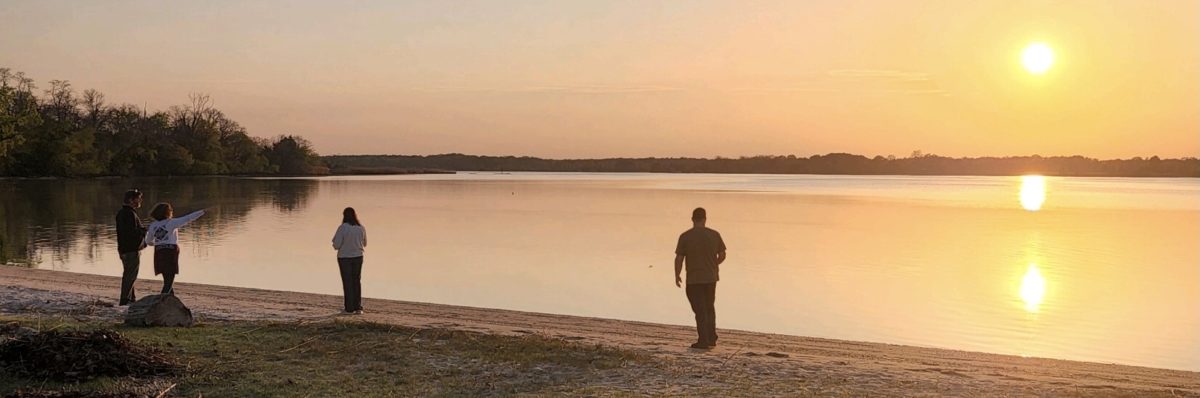
Much to ponder, much to cherish, much to lament

It’s been a heavy season of late. Funerals, hospice, medical, pastoral, for friends and family. When things are heavy, I often seek solitude and frequently that leads me to find some space in Oxford, the town where I grew up and continue to grow.

A couple Sundays ago, after our church services were done, I drove down to Oxford. It ended up being Plein Air day and the town, and the park where I often sit, were full of people. That and the park benches being in full sun, I walked to the end of Market Street, where there is a shaded bench next to Town Creek.

I sat quietly for a while, breathing and feeling a welcome breeze on my face. And then I pulled out three books I’ve been working on:

“Theo of Golden” by Allen Levi
“Four Quartets” by T.S. Eliot
“What Grows in Weary Lands” by Tish Harrison Warren

“Theo of Golden” is a novel that has been making its way around our congregation, talked up, talked about, and sometimes copies are passed around. A friend sent me a copy a few months ago, which I started, loved, and then reading for sermon prep, small groups, etc., took over, and I have been happy to pick it back up.

Getting to the end of the chapter I was reading, Levi wrote:

“There was, and would be, much to ponder.
Much to cherish.
Much to lament.”

I put the book down. That’s life. Every single day. We have much to ponder, much to cherish, much to lament. It is always a gift, each of those things, because to lament is wrapped up in loving. Loving opens us to lament. When we can love and cherish this life, we are fully living. Lamenting is a part of all of that, knowing that our time here is limited.

I read more in each of the books, enjoyed the company of other Market Street walkers who stopped and sat on the bench and enjoyed the shade and the breeze, and then moved along.

Among my practices for solitude is walking or running and that day was a walking day. I walked down Banks Street, cut onto Tilghman Street, and up Stewart Avenue, walking by a house where a friend and Little League baseball teammate lived, and it was his house where I first watched the slasher film classic, “Friday the 13th.” As all 11-year-old kids should (kidding).

Oxford is a town made up of memories for me, where the present and the past blend together. I wrote something about that in the August issue of Tidewater Times. Though the town has changed, it still feels like home, which is part of why I am drawn there.


I walked up onto The Strand and found a tree to sit under near the Oxford-Bellevue Ferry Dock. There I dug further into Eliot’s “Four Quartets.” I have lost count of how many times I have read this poem/book, it is one of a handful of books (mostly poetry) that I can and do carry in a backpack for quick and frequent access. Break glass/open book in case of existential emergency, or for inspiration, or to ponder, cherish, lament.

“Four Quartets” is divided into four sections, and I try to read a full section at a time. That day it was “East Coker.” Here is a stretch that jumped out at me:

“… Do not let me hear
Of the wisdom of old men, but rather of their folly,
Their fear of fear and frenzy, their fear of possession,
Of belonging to another, or to others, or to God.
The only wisdom we can hope to acquire
Is the wisdom of humility: humility is endless.”

I try to keep the wisdom of humility close to my heart day to day, moment by moment. If you are a follower, or even a fan of Jesus, humility was part of the marrow of his Incarnation. If you look back over the history of humanity, when we lose humility, we lose ourselves, and one way or another, individually and/or collectively, a crash/fall is in the works.

Eliot’s “Four Quartets” teaches or reminds me of something every time I pick it up. If I string things together, actively pondering, cherishing, and lamenting should keep us humble.

Though I also read “What Grows in Weary Lands” on my Oxford walkabout, the chapter that connects here is one I read a few days later on our back porch.

Tish Harrison Warren shares a wisdom story from the sayings of the Christian Desert Fathers and Mothers. It’s the story of three friends who were monks, who were all earnest and faithful:

“One of them, motivated by the call in Matthew’s Gospel to be a peacemaker, chose to spend his time seeking to ‘make peace between people who were at odds.’ The second monk, motivated by Christ’s concern for the vulnerable, decided to ‘visit the sick.’ The third chose to ‘go away to be quiet in solitude.’

“The first monk did some good helping others to reconcile, but he grew sad over conflicts he could not solve. He felt ‘overcome with weariness.’ So he went to visit his friend who was tending the sick, only to discover that his friend, too, was ‘flailing in spirit.’

“The two men visited the third monk and told him about their exhaustion and sense of futility–what today we might call burnout.

“The third monk sat silently for a long while, then he poured water into a cup. ‘Look at the water,’ he said. The water was murky with silt. But after they sat together for a while, the water settled. ‘See now, how clear the water has become. So it is with anyone who lives in a crowd; because of the turbulence, he does not see his sins: but when he has been quiet, above all in solitude, then he recognizes his own faults.”

Loving, helping, and caring for others is part of why we are here. And if we are constantly focusing on others, we can lose ourselves, the things we need to work on, our own shortcomings, and also our own connection to and relationship with God.

Of course the monastic Desert Fathers and Mothers are going to drive home the need for solitude. And it is a teaching and message that resonates with my soul.

Warren brings the point home:

“This story implies that solitude and silence are our orienting goals, the re-humanizing rhythms that teach us that we are not, in fact, machines, but creatures–creatures with faults, limits, beauty, and worth, creatures made to dwell deeply with God.

“If we see solitude and stillness primarily as a means to more productivity, we will try to get by with just enough to keep us going and no more. But if these practices are essential to our very being, to our purpose and humanity, then we will orient our work and our days, our weeks and our years, around them.”

That’s what I was looking for in my Oxford walking, sitting, and reading. That’s what I look for in centering prayer, in mornings on the back porch–“to dwell deeply with God,” to rehumanize.

We have four-week small group studies of Warren’s book coming up in August at Christ Church Easton and I am looking forward to our discussions and how we might help ourselves reconnect and dwell deeply with God, especially during seasons where that can feel difficult.

Goals for any/every given day: ponder, cherish, lament, mind the wisdom of humility, dwell deeply with God.

To do these things, solitude, silence, and stillness are required.

The Kingfisher’s Wing

Driving Trappe backroads I had to stop the car on a small bridge, mid-conversation, just to take in the scene. To recognize and capture the moment: the mist on the river, the slick calm surface of the water, the way the sun froze everything in time, just for a second.

“… After the kingfisher’s wing
Has answered light to light, and is silent, the light is still
At the still point of the turning world.”

T.S. Eliot, Burnt Norton, “Four Quartets”

That’s how Eliot puts those iridescent moments–they can become the still point of a turning world. If there are a handful of books that we get sent back to over and over again in the course of our lives, T.S. Eliot’s “Four Quartets” is one of those books for me.

This weekend it was Rowan Williams’ book “Being Disciples,” that sent me either down the chute or up the ladder to the kingfisher’s wing. Williams compared prayer to birdwatching (two things I dig and want to spend more time doing). He said:

“I’ve always loved that image of prayer as birdwatching. You sit very still because something is liable to burst into view, and sometimes of course it means a long day of sitting in the rain with nothing very much happening. I suspect that, for most of us, a lot of our experience is precisely that. But the odd occasions when you do see what T.S. Eliot (in section IV of ‘Burnt Norton’) called ‘the kingfisher’s wing’ flashing ‘light to light’ make it all worthwhile. And I think that living in this sort of expectancy–living in awareness, your eyes sufficiently open and your mind both relaxed and attentive enough to see when it happens–is basic to discipleship.”

And that’s it–having our minds and hearts open and expectant, so that we can catch those moments when they happen. Eliot pointed it out for me years ago, Williams reminded me and sent me back to Eliot, but God presents us with those moments every day.

Running through John Ford Park on a Friday morning after a Thursday night rain, and a magnolia blossom all but audibly called out to be noticed and appreciated. It’s so easy to put my head down and pass those moments by, but thankfully I am easily led when it comes to opportunities to marvel and wonder.

Another one of those books to return to countless times over a lifetime is Walt Whitman’s “Leaves of Grass,” particularly “Song of Myself.”

“Swiftly arose and spread around me the peace and joy and knowledge that
pass all the art and argument of the earth”

Walt Whitman, “Song of Myself”

Have you had those feelings, possibly brought on by those kingfishers’ wing moments that we happen to catch? When you are sitting there, drinking in the day, firehose style, where you know you are missing a lot of what you are trying to take in, and you breathe, and look over and the moment transforms into a feeling and you are in it and it is in you.

Sometimes adventure looks like

Sometimes adventure looks like guys in their 40s meeting early on a Saturday morning, last minute, to skateboard the newest pavement in town.

Sometimes adventure looks like following a strange urge to drive on a Sunday afternoon to take a picture of a Celtic cross at a church up the road.


Sometimes adventure looks like picking a place you’ve never been and making a weekend road trip of it, just for the experience of it, and to make what Brene Brown calls “picture memories.”

Sometimes adventure sounds like saying “Here I am,” in following a path that you don’t know where it will lead, but you know it is laid out for you to walk.

Sometimes adventure sounds like taking a chance, starting something new, whether in business, art, career, love, fitness–something you aren’t sure will work, but you know you have to find out.

Sometimes adventure feels like showing up at the blank canvas, or for the morning run, or at the gym, or in front of the blank page, or the studio, even and especially on days where you don’t feel like it, on the way to something bigger, and finding a reward that you wouldn’t have found if you hit snooze, or came up with an excuse not to do it.

Sometimes adventure feels like letting go.

Sometimes adventure looks like helping a friend move.

Sometimes adventure sounds like sharing stories and connecting with someone.

Sometimes adventure looks like stretching out an afternoon, just to have a little more time together, to see the sun on the river.

Sometimes adventure sounds like daydreaming with someone and then trying to make daydreams things that actually happen.

Most of the time, adventure is a state of mind. It’s being open to possibilities. It’s being fully present in the moment, right now. It’s being surprised by something simple, something everyday, something that could be brushed off as ordinary.

There is adventure in the everyday, which is where we spend most of our lives. There is adventure in the epic, the unknown, the new. There is adventure in making the everyday new. I never get tired of T.S. Eliot writing:

“We shall not cease from exploration
And the end of all our exploring
Will be to arrive where we started
And know the place for the first time.”

T.S. Eliot, “Four Quartets”


Sometimes adventure looks like planting a garden.

Sometimes adventure sounds like putting a dog and two teenagers in a car and picking somewhere to walk outside on a nice day and hearing what life looks like to them.

Sometimes adventure looks like parking in a different place at a state park on a beautiful morning and taking all the log crossings you can find along the way.


Sometimes adventure sounds like getting excited for opening day–of baseball season, of rockfish season, of whatever it is that is coming that puts a smile on your face.

Sometimes adventure looks like trying out for something, or trying something you’ve never done before, at whatever age you are now.

Sometimes adventure looks like spending a sunny Sunday spring cleaning the yard.

Sometimes adventure smells like a backyard fire pit on a clear night.

Sometimes adventure feels like seeing buds on a magnolia tree that you know is soon going to burst into 10 days of breathtaking blossom.


Sometimes adventure sounds like laughter that rolls through everyone in the room.

Sometimes adventure feels like spending time with the right people.

Maybe adventure looks like today.

What’s Next?

I have two kinds of reading: work/church reading and other/personal reading, though they almost always overlap.

Work/church reading is reading that goes toward discussion groups and Bible studies. Over the past few years, we have done chapter by chapter group studies of the Gospels of Matthew, Luke, and John, and Paul’s Letter to the Philippians; shorter survey’s of Mark and Matthew’s Gospels, book studies of two Bob Goff books, one Brene Brown book, Henri Nouwen’s “The Return of the Prodigal Son,” and a deep-dive into The Lord’s Prayer. We have groups that have become like family, who have been meeting for multiple years now and when one study is done, they ask, “what’s next?” And it’s awesome. 

When we could no longer gather together as groups this spring, Zoom meetings became our way of getting together. And for the past several weeks, on Tuesdays and Wednesdays, we have had folks on screen together, live from their homes in Wittman, Sherwood, outside Cambridge, all around Easton, and it has helped–both with the stir crazy, cooped up feelings, but also staying connected to each other and connected to God.

As we finished our long studies of John’s Gospel and our Lent survey of Matthew’s Gospel, we kicked around some options of what to explore next. The thought of Paul’s prison letters resonated, as we quarantine in place. A reliable, accessible commentary can be hugely illuminating for Bible study, and we have loved N.T. Wright’s New Testament for Everyone books. His “Paul for Everyone: The Prison Letters” is what we used for our Philippians study a couple years ago and we are heading back there to start with Paul’s Letter to the Ephesians.

From Wright’s introduction:

“This book includes the four short letters Paul wrote from prison: Ephesians, Philippians, Colossians, and Philemon. His own personal circumstances make these especially poignant, and give us a portrait of a man facing huge difficulties and hardships and coming through with his faith and hope unscathed. But what he has to say to young churches–and in the case of Philemon, to one man facing a hugely difficult moral dilemna–is even more impressive. Already, within 30 years of Jesus’ death and resurrection, Paul has worked out a wonderful, many-colored picture of what Jesus achieved, of God’s worldwide plan, and how it all works out in the lives of ordinary people.”

Paul’s letters from prison give us plenty to think, pray, and reflect on, and something to work towards. I always recall the line from Ephesians about putting on the “full armor of God.”

Something has happened in the shift from being able to come together at church, or anywhere, to now being distanced. Maybe we realize how much we need each other, how much we miss each other. And creating content to engage, inspire, and give hope, as well as creating interactive opportunities and experiences is more important than ever. So as we start with Ephesians and go through the prison letters, I want to throw out there for anyone who wants to, to do the same. I’ll be blogging and trying to find some creative writing opportunities with it; I will look to have some video conversations with Fr. Bill Ortt, Fr. Charlie Barton, and others to get their thoughts on issues and chapters that come up; possible podcasts with staff members and others; I will see if I can find some special guest stars to weigh in; and we can open up some Zoom meetings during the week where people can drop in and share and discuss their thoughts. The more the merrier–and has always been the case for our small groups, you don’t have to be a member of the church or any church to be a part of what’s going on. If it sounds interesting, give it a shot. With Zoom, Facebook, Instagram and the like, you can be in Florida, California, Maine, or in a different country.

In January 2017, I had started working at Christ Church Easton part-time in addition to my job as director of the Oxford Community Center. Our rector/pastor, Fr. Bill Ortt, asked me to put together a short (5-6 week) Bible study, whatever I picked to study, find 10 or so people to be a part of it, and he and I would co-lead the group. I had led small groups before, but this would be my first Bible study. I picked Ephesians. Many of the guinea pigs…er… willing participants, have become close friends, and are still both involved in and leading small groups at the church, with one woman finishing up her work to become a deacon. It’s been a wonderful journey together.

I was reminded recently (by Wright, in our John study) of lines from T.S. Eliot’s “Four Quartets,” which is one of my absolute favorite poems/books ever written. Eliot says:

“We shall not cease from exploration
And the end of all our exploring
Will be to arrive where we started
And know the place for the first time.”

T.S. Eliot

I feel like that is the case for me with Ephesians. It’s maybe the case with small groups. It’s maybe the case with church and communities, who are having to re-examine what’s important and how to do things.

Fair warning though: it seems the longer you study with and work with someone, the more likely you are to dress alike.

“Start Your Life Afresh”

A blind girl sees for the first time after getting her sight from cataract surgery. Annie Dillard describes the girl’s experience visiting a garden:

“She is greatly astonished and can scarcely be persuaded to answer, stands speechless in front of the tree, which she only names on taking hold of it,  and then as ‘the tree with the lights in it.'”

I don’t know how many times I have gone back to Dillard’s “Pilgrim at Tinker Creek,” but I’d forgotten that passage until coming across it again, afresh, while reading John Eldredge. I love the description of “the tree with the lights in it.”

Today is the first Sunday in Advent. In his sermon this morning. Father Scott Albergate invited us to look at Advent as a time to “pause and seek a fresh start in your life.” He described Advent as having a couple points, which resonated with me: 1) to live in hope, and 2) to live with a sense of a call to action and a purpose.

This has been a year of a lot of reflection for me, of trying to figure things, life out (nothing new there). It’s been a year where I have felt God and Christ in my life in ways I haven’t before, and I have tried to get out of the way, to surrender to these rolling waves that come over me, which I don’t have words to describe. They come in prayer, on walks, while running, while writing, raking leaves. All I can do is ride them as best I can.

2016-nov-jj-candle

Advent is new for me in that way. I’ve been through 40-some Advent seasons, and yet T.S. Eliot could have been using my eyes to say:

We shall not cease from exploration
And the end of all our exploring
Will be to arrive where we started
And know the place for the first time.

It’s not coincidence that I’ve written about Dillard and Eliot before, quoting some of the same passages, but now they circle back via Eldredge or others, and they are new, changed, even though the words are the same. I read them differently.

These waves of faith and feeling and newness aren’t constant. I misstep, get turned around, make mistakes on a regular and frequent basis. Life is still confusing and I still struggle.

But I hear Father Scott invite us to look back at “where we see God’s movement in our lives in the past year,” and I know He is at work in new ways; starting things this year that haven’t been there in the past.

There are times when I feel beat down by life. And there are times when I feel like the tree with the lights in it.

Light. Having new eyes, seeing things differently. Starting life afresh is choosing to be awake to what is going on around us; choosing to be awake to God at work around us and through us.

ig-lodge-photo

I was pulled into this photograph today, and the photography of Pete Muller more broadly afterwards. There is something about the landscape, the river, the boys tending their cows, a beauty in the present moment. It takes me around the world to Kenya, a place I have never been, and connects me through the human experience, nature, caring for animals (it is Muller walking his dog that puts him there). I can’t say for sure why, but the scene gives me a deep sense of peace; if a scene can smile, this one does for me.

Glory be to God for dappled things–
For skies of couple-colour as a brindled cow;
For rose-moles all in stipple upon trout that swim;
Fresh-firecoal chestnut-falls; finches’ wings;
Landscape plotted and pieced–fold, fallow, and plough;
And all trades, their gear and tackle and trim.
-Gerard Manley Hopkins, “Pied Beauty–”


Hopkins, Eliot, Dillard, each are awake to everything around them, each moment.

Advent is a time to pause and reflect and a call to action. It is both a looking forward with hope, and a being awake to life and what God is doing right now. Part of our job, going back to Father Scott’s sermon, is “to usher in the realm of God in the present moment.”

Amen.