Connected to God’s Family

The evening before Christmas Eve, two of us were asked by our Rector if we’d be willing to pinch-hit and lead prayer services and give short sermons on December 25 and 26. The 26th was my day. The Gospel reading for the day, which I needed to discuss was John 1:1-18, “In the beginning was the Word.” Not the one I would have picked for a first-ever sermon, but it was the right one. Part of a continually unfolding story.

An 11th hour, first sermon seems like something worth documenting and sharing, so here it is, with a few edits. And a quick note explaining the top photo: A few years back in a class led by Fr. Bill Ortt, he drew two circles–one with arrows all pointing inward, one with arrows all pointing out. And he asked, which circle looks like love?” The one with the arrows pointing out, away from ourselves to others. And (now) Rev. Barbara Coleman put her hands on her head, fingers out, looking like the circle showing apostolic, outgoing love. And her “apostolic antlers” have been a symbol/sign with a number of us since. Her husband John, pictured on the right, led prayers of the people at the end of the service, and Barbara told him he needed to get a picture of the two of us giving the sign. So there it is 🙂

“Connected to God’s Family”
December 26, 2021

Being called to do something is to be invited. It’s always an invitation. Studying Scripture, we learn that there is actually a right answer to being called—“Here I am, Lord.” When you try to make a point to answer, “Here I am,” you find yourself in some situations you aren’t prepared for. Like being asked the night before Christmas Eve services if you would lead morning prayer the day after Christmas. And have something to say about the prologue to John’s Gospel.

And here we are.

So what can we say about the opening of John’s Gospel?

If someone was to make a nativity play out of John’s introduction to the good news, it would not be a hit with families and kids. There are no shepherds, no wise men, no manger. It’s just words. But John is up to something at the beginning of his story that might just give us the most hope in the end.

Each of the four Gospel writers does something different with how they begin their stories.

Matthew gives us Jesus’s family tree, wise men traveling from afar, and does his best to make sure his readers know that this is the guy who is fulfilling prophecy; he is the King of Kings.

Mark skips any kind of birth narrative and gets straight to the story. I like to think of Mark’s storytelling approach as pulling up to the curb, opening the car door and saying, “Get in… Immediately!”

Luke is where we get shepherds and some of Mary’s joyful experience as an expectant mother, and Jesus’s connection to John the Baptist.

John goes back. Way back. To the Beginning. And he does it with incredible poetry. When I first sat down to really study the Gospels, John’s prologue gave me goosebumps. I am a sucker for language, but there is more.

The beginning John takes us back to is Genesis.

When you read Matthew, his genealogy for Jesus goes back to Abraham. Luke traces Jesus’s family tree back to Adam. One of the things John is telling us is that Jesus goes back even further—to the very beginning.

There is a Franciscan friar or monk named Richard Rohr who has written about the “Cosmic Christ.” He points out that Christ is eternal, that he has always been here. And that the incarnational Jesus, when he became human and lived with us in bodily form, happened at a particular time and place. But Christ as part of the Trinity is so much bigger than we can comprehend. And that’s where John takes us.

In our Bible studies, we have found NT Wright to be a wonderful guide for making sense of Scripture. He says this about John:

“that’s the theme of this gospel: if you want to know who the true God is, look long and hard at Jesus… The rest of the passage clusters around this central statement. The one we know as Jesus is identical, it seems, with the Word who was there from the very start, the Word through whom all things were made, the one who contained and contains life and light.”

That’s the goosebumps part of John for me. When I read him, I get that sense of awe, that sense of Jesus as the Word, Jesus as God. And that he has given us that same gift, of knowing God through him.

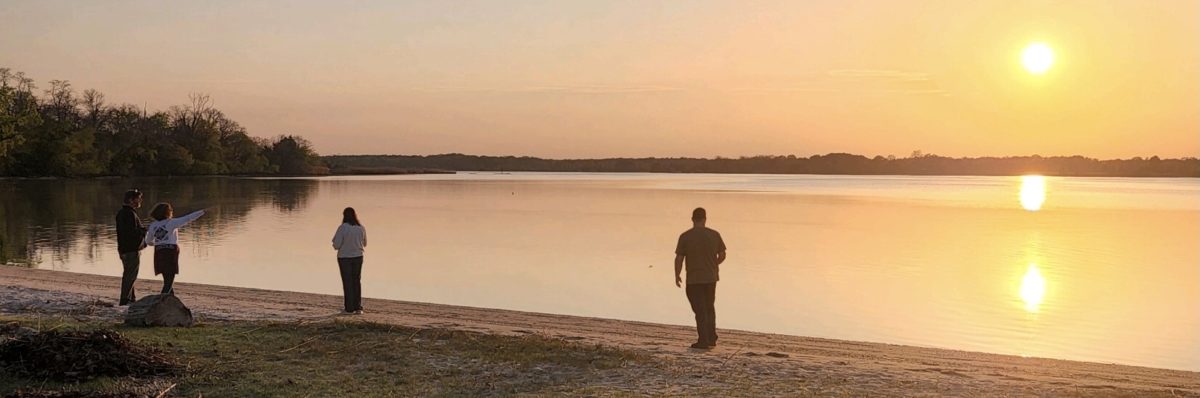
Do you ever get that sense of being connected to something so much bigger than yourself? There are times when I am watching a sunrise or a sunset; or it could be reading poetry—it actually happens a good bit here at Christ Church, listening to music during a worship service, or finding myself trying to scribble down notes about something Fr. Bill or Fr. Charlie mentions in a sermon. I have a sense, something I know but can’t explain, that I am, that we all are connected to the Divine.

I woke up today and learned that Archbishop Desmond Tutu died yesterday at the age of 90. I have a good friend and mentor that spent part of a semester at sea with Archbishop Tutu and he has such wonderful stories to share from that experience. Desmond Tutu is one of those people who I point to as being a huge inspiration and who has made me look and listen to what a calling in ministry might be. This summer and fall we had an outdoor evening prayer service on Thursdays, one of which fell on Archbishop Tutu’s 90th birthday and we included several of his prayers to honor him.

Tutu spoke to this exact thing, that transcendent feeling of connecting to God in different moments of our lives, if we pay attention. He said:

“We were made to enjoy music, to enjoy beautiful sunsets, to enjoy looking at the billows of the sea and to be thrilled with a rose that is bedecked with dew… Human beings are actually created for the transcendent, for the sublime, for the beautiful, for the truthful… and all of us are given the task of trying to make this world a little more hospitable to these beautiful things.”

These things, these experiences are reminders that we are wired to feel something more than just going through the motions of daily life.

I’ve talked recently about crying at Christ Church—and about how I have cried more in the past five years than maybe any other time. That it’s the kind of crying that comes from your heart being too full, so that something has to come welling up and out. And that welling up comes from being connected—both to God and to each other. That’s part of the package deal about loving God and loving your neighbor.

And that connection is what caring about each other looks like. That caring is love. And that love, that’s what was there in the beginning, that creative force that built and sustains the universe and that built and sustains us.

And that’s what John’s about. And that’s what God’s about. And that’s what we are supposed to be about.

I’ve seen that connecting and caring on full display at this church. We have all seen it in Bruce Richards and the last 18 years—it’s what the (pastoral care) Stephen Ministry is all about. That kind of caring, that kind of loving is what we are here on this earth to do. That’s the gift we are given of this life, the one that goes back to the beginning, goes back to the Word, goes back to Christ.

But it’s not meant to stop inside these walls. It’s meant to go out, apostolically. It’s the work that God has given us to do. And it feels right to end this morning’s message with words from Desmond Tutu to that effect:

“We are made for goodness. We are made for love. We are made for friendliness. We are made for togetherness. We are made for all of the beautiful things that you and I know. We are made to tell the world that there are no outsiders. All are welcome: black, white, red, yellow, rich, poor, educated, not educated, male, female, gay, straight, all, all, all. We all belong to this family, this human family, God’s family.”

Amen.

What’s Next?

I have two kinds of reading: work/church reading and other/personal reading, though they almost always overlap.

Work/church reading is reading that goes toward discussion groups and Bible studies. Over the past few years, we have done chapter by chapter group studies of the Gospels of Matthew, Luke, and John, and Paul’s Letter to the Philippians; shorter survey’s of Mark and Matthew’s Gospels, book studies of two Bob Goff books, one Brene Brown book, Henri Nouwen’s “The Return of the Prodigal Son,” and a deep-dive into The Lord’s Prayer. We have groups that have become like family, who have been meeting for multiple years now and when one study is done, they ask, “what’s next?” And it’s awesome. 

When we could no longer gather together as groups this spring, Zoom meetings became our way of getting together. And for the past several weeks, on Tuesdays and Wednesdays, we have had folks on screen together, live from their homes in Wittman, Sherwood, outside Cambridge, all around Easton, and it has helped–both with the stir crazy, cooped up feelings, but also staying connected to each other and connected to God.

As we finished our long studies of John’s Gospel and our Lent survey of Matthew’s Gospel, we kicked around some options of what to explore next. The thought of Paul’s prison letters resonated, as we quarantine in place. A reliable, accessible commentary can be hugely illuminating for Bible study, and we have loved N.T. Wright’s New Testament for Everyone books. His “Paul for Everyone: The Prison Letters” is what we used for our Philippians study a couple years ago and we are heading back there to start with Paul’s Letter to the Ephesians.

From Wright’s introduction:

“This book includes the four short letters Paul wrote from prison: Ephesians, Philippians, Colossians, and Philemon. His own personal circumstances make these especially poignant, and give us a portrait of a man facing huge difficulties and hardships and coming through with his faith and hope unscathed. But what he has to say to young churches–and in the case of Philemon, to one man facing a hugely difficult moral dilemna–is even more impressive. Already, within 30 years of Jesus’ death and resurrection, Paul has worked out a wonderful, many-colored picture of what Jesus achieved, of God’s worldwide plan, and how it all works out in the lives of ordinary people.”

Paul’s letters from prison give us plenty to think, pray, and reflect on, and something to work towards. I always recall the line from Ephesians about putting on the “full armor of God.”

Something has happened in the shift from being able to come together at church, or anywhere, to now being distanced. Maybe we realize how much we need each other, how much we miss each other. And creating content to engage, inspire, and give hope, as well as creating interactive opportunities and experiences is more important than ever. So as we start with Ephesians and go through the prison letters, I want to throw out there for anyone who wants to, to do the same. I’ll be blogging and trying to find some creative writing opportunities with it; I will look to have some video conversations with Fr. Bill Ortt, Fr. Charlie Barton, and others to get their thoughts on issues and chapters that come up; possible podcasts with staff members and others; I will see if I can find some special guest stars to weigh in; and we can open up some Zoom meetings during the week where people can drop in and share and discuss their thoughts. The more the merrier–and has always been the case for our small groups, you don’t have to be a member of the church or any church to be a part of what’s going on. If it sounds interesting, give it a shot. With Zoom, Facebook, Instagram and the like, you can be in Florida, California, Maine, or in a different country.

In January 2017, I had started working at Christ Church Easton part-time in addition to my job as director of the Oxford Community Center. Our rector/pastor, Fr. Bill Ortt, asked me to put together a short (5-6 week) Bible study, whatever I picked to study, find 10 or so people to be a part of it, and he and I would co-lead the group. I had led small groups before, but this would be my first Bible study. I picked Ephesians. Many of the guinea pigs…er… willing participants, have become close friends, and are still both involved in and leading small groups at the church, with one woman finishing up her work to become a deacon. It’s been a wonderful journey together.

I was reminded recently (by Wright, in our John study) of lines from T.S. Eliot’s “Four Quartets,” which is one of my absolute favorite poems/books ever written. Eliot says:

“We shall not cease from exploration
And the end of all our exploring
Will be to arrive where we started
And know the place for the first time.”

T.S. Eliot

I feel like that is the case for me with Ephesians. It’s maybe the case with small groups. It’s maybe the case with church and communities, who are having to re-examine what’s important and how to do things.

Fair warning though: it seems the longer you study with and work with someone, the more likely you are to dress alike.

Gratitude and Grace

Maybe you have these moments. Sitting in the back yard by a fire. The night sky is clear and stark and full of stars, even with light pollution from the town. It’s the end of a long day and my birthday, so it’s a day where memories are ripe, just below the surface, and waiting to bubble up.

Deep breaths, easy smile, a moment of clarity. Sturgill Simpson plays at low volume on the bench next to me.

Moments and memories extend and swirl and I feel like every second of my life to this point, every person I have met, every setback, every success, every heartbreak, everyone and everything I have ever loved, every bit of pain felt, every joy, every experience, all add up to and come together in this one moment, the present moment, and all of it, every bit of it, is gratitude.

And what it looks like is tears running down my face, with no attempt to stop them, because I know I haven’t done anything to deserve any of it; that it’s a gift that I can never repay, all I can do is be in awe of it; all I can do is start to put my finger on it.

But I know what it is.

It is grace.

It’s grace that even though I mess up and do the wrong thing, even though I lose my temper, I can sit under this incredible sky and find solace and a reset button. I can try again.

It’s grace that getting lost in the enormity of the night sky, that I am here and that there is place for me in all of it.

It’s grace that the sun comes up and there is another day and a chance for something new–that I’ve never seen or thought about or encountered before.

Grace maybe begins when we remember. We remember and are grateful for this gift that we can’t earn, but which ought to shape who and how we are in the world. It’s a gift that isn’t for us to to keep to ourselves but to try to extend to someone else.

“Grace is when God is a source of wholeness, which makes up for my failings. My failings hurt me and others and even the planet, and God’s grace to me is that my brokenness is not the final word … it’s that God makes beautiful things out of even my own [stuff].

Nadia Bolz-Weber

I sit in the back yard, next to a fire, under an expansive night sky, and memories and people and life dance with the stars and the flames. Stories swim in my head and they all rise to the sky.

If “prayer is the raising of the heart and mind to God,” (Baltimore catechism), then this fireside chat is prayer, maybe the best kind.

I think of Meister Eckhart, who said, “If the only prayer you said was thank you, that would be enough.”

Thank you.

Maybe grace begins with gratitude.

Contributing a Verse

Sometimes it’s there, just below the surface. My mind is distracted, looking for the familiar, but knowing it won’t come from there. It’s something new.

A beautiful morning, or evening, outside, smelling cut grass, swooning in the start of spring. It seems like normal. But go to grab groceries and it hits: it’s eerie. Off. Something is not right. You can feel it.

We are all called to respond in our own ways. To stay home, yes, but also called to look differently, think differently, maybe to live and be differently. I’ve been trying to get my head around it.

Before COVID-19 arrived, Fr. Bill Ortt put out a Lenten challenge at Christ Church Easton: 1) Find a word that speaks to you; 2) choose a Bible verse that uses your word; 3) Memorize your verse and pray, meditate, reflect on your word/verse as a Lenten mantra of sorts; 4) Write your word on one of the small, wooden crosses the church gives out. And if you are inspired to, take a picture and share your cross-verse.

There have been some wholly wonderful responses. “Heal,” “light,” “love,” “pray,” “faith”–it’s been inspiring to see and read how people came to their word (or their word came to them) and what they are doing with the experience.

My word wasn’t there at first. Or it was, but I wasn’t listening.

As a church, when it was clear that we weren’t going to be gathering together for a time, we had to figure out what that meant; what it looked like; how to stay relevant, be there for people; how to continue to shine a light; how to connect; how to help people be hopeful. We had to do things differently.

We had to create something new. Or at least new to us. We moved our meetings, small groups, and prayer gatherings to ZOOM. Worship services (what would worship look like now?) to Facebook Live. And our music ministries became video artists–I stop every time I hear/watch “Hold Us Together,” “Stand in Your Love / Chain Breaker,” or “Be Still My Soul.” These are videos that have been viewed tens of thousands of times now on Facebook and shared widely. They strike a chord, they speak to hope and faith and love and connection. They weren’t a priority before social distancing, until they became one of the key ways to communicate. This is a time that is teaching us how to create, how to be differently, how to look at what’s important. And it’s not about adapting to a temporary predicament–it’s about moving toward, embracing something new.

I am fascinated by stories. As a writer, I read them, listen to them, think about them, and hope to share and tell them in new and interesting ways. But with between work, two teenage daughters, life, it’s not always easy to make time to write.

As I sat, prayed, reflected, my word, both professionally and personally was there all along: CREATE. And when I started looking through Bible verses, Isaiah practically smacked me upside the head:

“For I am about to create new heavens
and a new earth;
the former things shall not be remembered
or come to mind.”

Isaiah, 65:17

In this time, our time, maybe we are called to look at our lives with an eye towards creating better lives.

Maybe we are called to look at our personal and collective stories, and tell new ones.

If our world is necessarily knocked off its axis, perhaps we can look at how to get it spinning around love, kindness, community, sustainability, and creativity.

If I stay home, simply waiting, doing things as I’ve always done them, and at the other end of this pandemic, just shrug, and go back to business as usual, what have I learned or gained from the experience?

This isn’t meant to be some Pollyanna motivational speech. I know my shortcomings. I know I will be lazy, I will fall short, I will miss opportunities. I try to own my humanity, my flaws, and my mistakes. But the idea behind a word, a mantra, a verse to think, pray, reflect on, is what I set my eyes to–what I aim towards, what I strive for. And in the face of a global virus the world is responding to in ways that none of us have seen in our lifetimes, it is a legitimate time to look at our lives and think about where and how we are and where we want to be.

Each spring, I go back to Walt Whitman’s “Leaves of Grass.” It’s become a way to enter the season of rebirth, of resurrection. And this year I am hit especially by his “O ME! O LIFE!” in the same space and way that Robin Williams quoted it in Dead Poets Society.

We are here. We exist. It didn’t have to be, but it is. And in life’s powerful play, we may contribute a verse. That is what we create. But it’s up to us.

I want to wake up open to what it is God is creating in the world and creating in me.

“Create in my a clean heart, O God, and put a new and right spirit within me. Do not cast me away from your presence, and do not take your holy spirit from me. Restore to me the joy of your salvation, and sustain in me a willing spirit.”

(Psalm 51:10-12)

One bloom might hold it all

The magnolia in the front yard is a ten-day tree. For maybe ten days at most, there is nothing like it; it’s in full blaze glory. Then it drops its bloom and doesn’t say much the rest of the year. But those ten days.

As our unplanned retreat/social distancing kicks in, we are in the middle of ten-day Magnolia time. It’s an excuse to sit on the bench under the tree, to walk around it, to put my head between blooms and breathe in. If I’m honest, I don’t need a virus to do this, it’s life everyday as long as I’m paying attention.

The sky is still dark, but the birds are noisy. It’s transition time, just before the sun changes the horizon’s color. Morning routine: coffee, prayer, reading, writing. Cat purring on the armrest against my left arm, dog curled up against my right thigh–demanding bookends with fur. As it warms, morning time will be on the deck or in the writing shed.

This early dark time matters. It frames the day with attention. It sets the tone before the day’s demands start. Lately, I’ve been thinking about writing, storytelling, the force of words that point to something words can’t really get to.

One of the books currently traveling with me–in the car, in waiting rooms, to work, the spare minutes picking the girls up from school.

In the preface to “The Field Guide to Writing Flash Nonfiction,” the Rose Metal Press folks point to Bernard Cooper’s notion that short nonfiction needs “an alertness to detail, a quickening of the senses, a focusing of the literary lens… until one has magnified some small aspect of what it means to be human.”

Mull that last phrase as you sit to pray, read, or write, “some small aspect of what it means to be human.”

Overshadowed by the Coronavirus these days, is Lent, a season where we look to pare away those things that distract us so that we can draw closer to God. When I spend time in the Bible, it’s the Gospels that sing. It’s not Paul’s letters, it’s Jesus’ stories. Christ tries to show us and tell us what it means to be human in a way we too often overlook.

“The kingdom of heaven is like a mustard seed that someone took and sowed in his field. It is the smallest of seeds, but when it has grown it is the greatest of shrubs and becomes a tree, so that the birds of the air come and make nests in its branches.”

Matthew 13:31-32

Ummm… thanks, Jesus. What the heck are we supposed to do with that? Even his followers want to know why he always talks in parables. And this is a parable told after the Parable of the Sower and after Jesus broke it down for them. It was part of our reading in N.T. Wright’s “Lent for Everyone,” on Saturday. Wright points out that, Jesus, “told parables because what he was doing was so different, so explosive, and so dangerous, that the only way he could talk about it was to use stories. They are earthly, and sometimes heavenly, stories with an emphatically earthly meaning. They explain the full meaning not of distant, timeless truths, but of what Jesus was up to then and there. This is what is going on, they say, if only you had eyes to see. Or, indeed, as Jesus frequently says, ears to hear… Jesus’ parables invite the hearer, to look at the world, and particularly at Jesus himself, in a whole new way.”

I am guilty of not catching anything the first time, or first several times, I hear it. It takes time for me to learn things, to let them sink in. I need seeds. I need seeds that take time to take root, take time to grow, but once they are there, they stick, and maybe they bloom in each of us uniquely, in ways that can only be made manifest in the exact way, with our particular eyes and ears.

Often my eyes and ears work against me. Words I’ve heard or used too many times or sights that have become ordinary and overlooked. We don’t see God if we don’t look, or take the time to make the connection. Maybe the more we connect, the more we awaken ourselves to His presence.

American Goldfinch, by Michael Brown. Macaulay Library at Cornell Lab of Ornithology.

Reading further in the Flash Field Guide, there is an essay by Lia Purpura called, “Augury.” She walks up on a dead Goldfinch hanging in a tree, caught up in fishing line. It’s jarring, disturbing, unexpected, confusing. It’s wrong for what is supposed to be there, how things are supposed to be.

Her description of this moment, this encounter is eerie and uncanny and beautiful all at once. In maybe a why moment for the experience, she latches onto, “It’s good to stand beneath a thing that takes words away. It’s good to be in a place where thought can’t form the usual way.”

Experiencing things that take words away, where thoughts can’t form the usual way.

I prefer my encounters to be with live Goldfinches, as I am sure Purpura does as well. But I appreciate her flash essay in the way it helps me to look at Goldfinches with new eyes. It helps me to look at writing with new eyes. Hopefully it helps me look at life with new eyes.

Life and death loom large. While I sit here, for the time I have, life looms larger. It’s part of the ten-day tree time. New birds, Goldfinches included, are appearing at the feeders, and at the edge of woods where I hike or trail run. Crisp, spring sunrises and sunsets are punctuated with cool, clear night skies full of stars. in the midst of it all, the magnolia makes a statement.

If I have eyes to see, one bloom might hold it all.

Beginner’s Mind: Reset to Wonder

“If your mind is empty, it is always ready for anything, it is open to everything. In the beginner’s mind there are many possibilities, in the expert’s mind there are few.” That line from Shunryu Suzuki and the idea of beginner’s mind have stuck with me as much or more than anything I’ve read. It applies to pretty well every breath and step we take each day, but it’s been on my mind a lot lately with different things–particularly practices and passions where you have to hit reset every time you do them.

Beginner’s mind has been loud for running, something I started doing when I was 15, but running doesn’t care how long you’ve done it. Every run is its own thing, no matter how good or bad the last one was. On a nine-mile run this morning, the races and distances I have run in the past don’t count. They don’t get me a step further. In getting ready for the Tuckahoe 25K (15.5 mile) trail race in November, I’m two minutes per mile slower than I was three years ago, when I was running more and in better shape. I may get some of that back, but I’m not really worried about it, I just like going out to run.

Seeing birds scatter from phragmites and cattails, watching cardinals and blue jays in trees along the rail trail; stopping to look off bridges at the sun coming through clouds; or watching a monarch butterfly fly across my path, followed instantly by a leaf of almost the same color, moving in the same way, mimicking each other, as God smiles and says, “see what I did there?” Even running on the same roads and routes I have run for years, there is always something new and different to hit the reset button and dial up the wonder.

Beginner’s mind has turned up during prayer or meditation, where what I did yesterday or last month or last year doesn’t mean I will show up, or make time, or connect today. If I want to get something out of prayer, I have to be mindful. N.T. Wright, in his book “The Lord and His Prayer,” says:

“Whenever we pray, that is what we are coming to do: to pursue the mystery, to listen and respond to the voice we thought we just heard, to follow the light which beckons round the next corner, to lay hold of the love of God which has somehow already laid hold of us.”

N.T. Wright

It’s funny how you can take something like the Lord’s Prayer, which maybe you’ve heard or recited enough not to even listen to the words anymore, but when you take it apart, pray or reflect on it line by line, or read about it, how it can take on new life, new meaning. Whether prayer, The Lord’s Prayer, or meditation, coming at it with beginner’s mind opens it to wonder and newness.

Each year, Uncle Chad and the kids make sand sculptures, just so they can wreck them.

Every year at the beach, my sister’s husband comes up with new ideas for sand sculptures. He and the kids have created airplanes, dragons, castles, all intricately and painstakingly built. But his end goal, the highlight of the creation, is when he has the kids destroy it. Sometimes they line up youngest to oldest to take their shots at it. The joy is in creating it, not trying to make it last. In that, their sculptures are like the sand mandalas the Tibetan monks create, simply to wipe them away. You start anew, every day.

Beginner’s mind applies to having new ears as well as new eyes. On the last mile of this morning’s run, the farthest I have run in a long time, Arrested Development’s “Tennessee” shuffled up.

I can’t count how many times I’ve heard this song, both when it came out, and from being on my running playlist for a while now. But it’s come to mean more over the last few years. The singer is talking to God and about their relationship. The song is a prayer.

“Lord it’s obvious we got a relationship
Talkin’ to each other every night and day
Although you’re superior over me
we talk to each other in a friendship way…

I ask you, Lord, why you enlightened me
without the enlightenment of all my folks
He said, cuz I set myself on a quest for truth
and he was there to quench my thirst.
But I am still thirsty.
The Lord allowed me to drink some more
He said what I am searching for are
The answers to all which are in front of me
the ultimate truth started to get blurry..

Speech (Todd Thomas)

There are songs whose lyrics wash over me new and differently maybe each time I hear them. At the end of a run, when legs are heavy, mind wants to be on autopilot, breathing is conscious, in a moment created and shared with the Universe, is an old song, a prayer, between a man and God.

Beginner’s mind is coming back for more. It’s seeing possibility. It’s starting again. It’s realizing we aren’t perfect and we don’t really know anything. It is finding wonder in the same roads, in the same songs, in the same body, but seeing it differently. It’s being thirsty for more.

And I am still thirsty.

Pray with your feet in the ocean

The ocean overpowers words, on the page or spoken. The sunrise defies fancy language, or maybe any language, but that doesn’t stop us from trying.

Words come for prayer, words and emotions well up in gratitude; questions can come like waves, and maybe waves are answers in themselves.

In three days at the beach, there have been more brown pelicans and porpoises than in other years combined. The sounds at sunrise are the same color as my soul.

If prayer felt like sunlight…
if prayer felt like cool morning sand between our toes…
if prayer tasted like coffee or brought us into the present moment like cold ocean water up to our knees before 7:00 am,
I bet we’d do it more.

It does.

Nothing gold can stay

“Nature’s first green is gold, / Her hardest hue to hold.”

Robert Frost might have had a magnolia tree in his front yard. I’ve never seen anything like it. Over the past week, it’s been in different phases of bloom and I just go out and stand underneath it in complete awe. It will only last a week or two, but man, what a week.

“Her early leaf’s a flower; / But only for an hour.”

Spring is a time for rebirth, for taking root and for growth. But within that, there is also the notion that it doesn’t last, like the magnolia tree in bloom, so appreciate it while it’s here. Be present. Feel the growth. Take the moment.

W.S. Merwin in Hawaii at the Merwin Conservancy. Image from Stefan Schaefer.

W.S. Merwin, one of the brightest shining, most brilliant, and most venerable American poets died recently. I met him briefly in Washington, DC, after hearing him read. I’d made it a point to catch him after work when I worked in the city. He was one of the voices; one of the lives worth emulating, or using as a model to find your own.

In a great New Yorker article, Casey Cep writes about Merwin’s writing and his effort to preserve Hawaiian landscape, “The palm forest, like Merwin’s poetry, has become a kind of prophetic stance against contemporary life: bearing witness to individual, almost foolish acts of creativity while devastation abounds.” We do what we can in the time that we have.

Sometimes I can connect the dots, sometimes I lose the picture. My reading list of late has included large parts of Luke’s Gospel, Henri Nouwen’s “Return of the Prodigal Son,” and legendary and/or mind-bending graphic novels, including Brian Michael Bendis and Alex Maleev’s “Daredevil” run, Donny Cates’ “God Country,” and Jonathan Hickman’s “Fantastic Four.” I’ve never read Hickman, who is known for his epic story arcs for Marvel Comics. Marvel announced this past week that he is set to take over the X-Men this summer.

I’ve been thinking about the Faust/Faustus storyline a lot lately, where to gain unlimited knowledge, the seeker sells their soul to the devil. It has to deal with hubris, excessive pride, and pushing beyond the limits of where we should go. And Hickman plays that exact storyline out with Reed Richards in his Fantastic Four story. But when faced with the decision either come up with the answer to everything, to save the universe and feed his ego flashing his brilliance, or to be human, be with his family, Richards thinks back to the words of his father.

“All of my hopes and desires rest in you becoming what I am not. When you grow up, I expect more. Son, I expect better. I want you to be a better friend than I was. Be a better husband. Be a better father. Be a better man.”

Father-son, father-daughter messages hit me straight in the heart. And it makes me reflect on the prodigal son story, and how the father wants his sons to know his love, no matter what they’ve done. And that’s big.

For Lent this year, Fr. Bill Ortt at Christ Church Easton, has given out prayer stones during worship services. There are 11 different words and you choose without looking: love, peace, believe, remember, listen, forgive, hope, pray, heal, follow, grace. The idea is to use your word as a mantra during Lent. And to look up Scripture for your word that you connect with, and pray, reflect, and meditate on it for the season.

My stone is love. It’s not the one I expected or the one I would have picked. But it’s the one I needed. It’s what I need to remember and to focus on. I picked two verses.

John 13.34-35

I give you a new commandment, that you love one another. Just as I have loved you, you also should love one another. By this everyone will know that you are my disciples, if you have love for one another.’

And

Corinthians 13:4-8

Love is patient; love is kind; love is not envious or boastful or arrogant or rude. It does not insist on its own way; it is not irritable or resentful; it does not rejoice in wrongdoing, but rejoices in the truth. It bears all things, believes all things, hopes all things, endures all things.

Love never ends. 

Those are big for me. Because it is easy for me to look past, to get too busy, to be in my head or deep in thought too often.

Finishing up Robert Frost’s poem:

Then leaf subsides to leaf. / So Eden sank to grief, / So dawn goes down to day. /  Nothing gold can stay. 

Nothing gold can stay. And that’s true for spring. It’s true for knowledge and accomplishments. It’s true for the world. It’s true for almost everything we see around us.

But not for God. And not for love. “Love never ends.”

Dreams and Song

2019 is a blank page with a big box of Crayola crayons spread out around it. I dig the above photo that Caroline Phillips took on one of the last days of December, on assignment for Shore Monthly Magazine. It’s sunrise, with friends doing something we love, up and outside early that let us catch a crisp, clear morning to laugh, skate, and reconnect.

2019 is a year I don’t have a clue about in many ways. And part of that not knowing is that the past four-plus years have been foundation building.

Life has a way of pulling the rug out from under us when we get comfortable. I like to think that happens because we are getting comfortable in a way that is keeping us from where we need to be; where we could be going; what we could be doing. But that perspective likely only comes with some distance when we’re looking back.

When we get displaced, we try to get our footing–spiritually, mentally, and physically. We try to put our pieces back together in a meaningful way. We look for that place where we can breathe deeply and be ourselves. We look for somewhere we can build, and re-build our lives.

Over the past four years, I’ve lived in three different places and I’m in the first house where it feels like home, where the girls and I can be for a while, put some roots down and figure out where life goes as Anna gets closer to graduating high school and Ava finishes middle school.

The thing about building a foundation or putting down roots (choose your metaphor) is that that’s the beginning work, the base. For that to amount to anything, you’ve got to build something awesome, grow or bloom into something that no one else can–that’s what each of us has in us. And that’s what 2019 feels like it’s calling for–personally, professionally, physically, creatively–it’s time to stretch, to grow, to build, to do something more; something cool, fun, inspiring. The stuff the God puts each of us here to do.

Field guides, existing colors in the box of Crayolas that we get to color our lives with, to help show us what is possible, what’s been drawn, and what we can do.

Writing about Jorge Luis Borges, introducing Borges’ book, “Dreamtigers,” Miguel Enguidanos talks about dreams and song. That it is our capacity to dream and sing that “makes the world bearable, habitable; they make the dark places bright… Dreams and song. About the whole and the parts. About the universe and about each of its separate creatures.” And that “in spite of incompetence, stumblings, and disillusionment,” that our dreams, played out in the song we choose to sing with our lives can connect and resonate with others.

I guess that’s my hope for 2019. To feel our dreams and find and sing our song in new, surprising, inspiring, and wonder-filled ways. And in doing so, to help others do the same with theirs.

Via Contemplative Monk and Mystic Prayers

Helped are those

I’ve got to get to know Alice Walker. I’ve never read “The Color Purple,” but I love and live by her character Shug Avery’s quote, “I think it pisses God off if you walk by the color purple in a field somewhere and don’t notice it.” God gives us things to notice, to experience, to enjoy, to wonder about, but it’s up to us to see them.

We are up to chapter six in our study of Luke’s reporting of the Gospel at Christ Church Easton, which includes Luke’s version of the Beatitudes–Jesus’ sermon on the plain, which is slightly different than His sermon on the mount in Matthew’s Gospel. Most people have heard it–“Blessed are the poor, for yours is the kingdom of God, Blessed are you who are hungry now, for you will be filled. Blessed are you who weep now, for you will laugh.” (Luke 6:20-21)–even if they don’t know it. But it’s fair to say that most people don’t give it much thought.

“Blessed” is a word that is overused and casually used, to the point that maybe it has lost its meaning in daily life, or at least it’s been watered down. As I was looking around this week for thoughts, commentary, and creative takes on the Beatitudes, Alice Walker popped up again. It was her same character, Shug Avery, but in the sequel to “The Color Purple,” the novel “The Temple of My Familiar.” In it, Shug gives her own version of the Beatitudes, but she replaces the word “blessed” with “helped.” And it changes so much  (grabbing just a few):

“HELPED are those who are content to be themselves; they will never lack mystery in their lives and the joys of self-discovery will be constant.
HELPED are those who love the entire cosmos rather than their own tiny country, city, or farm, for to them will be shown the unbroken web of life and the meaning of infinity.
HELPED are those who live in quietness, knowing neither brand name nor fad; they shall live every day as if in eternity, and each moment shall be as full as it is long.
HELPED are those who create anything at all, for they shall relive the thrill of their own conception, and realize a partnership in the creation of the Universe that keeps them responsible and cheerful.
HELPED are those who love the earth, their mother, and who willingly suffer that she may not die; in their grief over her pain they will weep rivers of blood, and in their joy of her lively response to love, they will converse with the trees.
HELPED are those whose every act is a prayer for harmony in the Universe, for they are the restorers of balance to our planet. To them will be given the insight that every good act done anywhere in the cosmos welcomes the life of an animal or child.”

I love the way “helped,” changes the way we think about things; blessed is easy for us to think, oh, that’s nice, things will balance out eventually. Helped lets us know that we are helped by seeing things that way, or by being or acting a certain way. We can also look at it as helped by God for loving, living, acting, or seeing in a particular way. But it puts it on us to take action, to be in the world.

Eknath Easwaran was a fascinating, brilliant mystic who wrote about all kinds of religions, on meditation, prayer, and who has written a commentary on the Beatitudes called “Original Goodness.”

To begin his book, Easwaran quotes another mystic, Meister Eckhart:

“I have spoken at times of a light in the soul, a light that is uncreated and uncreatable… to the extent that we can deny ourselves and turn away from created things, we shall find our unity and blessing in that little spark in the soul, which neither space nor time touches.”

Easwaran goes on to outline four principles that Eckhart tried to get across:

  1. “…there is a light in the soul that is uncreated and uncreatable… a divine core of personality that cannot be separated from God.
  2. “This divine essence can be realized… it can and should be discovered, so that its presence becomes a reality in daily life.”
  3. “This discovery is life’s real and highest goal. Our supreme purpose in life is not to make a fortune, nor to pursue pleasure, nor to write our names in history, but to discover this spark of the divine that is in our hearts.”
  4. “When we realize this goal, we discover simultaneously that the divinity within ourselves is one and the same in all–all individuals, all creatures, all of life.”

From Jesus, to Eckhart, to Easwaran, to Shug/Walker, the idea is that we can know God directly, personally, that He dwells in each of us, and that we would do well to get in touch with this Holy Spirit inside us, which connects us to God; and in order to do so, we need to look past, to strip away so many of the worldly things that we hold up as more important.

Simple, right? Not so much. Jesus calls for a reversal, for us to change our priorities, our way of looking at and being in the world; how we look at and treat each other. That’s the goal, what we aim toward–feeling connected to God, feeling helped or blessed in all that we do. We may never get there (I’ll probably never get there), but that doesn’t mean we don’t pray, meditate, study Scripture, love each other, live it out, and try to get closer to God in our attempt.

We’ll leave it to Shug to say a thing or two more about the “helped:”

“HELPED are those who strive to give up their anger; their reward will be that in any confrontation their first thoughts will never be of violence or or war.
HELPED are those who forgive; their reward shall be forgiveness of every evil done to them. It will be in their power, therefore, to envision the new Earth.
HELPED are those who are shown the existence of the Creator’s magic in the Universe; they shall experience delight and astonishment without ceasing.
HELPED are those who love all the colors of all the human beings, as they love all the colors of the animals and plants; none of their children, nor any of their ancestors, nor any parts of themselves, shall be hidden from them.
HELPED are those who find the courage to do at least one small thing each day to help the existence of another–plant, animal, river, or human being.”