A Sermon in the Books

Prologue

Sunday morning, I walked up to the church about an hour before the 8:00am service. The evening before, I preached a sermon–still a very new-to-me experience–on Luke’s gospel story of Jesus healing a man possessed by demons.

Christ Church Easton has multiple worship services each weekend and Saturday is the most casual. People in the service, priest included, wear regular clothes. I was myself–talking in jeans and a Hawaiian-ish shirt and Vans. On Sundays, those serving are vested/robed. I was on my way inside to get robed up for three Sunday services.

The sunlight was dancing in the garden next to the church and I almost walked by it, feeling like a needed to be on task. And then I thought about being in the moment, for as many moments as we can, and I stopped and walked over. And perched on a flower was a dragonfly, who stayed, and didn’t fly away.

The dragonfly, the sunlight, and the flowers set the tone. Be in the moment.

A little background.

This past year, I became a first-year seminary student discerning a call to the priesthood. I’ve been a full-time church educator for the past five years. Our rector/pastor is giving a co-worker/fellow seminarian and I opportunities to preach, each of us being scheduled one weekend every other month. We have an incredible congregation/community, who are encouraging us.

So there’s that.

In the Episcopal Church, what the readings are each week comes from a common lectionary, which rotates over a three-year cycle. Generally speaking, an Episcopal service on a given weekend anywhere you go, will likely have the same Gospel reading. And if you are preaching, that is the Gospel you want to make sense of for folks in some way.

The reading for my preaching weekend was Luke 8:26-39, the story of Jesus healing the Gerasene demoniac. You know, a story that anyone would be keen to talk about 🙂

But as I thought about the reading during the week, an angle presented itself–talking about why a seemingly dated, archaic reading, which to many people might not seem to be at all relevant, actually matters here and now.

So I set out to look at demon possession through a modern lens. And here is what I came up with.

Personally, I retain more by reading than I do from listening. So the text is below. A friend was able to record the sermon portion of our 10:00am traditional music service, which you can watch here. Bear in mind that this is among the earliest sermons of someone not inclined to speak in front of gatherings of people.

An alternative to being demon possessed

Leading up to today’s reading, in Luke’s Gospel story, Jesus has been walking through cities and towns “proclaiming and bringing the good news of the kingdom of God.”

The crowds are everywhere around him, so much so that when his mother and brothers come to see him, they can’t even get to him.

So Jesus does something that plenty of people on the Eastern Shore can relate to: he gets on a boat.

And he says, “Let’s go over to the other side of the lake.” Jesus falls asleep in the boat, and Luke gives us his account of the storm coming up, the disciples waking Jesus and Jesus calming the storm. The disciples are blown away that he can even command the wind and the waves.

So in our reading for today this boat ride takes them to the country of the Gerasenes. Jesus has gone over to the other side of the lake to get away from the crowds. And as soon as he steps on land, a man with demons meets him.

The funny thing, reading about the demon-possessed people in Scripture is that I think we dismiss these stories. Because we don’t talk like that anymore. Most of us aren’t worried about demons when we go into the grocery store or walk across town. So we say, okay, this story doesn’t apply to me. It’s not relevant.

Let’s think for a bit on this man and his demons. Here is a guy who is not in his right mind. His mind has been taken over by so many demons, they identify themselves as “Legion.” Here is a man on the opposite side of the lake from Galilee, meaning he is a gentile, not Jewish, which we further see by the fact that there are pigs around, which anyone Jewish wouldn’t have had. But what this area did have in common with Galilee, Jerusalem, the whole region, is that it had been taken over by Rome. And legions of Roman soldiers. So here is a man whose people had been conquered by foreign powers, and whose lives would have been affected accordingly. We might say that he was dealing with the spirit of the times.

Do we feel like the spirit of the times, of our times, might take over our minds sometimes? As Fr. Bill mentioned last week, do we feel like an unholy trinity of fear, leading to anger, leading to violence might carry us away with it sometimes?

Social media offers us more than a peek inside something like this. I have seen people who I know to be loving, caring, do anything for anyone people, say things on social media that certainly point to something taking over their minds and hearts—things full of blame and hate and anger and fear. Those are things, especially when they take over people who are otherwise loving and giving and caring, that lead us nowhere we want to go. And I get it, I feel those things too, I can be overcome with thoughts and feelings I don’t know where they came from and I wish they weren’t there.

We have dear friends and brothers and sisters at Christ Church who have shared their addiction stories and their journeys in recovery. Addiction is a disease that takes over someone, in a way that someone in Jesus’s time might well have described as demon possessed.

And when we look around the country at a new mass shooting each week, now including St. Stephens Episcopal Church in Alabama—it is not hard to make the case that we have people, here and now, who are not in their right minds; we are struggling and trying to understand and to help people through mental health crises, to help them know that they are loved and valued, at times when they are having trouble finding themselves.

We can see all around us that there are forces at work that have nothing to do with love, grace, forgiveness, or God.

All of this is to say, when we run into the demon possessed in Scripture, don’t be so quick to dismiss these stories—they still happen today, to us, just as much—with things taking over the way we think, feel, and act—which cause us to act in ways we normally wouldn’t.

And so in today’s reading, what do we see immediately with Jesus: these demons know him, and know that he has authority over them. They know he can get rid of them. Which he does and puts this man back into his right mind. And that is a great line, I think, when the people came out to see what happened, “they found the man from whom the demons had gone sitting at the feet of Jesus, clothed and in his right mind.”

And then there is one of the most curious, interesting lines. Seeing this guy back in his right mind, how did this make the people feel? “They were afraid.”

Let’s circle back to our times. If we know that love conquers all; if somewhere in our hearts, we know we could live differently, be more loving, but we would have to put down this armor, this way of seeing and being that we’ve become accustomed to… if we were asked to stop blaming people we disagree with, if we were asked to love our neighbor who lives differently or votes differently than we do: would we? If we are asked to love and forgive and do something about the state of the world around us—will we?

If we get so used to looking at the world through certain lenses, taking those lenses off, and trying on a different way of seeing, of living, can be scary. It requires us to change. It asks something of us.

So into this demon-possessed way of being, Jesus comes, and frees this man from the legion of things that cloud his heart and mind. Jesus, with power and authority, gives him, and gives us, an alternative way to be. A different way of seeing things and being in the world.

Jesus restores the man who was possessed by demons. And in the next chapter of Luke’s Gospel, we see Jesus calling the twelve together and giving them power and authority over all demons and to cure diseases and sending them out.

We are called to be disciples of Jesus, right? I am going to speak for probably most of us, when I say I don’t know how well equipped I am for casting out demons and healing the sick. But there is some good news for those of us who don’t feel up to those tasks. And this season of Pentecost gives us a clue: He hasn’t left us alone to do this kind of work. He has sent us the Holy Spirit as our advocate, as our comforter, as our helper. We are never alone, especially when we are doing the work that God has given us to do.

A number of us have begun a three-week study of former Archbishop of Canterbury, Rowan Williams’ book “Being Disciples.” And at the end of the first chapter, Williams has this profound thing to say about discipleship. He says:

“A disciple is, as we have seen, simply a learner; and this, ultimately, is what the disciple learns: how to be a place in the world where the act of God can come alive.”

We are learning how to be a place in the world where the act of God can come alive.

No pressure, right?

Let me tell you a quick story. Over the past month and a half, I have taken 20 minutes each morning for centering prayer. What that is, at base, is breathing, clearing my mind, and being in the presence of God. One of the ways I try to keep that focus is when I breath in, I think about breathing in God’s love. And that makes me smile. And when I breathe out, I think about filtering God’s love through me, and breathing out compassion, empathy, and love for others. And if I sit with that for a minute, and wrap my mind around spending more time breathing love into the world, than I do fear, or hate, or anger, that should certainly change how I act, how I see other people, and how I treat others.

This is maybe the exact opposite of demon possession. Instead of taking in all these things of the world that keep us from God, I try to take in, to dwell on, to feel God’s love and grace.

I’m not saying that centering prayer is the answer to evil in the world. But let’s ask ourselves, what are those things we can do to help us focus on God, on love, on healing and forgiveness, rather than the different forces at work that want to keep us from the power of God’s love.

Rowan Williams has a few suggestions as to things that can help. He says: 1) attending to Scripture, following the Gospels so we can better understand this life we are called to live. 2) He says coming together to worship, to baptize, to celebrate Communion together and to welcome others to do the same. 3) And he says looking to the lives of others around us that help us to have faith. We need each other for that, to help us focus on God.

And so what if all of us who think of ourselves as Christians spent even a little time each day trying to focus on God’s gifts for us; on God’s grace and his love, in whatever ways we find most nourishing.

And then what if, by our breath, by our thoughts, by our actions, we tried to put more love into the world—taking in God’s love for us—and putting that love, in our own special and unique ways, into our community, into our world. Would that make a difference? And if it would, are we willing to put the time in, to put the work in, to do it?

We are called to be those people. We are called to be that community. We are called to further this work.

Today’s story of a demon-possessed man should resonate with us in today’s world, if we use the language of our time. And Jesus having the power to heal, to drive out the demons that tormented this man, and many others, is still as true today as it was then.

The world we live in is a frightening and heart-breaking place too much of the time. Helping to set it right, helping to be places where the acts of God can happen in the world is the work we have been given to do.

But we don’t do it alone. We have each other, and we have the Holy Spirit. And that is enough.

Amen.

Oh, also. It helps to wear your preaching Vans.

Sediment, Tents, Hot Dogs and the Holy Spirit

Shake a snow globe full of sediment and you’ll have to wait a while for the sediment to settle. Only then can you see through it. Clarity comes from letting the sediment settle. Now think of the sediment as all the demands and distractions in our daily lives–and there is always something or someone shaking our snow globes.

The weekend retreat during The Alpha Course is designed to help us settle, unwind, and unplug so we can plug into something that will recharge us. It’s a time to connect with the Holy Spirit and with each other.

Five years to the weekend after Christ Church Easton‘s first Alpha retreat, we took a group of more than 20 people to Pecometh’s Riverside Retreat Center outside Centreville, MD, for a weekend to reconnect. The weather was in the 70s during the days, the night skies were starry and clear, and the waterfront campus is full of trails, woods, and structures to get you dialed-in to creation.

Saturday morning, we had a group gathered on benches outside by the river for morning prayer. We read from Padraig O’Tuama‘s “Daily Prayers,” in which we pray, in part:

We resolve to live life in its fullness:
We will welcome the people who’ll be a part of this day.
We will greet God in the ordinary and hidden moments.
We will live the life we are living.

We set our intention to be present, open, and to appreciate one another and our lives.

Weekends like this are about moments; they are about relationships; they are about laughter and tears from being overfilled; they are made up of sharing meals, of taking hikes and walks or going skateboarding; they are built around small group discussions and big questions and shared experiences and being vulnerable.

The Alpha Weekend five years ago is the first time I reflected on advice that St. Paul gave in his letter to the Romans where he said:

“Do not be conformed to the pattern of this world, but be transformed by the renewing of your mind.”

Romans 12:2 (NIV)

In a world that wants us to conform, we are encouraged to live differently. In a series of videos over the weekend, we meet Jackie Pullinger, a missionary who went from England to Hong Kong more than 50 years ago, who has worked to help prostitutes, gang members, and the poor. She has done amazing work and points out that what we need to spread God’s love in the world are “soft hearts and hard feet.” And she says that maybe the only way our hearts soften is by being broken.

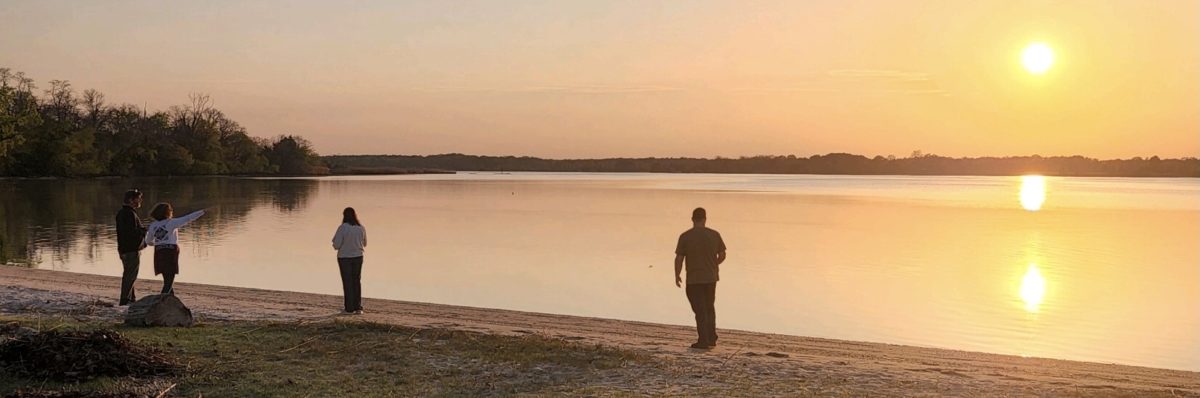
An Alpha Weekend is about relationships and downtime and making memories, including the debut of a non-existent band called “Skater Dads.” It’s skipping stones at sunset and exploring the campus for the camp’s famed outdoor chapel.

The Alpha Weekend is about sitting around a campfire singing songs, roasting marshmallows and hot dogs and being awestruck when someone reaches their hand into the fire to successfully rescue a fallen hot dog and comes out unburned (don’t try this at home or around a youth director) ; it’s about feeling seen simply by someone noticing that you are almost done cooking your hot dog and being asking if you want a bun.

It’s what happens when a group of people gather in a beautiful place for the sacred purpose of being together, worshipping God, and being open to the Holy Spirit.

Sunday morning, the ending of such a powerful and peaceful weekend, the big feelings were about not wanting the weekend to end. A conversation made me think about the transfiguration of Jesus on the mountaintop, this absolutely incredible experience of Jesus, Elijah, and Moses, and Peter’s immediate response is to build tents–“Master, it is good for us to be here; let us make three dwellings” (Luke 9:33)–he wants to stay in that moment, he wants to keep it going, just like each of us wanted the weekend to keep going. But Jesus knew differently. He knew that as incredible as those experiences are, it is not about building tents and trying to hold the moment–it is about carrying the moment back into the real world, because we have work to do. We have to spread that Holy Spirit experience. I mentioned all this to our collected groups. Which gave Rev. Susie Leight an idea.

Susie expounded on the theme of leaving, going back to the world, by opening our Sunday morning worship service with a blessing/prayer from Jan Richardson:

Dazzling

A Blessing for Transfiguration Sunday

“Believe me, I know how tempting it is to remain inside this blessing, to linger where everything is dazzling and clear. We could build walls around this blessing, put a roof over it. We could bring in a table, chairs, have the most amazing meals. We could make a home. We could stay. But this blessing is built for leaving. This blessing is made for coming down the mountain. This blessing wants to be in motion, to travel with you as you return to level ground. It will seem strange how quiet this blessing becomes when it returns to earth. It is not shy. It is not afraid. It simply knows how to bide its time, to watch and wait, to discern and pray until the moment comes when it will reveal everything it knows, when it will shine forth with all it has seen, when it will dazzle with the unforgettable light you have carried all this way.”

This weekend was a blessing made for coming down the mountain, back into the world; it was an experience, it was moments, it was deepened relationships. It is a blessing for us to share with those we meet, with those who are a part of our days.

Here to Wonder

Do you ever get to wondering? I seem to spend a lot of time that way, wondering. There is a conversation towards the end of Alice Walker’s novel “The Color Purple,” where Albert gets to wondering:

“You ast yourself one question, it lead to fifteen. I start to wonder why us need love. Why us suffer. Why us black. Why us men and women… It didn’t take long to realize I didn’t hardly know nothing. And that if you ast yourself why you black or a man or a woman or a bush it don’t mean nothing if you don’t ast why you here, period.”

Now we’re getting somewhere. Our lives are often defined by the questions we ask. So let’s ask the big ones, the juicy ones. And the right ones. So why does Albert think we’re here?

“I think us here to wonder, myself. To wonder. To ast. And that in wondering about the big things and asting about the big things, you learn about the little ones, almost by accident. But you never know nothing more about the big things than you start out with. The more I wonder, the more I love.”

Albert, via Alice Walker, “The Color Purple”

The more I wonder, the more I love. Yes to that, and so much more of it.

I wanted to read “The Color Purple” because of a quote; a quote I read and loved immediately; a quote that spoke directly to my soul and I have thought and used and felt so many times since, that I knew I needed to read the book where it came from.

And when I read it in context of the story, it was even better and deeper. Two of the main characters, Celie and Shug Avery are talking about God. And about how God is not an old white man in robes sitting on a throne. And how “God is inside you and inside everybody else. You come into the world with God. But only them that search for it inside find it. And sometimes it just manifest itself even if you not looking, or don’t know what you looking for.” Shug talking. And what a wonderful way to describe the Holy Spirit.

And Celie asks what God looks like, if not an old white man. And Shug says:

“Don’t look like nothing, she say. It’ ain’t a picture show. It ain’t something you can look at apart from anything else, including yourself. I believe that God is everything, say Shug. Everything that is or ever was or ever will be. And when you feel that, and be happy to feel that, you’ve found It.”

Shug says people “come to church to share God, not find God.” And I love that thought and thinking that sharing God is what church is for.

But none of those are the quote that made me want to read the book. Here’s the conversation:

Shug: God love everything you love–and a mess of stuff you don’t. But more than anything else, God love admiration.
Celie: You saying God vain?
Shug: Naw. Not vain, just wanting to share a good thing. I think it pisses God off if you walk by the color purple in a field somewhere and don’t notice it.

And there it is. “I think it pisses God off if you walk by the color purple in a field somewhere and don’t notice it.” That quote has been a part of me since I first read it years ago. It describes how I go through life. God made a flower, a field, a planet, a universe for us to wonder at. To ask about. And the more we wonder, the more we ask, the more we love.

And God made us for each other. He made each of us, to love each other and to love Him. And I don’t and won’t ever claim to speak for God, but it seems in the same way, it pisses Him off when we don’t love each other; when we spew hate and not kindness; when we divide, point fingers, and blame, instead of helping each other up, lifting each other’s spirits, using our gifts and His gifts to connect us to each other and to God.

Celie and Shug keep talking (Celie writing) –

What it do when it pissed off? I ast.
Oh, it make something else. People think that pleasing God is all God care about. But any fool living in the world can see it always trying to please us back.
Yeah? I say.
Yeah, she say. It always making little surprises and springing them on us when we least expect.
You mean it want to be loved, just like the bible say.
Yes, Celie, she say. Everything want to be loved. Us sing and dance, make faces and give flower bouquets, trying to be loved.

Everything wants to be loved. Everyone wants to be loved. God is giving us opportunities–what are we doing with them?

What if we try to notice the color purple? What if we try to see, to really see, and get to know each other? What if we wonder? What if we ask? What if the more we wonder, the more we love.

By the same spirit

There is freedom in getting away. There is friendship in breaking bread and eating together. There is awe in exploring Creation in the rolling hills in early fall. There is joy in worshiping together. There is peace in praying with and for each other. And when you bring close to 70 adults and youth together for a weekend away at The Claggett Center in Adamstown, Md., there is ever-present laughter waiting to bust loose.

This is the fourth consecutive season that Christ Church Easton has run The Alpha Course on Saturday evenings. Alpha is billed as an adventure to explore life, faith, and meaning. It’s also an opportunity to come together with like-minded people and build friendships. In the middle of the course is a weekend away, a chance to take a break from everyday life and create space and intention to shift your focus; a time to connect with each other and with God in Christ. God works in our lives and in our hearts through the Holy Spirit, and that’s what Alpha presents us with, a chance to better understand and personally connect with the Holy Spirit. That starts with making space:

“The greatest need in our time is to clear out the enormous mass of mental and emotional rubbish that clutters our mind.” – Thomas Merton

Stepping back from daily life to step more fully into it, centered and recharged. That’s the goal. It sounds high-minded, but it’s also frequently hilarious. Some of my deepest soul/belly laughs in recent years have come on these weekends. There is a lightness of being that emanates from everyone there.

“At the height of laughter, the universe is flung into a kaleidoscope of new possibilities.” – Jean Houston

That kind of laughter, the kind that floats from the soul out to others and out into the universe. The kind of laughter that when shared, connects people, binds them together.

There is something to the setting at Claggett, the chance to hike through the woods, or walk a labyrinth, or skateboard paved trails, that puts the adventure card on the table.

“Every day God invites us on the same kind of adventure. It’s not a trip where He sends us a rigid itinerary, He simply invites us. God asks what it is He’s made us to love, what it is that captures our attention, what feeds that indescribable need of our souls to experience the richness of the world He made. And then, leaning over us, He whispers, ‘Let’s go do that together.'” -Bob Goff


That is part of what the weekend is about. Finding our own way, our own passion, making the most out of our lives by connecting, or re-connecting to our particular passions and gifts, despite what the world may say. “Do not conform to the pattern of this world, but be transformed by the renewing of your mind,” Paul writes in his letter to the Romans. Renewing our minds and hearts.

But a funny thing happens, as we try to do that individually, as we follow our own hearts and passions: we realize we are connected to those around us.

“There are different kinds of gifts, but the same spirit distributes them. There are different kinds of service, but the same Lord. There are different kinds of working, but in all of them and in everyone it is the same God at work.” – 1 Corinthians, 4-6.

We are all of the same spirit. We are united by the love of God and through the Holy Spirit, a gift Christ left to all of us. The gift of time away together is the chance to realize that, to feel and see it in a community of people, who through worship, prayer, breaking bread, laughter, tears, shared experience, grace and the Holy Spirit, become the body of Christ, for a time.

Signs, Spirit, Connections

Love, joy, peace, patience, kindness, generosity, faithfulness, gentleness and self-control. Who wouldn’t want more of each of those in their lives? Those are the fruits of the Spirit as Paul describes them in his letter to the Galatians.

April 13-15, Christ Church Easton went to Camp Arrowhead in Lewes, Delaware, for an Alpha Weekend retreat. More than 40 people headed for the woods, the beach, cabins, bonfires, camaraderie, laughter, and discussions in small groups about our own journeys, struggles, questions, and where we are.

This is our third Alpha Retreat in the past year, running the Alpha Course in the spring and the fall, and I have been blown away each time with amazing and honest people and generous spirits. And the deep laughter that comes with spending a weekend with people in cool places, talking about stuff that matters.

When you ask questions like “How does God guide us?” and “How can I make the most out of the rest of my life?” and people get real with their stories and experiences, profound and unexpected things can happen.

It’s often the unscripted time that makes the weekend. Try showing up at a camp with cabins on the water on Friday the 13th and get ready for the Jason stories. Give people a beach, bonfire, marshmallows, hot dogs, and guitars, and you have an instant party. Break bread together on the beach and in the dining hall, gathered to talk and learn about faith, and in my experience, the Holy Spirit is present in those moments, with these people.

Some people think of worship as what happens at a church service. And it is. But worship is also much more than that. The entire weekend was a celebration, worship. Worship can connect us to God, to people, and to nature, creation. And Camp Arrowhead is a setting to allow all those things to happen. On Sunday morning, before breakfast, I wandered the camp, finding Egrets, Great Blue Herons, Cardinals, Blue Jays. I sat down to read and think about Galatians again after Saturday and read in Gary Snyder’s “Turtle Island,” which is a book I almost always carry.

the path is whatever passes–no
end in itself.

the end is,
grace–ease–

healing,
not saving.

singing
the proof

the proof of the power within.

Joining Snyder’s words, the path, the weekend was grace, ease, healing, singing–the proof of the power within.

After breakfast, and our last small group gathering for the weekend, we gather for a worship service proper, a celebration and culmination of the our time together. Jerrett Hansen, our interim pastor who joined us for the weekend points out, “When the church is in its proper place, we don’t have to go through this thing called life alone.”

He talks about the power of simple signs that we can see throughout our lives if we aren’t too busy looking for the big signs.

“We have been given the great gift in our community to be signs to each other.”

This morning (Monday), I woke up thinking about the Saturday night bonfire on the beach; of everyone coming up with the best way to roast marshmallows or hot dogs; the laughter and conversations. And I got this in a daily e-mail of Frederick Buechner’s  writing:

“In the pages of Scripture, fire is holiness, and perhaps never more hauntingly than in the little charcoal fire that Jesus of Nazareth, newly risen from the dead, kindles for cooking his friends’ breakfast on the beach at daybreak.”

And that’s maybe what a weekend like this is about, what a faith community, a church, is all about. During the Easter season, post-Resurrection: being signs to each other; helping one another along the way; staying connected to God, to the Holy Spirit, to each other, through Jesus Christ.

Summer as a Verb

Summer means different things to different people. If you are a kid, it means no school. If you dig the water, it means game on. If you are in Maryland, it can mean eating steamed crabs, rockfish season, river swimming, and/or lightning bugs. Maybe it means family vacations.

Winter and spring this year were fully scheduled. Events and programs at the community center; three different evening small groups at Christ Church Easton; lacrosse season and school for the girls. All great things, which drove where and when to be and what to do.

Summer right now is an opening up of the schedule. But in some ways, I can already feel this notion of chaos taking over from order, or inactivity as a response to hyperactivity. So it’s time to create fun and balance and challenge all at the same time.

Yesterday morning, I found Paul’s Letter to the Galatians staring at me:

…the fruit of the Spirit is love, joy, peace, patience, kindness, generosity, faithfulness, gentleness, and self-control… If we live by the Spirit, let us also be guided by the Spirit. (Galatians 5, 22-25)

That is a great reminder, note to self, and guide for how to approach summer, or life in general, every day.

With all that as backdrop, I like making fun “to do” lists. Here’s one for the summer months.

1. Summer reading – read three unread/unfinished books from my bookshelf. My “to be read” stacks of books grow and books I have started or wanted to read get cast off. I started yesterday by picking back up T. H. White’s “The Once and Future King,” White’s wild take on the King Arthur legend, an imagination-shaping story for me as a kid, a favorite book of my brother-in-law, a book I have started and not finished. I am giving myself to the end of June. Other likely contenders are James Hillman’s “A Blue Fire,” Richard Rohr’s “The Divine Dance” and Kurt Vonnegut’s “Breakfast of Champions.” Every summer should have some Vonnegut.

2. Regular running – as a 5-mile run yesterday evening can attest to, I have some work to do. I let my running slide this winter/spring, and it is one of the habits that rights my body and mind.

3. Paddleboarding – at least 50 miles of summer paddleboarding. More than doable without being a stretch goal at all. I’ve just written about stand-up paddleboarding on the Shore, I live walking distance to the water, make the miles happen.

4. It’s called Natitude – go to five Washington Nationals home games (September counts). When I worked in DC, it was a habit. The girls are Nats fans and enjoy live baseball, and we haven’t caught a Nats home game the last two seasons. Time to change that.

5. Prayer – My deepest connections and most meaningful moments are when I can feel the Holy Spirit at work, when I “let go and let God” to quote a friend and small group leader. That happens more frequently when I silence and open my mind. Making time for prayer is an integral part of being guided by the Spirit.

6. Life’s a Beach – we’ve got our annual Ocean City pilgrimage on the map for July. But Assateague Island is easy. Boat and paddleboard beach exploring. Make more time beach time.

7. Go new places – I’m going to keep this broad. It could be trails, small towns, road trips, scheduled or unscripted.

8. Grow things – summer mulching has begun. I need to plant tomatoes again and regain that connection to the earth, even potted flowers and plants and the habit of watering in the mornings while drinking coffee.

9. Make a skateboarding adventure – there are a few folks who I think will be on board with this. We’ve pondered the Western Maryland Rail Trail before. I don’t know what this might become or where, but I want to recapture the feeling skater Jason Adams talks about here.

10. Live music – summer and live music are meant to go together. In June, we’ve got Josh Ritter at the Avalon Theatre and The Specials in Baltimore on the books. The Avalon has outdoor music on Harrison Street, the community center will be having Philip Dutton and the Alligators, just to name a few.

This list is hardly exhaustive, but it’s a way to shape thinking about the summer. A way to carpe the diem. John Eldredge wrote something that resonates with me: “We are created for adventure, and if we cannot find one, we start blowing things out of proportion so it feels like we have one.”

In the case of adventure, or summer, it can also be a state of mind. Be guided by the spirit, and approach these days, weeks, and months for all that they, and we can be.

Difference Makers: Christ Church Easton’s Alpha Weekend

Faith is not a sprint. The Holy Spirit is irrational and real. And sometimes, finding ways to nurture and stoke a community of faith and love; something that feels like a family, is about the best way you can spend a weekend.

Christ Church Easton‘s Alpha Weekend was a retreat suited for people who would quickly tell you they don’t do church retreats. I know because I was one of those people–I’d never done anything like it. But you’d be hard pressed to find someone at the end of the weekend who didn’t feel like they had been part of something totally unique, moving, connecting, and Spirit-filled.

The Alpha Course is billed as a sort of introduction to Christianity. It’s about understanding and building a relationship with God, not about hitting the books or simply learning facts. It was created in London and since Nicky Gumbel took it over in 1990, it’s become a bit of a global phenomenon. It’s designed with people who don’t know much of anything about church in mind; who maybe never thought they’d have a need or interest. Each meeting is centered on food, fun, discussion, and laughter. In my experience, it’s as much a personal and group adventure as it is a course.

At Christ Church, Kelsey Spiker, who heads up the youth ministry, was gearing up to lead a Teen Alpha Course. Fr. Bill Ortt and Jana Leslie liked the idea of running an adult Alpha at the same time, for any parents or others who were interested. What followed was 100 people–roughly half kids and half adults–who signed up. On Saturdays, after the 5pm worship service, the whole group sits down for dinner together, eats and laughs and connects, then breaks up into groups to watch a video and discuss. I signed on as a leader, and I’ve seen some pretty cool things go on each Saturday.

Which led to the Alpha Weekend away.

My daughters are part of the Teen Alpha group. The three of us were a part of about 60 people who headed out to the Claggett Center in Adamstown, Md–an idyllic setting in Maryland mountains.

It was a weekend to unplug from the distractions of everyday life; to refocus energy and attention; to connect with each other; to grow together in faith and understanding.

The youth movement took nature walks, played basketball and impromptu capture the flag, and made the most of the Claggett Center campus on a rainy Saturday. The adults went between group videos and discussion and unstructured time for reflection, with everyone coming together to eat, and morning and evening time to pray. As someone who generally prays by myself in solitude, there is something about praying as a community that transcends anything I can feel on my own.

Saturday evening, the rain let up and everyone gathered around a fire. There is a core of this group who radiate music and just being around them is being around a concert ready to happen at any moment. That night it was Grace (yes, that kind of Grace, but also a person), a soft-spoken 18-year-old arts student, who opened the song flood gates with a guitar and a song called “Difference Makers.”

It’s easy to think of a retreat as an escape. This wasn’t. The death of an Easton High School student preceded the weekend and was on hearts and minds of everyone. While we were there, word came in of a tragic death of a young child of somone’s close friend. People’s lives, loved ones, joy, pain, questions, sorrow, searching, and happiness were all present. And all real.

With the rain, Saturday was a day largely spent indoors. So when the sun came out Sunday morning, I ate breakfast quickly and hit a hilly hiking trail at Claggett. I wandered through the woods until I found a stream flowing downhill, and hopped onto rocks and followed the stream to the river. I sat next to the river, listened to birds, felt a breeze on my face and prayed for a while. Until I realized I had to get back for the morning’s movie, “How can I make the most out of the rest of my life?”

With a book in my hand, wearing jeans, I hit the trail running, smiling and laughing like a kid, making it with a couple minutes to spare.

I am a note taker–never leaving home without a pocket notebook and pen. The weekend was filled with things to write down:

“Prayer is a two-way conversation.” – Nicky Gumbel

“Jesus didn’t come to make life easy, He came to make people great.” – NG

“You’re not saved by doing good; you are saved in order to do good.” – NG

“The Holy Spirit is completely irrational and totally real and relevant.” – Fr. Bill Ortt

“The inspiration of the Holy Spirit isn’t found on page 101 of the prayer book.” – Fr. Bill (meaning it isn’t as simple as just opening a book)

After the movie and group discussions, morning worship service was filled with song and Spirit. People who don’t generally speak in front of groups shared gratitude and thanks for having a church family. We left the Claggett Center, and the weekend, fully charged.

This past weekend, we were back at Christ Church. Fr. Charles Osberger, a guest minister, led the Alive at Five Saturday service. He talked about his own experience with Alpha, saying, “the love of God is present like surfing on a wave.”

Building on a theme, he prayed that we “have the Scriptures open to us in ways that stretch and deepen our understanding.” And he noted that, “When God moves from a God ‘out there’ to a God inside us, it is like igniting a fire.”

That fire, the feeling that something is starting and building, that’s what it feels like is at work right now at Christ Church. With Alpha, but that’s only part of it. It’s something that is hard to put into words, but something you can see and feel. It’s people making a difference in each other’s lives. It’s people trying to walk their walk and live God’s love. It’s struggles, failures, challenges, and successes. To use a Christ Church notion, it’s “real hope, real grace, real joy, real God.”

Off-Road Spirituality: Finding a Compass

Sometimes I feel like I need a guide. Someone who’s been there, walked it, looked around, and can report back. I think we all get there. I don’t want someone to walk for me–I want to take it all in, experience it, know it for myself, but someone pointing a finger in the right direction, throwing a knowing smile that I’m on the right track can be huge. Those people pop up in our lives, sometimes in the form of actual people we meet or know, sometimes through books they’ve written or the story of their lives, which can be an example. John Muir is someone I come back to a good bit.

The sun shines not on us but in us. The rivers flow not past, but through us. Thrilling, tingling, vibrating every fiber and cell of the substance of our bodies, making them glide and sing. The trees and the flowers bloom in our bodies as well as our souls, and every bird song, wind song, and tremendous storm song of the rocks in the heart of the mountains is our song, our very own, and sings our love. – John Muir

Muir understood the correlation between our interior lives, what is inside us, and the natural world. That is key for any spirituality for me. And though Muir made that connection eloquently, beautifully, and all the more so because he lived it, his life’s work was getting that point across to people, finding the Divine in nature, finding the Divine in us, and connecting them, encouraging folks to get outside, this was not a new concept.

I think there is a misconception that Christianity happens in a church, is all about “thou shalt not” and is generally boring. For those that would knock it, it seems more about keeping people in line, a blinding form of mind control. And there is some validity to those criticisms, when you look at some of the fundamentalism and the parts of what it is to be a Christian that some churches decide to focus on. Those churches aren’t focusing on what Christ did with his life, how he lived, what he taught, or how he encouraged us to be. There is so much more to it, to Him, if we just take the time to find out for ourselves.

It’s the Christian mystics who light me up, who seem to come the closest to communicating what Jesus taught and lived. They are interested in experiencing God’s love, following Jesus, living out his teaching, not simply sitting passively, or being talked to, or taught.

rublev-trinity-icon-no-text-for-wp

If we move our idea of wilderness into metaphor for a minute, it’s a wide world out there, and we are all wandering, looking for something. Spirituality is maybe that notion of trying to find the right path, trying to make our way through the wilderness to get somewhere. No one walks it for us, but we could use some help.

Finding Christ, in the deep and mystical sense, the experiential sense, Jesus as the coming together of the Divine and the world, is finding our compass, the way to point us and show us the way to get where we are trying to go. The even better part of finding our compass, on our walk, is that it’s not just about the destination (it never is), it’s reassurance, it’s guidance on our walk, in a way that makes each step that much better, that much more loving, that allows us to fully be in those moments.

I’ve been getting a double dose of Richard Rohr this week, reading his book “From Wild Man to Wise Man,” and really drinking in his daily meditations, which this week have been focused on the “Cosmic Christ.” Rohr talks about the Eternal Christ, as part of the Trinity, who goes back to the beginning with God, as well as His becoming human to show us, teach us, give us an example of how to live, how to love, how to navigate the wilderness of our lives. Rohr points out St. Francis of Assissi, the Desert Fathers, and others, who got it and lived their lives knowing:

Jesus is the union of human and divine in space and time, and the Christ is the eternal union of matter and Spirit from the beginning of time. When we believe in Jesus Christ, we’re believing in something much bigger than just the historical incarnation we call Jesus. Jesus is just the visible map. The entire sweep of the meaning of the Anointed One, the Christ, includes us and includes all of creation since the beginning of time. Revelation was geological, physical, and nature-based before it was ever personal and fully relational (see Romans 1:20).

As someone who thinks deeply, who (on a good day) meditates and prays on things, who tries to open myself, I find Christ to be the way to go deeper to a real understanding of things; the way to embrace life and love and recognize God in all things. And not in a way that dismisses cosmology, or science, or logic, but in a way that picks up where those things leave off, where they end in paradox. Because the mind stops short. The trail ends and we have to look for a new way to continue. That way is the heart.

The compass that we are given is the Trinity–it’s in each of us, as the Holy Spirit, flowing through our hearts. Our compass is our heart and life lived with and from the heart.

ransomed-heart-quote-oct-26-2016

It’s opening ourselves up to a new, deeper way of knowing. It’s finding our spiritual compass, built into our heart, that can guide us in our walk. It’s recognizing, heeding, and living our lives from the heart.

Open Our Hearts, Open Our Lives

I’m learning to get out of the way. Sometimes that means to move over to let what’s coming through get where it’s going. Sometimes I realize it’s because I’m what’s standing in the way of me getting to where I need to be.

When I pray (someone cue MC Hammer), I get out of the way. When I am quiet, when I listen, I get out of the way. It’s a matter of clearing out my ego, clearing out uncertainty, and trusting God, allowing bigger things to work.

Lately I’ve been moving in a certain direction. I’ve listened, written things down, made a gameplan. I’ve been looking for ways to help put things in motion, ways to serve, and at the same time, still having those pangs of doubt. A friend/mentor came across a quote from Henri Nouwen and sent it along:

When all is said and done, what we must learn above all is to offer ourselves–imperfections and all–to God. If we keep waiting until we are ‘worthy’ of God, we will move farther rather than closer to Him. It is through our broken, vulnerable, mortal ways of being that the healing power of the eternal God becomes visible to us.

We are called each day to present to the Lord the whole of our lives–our joys as well as our sorrows, our successes as well as our failures, our hopes as well as fears. We are called to do so with our limited means, our stuttering words and halting expressions. In this way we will come to know in mind and heart the unceasing prayer of God’s Spirit in us. Our many prayers are in fact confessions of our inability to pray. But they are confessions that enable us to perceive the merciful presence of God. – Henri Nouwen, “A Cry for Mercy”

Sometimes I’m good with cliff diving. Sometimes I can use a shove off the ledge. Sometimes it can be just a nod. That’s where having others to encourage us along the way, fellow pilgrims on their own journeys, makes the walk easier, lighter, more certain. It can be a hard road alone.

2016-oct-tree

Pride is a funny thing. We think we need it to accomplish things. We naturally feel proud if we do something well and it turns out better than we hoped. But riding pride’s high horse can be a dangerous trip. It grows our egos and prevents us from getting out of our own way. Today’s Gospel in church was from Luke (18:9-14). It’s the parable of the proud Pharisee and the repentant tax collector. Jesus closes with:

…all who exalt themselves will be humbled, but all who humble themselves will be exalted.

Jesus digs parables. He’d rather make us think than tell us straight. But that one is pretty clear. Be humble, you’ll find the reward in it.

Getting out of my own way means opening myself up to possibilities. Opening my heart to the flow of what’s coming through. Whatever we choose to call it, we’ve all had those moments, whether playing sports, or fishing, hiking, playing music, running, writing, where we have felt we were in the zone, in the flow, something bigger than ourselves took over. Getting out of our own way opens us up to what God is sending through. In the Trinity notion, it’s the Holy Spirit.

And when we open our hearts, we open our lives to let things happen. To let God work. To do things, move in directions, I wouldn’t have come up with on my own.

2016-serve

Opening our hearts and lives to something bigger than us, is to serve. To offer ourselves to and for a bigger purpose. The contemporary choir this morning, with a soloist, belted an inspired version of Matthew West’s “Do Something.” The lyrics pretty well sum up the notion of God/Jesus at work in the world. Working through people. The singer is fed up with all the terrible things that happen in the world and asks God to do something:

He said, “I did, I created you.”

That’s how I think about how God works in the world: through us:

But it’s easier to say than to be
Live like angels of apathy who tell ourselves
It’s alright, “somebody else will do something”
Well, I don’t know about you
But I’m sick and tired of life with no desire
I don’t want a flame, I want a fire
I wanna be the one who stands up and says,
“I’m gonna do something”

It’s not a song I would have listened to on the radio or downloaded. But if I could have the version that was performed in church–choir, band, soloist, live, inspired, moving an entire congregation–I would play it on a loop. It’s the kind of message that always hits me hardest. God works through people. God works through you. If you see a problem, it’s on you to fix it. To do something.

I’m learning to get out of the way. I’m learning to let bigger things work. To let God work. I’m learning to open my heart, to open my life. To serve. To do something, those things that I can do differently than anybody else could. Even me, flawed, imperfect, with my “limited means, (my) stuttering words, (my) halting expressions.”

I’m learning to get out of the way.

Just Get Living

“Just Keep Livin,” was a notion from David Wooderson, Matthew McConaughey’s character from the movie “Dazed and Confused.” The motto struck McConaughey so much that he named his foundation after it. I have dug it as a way of going about life–you struggle, you fall down, if you are lucky enough to get back up, just keep livin. You have great moments, you celebrate, you drink it in, just keep livin. What else can you do?

But what if you get to a point in life, you come to a crossroads, you have an awakening of some sort, and you look at life differently? What if you wake up to a revelation you can’t go back from? You are compelled to do something. You have to act.

Our destiny is to live out what we think, because unless we live what we know, we do not even know it. It is only by making our knowledge part of ourselves, through action, that we enter into the reality that is signified by our concepts. – Thomas Merton, “Thoughts in Solitude”

You can know something all you want, right down into your very being, but unless you act on it, act in accordance with it, unless it means enough to live it, what do you really have?

Thought and life, thought and action, need to be aligned. They need to have each other’s back, to prove one another. It can be a feedback loop:

Living is the constant adjustment of thought to life and life to thought in such a way that we are always growing, always experiencing new things in the old and old things in the new. – Merton

2016-oct-cove-sunrise

I would venture to say, if you live in an area where you grew up, and you love life, you are tapping into something like experiencing new things in the old and old in the new. Coming at something familiar with fresh eyes is huge for me.

Let’s get back to action. We are a society whose actions don’t line up with our words. We see it in churches, politics, sports, schools, you name it. We are all guilty of it to some extent. But we can do something about it in our own lives.

I’ve been pretty good at thinking elevated thoughts, finding and mining great experiences outside, or as a father;  having moments, minor epiphanies that leave me reeling; riding that stoke, maybe writing it down, on to the next. Surely they are moments to be savored, to carry with us, to seek out.

Then I come to a place in life, where things look different. Things feel different. Life the way it was falls apart, shakes to pieces. And a new life is opened up–opened up and connected, or uncovered to be part of something bigger. Like I’ve been given the gift of a new way of seeing and being. If I do nothing with that, if I put it on a shelf to come back to later, or I just keep living the same way, and sit on it, then what do I know differently? What have I done with the gift?

The spiritual life if first of all a life. It is not merely something to be known and studied, it is to be lived. – Merton

When you know things to be different than they were, it is no longer okay to just keep living. It’s more a matter to just get living.

There’s a funny thing about an awakening where God is concerned. That kind of awakening is not a matter of: go to church, be good, color inside the lines and everything will be okay. Anybody can do that and churches are full of people who like that safe approach to spirituality: follow the rules, keep your arms and legs inside the car at all times. It’s comfortable, reassuring.

Look back at the lives that the early prophets lived, the life that Jesus lived, the lives the disciples lived. Did they play it safe? Not so much.

The prophets, too, were a wild bunch. They had to be because they were the spokespeople of a wild God, a God who didn’t care much about temples and offerings but who cared a lot about the way people were treated and the opening of the human heart. – Richard Rohr, “From Wild Man to Wise Man”

In my mind, any kind of spiritual life is not about playing it safe, but following, being led by the spirit, or more specifically, the Holy Spirit working through us. The opening of the human heart. And that can be some scary stuff. But it’s when and where the adventure begins. It’s where it gets good. It’s open eyes, new eyes, wide eyes, looking down a path, taking it all in, and walking it to see where it goes.

2016-oct-harper-wye

Hold on, what’s different? I’ve walked paths, walked and run trails for years? What’s new? The difference is a new understanding: it’s not about me, or my walk specifically. I’m not just randomly picking paths. I’m trying to go where I am led, called, and trust it, trust God. I’m not setting out down a path I would have chosen or thought about prior to now. I’m trying to act on thoughts that I don’t exactly know how they came to me.

Wisdom is God Himself, living in us, revealing Himself to us only in so far as we live it. – Merton

I’m trying to wise up. And just get living.