Making Space for Hope

“In the beginning…” seems like a solid place to start. It’s how both Genesis and the Gospel According to John get going. Genesis opens with “In the beginning, God created the heavens and the earth,” and John with “In the beginning was the Word, and the Word was with God, and the Word was God.”

That’s not an accident or coincidence–John knew Genesis and sends the reader back to it in our minds, at the same time revealing something new to us.

A number of churches use a common lectionary, a common set of readings, so that the readings are prescribed and the same for a given day, and they change each year, rotating through a three-year cycle. This year, on Christmas Eve, we read/heard the birth story from Luke, the one that Linus used when explaining the meaning of Christmas to Charlie Brown. And on Sunday, Dec. 28, the first Sunday following Christmas, we read/heard the “In the beginning” prologue of John’s Gospel. If you are curious, here are the readings laid out for the Christmas season.

A number of years ago, I sat down to read the New Testament on my own, to see what the fuss was about. It was all fascinating (it must have done something, I work for a church now) but it was the beginning of John’s Gospel that gave me goose bumps–it sent me somewhere in the way that poetry and Scripture is designed to do. And as timing would have it, at Christ Church Easton, we currently have three classes in the middle of a chapter-by-chapter study of John’s Gospel. As we listened to yesterday’s reading, I found myself wishing everybody there had the perspective of a slow read and discussion of the Gospels, making them relevant, making them personal, giving you more to reflect on, and opening you up.

Scripture is one thing, inspired words meant to point us to something bigger–to God, to community, to each other. What we do with Scripture, how we relate it and relate to it is equally as important. In his sermons and discussions, Fr. Bill Ortt has been pointing us toward hope.

Earlier this month, Fr. Bill talked about how it getting dark so early in the evenings affects him, throws him into a funk, and that a slight, almost imperceptible turning point, the Winter Solstice, the shortest day of the year,is a game-changer for him. That after that day, he knew that each day after it was light out for just a little bit longer. The change is “imperceptible, but real,” he said.

“Learning to find the signs of hope is my spiritual discipline during this season. As long as there is any light in the world, there is hope.”

Fr. Bill Ortt

The Christmas season is a thin place, a place where the Holy Spirit is close and also a place where memories, heartache, pain, family, stress–you name it, are all right there. For me, it’s a time where my emotions and my psyche are on a roller coaster–from high highs to low lows and back again.

Yesterday, Fr. Bill walked us through connections from Genesis to John. He walked us through the creation narrative:

“…the earth was a formless void and darkness covered the face of the deep, while a wind from God swept over the face of the waters. Then God said, “Let there be light;” and there was light. And God saw that the light was good; and God separated the light from the darkness…” (Genesis 1:2-4)

The biblical Hebrew word for chaos, the formless void is “Tohu wa-bohu,” which is a word that has stuck with me since first hearing it a few years ago. So when dealing with this chaos, this formless void, this tohu wa-bohu, the first thing God does is shine light on it. The second thing He does is create space, separates light from darkness, day from night. This is key.

And it’s something we can do as well, when faced with chaos–we can shine a light on it, and create space around it. Fr. Bill points out that “chaos is the condition for new creation.” Shine a light, make space, create/start something new. God can help us use the chaos in our lives to begin something new.

“Allowing for this new creation that He will make in our hearts and our lives. It’s the same truth, the same love, the same hope for us today in our lives as it was then. It’s something we can see, feel, and know; that we might become what God intends us to be: just children on earth.”

Fr. Bill

This isn’t always easy. I saw friends on Christmas Eve who are going through their first holidays without a family member who was a huge light in their lives, and in the life of our community. Yesterday a friend was found dead in his car, who leaves behind a young son. There is pain and heartbreak everywhere we look. And sometimes it’s too much.

And at the same time, there are weddings, births, people in communities reaching out to help others. There are days getting longer. There are chances. There is light. There is hope. This morning, as I sat down to write about hope, there was an e-mail in my inbox with the subject, “The Wild Hope,” from the Frederick Buechner Center. As often happens with me, Buechner’s words give voice to my mind and my heart. So we will finish with him:

“TO LOOK AT THE last great self-portraits of Rembrandt or to read Pascal or hear Bach’s B-minor Mass is to know beyond the need for further evidence that if God is anywhere, he is with them, as he is also with the man behind the meat counter, the woman who scrubs floors at Roosevelt Memorial, the high-school math teacher who explains fractions to the bewildered child. And the step from “God with them” to Emmanuel, “God with us,” may not be as great as it seems. What keeps the wild hope of Christmas alive year after year in a world notorious for dashing all hopes is the haunting dream that the child who was born that day may yet be born again even in us and our own snowbound, snowblind longing for him.” – From “A Room Called Remember.”

Being Neighbors: Our Sacred Call to Empathy

If you take Jesus at his word, loving our neighbors is a big deal. In the gospels of Matthew, Mark, and Luke, they record the same to-do list from Jesus, “‘Love the Lord your God with all your heart and with all your soul and with all your mind.’ This is the first and greatest commandment. And the second is like it: love your neighbor as yourself.’ All the law and the prophets hang on these two commandments.” (Matthew 22:36-40 NIV)

These are important. And if we take to reading, studying, reflecting and meditating on, and praying on Scripture, we’ll find new depths and heights for how to connect to and love and obey God.

I’ve got to say, the Bible is my favorite book. That is not a statement I could have made 10 years ago. And part of the reason I say that is that I’ve spent the last three years reading Matthew, Mark, and Luke’s versions of the Gospel, slowly, chapter by chapter, studying with different groups, using the help of N.T. Wright’s “New Testament for Everyone” commentaries. And we’ve prayed, laughed (a lot), cried, wrestled with things, been confused, found grace, found ourselves in the stories, found God and Christ in the Scriptures, found poetry, and soared to new heights of feeling and depths of understanding. I can’t recommend it enough and it has become one of my favorite things to do. We’re currently studying John’s Gospel and, wow.

But about this loving our neighbor thing: what if our neighbor has no interest in the Bible? And there are plenty of big reasons they might not (disdain for organized religion being one). One of the best things we can do is look to Jesus for an example. Jesus is constantly reaching out to the lonely, the outcast, the disenfranchised, the unclean, the sick, the marginalized–the people who the “church people” of the day wouldn’t have anything to do with. And when he reached out, he didn’t tell them to go to church, read their Old Testament, etc. He heard them. He met them where they were. He healed them. He loved them. He knew them and spoke to them. In the story of the Samaritan woman at the well, who society would have told Jesus he had no business talking to, Jesus talks to her, tells her things about who he is and who she is; the woman is amazed and tells others he “told me everything I have ever done!” He told her HER story.

At a time where we don’t know our neighbors, or their stories, and in many cases, maybe we don’t know ourselves the way we should, it’s our sacred duty to recognize the divine in each of us. In a 2018 sermon at the National Cathedral in Washington, DC, Brene Brown reminds us that,

“If you are a person of faith, you are called to find the face of God in every single person you meet.”

Brene Brown

Sometimes that is not the easiest thing to do. Especially when we disagree with someone, maybe don’t like them; or if they look, think, love, or act differently than we do. A key way to know someone is to hear their stories; to understand who they are. Brown shows one way of doing that in a short, narrated cartoon video about empathy. Sometimes it is no more simple, and no more profound, than just being there.

Brown says that empathy fuels connection and cites Theresa Wiseman’s four qualities of empathy: perspective taking, staying out of judgment, recognizing emotions in others, and communicating that. If we want to love our neighbor as Christ both told us and demonstrated, this is a pretty solid beginning.

Part of the problem is that this isn’t an easy thing to learn. It doesn’t come naturally to everyone. And it isn’t always easy. We need all the help that we can get.

This fall, we’ve had two evening classes reading and discussing Brown’s book, “Daring Greatly: How the Courage to Be Vulnerable Transforms the Way We Live, Love, Parent, and Lead.” It’s been interesting, hearing some folks who are not church-goers, who say, “A church discussing a Brene Brown book? Wow, that’s really cool, I’d love to be a part of that.” And some folks at the church, who wonder about discussing a book that isn’t the Bible and doesn’t talk directly about the Bible or God in the way that we are used to. And both of those things are great and right and fair discussions to have.

I love the idea of thin places–places where heaven and earth are closer, or places where we are closer to God. There are absolutely physical places in the world where that space exists. But I think it that space can also be a state of mind or emotion. And when we feel vulnerable, that is one of the places–being exposed, and truly seen and heard, where we feel our need for God and for each other. Brown defines vulnerability as “uncertainty, risk, and emotional exposure.”And she points out that love for us feels uncertain, incredibly risky, and leaves us emotionally exposed.

She points out that, “vulnerability is the birthplace of love, belonging, joy, courage, empathy, and creativity. It is the source of hope, empathy, accountability, and authenticity. If we want greater clarity in our purpose or deeper and more meaningful spiritual lives, vulnerability is the path.”

This is not easy stuff and it’s not necessarily a feel good book, in that it asks us to look past all the barriers we build to protect ourselves and be open with ourselves, each other, and with God. Being open to God is to be vulnerable, to put our hearts out there, which is the business God is in: the battle for our hearts.

Brown gets the title for her book from Teddy Roosevelt’s famous speech, about the “Man in the Arena:”

“The credit belongs to the man who is actually in the arena, whose face is marred by dust and sweat and blood; who strives valiantly; who errs, who comes short again and again, because there is no effort without shortcoming; but who does actually strive to do the deeds; who knows great enthusiasms, the great devotions; who spends himself in a worthy cause; who at the best knows in the end the triumph of high achievement, and who at worst, if he fails, at least fails while daring greatly…”

God calls us not to be on the sidelines, but in the arena. He tells us that Jesus has come so that we may “have life and have it abundantly” (John 10:10). He wants us to get to know Him and get to know each other. And He knows it is a struggle, a journey to get there, one where we lay down our old lives to have a new life in and through Him. And that it’s worth it.

What keeps us from having that life in all its fullness? The life that we might dream of, or that God dreams for us? What, in our culture, are the things that most stand in our way? If most of us had to name it, it would probably involve fear, shame, vulnerability. We are often afraid of failing, afraid of falling, afraid of being ridiculed, afraid of being exposed. This is true in our personal lives, in our education system, and at work. And in Daring Greatly, Brown helps us to look at this, to name and understand it, and talks about how we can connect with one another and develop a resilience that could allow us to try; to dare.

In the Gospels, Jesus compares himself to a physician, who is not here to help the healthy, but here to help the sick. He asks Peter and his disciples to continue his work. He asks us to continue his work today. And when we can diagnose something that keeps people down, keeps us from knowing each other and knowing ourselves; keeps us armored up, numb, and therefore not open to God or His love for us and what plans He might have for us, maybe He asks us to reach out to people where they are. Maybe he asks us to open ourselves up and help others connect to us and to Him.

And maybe we need to use every tool, every language, every means that He has given us to help do that. It’s a sacred call, to love our neighbors. And to love them, we have to know them, and know ourselves.

There are different paths to come to faith. I know my own did not involve the Bible until it did. And that has begun one of the coolest lifetime adventures there is. And our paths also involve finding God in all of creation, in other people, and in books, some of which are obvious, some of which are subtle, but all of which are part of God.

At our best, maybe we are called to synthesize secular and sacred texts, or to view everything as sacred, seeing with the eyes of a Creator who loves his Creation. Maybe we can create a language and a vision with room for both. I appreciate folks like Rev. Arianne Rice, who in her practice is both an Episcopal priest and a certified Daring Way instructor, bringing together Scripture, faith, social work, research, vulnerability, and empathy. And who may be able to help us, and others, do the same. It’s cool to see Christ Church Charlotte offering classes, lectures, and an evening with Brene Brown; Stonebriar Church in Texas talking about healing from shame; and the Episcopal Church and United Thank Offering talking about return, practice, and gratitude, citing Brown’s work. The point here is not about Brown, but about cases where churches are looking to engage their congregations and communities by being open to new ways of thinking about connection, empathy, vulnerability, and how to be neighbors. It doesn’t change our sacred calling, it engages it on the ground.

I have so much to learn from so many different people. And so much to learn about God’s love, and grace, and Word. And I am grateful for all those in the arena, trying to do God’s work , through their unique gifts, perspective, and place in the world.

Prodigal in Flux

Two kids. One is out of control, squanders opportunities, messes up, fails repeatedly, doesn’t know which way is up, goes off track, loses track, what track? Tries to find their own way in so many ways they get lost. The other child doesn’t question, stays in line, is dutiful, doesn’t stray from home. And a father (or parent) who loves them both. That’s a set up of the parable of the prodigal son that Jesus lays out in chapter 15 of Luke’s Gospel. And it’s a story, and family dynamic that is familiar to a lot of us.

I have always been the first example; I am much more prodigal than prodigy. I’ve taken more wrong turns, wasted time and money, and been clueless enough to be dropkicked more times than I can count.

But a funny thing happens to the wayward, reckless prodigal son in Jesus’ parable. When he is lost and at his lowest, he humbles himself. He swallows his pride, casts off his son-ship, and looks to return home to his father to beg to be a servant or slave, no longer a son. The father is overjoyed, knows in his bones that his son was lost, but now is found, welcomes him home and celebrates.

Meanwhile, the other son, the one who was there all along, didn’t stray, stayed in line, is furious. And we get that, we recognize it, we see that tendency in ourselves. When Jesus told his parable, he used it as a way to talk about groups and types of people, but man, can we feel it personally and emotionally. It works both ways. We recently discussed it in our Luke studies and it is remarkable what it stirs up in us. It’s the parable in the Gospels that I most identify with.

Writer and theologian Henri Nouwen had an encounter with Rembrandt’s painting, “The Return of the Prodigal Son,” which changed Nouwen’s life. It started him on a long spiritual adventure, got him thinking about his own life and calling in terms of the parable, and sent him searching inside himself in new ways. He took his reflections and experiences and turned them into what he calls his favorite of the many books he has written.

“For many years I tried to get a glimpse of God by looking carefully at the varieties of human experience: loneliness and love, sorrow and joy, resentment and gratitude, war and peace. I sought to understand the ups and downs of the human soul, to discern there a hunger and thirst that only a God whose name is Love could satisfy.”

Rembrandt’s painting helped him find God’s home in Nouwen’s own heart, showed him to look inside himself as well.

“I have to kneel before the Father, put my ear against his chest and listen, without interruption, to the heartbeat of God… I know now that I have to speak from eternity into time, from the lasting joy into passing realities of our short existence on this world, from the house of love into the houses of fear, from God’s abode into the dwellings of human beings.”

Jesus invites us into his story and Nouwen invites us along for his journey of personal discovery. This March and April for five weeks, I am stoked that we are going to make it a group adventure. Wednesday evenings at 6:30pm, from March 20 through April 17 at Christ Church Easton. If it’s the kind of adventure that you are looking for, you can sign up here.

I like this from the back cover of the book, “For all who ask, ‘Where has my struggle led me?’ or for those ‘on the road’ who have the courage to embark on the journey but seek the illumination of a known way and safe passage, this book will inspire and guide each time its read.”

And I am a big fan of Charlie Mackey‘s bronzes and drawings of the prodigal son (below).

Ultimately, I wonder if we are each of the characters in the story–the prodigal when we are reckless, self-destructive, stray and feel lost. And when we humble ourselves and look for forgiveness. The other brother when we feel resentful of others, entitled to what we feel we deserve, and maybe when we go through the motions without putting our hearts and souls into things. And we are asked to be the father when we forgive, welcome back, and celebrate those who were lost, but now are found.

The Tree Which Moves Us

William Blake’s writing and artwork inspired my first tattoo, 21 years ago. This morning he reminded me to see God in all things. And it turns out today (Nov. 28) is also Blake’s birthday.

Reading him in a British romanticism class at Washington College changed the way I thought about writing. This morning, drinking coffee and reading, a letter Blake wrote to a patron-turned-critic popped up:

“I see everything I paint in this world, but everybody does not see alike. To the eye of a miser a guinea is far more beautiful than the sun, and a bag worn with the use of money has more beautiful proportions than a vine filled with grapes. The tree which moves some to tears of joy is in the eyes of others only a green thing which stands in the way… But to the eyes of the man of imagination, nature is imagination itself.”

I didn’t set out to read Blake this morning, the letter was  in a chapter of Eknath Easwaran’s commentary on the Beatitudes. I came across the same letter again, referenced by Maria Popova’s Brainpickings, pointing out his birthday. I like it when God makes it obvious that you are supposed to read and think about something today.

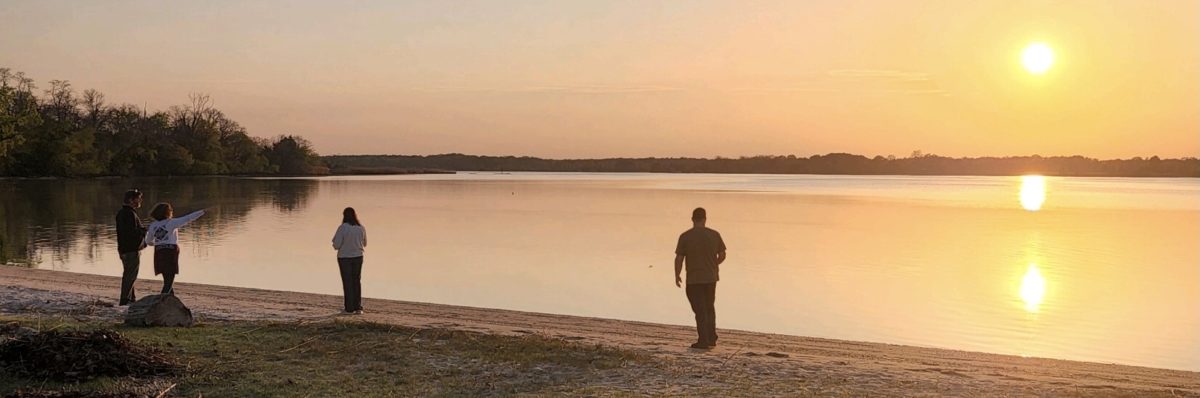
Walking around Tuckahoe State Park on Sunday, I kept taking pictures because the sun was setting and bouncing light beautifully off the trees and the water. We live in a place where we can be frequently reminded to stop and look at amazing things. If we make time. It’s all around us: yellow ginkgo leaves covering the ground, Great Blue Herons in flight, seldom seen birds at the feeder outside the window.

Blake’s point is that we don’t all look at things the same way. For someone looking to clear land and build a house, or someone who is late to work, a tree might be just something in the way or background scenery. For others, it can be the tree which moves us to tears; overwhelms us with gratitude and wonder at being out in nature.

After quoting Blake, Easwaran goes on to quote Thomas a Kempis, saying:

“If your heart were sincere and upright, every creature would be unto you a looking-glass of life and a book of holy doctrine.” The pure in spirit, who see God, see him here and now: in his handiwork, his hidden purpose, the wry humor of his creation.

Every creature a book of holy doctrine. Wow. It comes back to being able to look, being able to see things that way, see each other that way. We determine how and what we see in the world. Seeing the tree which moves us, seeing God’s handiwork in nature and people in our lives, is the reminder I take today.

It’s cool to have Blake surface while studying Luke’s Gospel and the Beatitudes. Jesus was calling for people to see and be in new and different ways than what was going on around them. In his art and writing, Blake saw in new ways, broke from tradition, and conveyed the prophetic and the wondrous. He opened my eyes to writing being able to break free from form and constraint.

Since it’s his birthday, let’s walk toward Blake a bit more. He illustrated religious texts; it’s moving quickly into Advent and Christmas; and we have groups who have studied Luke’s take on Jesus’ birth narrative where angels appear to the shepherds. So this struck me today: Blake drew and painted scenes for a John Milton poem, “On the Morning of Christ’s Nativity.”  Blake illustrates Milton’s words, which describe a scene we know better using Luke’s words:

And suddenly there was with the angel, a multitude of the heavenly host, praising God and saying, “Glory to God in the highest, and on earth peace, goodwill toward men.” (Luke 2:14)

Today, on Blake’s birthday, and every day, whether we need angels to point it out to us, or whether we can use our own eyes, maybe we can see the divine in the everyday, the tree which moves us.

Weekly Reader: Luke, Linus, Fred and Gary

I hear Linus Van Pelt’s voice in my head. We are two chapters into our study of Luke’s Gospel at Christ Church Easton and there is Linus.

“And there were in the same country, shepherds abiding in the field, keeping watch over their flock by night. And, lo, the angel of the Lord came upon them, and the glory of the Lord shone round about them: and they were sore afraid. And the angel said unto them, “Fear not: for, behold, I bring you good tidings of great joy, which shall be to all people. For unto you is born this day in the city of David a Saviour, which is Christ the Lord. And this [shall be] a sign unto you; Ye shall find the babe wrapped in swaddling clothes, lying in a manger. And suddenly there was with the angel a multitude of the heavenly host praising God, and saying, “Glory to God in the highest, and on earth peace, good will toward men.” – Luke 2:8-14

That’s what Christmas is all about, Charlie Brown. – LVP

That last line might not be in the Bible. But it applies. I still well up a bit anytime I watch the Charlie Brown Christmas special and the feckless search for the meaning of Christmas leads to Luke and Linus. And I will say, just two chapters into Luke, it is beyond cool to get a deeper sense of Luke’s good news and what he is doing as essentially a journalist, making sure we don’t miss the story of Jesus.

Yesterday morning, I opened up Frederick Buechner’s quote of the day and found my mind in an upward spiral thinking about this:

“Some moment happens in your life that you say yes to right up to the roots of your hair, that makes it worth having been born just to have happen. Laughing with somebody till the tears run down your cheeks. Waking up to the first snow. Being in bed with someone you love.

“Whether you thank God for such a moment or thank your lucky stars, it is a moment that is trying to open up your whole life. If you turn your back on such a moment and hurry along to business as usual, it may lose you the ball game. If you throw your arms around such a moment and bless it, it may save your soul.”

Buechner’s context with salvation, love, and gratitude is key, but that is the part that spoke to me.

This morning I returned to Gary Snyder’s “Mountains and Rivers Without End,” a book/meditation it took him 40 years to write, and which I never keep far from reach.  I’m trying to read Snyder and Jim Harrison in the mornings with coffee, to stoke my sense of wonder and to remember to look at the world around me with eyes and a heart to take everything in. Snyder’s meditation goes throughout the world, history, into our minds and souls, and was begun looking at a scroll of a landscape.

I had a picture in my head this morning of Weekly Readers, a weekly newspaper/magazine we got in elementary school that told us what was going on the world that we might want to pay attention to.

The week is just starting, but I like the notion that this week, the things I am reading, that I want to pay attention to–Luke, Linus, Fred, and Gary–help keep my mind connected to God, nature, blessing everyday moments in our lives, creativity, incarnation, and love.

We tell stories

Jesus told stories. That’s how He taught. Because He knew people wouldn’t remember just facts. He told stories that stuck. Parables that people had to think about; that planted seeds, took hold, and grew in hearts, minds, and souls. And when it came time to remember Jesus, it was His stories that got written down so that we might know them (and Him through them) as well.

I love thinking about people gathering around as Jesus got rolling. You can kind of see the 12 looking at each other as He got going and thinking, “Ah, yep, the sower story again, I dig this one,” even though they’d heard it and probably still hadn’t gotten it. Jesus knew people would keep telling His stories, and His story; He counted on it. It’s why he walked the 12 through them; it’s why the Gospel writers went to so much trouble to write them down; and it’s why there are four separate Gospels, not just one condensed version. Telling the stories matters.

Stories last. None of us know Homer or Mark Twain, but we may know something about The Odyssey or Huck Finn. And likely they would rather us remember their stories than themselves. We may have never met Martin Luther King Jr., but we know his story and some of his stories. Neil Gaiman, a favorite modern day storyteller of mine,  gets it:

“Stories, like people and butterflies and songbirds’ eggs and human hearts and dreams, are also fragile things, made up of nothing stronger or more lasting than 26 letters and a handful of punctuation marks. Or they are words on the air, composed of sounds and ideas–abstract, invisible, gone once they’ve been spoken–and what could be more frail than that? But some stories, small, simple ones about setting out on adventures or people doing wonders, tales of miracles and monsters, have outlasted all the people who told them, and some of them have outlasted the lands in which they were created.”

Our lives and thoughts are shaped all around by stories–our own stories, our families’ stories, and the stories we identify with. I loved being around our cousin Doug Hanks Jr. when he held court at Schooner’s Llanding, or at the Tred Avon Yacht Club, or at family parties. Even after his mother’s funeral, back at his house, telling stories of her life that had a crowd both laughing hysterically and realizing what a unique character was “Mary Hanks of Oxford.” I miss Doug’s stories and his storytelling and the way he made us all feel when he told them.

Jim Harrison is a favorite storyteller of mine. I never got to meet him, but I will be forever moved and shaped by some of his stories and poetry. He wrote that, “Death steals everything except our stories.”

I dig this story of a writer getting to know and remember him after an article:

“…we sat on your porch in Patagonia, watching you watch birds. There were hundreds of them, and you knew their names, rattling one off every now and then between long, choking drags of your American Spirits… you were gracious in the retelling of your wildest stories… you wrote from your bones, your marrow into poetry, novellas. And you made me believe that there was something to writing. That storytelling really was something romantic, magic even.”

If there is magic in stories, it is in how we remember them and how we connect to them. When we hear the stories that move us the most, it is not just because we connect with who wrote it, but because what is said speaks to us, becomes part of us. In our stories, we learn who we are; we are able to speak it and understand ourselves better. Our stories connect us, teach us, inspire us, and help define us.

What we hear in the stories that matter the most to us, is who we are.

“If a story is not about the hearer he will not listen… a great and interesting story is about everyone or it will not last.” – John Steinbeck, “East of Eden.”

Matthew and the Rock Face

If you’d told me 15 years ago that I would find laughter, joy, friendships, tears, questions, answers, life, sorrow, challenges, confusion, exhaustion, and exhilaration, all in a Bible study, I am sure I would have dismissed it.

At the beginning of October 2017, two groups at Christ Church Easton started a journey through Matthew’s gospel, using N.T. Wright’s “Matthew for Everyone” as a touchstone. We weren’t sure whether to end at Christmas, part-way down the path, but both groups wanted to see it through. With three weeks left to go, Jesus has been arrested, and we know what’s coming.

Wright looks at where we are in the story and compares it to standing at the bottom of a huge rock face.

“That is how we should feel as we stand at the foot of the final ascent of St. Matthew’s gospel. We have walked at a steady pace through the hills and the valleys of the story. We have sat down to hear Jesus deliver another parable or discourse. We have marched with him along the road, enjoying the sunshine of the early days in Galilee, and the remarkable views as the disciples gradually realized more of what the kingdom was about. We have arrived in Jerusalem at watched dramatic events unfold. But we are now standing in front of a sheer wall of rock, and if we don’t find it both compelling and terrifying, we haven’t got the right spectacles on.”

I feel that. I feel it in my life and I feel it as we read and work through Matthew. I feel it as we approach both spring and Easter. With all the beauty and questions, there is death ahead. There is rebirth and renewal after, but it only comes after and because of a death. I think that is also true of our lives. It is of mine–some of the most beautiful and meaningful times come after loss, come after the low, come after the crap. And sometimes they only happen because of the painful experience that preceded it.

Wright goes on:

“The theories about why Jesus died–theories of the ‘atonement,’ as they are called–are like maps or old photographs, taken from a distance. They may be accurate in their way, and the’re helpful particularly when it’s cloudy and you can’t see too much for the moment. But they’re not the same thing as climbing to the top yourself, and perhaps, if you’re lucky, getting there on a clear day when you can see the view. When that happens, you will find you quickly run out of words to describe what you are looking at.”

It’s not the same thing as climbing to the top yourself. What we find in Scripture is a lot like what we find in life–we get out of it what we invest in it, what we live into it. And if we are going to understand Scripture, or life, it is going to help to have guides, and friends to share the journey with, and the views. We are going to stumble and we are going to need help.

We’ve got three classes left, finishing this ascent during Holy Week as we head into Easter. Our two groups of pilgrims are at the rock face. A journey that started together five months ago. When I look back, when I look around, and when I look forward, I “quickly run out of words to describe” it.

Distractions and Renewal

Stuff gets in the way. Stuff gets in the way of life happening the way it is supposed to. We get distracted, we lose focus, and before we know it, our lives have veered from where we thought they were supposed to go.

Maybe that’s where Lent comes in. As a season, it asks us to let go of some of those distractions. To let go of those things that keep us from living life as we were meant to live it. When people pick a trivial thing, even a happy thing, to give up for Lent, I think maybe it misses the mark.

I like the notion of Lent as a time for renewal and refocusing. Last week at Christ Church Easton, the Gospel reading was Mark’s account of Jesus’ transfiguration on the mountain. Interim pastor Jerrett Hansen, reflecting on this mountaintop experience, asked, “How are we connected to the story?”

He posited we need to live into the mystery of the story, the mystery of God and Christ, rather than try to intellectually analyze it.

“Jesus and God are to be experienced. We need to be open to these experiences… Experiencing God is essential to our journey.”

I think that is what life’s distractions prevent us from doing. They get in the way of our wonder; they get in the way of loving more fully; they get in the way of opening ourselves to possibilities and to each other. Distractions keep us from knowing ourselves more fully and from knowing God more fully.

Maybe instead of giving something up just to give something up, for Lent we can think about getting ourselves into spiritual shape. Building better habits to peel back the distractions. Jerrett introduced a notion that a friend of his, Michael Foss, spelled out as marks of discipleship:

1. Pray daily
2. Worship weekly
3. Read the Bible daily
4. Build spiritual friendships
5. Serve in the community
6. Be generous in all things

We’ll be spending time over the next weeks working through what some of those look like and what they mean. If you are up for it, maybe think of Lent as time to take on a discipline, or a devotional habit, to help get into shape a bit.

We all need help in our lives in some form or fashion. We can all be better people, for ourselves, our family, our friends, our community, our world.

I’m stoked to be helping lead groups this Lent and spring, which will be looking at Mark’s Gospel; which will be looking at how and why to pray and read the Bible. And the Alpha Course.

I love Mother Teresa’s notion that through prayer God guides us to do the things that need to be done in the world, that “prayer changes us and we change things.”

God invites us to come as we are, just as we are. But He also knows we are capable of being so much more. We can be better. We can do better. Maybe we can start now.

I’ll leave with a final though from Jerrett’s sermon this past Saturrday:

“God loves you the way you are, but He knows how much more you can be.”

Mountaintop Experiences

Sometimes hospitals can be mountaintops. Mountaintop experiences are those moments or experiences in our lives that rearrange things, change our hearts, bring us closer to God.

Two years ago today, while visiting her mom’s family in Pennsylvania, Ava had a seizure that led her to be flown by helicopter to Children’s Hospital in Pittsburgh. I was sitting in my sun room at home at 9pm, and got a phone call, and was on the road within a few minutes.

She spent 10 days in pediatric intensive care and all told about a month in the hospital between neurology and the rehab unit. After EKGs and MRIs and who knows what other acronyms, the likely diagnosis was that Epstein-Barr Virus had gotten into her spine, and caused her brain to swell and provoked that and subsequent and ongoing seizures. The doctors, nurses, and technicians at Children’s were rock stars, stayed the course and sent Ava home to conquer 5th grade. Since then, she has been on medication to manage her seizures and we have learned a bit about the world of provoked epilepsy. Ava’s has been a good story, with her making honor roll at school, playing sports, and living a mostly normal life, albeit mornings and evenings feeling like a pharmacy.

Mountaintops are what you make of them. The main thing I remember is the amazing support, prayers, good vibes and good deeds from so many people. It redefined what community meant to me. What Ava went through, and her attitude, and watching her come back to herself gave me a sense of gratitude I wouldn’t have come to any other way. It showed me first-hand, the way a community of people praying can change the heart(s) of the people being prayed for. I have been in a constant and growing conversation with God since (not that I always listen the first time or catch what He’s saying).

Yesterday’s Gospel reading and sermon at Christ Church Easton were about a mountaintop experience–Luke’s story of Peter, John, and James witnessing Jesus’s transfiguration, “And while he was praying, the appearance of his face changed, and his clothes became dazzling white.”(Luke 9:29). You can’t get much more mountaintop than that. I like how Frederick Buechner brings transfiguration back to everyday life:

“Even with us something like that happens once in a while. The face of a man walking his child in the park, of a woman picking peas in the garden, of sometimes even the unlikeliest person listening to a concert, say, or standing barefoot in the sand watching the waves roll in, or just having a beer at a Saturday baseball game in July. Every once and so often, something so touching, so incandescent, so alive transfigures the human face that it’s almost beyond bearing.”

When I think back to two years ago in the hospital and getting home, I have seen that look on a face. It was there in Anna caring for her sister; it was there in Ava getting home, excited to see her friends and start the school year. And because of that mountaintop experience, when I remember to look with the eyes of my heart, I see it now.


Seasons, Journeys, Treasure

I dig the seasons changing. There is something to that elemental shift that stirs my soul. These warm days of walking home for lunch and feeling the sun on my face; longboarding to work; thinking about sunrise or sunset paddleboarding on the horizon; putting tomatoes in and mulching gardens; seeing the return of green grass. I’m looking forward.

This is maybe the first time I have fully paid attention to the changing seasons of the church: from Advent to Christmas, from Epiphany now into Lent, looking to the Passion and Easter. Another new thing for me is leading a small group as we journey through Lent.

At the Ash Wednesday service last evening at Christ Church Easton, Father Bill Ortt gave out some information on what Lent is all about. Among other things, I like getting into the word itself:

The word Lent is derived from the old English word “lente” meaning “Springtime” or “lencten” referring to the lengthening of the daylight hours. In the agricultural sense, it is a time when fields are prepared to receive the seeds for the crops to be planted. On a spiritual basis, we might look at it the same way. There is much work to do to break the ground compacted by the weight of the winter period of “death” and there are weeds and obstacles to remove. And yet there is good to be found in the preparations, because it is preparation for new life. In other words, this is more than a good thing.

Lent is a preparation. Lent is also a journey. Lent is a journey over a period of time, 40 days, and it is also a journey over the terrain of the soul.

This morning, thinking about journeys, I went back to a book I pick up a lot for those kind of travels, Jim Harrison’s “The Shape of the Journey:”

It is not so much that I got
there from here, which is everyone’s
story: but the shape
of the voyage: how it pushed
onward in every direction
until it stopped

It’s not the destination, it’s the shape of the voyage that defines it. And can define us. In Walter Brueggemann’s “A Way Other Than Our Own: Devotions for Lent,” he offers this prayer for today:

Self-giving God, call us to walk the road of
newness–a new self, a new society, a new world,
one neighbor at a time. May we have traveling
mercies this Lenten season. Amen.

We are each on our own journey. Some are fortunate enough to help others in their travels, some people help us along. Where our paths intersect, and where we can travel together, those are great times. This kind of trip can be lonely and rough and we need help.

The Ash Wednesday reading from the Gospel of Matthew had some really key traveling advice. Something we may want to take to heart. Matthew quotes Jesus, who talks about not storing up treasures on earth–material things, money, fame, success–but storing up “treasures in heaven,” those things that light the soul, that put us in touch with something bigger, that connect us to God:

For where your treasure is, there your heart will be also.

This Lent, this spring, as we set out on our journeys; may we find and store up the right kind of treasures and know our hearts; help our fellow travelers on their way; and all know traveling mercies, as Anne Lamott and Brueggemann call them, remembering it is the shape of the journey at least as much as the destination.