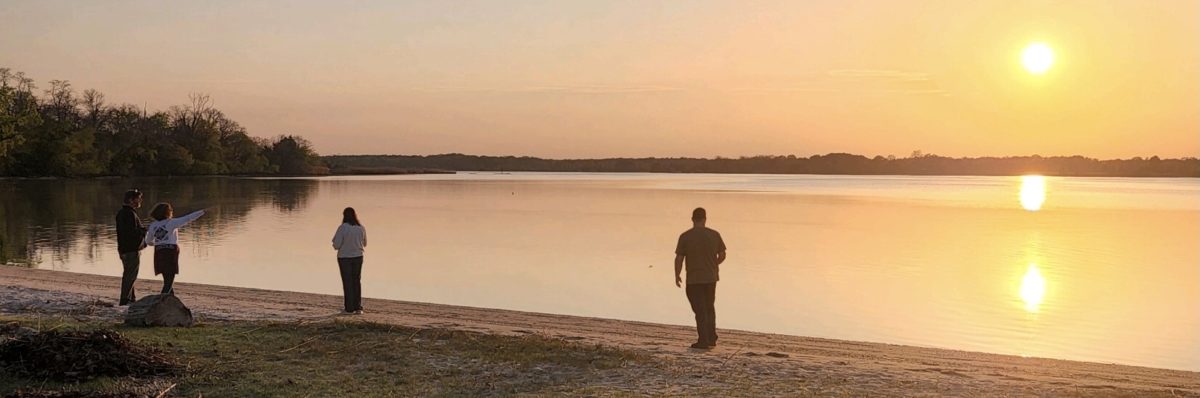
Sitting on the bank of the cove, watching a Weeping Willow move in the wind and feeling the same breeze on my skin is worth waking up for. I’ve been looking for this solitude and this quiet. Ordination to the priesthood is this Saturday and I want to rest in the afternoon.
The current is coming to a head from opposite directions and swirling right in front of me. I’m sitting under my praying/thinking tree at the Oxford Cemetery, where family and friends are buried and over the past year I have officiated funerals. This is a place where past, present, and future dwell together.
The cove itself is home if a body of water can be home: I’ve gotten boots stuck in the mud here at low tide as a kid, canoed, come and gone by Boston Whaler, kayaks, and paddleboards. That’s part of what draws me here to pray and listen, to read and write, and skateboard to get to the spot.
“Oh, feed me this day, Holy Spirit, with the fragrance of the fields and the freshness of the oceans which you have made, and help me to hear and to hold in all dearness those exacting and wonderful words of our Lord Jesus Christ, saying: Follow me.”
–Mary Oliver, from “Six Recognitions of the Lord”
Mary Oliver should be read outside. I have her book “Thirst” and Frederick Buechner’s “The Alphabet of Grace” with me. “Follow me.” That’s it in a hazel nut.
I get up and skate back to and around the conservation park. It’s lightly raining, the kind of rain that wakes your skin up. I stop when I see purple, per Alice Walker’s advice, which I follow meticulously. Then I head over to the Oxford Park.
Twelve years ago this month, I sat in the park reading this same copy of Buechner’s book. I look back over what I underlined then. This was at the end of a summer (2013) where I knew in my bones that I was supposed to go to seminary. It made no sense. I reached out to Fr. John Merchant, the chaplain at St. James School when I was there, and he told me it didn’t have to make sense. I read Buechner and Barbara Brown Taylor and Thomas Merton and I was stirred and moved and then laid all that aside, taking a job to head back to Washington, DC, to work as a technical writer.
I don’t have words to describe what the 12 years in between have been, except to say heels-over-head, upside down, life-changing; from profound heartbreak to indescribable joy, confusion and clarity, discernment, wonder, awe, gratitude, and everything in between, ultimately shedding some parts of myself and growing in others to where I feel alive in ways I wasn’t. Living now with my whole and open heart.
Here’s a bit of Buechner:
“You are alive. It needn’t have been so. It wasn’t so once, and it will not be so forever. But it is so now. And what is it like: to be alive in this maybe one place of all places where life is? Live a day of it and see. Take any day and be alive in it. Nobody claims that it will be painless, but no matter. It is your birthday, and there are many presents to open. The world is to open.”
Part of that I underlined 12 years ago, but it didn’t register. Each day is new, each day is a gift that we get to live and be alive in. Be grateful.
In the park, I often sit on a bench set off to the side at the edge. It’s in the shade. As I sit there, a child belly-laughs on the swing with her father; a workboat motors down to pull into the marina nearby; a man pulls his crabpots up on his dock; people and dogs come and go; the sun breaks through the clouds infrequently but unmistakably.
Today isn’t a day for revelations. It’s a day to rest and be glad in. It’s a day to breathe, a day to smile, a day to pray. I finish Mary Oliver’s book with the title poem, “Thirst,” which I have been reading a lot lately:
“Another morning and I wake with thirst for the goodness I do not have. I walk out to the pond and all the way God has given us such beautiful lessons. Oh Lord, I was never a quick scholar but sulked and hunched over my books past the hour and the bell; grant me, in your mercy, a little more time. Love for the earth and love for you are having such a long conversation in my heart. Who knows what will finally happen or where I will be sent, yet already I have given a great many things away, expect- ing to be told to pack nothing, except the prayers which, with this thirst, I am slowly learning.”
From Ash Wednesday to Easter. A journey, a transformation, and one of the most intentional and richest parts of our liturgical calendar.
Our Lenten e-mail prompt and discussion of John O’Donohue’s book, “To Bless the Space Between Us,” was rich, meaningful, and eye-opening. It was a continuing and deepening conversation with 20 people which included the Eastern Shore, Vermont, and even photos and stories sent from Finland.
One of the purposes of the book for O’Donohue was/is to get us thinking about “blessing” differently, and that blessings can take many forms, not always something that we would wish, ask for, or even want. Sometimes blessings can be the sun and sometimes the silver lining.
The last section of the book is “To Retrieve the Lost Art of Blessing.” It is an intentional walk through a way of seeing. Here are a few early quotes:
“Something deep in the human soul seems to depend on the presence of kindness; something instinctive in us expects it, and once we sense it, we are able to trust and open ourselves.”
“Kindness has gracious eyes; it is not small-minded or competitive; it wants nothing back for itself. Kindness strikes a resonance with the depths of your own heart; it also suggests that your vulnerability, though somehow exposed, is not taken advantage of; rather it has become an occasion for dignity and empathy.
“Despite all the darkness, human hope is based on the instinct that at the deepest level of reality some intimate kindness holds sway. This is the heart of blessing. To believe in blessing is to believe that our being here, our very presence in the world, is itself the first gift, the primal blessing.”
That last paragraph especially: to see life itself as the first gift, the most basic blessing. Despite all the darkness.
We’ve just gone through an entire liturgical season that sees light overcome what seemed like the ultimate darkness. When faced with what seemed like the end, death, God shows us more, that new life overcomes death. That hope is not in vain, but intrinsic and ever-present, if we will see it.
Over the course of our group discussion, participants responded with pictures of the Northern Lights in Finland and an Assateague camping sunrise.
The Resurrection is nuanced and layered in its meanings. One of the things it did was give credibility to Jesus being who he said he was. And it made the disciples for the next few generations, reflect back on what Jesus said and did, to the point of writing it down so that it could be passed down.
Many writers and theologians point out that Jesus’s words to his disciples were “follow me,” not “worship me.” It’s really a both-and situation, we can do both; and worship is a perfect response to God. But a problem over the years has been and continues to be that many Christians are content with worshipping ( and “believing” without living or living into any of that belief) and have dropped the following aspect of our faith.
Following Jesus means living like he did, loving like he did, doing our best to emulate his example. In John’s Gospel, Jesus gives the disciples (and us) the new commandment of “loving each other as I have loved you.” which he says knowing he is about to be arrested and put to death. That’s what his love looks like–sacrificing himself for the love of his friends and for humanity.
When we look at kindness through the example and eyes of Jesus, we have a sense of what we are called to do and who we are called to be.
O’Donohue closes his book with the poem, “The Eyes of Jesus”–
I imagine the eyes of Jesus Were harvest brown, The light of their gazing Suffused with the seasons:
The shadow of winter. The mind of spring, The bues of summer, And amber of harvest.
A gaze that is perfect sister to the kindness that dwells In his beautiful hands.
The eyes of Jesus gaze on us, Stirring in the heart’s clay The confidence of seasons That never lose their way to harvest.
This gaze knows the signature Of our heartbeat, the first glimmer From the dawn that dreamed our minds,
The crevices where thoughts grow Long before the longing in the bone Sends them toward the mind’s eye,
The artistry of the emptiness That knows to slow the hunger Of outside things until they weave Into the twilight side of the heart.
A gaze full of all that is still future Looking out for us to glimpse The jeweled light in winter stone,
Quickening the eyes that look at us To see through to where words Are blind to say what we would love,
Forever falling softly on our faces, His first gaze plies the soul with light, Laying down a luminous layer
Beneath our brief and brittle days Until the appointed dawn comes Assured and harvest deft
To unravel the last black knot And we are back home in the house That we have never left.
The eyes of Jesus are a way of seeing and a way of being, in terms of how we see and treat each other. O’Donohue talks about the way Jesus sees us, his gaze, and describes it in a way that should make us feel like we are loved before we do or say anything. Our souls are loved, as well as our bodies and minds. Do we allow ourselves to feel seen and loved that way?
Following Jesus means to try to look at ourselves, each other, and Creation with these eyes and this love.
Why do we take a journey through Lent? Why do we try to take in, reflect on, pray on, the Passion/suffering of Jesus over Holy Week? Why do we celebrate Jesus’s Resurrection?
I hope that at least part of the reason is to allow ourselves to be transformed, to become more Christ-like, to live and love like Jesus, which is to experience the kingdom of God and to do our part to help bring that kingdom, that love, to others, and play whatever role we can in bringing the kingdom here.
May we feel the eyes of Jesus gazing on us. May we be the eyes of Jesus gazing on others.
May we know the love of Jesus, who became one of us, showed us how to live and how to love, gave his life for us, and then showed us that his love, God’s love, is greater than death, overcomes death and brings us to eternal life.
May we be the love of Jesus for everyone we encounter. And echoing Fr. Gregory Boyle, everyone: no exceptions.
Background: October 5-6 was a preaching weekend for me at Christ Church Easton. The Gospel reading for the lectionary was Mark 10:2-16, where Jesus is questioned about divorce and he goes on to say, “whoever does not receive the kingdom of God as a little child will never enter it.” This is the text of the sermon I gave.
“Let’s Get Back to Love”
In the not quite three years I have been preaching, this is the second time I’ve landed on one of Jesus’s divorce readings. As someone who has been through a divorce, last time out I bounced off personal experience to talk about how devastating divorce can be and how it is to be avoided if at all possible.
This time I want to take a step back and look at why Jesus always seems to make our lives harder by making the laws and rules even more strict than what the Pharisees and scribes bring to him.
Something to keep in mind: Jesus fully engaged and answered everyone who came to him with an honest question or concern. We’ll see that next week in the case of the rich, young ruler. But Jesus is wary when the Pharisees try to test him or trick him into saying something that will get him in trouble. He is wise to what they are up to.
The Pharisees ask: is it lawful for a man to divorce his wife? Jesus asks: what did Moses command you? They said: Moses allowed a man to write a certificate of dismissal and to divorce her.
And now Jesus gets to the crux of the matter: “Because of your hardness of heart he wrote this commandment for you.”
The law gives us the least we have to do to in order to play by the rules and to get what we want. The Pharisees who repeatedly question Jesus are concerned with the law for the sake of the law. They aren’t concerned with the why behind the law, the intent of the law.
First of all, if you are approaching marriage with the attitude and question, is it legal to get divorced? You probably shouldn’t be thinking about marriage.
People then, and now, want to know what rules or code do I have to follow to be considered righteous, to be a good person, and to go to heaven, right? We’d all like to know that, and to know if we are on the right path, or if we need to make some adjustments.
That’s putting the cart before the horse. Jesus, then and now, is concerned about our hearts, about our relationships, with God and with each other. About us living life and living life abundantly. If we are going to do that, our abundance can’t be at someone else’s loss, pain, or cost.
Jesus was aware of what happened back then to a woman who had been divorced. It would be hard for her to find protection, provision of any kind, dignity, or to have much of a future. That does not give her much of a chance to live life abundantly, to be in right relationship with God and her neighbors.
The laws are the lowest standard. Let’s look just quickly at the commandments that are concerned just with how we treat each other:
Honor your mother and your father
Don’t commit murder
Don’t commit adultery
Don’t steal
Don’t give false testimony against your neighbor
Don’t covet anything that belongs to your neighbor
If we live and follow those laws, does that sound like a happy life? Does that sound like abundant life? That sounds like the bare minimum you can do to stay out of trouble.
All of these laws address the hard-heartedness of people; what they had become, what we are still, and where we fall short in needing clear-cut rules to keep us straight and spell out how to treat each other.
That’s why in the Sermon on the Mount, Jesus says, “murder? That’s a pretty low bar. You’ve got to deal with and address that feeling when it’s still anger, long before it gets anywhere close to murder.” It’s not about the law, it’s about the heart. We need soft hearts to love.
Here is what we’ve lost: LOVE IS OUR DEFAULT SETTING. Jesus gets that.
In Mark Chapter 12, one of the scribes asks Jesus, which commandment is first (or greatest) of all? And Jesus gives the response we’ve come to know: “Love God with all your heart, with all your soul, with all your mind, and with all your strength, and love your neighbor as yourself.”
Love. Be passionate. Care for each other. Live life to the fullest. There is no, “thou shalt not…”; there is no, “is it legal if…”
Jesus is trying to help us get back to our default settings. But we’ve put so much in the way of that, even as the church, which is the issue Jesus kept having with the Temple leadership who cite laws left and right, but keep out the people—the poor, the sick, the marginalized; the sinners and the tax collectors, who Jesus was at the table with and caring for.
In last week’s Gospel, we heard Jesus say, “If any of you put a stumbling block before one of these little ones who believe in me, it would be better for you if a great millstone were hung around your neck and you were thrown into the sea.”
These little ones, who are learning to believe, learning to love, don’t go quoting Scripture, quoting laws at them, don’t belittle them or cause them to stumble. Help them. Encourage them.
But how? How are we supposed to do all that? People are so weird and hard to deal with. They’re too people’y.
On the road with his disciples, Jesus has been trying to get it through to them. You’ve got to put down, you’ve got to give up, these lives that society is trying to hand to you. You’ve got to put down the things that divide us and put barriers between us.You’ve got to give up the lives you’ve been living, pick up your cross, and follow me.
If we put down the crap that we’re being fed, if we give up the lives that are full of judgment, hatred, power, and status, we are free to pick up and be filled with Jesus’s love. We give up our small, ego selves so that we can be filled with the Holy Spirit.
When we let go of the doubt, the fear, the skepticism and pessimism we are being handed, we become like children: free to love.
“Let the little children come to me; do not stop them; for it is to such as these that the kingdom of God belongs. Truly I tell you, whoever does not receive the kingdom of God as a little child will never enter it.”
As a little child. Open, innocent—not jaded, tainted, asking which laws are the ones that really count.
Love is our default setting. Jesus and gift of the Holy Spirit are the reset button. God’s grace is our fresh start.
Well, sure, that’s easy for Jesus to say; He’s Jesus. What about us, who are flawed and human and who mess up? What does it look like for us to let go and start again?
Let me introduce you to Francis. Saint. Francis. Of Assisi. October 4 was the Feast of Saint Francis, who is often held up as the human being who most fully lived a life of Christ-like love. He saw the divine in everything and everyone and lived his life in a simple way. He didn’t start out that way, he found it as a new way of being.
Francis let his love of Christ guide him, rather than rules or laws. Franciscan Friar and author Richard Rohr describes Francis like this:
“Creation itself—not ritual or spaces constructed by human hands—was Francis’ primary cathedral. His love for creation drove him back into the needs of the city, a pattern very similar to Jesus’ own movement between desert solitude (contemplation) and small-town healing ministry (action). The Gospel transforms us by putting us in touch with that which is much more constant and satisfying, literally the “ground of our being,” which has much more “reality” to it, rather than theological concepts or ritualization of reality. Daily cosmic events in the sky and on the earth are the Reality above our heads and beneath our feet every minute of our lives: a continuous sacrament, signs of God’s universal presence in all things.”
Wow. Not a bad way to live and look at the world.
Imagine being so filled with God’s love that when we go out the doors of the church, we carry it with us and give it to everyone and everything we encounter. Imagine someone’s impression of us being, “wow, they were full of love and light”—where did they get that? How can I get some too?
The Pharisees and scribes asked Jesus questions to try to trip him up and to get him in trouble. They were the law-abiding citizens. They wanted to know if it is legal for a man to divorce his wife.
That’s one end of the continuum: following the rules for the rules’ sake. Righteousness is following the law. Now listen to the words that St. Francis is most known for, the prayer that is attributed to him:
“Lord, make us instruments of your peace. Where there is hatred, let us sow love; where there is injury, pardon; where there is discord, union; where there is doubt, faith; where there is despair, hope; where there is darkness, light; where there is sadness, joy. Grant that we may not so much seek to be consoled as to console; to be understood as to understand; to be loved as to love. For it is in giving that we receive; it is in pardoning that we are pardoned; and it is in dying that we are born to eternal life.”
That’s not about the law, it’s about love; the self-sacrificing love that Jesus modeled for us with his life and through his death—the love that overcame death. The love that opens the door for us.
Which do you want your life to be about? Let’s go with Jesus and Francis. Let’s get back to love.
Thank you for breakfast with Anna this morning at Rise Up.
Thank you for laughter and conversation taking Ava to work.
Thank you for the slow driver on Oxford Road who reminded me to slow down.
Thank you for the Oxford Conservation Park.
Thank you for the body and energy to skateboard and for the joy I get from it.
Thank you for the Eastern Bluebirds who cut across my path.
Thank you for the tree I sit under to think and pray and listen.
Thank you for the Great Blue Heron who squawked and landed on the dock across the cove.
Thank you for the hammock on the point across the way, which has been there for years and always reminds me to rest.
Thank you for the Bishop’s words on Wednesday that “Every day is a conversion experience.”
Thank you for giving me new eyes to see familiar places afresh.
Thank you for giving me words when I frequently don’t know where they come from.
Thank you for making my path clearer and clearer for me each day, even though I don’t fully know where it leads.
Thank you for companions on the way.
Thank you for the everyone I have crossed paths with, people walking their own paths, walking together for a time; thank you for those who have encouraged me and for those who I have struggled with.
Thank you for forgiveness for the countless times I have screwed up and the countless times I will screw up in the future.
Thank you for your Creation and for making me feel at home and at peace in it.
Thank you for the wisdom and inspiration that comes from your Word and from the words you’ve given to poets, mystics, artists, musicians, and prophets, known and unknown.
Thank you for the conversation this morning, under the tree, through Mary Oliver:
(Note: I was compelled to pick up Mary Oliver’s book “Devotions” when I left home this morning. I always start reading at the bookmark, where I stopped reading last time. I opened to “When I Am Among the Trees” and it picked up steam from there.)
“Oh, feed me this day, Holy Spirit, with the fragrance of the fields and the freshness of the oceans which you have made, and help me to hear and to hold in all dearness those exacting and wonderful words of our Lord Jesus Christ saying: Follow me.”
Thank you for your Son and for his invitation to “Follow me.”
Thank you for your love, which always comes from you, and your love that comes through others.
Lord, help me use my life and myself to serve you, to glorify you, to be your love and to shine your light in the world.
Background: This is a homily given in response to a reading from Mark’s Gospel, Chapter 1:14-20, where John the Baptist is arrested, Jesus begins his ministry proclaiming the word, and calls his first disciples to follow him.
How many people have a favorite character—movies, books, TV? Anyone want to name them? And how many of you can tell me his/her first lines, the first thing they say in the story?
My favorite character of all time in any media is Chris Stevens, the radio DJ from the 1990s TV show “Northern Exposure.” His first words, he is on air, and he relates a coming-of-age story of breaking into a house and while he is stealing a gold-leaf pen and a silver humidor, he finds a copy of the Complete Works of Walt Whitman and it changes his life. If you watched the show, that’s a solid indication of his whole character.
In Mark’s Gospel, these are the first words Jesus says in the story, “The time has come (or the time is fulfilled), and the kingdom of God has come near; repent, and believe in the good news.”
Hard to have first words that are more indicative of who someone is. There is the key, there is the game plan, spelled out in front of us.
It sounds very similar to what John the Baptist was saying, right? Jesus is continuing where John left off, after John was arrested. Jesus’s ministry begins as John’s ends. But there is a nuanced difference in their messages. John was saying, “repent, and wait for the one who is to come.” Jesus says, “the time has come, repent,” and then “follow me.”
We’ve got just six verses here, but there is a lot going on. Let’s dig in a bit. First, let’s look at TIME.
The word Mark uses for “time” as Jesus talks is the Greek word, “kairos,” which means something special is going on, not the word “chronos,” which describes sequential time, the way we tend to think about it.
This is how rabbi, New Testament scholar, and author Amy-Jill Levine puts it in her book “The Gospel of Mark: A Beginner’s Guide to the Good News”—
“Kairos time is on God’s watch; it’s not a minute-by-minute concern but a recognition something special is happening. When I look at my watch, I can do more than determine how much time I have to finish a project. I can think about God’s time: what should I have done that I failed to do? What can I do to make every moment more meaningful?”
Fr. Bill Ortt (our recently retired rector and mentor) talks about chronos as minutes and kairos as moments. I’ve always appreciated that as a kind of short-hand way to remember the difference. And I love that kairos is among Jesus’s first words here. JESUS is moving us from MINUTES into MOMENTS. He’s clueing us in that something special is taking place, that this is something we want to pay attention to. And as he begins to call his first disciples, it’s something that they want to sign on for.
Let’s remember that we are in Epiphany, a season all about the manifestation of Christ to the people of the world. If you look up definitions of the word epiphany with a lower case “e,” Merriam Webster gives you: 1) “a sudden manifestation or perception of the essential nature or meaning of something,” or 2) “an intuitive grasp of reality through something simple or striking.”
Epiphany.
I’ve come across a book that has me thinking more about how this whole opening chapter of Mark works. We know that Mark is:
the shortest of the Gospels,
the earliest of the four Gospels,
that Mark doesn’t add superfluous details, he tells the story straight,
and that if he had a copy editor in today’s world, they’d have the red pen all over the word “immediately” or “straightway” for how many times he uses it.
For the record, Mark uses “immediately” more than 40 times, more often than the rest of the New Testament combined. He is stressing the the urgency of what is happening.
Mark’s Gospel is also referred to by many scholars as “a passion narrative with an extended introduction.” Mark goes through Jesus’s teaching and healing, his ministry, and gets us to the point: his arrest, crucifixion, suffering, death, and empty tomb. We’re told that’s the meat of the story for Mark.
Saying that, in a book called “Mark As Story,” by David Rhoads, Joanna Dewey, and Donald Michie, they turn that idea around. They look at the opening of Mark’s Gospel and say what is happening here is the arrival of God’s rule.
“The arrival of God’s rule—the heavens opening, the defeat of Satan in the desert, and the announcement by Jesus—is the key watershed event in the narrative (storytelling) world. Mark, then, may be described as “the arrival of the rule of God with an extended denouement (fancy literary word meaning the final outcome, when everything comes together and is made clear)—that is, all events in the story are manifestations and consequences of God’s activity in establishing God’s reign.”
Mark’s whole Gospel is a series of epiphanies, or an ephipany working itself out, clarifying itself over the story. Jesus’s incarnation is the Epiphany. And Mark is rushing us headlong into this realization.
The world Jesus has come into, has come to change, has come to save, is moving in the wrong direction. The priorities are wrong, morality is wrong, the actions of those in power are wrong, even the sense of time needs help, and he’s got to set things in proper order. There is work to be done… immediately.
So right away, Jesus spells out what has to happen: “The time has come and the kingdom of God has come near. Repent, and believe in the good news.”
For our way of thinking today, one of the most problematic, confusing words and phrases in the Gospels is “the kingdom of God.” When you hear the word “kingdom,” what do you picture? A place. Somewhere to go. Kingdom of God? Sweet, let’s go! How do we get there? Who’s driving?
The way it was meant is better said as the reign of God. The king-ship of God. My other favorite Fr. Bill-ism is, “the kingdom of God is RELATIONAL, not locational.” It’s a way of being, a way of relating, not a place to go.
Let’s think about Jesus’s words that way, “The reign of God has come near. Repent and believe the good news.” What that reign looks like, Jesus is going to show them. How compelling is it? Compelling enough to get fishermen to walk away from their livelihood, their families, and everything they know when Jesus walks by and says, “Follow me.”
“Follow me” is the a-ha moment, the sudden manifestation or perception of the essential nature or meaning of who Jesus is for his first followers. Jesus’s presence and his invitation or command are all the epiphany they need. And the rest of the story will break it wide open.
If we move our attention to the beginning of the narrative instead of racing our way to the passion, what does that do for the story? Here’s what our friends in “Mark As Story” say:
“This shift in focus to the beginning of the narrative does not diminish the power and climactic force of the execution of Jesus—an event that reveals more fully the nature of God’s reign and seals a covenant with all who would embrace God’s rule… the shift does place the entire narrative firmly in the broader framework of God’s activity in establishing God’s rule over all of life.”
Here’s Jesus at the beginning: It’s time. God’s reign, not the world’s, not Caesar’s. It’s here. Stop what you are doing, you are going the wrong way. Turn around. Believe in this good news. Want to see for yourself? Want to be a part of it? Follow me.
“Stars and Sea at Night,” by Bill Jacklin RA (monoprint), Royal Academy of Arts exhibition
Everything that happens in the story from there shows us manifestations and consequences of what it looks like, of what happens, in establishing God’s reign.
Mark’s story itself is an epiphany for those who first heard it and for us. He means for it, in itself, the telling of it and the hearing of it, to be a transformational experience, showing us, calling us to be a part of establishing God’s reign, in our own lives, and those of others.
Jesus’s call to “follow me” wasn’t just for the first disciples. It’s for us.
Will we?
Sounds like a good way to spend our time. Kairos time. God’s time.
Lead in: I just finished my second year of seminary through the Iona Eastern Shore program, which allows our cohort to continue working while we are going to school.June 17 and 18 was a preaching weekend for me at Christ Church Easton. This is the text of the sermon I gave.
Churches/denominations that use the Revised Common Lectionary have prescribed readings for each day and Gospel readings for each Sunday. So we don’t get to pick what Gospel we preach on.
The Gospel reading for June 18 wasMatthew 9:25-10:23, where Jesus calls his 12 apostles and sends them out to further the work that he has been doing: curing the sick, raising the dead, cleansing lepers, and casting out demons, with warnings about what will happen to them.
“Send Us Out”
In January 2017, I had just started working at the church and I remember sitting down with Fr. Bill Ortt. It was time to start Bible studies and kick off The Alpha Course and he asked how I felt about everything. I said, “it’s daunting. And exciting.”
I was starting things I hadn’t done before. Anticipation and anxiety were in the water together. And all I could do was jump in.
Saying that, I can’t imagine what was going through the minds of the 12 disciples when Jesus calls them in today’s reading. So far in Matthew’s Gospel, they have seen Jesus teach, heal, and cure diseases; they have heard him give his Sermon on the Mount. They watched Jesus make a leper clean and were afraid for their lives on a boat as he commanded a storm to stop. When they got off the boat, he drove demons out of man everyone was afraid of; and we heard last week how he cured a woman who had been hemorrhaging for 12 years and then he raised a leader from the synagogue’s daughter from the dead.
Now he calls the 12 together and says, okay, your turn. Now you do it. “Proclaim the good news, the kingdom of heaven has come near, cure the sick, raise the dead, cleanse the lepers, cast out demons.” Wow. No nerves or pressure there.
The disciples have been riding the bus that Jesus was driving, but he was making all the stops and doing all the work. They were just along for the ride. They probably didn’t realize what “Follow me” entailed.
Let’s look at today’s text just before Jesus sends them out to see what prompts him to do this. He’s going about to all the cities and all the villages teaching and proclaiming the good news and curing every disease.
And then Matthew tells us: “When he saw the crowds, he had compassion for them, because they were harassed and helpless, like sheep without a shepherd. Then he said to his disciples, “The harvest is plentiful, but the laborers are few; therefore, ask the Lord of the harvest to send out laborers into his harvest.” And Jesus calls his 12.
The time is now. The harvest is ready. People are lost, hurting, sick. And Jesus needs those he has called to help him, to be the laborers.
This is the first time in Matthew’s Gospel that he refers to them as “apostles,” which means those who are sent out.
What are they sent out to do? Help people. Cure the sick, raise the dead, cleanse lepers, cast out demons. Do what Jesus has been doing. They are to share in and further his calling, his mission, under his authority. Go to where people are hurting. Care for them, give them hope. The things you do when you love someone.
As Matthew was making the point to get these things across to his readers then, they are still intended to speak to us now. Michael Green was an international evangelist, pastor, and author. In his book, “The Message of Matthew,” he gives us a way of thinking about Jesus’s mission charge to the apostles by summarizing it in five words: see, care, pray, receive, go.
SEE: “When Jesus SAW the crowds”—this is first and foremost, the apostles had to SEE the needs of those who were suffering or in trouble. We need to do the same.
CARE: “When Jesus saw the crowds, he had compassion on them.” Green points out that the word Matthew used for having compassion means “he was moved in his guts,” he was stirred deep inside. For the first apostles, or for us, when we see people suffering, we are called to care deeply.
PRAY: “Ask the Lord of the harvest to send workers into his harvest.” We are not the Lord of the harvest, that’s God, and we need to ask for his help and guidance. Stay connected to Him.
RECEIVE: And what Green says here is that the apostles, and we, need to receive training from Jesus, which they do both in watching him, in being with him, and in being sent out by him; and that they also need to receive authority. “It will not be you speaking but the Spirit of the Father speaking through you.” We need to allow ourselves to be open to, and filled with God’s Spirit. It’s not about us, it is about what God can do through us.
GO: Jesus commands, “Go,” and “As you go”… that’s the thing about being sent out. They and we actually have to go out. In preparing them for what’s to come, Jesus doesn’t lecture them about weekly church attendance. He sends them out and warns them that it is going to be dangerous.
Jesus and apostles. Fresco in Cappadocia
Jesus spends some time on this warning. He goes over the rough things that are on the horizon for the apostles. It’s going to be difficult, and it is going to be costly. “But the one who endures to the end will be saved.”
Debie Thomas in her book, “Into the Mess,” says when it comes to faith, “Discomfort is what success looks like.”
“If our overriding priority as Christians is to secure our own comfort, then we cannot follow Jesus. The discipleship Jesus describes will disorient and disrupt us. It will make us the neighborhood weirdos. It will shake things up in our families, our friendship circles, our churches, our communities.”
Caring is costly. As a society now, we are flooded with images and stories of worldwide suffering, violence, sickness—and what is the most common response? Change the channel. Close the laptop. Don’t think about it. Or better yet these days, find someone or a group of people who don’t agree with us and blame them. If we make it a point to care for the marginalized and cast out, we risk becoming marginalized or cast out ourselves. Jesus asks us to step out and take that risk.
When we care about those around us, we open ourselves to getting hurt. When we open our heart to love someone, sooner or later, pain is a part of that love. Love in this life also has loss lingering behind it.
The apostle Paul has a sense of that loss, of that cost, when he writes today’s reading from Romans. He finds something in this suffering:
“We boast in our hope of sharing the glory of God. And not only that, but we also boast in our sufferings, knowing that suffering produces endurance, and endurance produces character, and character produces hope, and hope does not disappoint us, because God’s love has been poured into our hearts through the Holy Spirit that has been given to us.” (Romans 5:2-5)
Jesus didn’t send the apostles out alone. He was with them. He cared about them. And he doesn’t send us out alone. He cares about us. And when we go through the pain and suffering that loving God and each other can bring, Jesus shows us that suffering can point ultimately to hope, and hope in God does not disappoint us.
If we are doing the work that God has given us to do, loving like Jesus, in a world that pushes back against it, we are going to struggle. I will tell you something that is amazing to me: we have so many people in our church community, who have used the struggles, the suffering, the loss they have experienced as a launching point either for ministries that they have helped start, or who are showing up for people in new and deeper ways because of what they have been through. They don’t want others to go through the same struggles alone.
That’s part of what being sent out looks like. Seeing, Caring, Praying, Receiving, Going.
A number of years go in Fr. Bill’s 30-week Kerygma Class, he drew two circles on a white board, one that had arrows pointing inward, and one with arrows pointing out. He talked about the circles as churches, inward facing and outward facing, and asked which one looked more like Jesus’s idea of love and caring? Barbara Coleman, now the Reverend Barbara, put her hands on top of her head with her fingers facing up to show the arrows facing out. And that has been her apostolic antler reminder ever since. We don’t see Barbara as much here anymore because she discerned a call to become a Deacon. She was ordained here in this church in October 2020, and now serves multiple parishes in Dorchester County, and heads up the food pantry. She calls herself the “Deacon of Dorchester.” She’s been sent out.
“Apostolic Antlers” from Rev. Barbara, Fr. Bill, and our Kerygma Class
Another part of today’s reading that keeps stirring me up is how the apostles learned from Jesus. He didn’t ask them to do anything he wasn’t already doing. Beyond his teaching, I bet they learned as much from watching him, from being around him, and from trying to do what he did.
It’s Father’s Day weekend. Happy Father’s Day to all the dads here. I’m convinced that we learn more from watching our fathers, our parents, and who they are, than from anything they might tell us. At least I hope that is the case, as neither of my daughters seem to listen to anything I say… The story about watching who someone is that that comes to my heart happened leading up to Halloween many years ago. So you get a quick Halloween story in June. Sorry, I’ve got the microphone.
From the late 1970s to the mid-80s, Easton had an annual haunted house that was unparalleled and unrivaled. In terms of scariness, creativity, and ingenuity, Disney World fell short of the haunted houses that the Easton Kiwanis Club put on. My father was a part of the Kiwanis Club and our whole family jumped into helping, for a good chunk of September and all of October each year.
They moved from place to place—from an old house on Dutchman’s Lane, to the old Idlewild Elementary School, when it was left empty in Idlewild Park. There were spot-built hydraulic floors, an illusion where a man changed into a werewolf on stage; swinging rope bridges, chainsaws, and even a flamethrower. The last two years of the haunted house, it was on a property in the woods off Manadier Road, at the end of Dutchman’s Lane. People had to park in front of what is now Auto Zone on Dover Road, and ride buses to the haunted woods.
The last year they held it, my friends and I as teenagers were given our own area along the wooded trail, a rundown old farm building, to create our scene to scare people. It was right next to where the buses pulled in.
One night a crowd got off the buses, a big crowd, most were in their 20s, and after riding the buses out there to this dark, deserted woods, they were scared, freaked out, didn’t want to go in and started screaming and shoving, not listening to anyone—it was the beginning of a riot. No one could calm them down and things were elevating past a boiling point.
From where I was standing, I could see my Dad come out of the woods, walk right up to the guys in the front of the crowd, who no one wanted any part of dealing with, and he stepped right into the mess, right where someone was needed. He diffused the whole situation. The entire crowd calmed down, made peace, and the evening, and the show, went on.
My Dad, 1980s era
That night was more than 35 years ago and I have never forgotten it, watching my dad help restore order out of short-fused chaos. Talking about it later, he said, “I have no idea what I would have done if it turned violent.” He didn’t think, he acted—not just sent out, he seemed shot out, going to where the critical need was. There have been times when I have called on his example in chaotic situations and tried to live into that, diffusing things, and trying to bring peace.
God connects us to people we can learn from; we are always being shaped.
I have to imagine that as Peter, John, and Matthew the tax collector were sent out, and their ministries expanded, that they had their own experiences of watching and learning from Jesus as he healed, cared, loved, and brought peace. They could call on their experiences of watching him. And as we read and discuss the stories of Jesus in the Gospels, we learn how to model ourselves after him. What would Jesus see? What would he care about? How would he love? Who would he send?
How about us? Are we ready to see, care, pray, receive, and go?