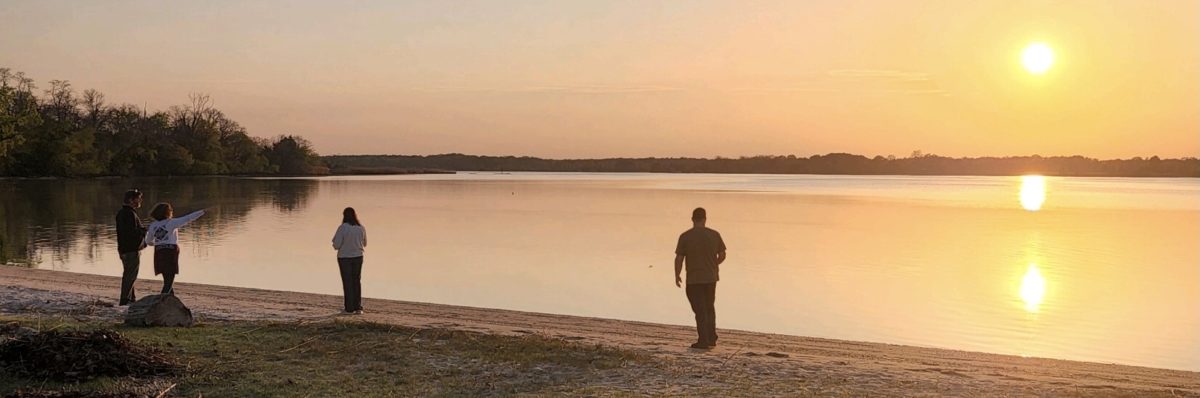
I am rarely without a notebook and pen. It would be fair for me to wear a sign on my back that says, “Will stop to write.” Mostly because otherwise I will forget. I will stop my longboard if a compelling thought jumps into my mind. And I frequently sit along a shoreline, in the woods, on a bench or wherever to take notes.
When it comes to church, for the readings and the sermon, I often just have pen and paper at the ready.
These are notes and thoughts after sermons and discussion last weekend at Christ Church Easton.
Last weekend’s lectionary readings were Isaiah 11:1-10 (The Peaceful Kingdom) and Matthew 3:1-12 (The Proclamation of John the Baptist). They will both speak to you if you let them.
A shoot shall come out from the stump of Jesse, and a branch shall grow out of his roots. The spirit of the Lord shall rest on him, the spirit of wisdom and understanding, the spirit of counsel and might, the spirit of knowledge and the fear of the Lord. His delight shall be in the fear of the Lord.
Isaiah 11:1-3
On our Sunday morning Zoom discussion, Fr. Bill Ortt unpacked the Isaiah reading.
Wisdom happens in the heart and soul. Understanding takes place in the mind.
Fr. Bill Ortt
That’s one to sit with. We comprehend things with our mind, but when something sinks into our soul, it changes us.
And as we got talking about how to take “the fear of the Lord,” Fr. Bill talked about the ocean–how it deserves reverence and respect; how it leaves us humbled and in awe when we think about its size and power.
My mind went to the stars. When I stare at a clear night sky and try to think about the distance and time that is between us and God’s artwork across the cosmos; if I see a shooting star or the recent eclipse, my sense of awe and wonder is beyond stoked.
In verses 6-10, Isaiah goes on to describe what the coming peaceful kingdom might be like:
The wolf shall live with the lamb; the leopard shall lie down with the kid; the calf and the lion will feed together, and a little child shall lead them. 7 The cow and the bear shall graze; their young shall lie down together; and the lion shall eat straw like the ox. 8 The nursing child shall play over the hole of the asp, and the weaned child shall put its hand on the adder’s den. 9 They will not hurt or destroy on all my holy mountain, for the earth will be full of the knowledge of the Lord as the waters cover the sea.
This whole section is filled with hope for a people that need it. Maybe with what the world we live in feels like, looking forward with hope for a time to come might do us some good.
In Matthew’s Gospel, John the Baptist appears in the wilderness. He looks crazy, wearing camel-hair clothing and a leather belt, eating locusts and wild honey. He tells people to change their lives, to live differently.
The kind of wilderness they talk about in the Bible is not a place we want to be. Wilderness experiences are those times we feel alone, lost, stripped down, exhausted, confused.
We talked about the need for recognizing those times in the wilderness, those times of desperation.
“Sometimes we go into the wilderness, but sometimes the wilderness comes to us.”
That was a comment made in our Zoom discussion. There is a lot of truth to that. Being aware of the wilderness, even if we don’t feel that’s where we are, can be a saving grace.
Wilderness changes us. It can make us wiser. It can help us understand what other people are going through. It can wake up our compassion. When we come out of the wilderness renewed, we want to be people who help others who are struggling to make it through.
Towards the end of Fr. Bill’s sermon in the church on Sunday morning, he tied it together:
“We need to know what it means to be people who have been healed, forgiven, and renewed.”
Lead in: I am about to begin my second year in seminary through the Iona Eastern Shore program, which allows our cohort to continue working while we are in seminary. August 13-14 was a preaching weekend for me at Christ Church Easton. This is the text of the sermon I gave.
Churches/denominations that use the Revised Common Lectionary have prescribed readings for each day and Gospel readings for each Sunday. So we don’t get to pick what Gospel we preach on.
The Gospel reading for August 14 was Luke 12:49-56, which begins with Jesus saying “I have come to cast fire upon the earth and how I wish it were already ablaze!” and then gets more confusing from there.
For my last two preaching weekends, I have had demoniacs and fire-casting Jesus, both of which ask us to get our thinking caps on. The upside to getting the more obscure or confusing Gospel passages is that I generally have a lot of room to work with. We’re all kind of left scratching our heads and wondering what Jesus, and Luke, are talking about.
I think it is safe to say that the disciples were doing the same thing. I can imagine them looking back and forth to each other going, “I have no idea what he is talking about…”
And that is a theme throughout the Gospels: Jesus delivering a message that people didn’t understand or weren’t ready for. Or in some cases, that people didn’t want to hear.
One of the things we find Jesus talking about repeatedly is the way the world is…and the way the Kingdom of Heaven or the Kingdom of God is. And he wants to help us bring about the Kingdom of Heaven. Which is not how things were, and not how they in the world now. But they could be.
Jesus was not one for the status quo. He didn’t want things to just keep going the way they were. He came to be different and to show us how to be different, and how to live differently.
Thinking about Jesus’s strange message in today’s Gospel, I thought it might be helpful to point out a few things that Jesus IS NOT KNOWN TO HAVE SAID.
Here we go:
Jesus never said, “It’s all good.”
Jesus never said, “You do you.”
Jesus never said, “As long as you don’t hurt anyone.”
And Jesus never said, “Just keep doing what you’re doing.”
Jesus followed more in the sandals (not shoes) of John the Baptist, who said, “Repent.” Turn around. Stop doing what you are doing and live differently.
It’s important to put today’s message in context of Luke’s Gospel and the passages that are going on around it.
Over the last couple weeks, we’ve heard Father Charlie Barton distill the preceding Gospel messages to a few key phrases:
“Be rich toward God—don’t make your life about material things or treasures.”
And “Where your treasure is, there your heart will be also.”
“The simplest rule of thumb for each of us to ask, ‘Where do we spend our time and where do we spend our money?’ That’s where our treasure is, we can be sure. The focus of your time and money will tell you what your God is and what is important in your life. As others have wisely said, your checkbook and your calendar reveal your true belief system.”
Where we focus, what we value most, that will determine who we become and how we act in the world. So focus on God. Don’t focus on the things of this world, but on what Jesus has been telling us is more important. Things like caring for the poor and the sick, lifting each other up, loving God and our neighbor.
So when Jesus says, “I have come to cast fire upon the earth, and how I wish it were already ablaze”—he is talking about the way the world was, those who are storing up earthly treasures, those who are focused on power and not on love.
Burn down the old ways, Jesus is offering something new.
“Do you think I have come to bring peace to the earth? No, I tell you, but rather division.” And what happened to the people of Israel who decided to follow Jesus: division.
Even in and among households. If you are living in the old house and can’t picture what the new one looks like yet, you might not be ready to burn what you’ve got. Or maybe you think this guy is full of nonsense, you have no desire to do what he says or follow where he leads. Some followed, some didn’t. And households became divided.
Well, it’s a good thing we don’t have divided households now [raised eyebrow, pulls at collar] Glad they got that out of the way… or maybe what seemed like a strange, bombastic reading has some relevance.
How many people have family members or close friends who you aren’t speaking to or can’t talk to about religion or politics? How many have divided houses when it comes to big, important issues?
Maybe Jesus was on to something.
We all know the peace-and-love Jesus, and that’s the Jesus we hold dear. That’s the Jesus we want to study and to emulate. And that’s what we should do.
But we also need to remember that Jesus was not afraid to call people out.
Blessed are the peacemakers, absolutely. But the status quo then, AND NOW, isn’t peace. We have a lot of work to do.
Here at Christ Church, in our Bible studies we’ve used commentary by a bishop and theologian named N.T. Wright, and we have found him to be helpful for making sense of Scripture. In talking about this passage, Wright says that there may come a time when Christian teachers and leaders find people have become too cozy and comfortable.
He says that maybe churches might start to omit the Bible readings that talk about judgment, or warnings, or the demands of God’s holiness, because they ask something of us. And that maybe there are times when, like Jesus himself on this occasion, we need to wake people up with a crash. There are, after all, he says, plenty of warnings in the Bible about the dangers of going to sleep on the job.
Cruise control does not serve us well when we are heading in the wrong direction, or off a cliff.
“It’s all good” doesn’t work when it’s not all good for a lot of people, or when power and security are held closer to the heart than love and compassion.
Jesus talks to the crowds about how when you see clouds, you know it’s going to rain and when you see the south wind blowing, you know it’s going to get scorching hot.
Granted, weather forecasters don’t get much credit in our world today, but there are so many things we can know, we can predict, we can figure out. Look at all the technology around us and what we can do. On the simplest scale, I was blown away recently with the thought that I can send my family pictures while I am in Alaska and they get them instantaneously back here.
If we can do so many things, how come we can’t step up for those who can’t stand for themselves? How come we still store up earthly treasures but aren’t rich toward God? Let’s look where our treasure is, where our priorities are, and try to see where our collective heart is?
Jesus came to change the direction humanity was heading.
He came to show us a different way to be—one that isn’t easy, one that not everyone will get… a way that will cause division, and will call for the burning of some of our current, misdirected ways.
And he gave his life for that cause, and in today’s reading, he knew that that’s where he was heading.
Maybe it was fair to call out the crowds. And guess what?
We’re the crowds. Maybe it’s still fair to call us out.
N.T. Wright says:
“If the kingdom of God is to come on earth as it is in heaven, part of the prophetic role of the church is to understand the events of the earth and to seek to address them with the message of heaven.”
Maybe we need to do a better job of addressing the world with the message of heaven.
Maybe we should help burn down some of what’s broken for a new way, for a more loving way, for a more caring way.
Do you ever get to wondering? I seem to spend a lot of time that way, wondering. There is a conversation towards the end of Alice Walker’s novel “The Color Purple,” where Albert gets to wondering:
“You ast yourself one question, it lead to fifteen. I start to wonder why us need love. Why us suffer. Why us black. Why us men and women… It didn’t take long to realize I didn’t hardly know nothing. And that if you ast yourself why you black or a man or a woman or a bush it don’t mean nothing if you don’t ast why you here, period.”
Now we’re getting somewhere. Our lives are often defined by the questions we ask. So let’s ask the big ones, the juicy ones. And the right ones. So why does Albert think we’re here?
“I think us here to wonder, myself. To wonder. To ast. And that in wondering about the big things and asting about the big things, you learn about the little ones, almost by accident. But you never know nothing more about the big things than you start out with. The more I wonder, the more I love.”
Albert, via Alice Walker, “The Color Purple”
The more I wonder, the more I love. Yes to that, and so much more of it.
I wanted to read “The Color Purple” because of a quote; a quote I read and loved immediately; a quote that spoke directly to my soul and I have thought and used and felt so many times since, that I knew I needed to read the book where it came from.
And when I read it in context of the story, it was even better and deeper. Two of the main characters, Celie and Shug Avery are talking about God. And about how God is not an old white man in robes sitting on a throne. And how “God is inside you and inside everybody else. You come into the world with God. But only them that search for it inside find it. And sometimes it just manifest itself even if you not looking, or don’t know what you looking for.” Shug talking. And what a wonderful way to describe the Holy Spirit.
And Celie asks what God looks like, if not an old white man. And Shug says:
“Don’t look like nothing, she say. It’ ain’t a picture show. It ain’t something you can look at apart from anything else, including yourself. I believe that God is everything, say Shug. Everything that is or ever was or ever will be. And when you feel that, and be happy to feel that, you’ve found It.”
Shug says people “come to church to share God, not find God.” And I love that thought and thinking that sharing God is what church is for.
But none of those are the quote that made me want to read the book. Here’s the conversation:
Shug: God love everything you love–and a mess of stuff you don’t. But more than anything else, God love admiration. Celie: You saying God vain? Shug: Naw. Not vain, just wanting to share a good thing. I think it pisses God off if you walk by the color purple in a field somewhere and don’t notice it.
And there it is. “I think it pisses God off if you walk by the color purple in a field somewhere and don’t notice it.” That quote has been a part of me since I first read it years ago. It describes how I go through life. God made a flower, a field, a planet, a universe for us to wonder at. To ask about. And the more we wonder, the more we ask, the more we love.
And God made us for each other. He made each of us, to love each other and to love Him. And I don’t and won’t ever claim to speak for God, but it seems in the same way, it pisses Him off when we don’t love each other; when we spew hate and not kindness; when we divide, point fingers, and blame, instead of helping each other up, lifting each other’s spirits, using our gifts and His gifts to connect us to each other and to God.
Celie and Shug keep talking (Celie writing) –
What it do when it pissed off? I ast. Oh, it make something else. People think that pleasing God is all God care about. But any fool living in the world can see it always trying to please us back. Yeah? I say. Yeah, she say. It always making little surprises and springing them on us when we least expect. You mean it want to be loved, just like the bible say. Yes, Celie, she say. Everything want to be loved. Us sing and dance, make faces and give flower bouquets, trying to be loved.
Everything wants to be loved. Everyone wants to be loved. God is giving us opportunities–what are we doing with them?
What if we try to notice the color purple? What if we try to see, to really see, and get to know each other? What if we wonder? What if we ask? What if the more we wonder, the more we love.
It’s hard to know what to say, so I can only speak from my life and experiences. And my life is one of privilege. I haven’t earned the life I live based on my own sweat and effort–I was given a gift of an upbringing and a social and economic status that I had nothing to do with. I try to live up to and into that gift, and I am grateful for it daily. I try to dream and picture what my daughters’ lives might look like, and I know they are only limited by themselves.
When I run through town, I am the maybe overly friendly guy who says good morning or hello to everyone I pass. And I have never gotten weird looks–usually a wave or smile back. People aren’t generally intimidated by or suspect of me at first encounter. Again, none of this has much of anything to do with anything I have done. If my skin were a different color, I’m not sure reactions would be the same.
In my teens and early 20’s, we were troublemakers often enough and had run-ins with police, but I never feared for my life. We live in a small community and over the years, I have come to know more and more police officers as friends, and I know them all to be amazing human beings who help people at an instant. Theirs are friendships I am blessed to have–getting to know the people and not just their jobs. And they have seen me for who I am.
Over the years my heart has hurt and my mind has been jarred by so many events on the news, or listening to others’ experiences of the world. And these stories rise up, make their rounds, and then life goes on. For those not directly affected. But each time, it is only a glimpse; only a flicker. Too many people can change the channel and not have to face something directly.
When people speak up and speak out, they are quickly silenced. Yes, you can protest, but not like that. And no, not like that. Yes, we believe in your right to be heard, but we are watching football right now. How about some other time, some other place, where I can still watch what I want and think how I want and not have to pay attention?
Right now, there is attention. We are not promised tomorrow, so right now is what we have. I can’t know or understand what it is to be black, but I can listen and I can stand.
I am a part of a faith community where I know that people of any race, culture, or religion are welcome, and I consider that a blessing. I have watched our rector befriend a Hindu man who was working in Easton and loved coming to our 5:00pm service. He was happy in his faith, he just loved the music and energy of the service, and it was a beautiful thing.
After the murder of George Floyd and the ensuing protests and riots, the Presiding Bishop of the Episcopal Church, Michael Curry, an African-American man, on Sunday published an op-ed in The Washington Post about choosing love over hate. He also talked about what the path of love might look like in these times:
“Love looks like all of us — people of every race and religion and national origin and political affiliation — standing up and saying “Enough! We can do better than this. We can be better than this.”
“What does love look like? I believe that is what Jesus of Nazareth taught us. It looks like the biblical Good Samaritan, an outsider who spends his time and money healing somebody he doesn’t know or even like.”
There is a way forward through this that looks like love. That looks like the self-sacrificial love that Jesus showed us, taught us, and modeled with his life. And it looks like coming together, in love.
In Bible studies over the past months, we have been studying Paul’s letter to the Ephesians, in which Paul is emphatic about the unity of the church. In his commentary on Chapter 2, scholar and former bishop N.T. Wright says:
“If our churches are still divided in any way along racial or cultural lines, (Paul) would say that our gospel, our very grasp of the meaning of Jesus’ death is called into question. How long will it be before those who claim to follow Jesus, not least those who claim also to love Paul’s thinking, come to terms with the demands he actually makes?”
The way forward in love right now is not about doctrine. If we look at Jesus, when he dealt with the hurting, the sick, the lonely, the disenfranchised–he saw them, he healed them, he loved them, he brought them into the fold. Where Jesus is love, Paul also calls that love into unity.
I don’t know exactly what that looks like yet. But I know I can’t really think or write about anything else with it so large on my heart and mind right now.
In talking about love and faith, Krista Tippett, author and the host of “On Being,” writes:
“Every time I let myself go deeper into the mess and mystery of human loving, I am hit over the head again by theology–an insistence that the love of God is so much fuller than we can usually imagine or take in… I keep pursuing faith, if for no other reason than because it is the place in our common life that keeps reminding me of the necessity of love–not the romantic love of poets, but the practical love of sacred texts–however fraught and imperfect our practice of it may ever and always be… love is not the starting point, but the goal. It is not something we are born knowing how to do, not something we fall into. It is something we spend our whole lives learning.”
That is a love I want to learn to do better. I want to spend my life learning and practicing it. Right now it feels like it starts with listening and with standing.
Sometimes it’s there, just below the surface. My mind is distracted, looking for the familiar, but knowing it won’t come from there. It’s something new.
A beautiful morning, or evening, outside, smelling cut grass, swooning in the start of spring. It seems like normal. But go to grab groceries and it hits: it’s eerie. Off. Something is not right. You can feel it.
We are all called to respond in our own ways. To stay home, yes, but also called to look differently, think differently, maybe to live and be differently. I’ve been trying to get my head around it.
Before COVID-19 arrived, Fr. Bill Ortt put out a Lenten challenge at Christ Church Easton: 1) Find a word that speaks to you; 2) choose a Bible verse that uses your word; 3) Memorize your verse and pray, meditate, reflect on your word/verse as a Lenten mantra of sorts; 4) Write your word on one of the small, wooden crosses the church gives out. And if you are inspired to, take a picture and share your cross-verse.
There have been some wholly wonderful responses. “Heal,” “light,” “love,” “pray,” “faith”–it’s been inspiring to see and read how people came to their word (or their word came to them) and what they are doing with the experience.
My word wasn’t there at first. Or it was, but I wasn’t listening.
As a church, when it was clear that we weren’t going to be gathering together for a time, we had to figure out what that meant; what it looked like; how to stay relevant, be there for people; how to continue to shine a light; how to connect; how to help people be hopeful. We had to do things differently.
We had to create something new. Or at least new to us. We moved our meetings, small groups, and prayer gatherings to ZOOM. Worship services (what would worship look like now?) to Facebook Live. And our music ministries became video artists–I stop every time I hear/watch “Hold Us Together,”“Stand in Your Love / Chain Breaker,” or “Be Still My Soul.” These are videos that have been viewed tens of thousands of times now on Facebook and shared widely. They strike a chord, they speak to hope and faith and love and connection. They weren’t a priority before social distancing, until they became one of the key ways to communicate. This is a time that is teaching us how to create, how to be differently, how to look at what’s important. And it’s not about adapting to a temporary predicament–it’s about moving toward, embracing something new.
I am fascinated by stories. As a writer, I read them, listen to them, think about them, and hope to share and tell them in new and interesting ways. But with between work, two teenage daughters, life, it’s not always easy to make time to write.
As I sat, prayed, reflected, my word, both professionally and personally was there all along: CREATE. And when I started looking through Bible verses, Isaiah practically smacked me upside the head:
“For I am about to create new heavens and a new earth; the former things shall not be remembered or come to mind.”
Isaiah, 65:17
In this time, our time, maybe we are called to look at our lives with an eye towards creating better lives.
Maybe we are called to look at our personal and collective stories, and tell new ones.
If our world is necessarily knocked off its axis, perhaps we can look at how to get it spinning around love, kindness, community, sustainability, and creativity.
If I stay home, simply waiting, doing things as I’ve always done them, and at the other end of this pandemic, just shrug, and go back to business as usual, what have I learned or gained from the experience?
This isn’t meant to be some Pollyanna motivational speech. I know my shortcomings. I know I will be lazy, I will fall short, I will miss opportunities. I try to own my humanity, my flaws, and my mistakes. But the idea behind a word, a mantra, a verse to think, pray, reflect on, is what I set my eyes to–what I aim towards, what I strive for. And in the face of a global virus the world is responding to in ways that none of us have seen in our lifetimes, it is a legitimate time to look at our lives and think about where and how we are and where we want to be.
Each spring, I go back to Walt Whitman’s “Leaves of Grass.” It’s become a way to enter the season of rebirth, of resurrection. And this year I am hit especially by his “O ME! O LIFE!” in the same space and way that Robin Williams quoted it in Dead Poets Society.
We are here. We exist. It didn’t have to be, but it is. And in life’s powerful play, we may contribute a verse. That is what we create. But it’s up to us.
I want to wake up open to what it is God is creating in the world and creating in me.
“Create in my a clean heart, O God, and put a new and right spirit within me. Do not cast me away from your presence, and do not take your holy spirit from me. Restore to me the joy of your salvation, and sustain in me a willing spirit.”
“In the beginning…” seems like a solid place to start. It’s how both Genesis and the Gospel According to John get going. Genesis opens with “In the beginning, God created the heavens and the earth,” and John with “In the beginning was the Word, and the Word was with God, and the Word was God.”
That’s not an accident or coincidence–John knew Genesis and sends the reader back to it in our minds, at the same time revealing something new to us.
A number of churches use a common lectionary, a common set of readings, so that the readings are prescribed and the same for a given day, and they change each year, rotating through a three-year cycle. This year, on Christmas Eve, we read/heard the birth story from Luke, the one that Linus used when explaining the meaning of Christmas to Charlie Brown. And on Sunday, Dec. 28, the first Sunday following Christmas, we read/heard the “In the beginning” prologue of John’s Gospel. If you are curious, here are the readings laid out for the Christmas season.
A number of years ago, I sat down to read the New Testament on my own, to see what the fuss was about. It was all fascinating (it must have done something, I work for a church now) but it was the beginning of John’s Gospel that gave me goose bumps–it sent me somewhere in the way that poetry and Scripture is designed to do. And as timing would have it, at Christ Church Easton, we currently have three classes in the middle of a chapter-by-chapter study of John’s Gospel. As we listened to yesterday’s reading, I found myself wishing everybody there had the perspective of a slow read and discussion of the Gospels, making them relevant, making them personal, giving you more to reflect on, and opening you up.
Scripture is one thing, inspired words meant to point us to something bigger–to God, to community, to each other. What we do with Scripture, how we relate it and relate to it is equally as important. In his sermons and discussions, Fr. Bill Ortt has been pointing us toward hope.
Earlier this month, Fr. Bill talked about how it getting dark so early in the evenings affects him, throws him into a funk, and that a slight, almost imperceptible turning point, the Winter Solstice, the shortest day of the year,is a game-changer for him. That after that day, he knew that each day after it was light out for just a little bit longer. The change is “imperceptible, but real,” he said.
“Learning to find the signs of hope is my spiritual discipline during this season. As long as there is any light in the world, there is hope.”
Fr. Bill Ortt
The Christmas season is a thin place, a place where the Holy Spirit is close and also a place where memories, heartache, pain, family, stress–you name it, are all right there. For me, it’s a time where my emotions and my psyche are on a roller coaster–from high highs to low lows and back again.
Yesterday, Fr. Bill walked us through connections from Genesis to John. He walked us through the creation narrative:
“…the earth was a formless void and darkness covered the face of the deep, while a wind from God swept over the face of the waters. Then God said, “Let there be light;” and there was light. And God saw that the light was good; and God separated the light from the darkness…” (Genesis 1:2-4)
The biblical Hebrew word for chaos, the formless void is “Tohu wa-bohu,” which is a word that has stuck with me since first hearing it a few years ago. So when dealing with this chaos, this formless void, this tohu wa-bohu, the first thing God does is shine light on it. The second thing He does is create space, separates light from darkness, day from night. This is key.
And it’s something we can do as well, when faced with chaos–we can shine a light on it, and create space around it. Fr. Bill points out that “chaos is the condition for new creation.” Shine a light, make space, create/start something new. God can help us use the chaos in our lives to begin something new.
“Allowing for this new creation that He will make in our hearts and our lives. It’s the same truth, the same love, the same hope for us today in our lives as it was then. It’s something we can see, feel, and know; that we might become what God intends us to be: just children on earth.”
Fr. Bill
This isn’t always easy. I saw friends on Christmas Eve who are going through their first holidays without a family member who was a huge light in their lives, and in the life of our community. Yesterday a friend was found dead in his car, who leaves behind a young son. There is pain and heartbreak everywhere we look. And sometimes it’s too much.
And at the same time, there are weddings, births, people in communities reaching out to help others. There are days getting longer. There are chances. There is light. There is hope. This morning, as I sat down to write about hope, there was an e-mail in my inbox with the subject, “The Wild Hope,” from the Frederick Buechner Center. As often happens with me, Buechner’s words give voice to my mind and my heart. So we will finish with him:
“TO LOOK AT THE last great self-portraits of Rembrandt or to read Pascal or hear Bach’s B-minor Mass is to know beyond the need for further evidence that if God is anywhere, he is with them, as he is also with the man behind the meat counter, the woman who scrubs floors at Roosevelt Memorial, the high-school math teacher who explains fractions to the bewildered child. And the step from “God with them” to Emmanuel, “God with us,” may not be as great as it seems. What keeps the wild hope of Christmas alive year after year in a world notorious for dashing all hopes is the haunting dream that the child who was born that day may yet be born again even in us and our own snowbound, snowblind longing for him.” – From “A Room Called Remember.”
If you take Jesus at his word, loving our neighbors is a big deal. In the gospels of Matthew, Mark, and Luke, they record the same to-do list from Jesus, “‘Love the Lord your God with all your heart and with all your soul and with all your mind.’ This is the first and greatest commandment. And the second is like it: love your neighbor as yourself.’ All the law and the prophets hang on these two commandments.” (Matthew 22:36-40 NIV)
These are important. And if we take to reading, studying, reflecting and meditating on, and praying on Scripture, we’ll find new depths and heights for how to connect to and love and obey God.
I’ve got to say, the Bible is my favorite book. That is not a statement I could have made 10 years ago. And part of the reason I say that is that I’ve spent the last three years reading Matthew, Mark, and Luke’s versions of the Gospel, slowly, chapter by chapter, studying with different groups, using the help of N.T. Wright’s “New Testament for Everyone” commentaries. And we’ve prayed, laughed (a lot), cried, wrestled with things, been confused, found grace, found ourselves in the stories, found God and Christ in the Scriptures, found poetry, and soared to new heights of feeling and depths of understanding. I can’t recommend it enough and it has become one of my favorite things to do. We’re currently studying John’s Gospel and, wow.
But about this loving our neighbor thing: what if our neighbor has no interest in the Bible? And there are plenty of big reasons they might not (disdain for organized religion being one). One of the best things we can do is look to Jesus for an example. Jesus is constantly reaching out to the lonely, the outcast, the disenfranchised, the unclean, the sick, the marginalized–the people who the “church people” of the day wouldn’t have anything to do with. And when he reached out, he didn’t tell them to go to church, read their Old Testament, etc. He heard them. He met them where they were. He healed them. He loved them. He knew them and spoke to them. In the story of the Samaritan woman at the well, who society would have told Jesus he had no business talking to, Jesus talks to her, tells her things about who he is and who she is; the woman is amazed and tells others he “told me everything I have ever done!” He told her HER story.
At a time where we don’t know our neighbors, or their stories, and in many cases, maybe we don’t know ourselves the way we should, it’s our sacred duty to recognize the divine in each of us. In a 2018 sermon at the National Cathedral in Washington, DC, Brene Brown reminds us that,
“If you are a person of faith, you are called to find the face of God in every single person you meet.”
Brene Brown
Sometimes that is not the easiest thing to do. Especially when we disagree with someone, maybe don’t like them; or if they look, think, love, or act differently than we do. A key way to know someone is to hear their stories; to understand who they are. Brown shows one way of doing that in a short, narrated cartoon video about empathy. Sometimes it is no more simple, and no more profound, than just being there.
Brown says that empathy fuels connection and cites Theresa Wiseman’s four qualities of empathy: perspective taking, staying out of judgment, recognizing emotions in others, and communicating that. If we want to love our neighbor as Christ both told us and demonstrated, this is a pretty solid beginning.
Part of the problem is that this isn’t an easy thing to learn. It doesn’t come naturally to everyone. And it isn’t always easy. We need all the help that we can get.
This fall, we’ve had two evening classes reading and discussing Brown’s book, “Daring Greatly: How the Courage to Be Vulnerable Transforms the Way We Live, Love, Parent, and Lead.” It’s been interesting, hearing some folks who are not church-goers, who say, “A church discussing a Brene Brown book? Wow, that’s really cool, I’d love to be a part of that.” And some folks at the church, who wonder about discussing a book that isn’t the Bible and doesn’t talk directly about the Bible or God in the way that we are used to. And both of those things are great and right and fair discussions to have.
I love the idea of thin places–places where heaven and earth are closer, or places where we are closer to God. There are absolutely physical places in the world where that space exists. But I think it that space can also be a state of mind or emotion. And when we feel vulnerable, that is one of the places–being exposed, and truly seen and heard, where we feel our need for God and for each other. Brown defines vulnerability as “uncertainty, risk, and emotional exposure.”And she points out that love for us feels uncertain, incredibly risky, and leaves us emotionally exposed.
She points out that, “vulnerability is the birthplace of love, belonging, joy, courage, empathy, and creativity. It is the source of hope, empathy, accountability, and authenticity. If we want greater clarity in our purpose or deeper and more meaningful spiritual lives, vulnerability is the path.”
This is not easy stuff and it’s not necessarily a feel good book, in that it asks us to look past all the barriers we build to protect ourselves and be open with ourselves, each other, and with God. Being open to God is to be vulnerable, to put our hearts out there, which is the business God is in: the battle for our hearts.
Brown gets the title for her book from Teddy Roosevelt’s famous speech, about the “Man in the Arena:”
“The credit belongs to the man who is actually in the arena, whose face is marred by dust and sweat and blood; who strives valiantly; who errs, who comes short again and again, because there is no effort without shortcoming; but who does actually strive to do the deeds; who knows great enthusiasms, the great devotions; who spends himself in a worthy cause; who at the best knows in the end the triumph of high achievement, and who at worst, if he fails, at least fails while daring greatly…”
God calls us not to be on the sidelines, but in the arena. He tells us that Jesus has come so that we may “have life and have it abundantly” (John 10:10). He wants us to get to know Him and get to know each other. And He knows it is a struggle, a journey to get there, one where we lay down our old lives to have a new life in and through Him. And that it’s worth it.
What keeps us from having that life in all its fullness? The life that we might dream of, or that God dreams for us? What, in our culture, are the things that most stand in our way? If most of us had to name it, it would probably involve fear, shame, vulnerability. We are often afraid of failing, afraid of falling, afraid of being ridiculed, afraid of being exposed. This is true in our personal lives, in our education system, and at work. And in Daring Greatly, Brown helps us to look at this, to name and understand it, and talks about how we can connect with one another and develop a resilience that could allow us to try; to dare.
In the Gospels, Jesus compares himself to a physician, who is not here to help the healthy, but here to help the sick. He asks Peter and his disciples to continue his work. He asks us to continue his work today. And when we can diagnose something that keeps people down, keeps us from knowing each other and knowing ourselves; keeps us armored up, numb, and therefore not open to God or His love for us and what plans He might have for us, maybe He asks us to reach out to people where they are. Maybe he asks us to open ourselves up and help others connect to us and to Him.
And maybe we need to use every tool, every language, every means that He has given us to help do that. It’s a sacred call, to love our neighbors. And to love them, we have to know them, and know ourselves.
There are different paths to come to faith. I know my own did not involve the Bible until it did. And that has begun one of the coolest lifetime adventures there is. And our paths also involve finding God in all of creation, in other people, and in books, some of which are obvious, some of which are subtle, but all of which are part of God.
At our best, maybe we are called to synthesize secular and sacred texts, or to view everything as sacred, seeing with the eyes of a Creator who loves his Creation. Maybe we can create a language and a vision with room for both. I appreciate folks like Rev. Arianne Rice, who in her practice is both an Episcopal priest and a certified Daring Way instructor, bringing together Scripture, faith, social work, research, vulnerability, and empathy. And who may be able to help us, and others, do the same. It’s cool to see Christ Church Charlotte offering classes, lectures, and an evening with Brene Brown; Stonebriar Church in Texas talking about healing from shame; and the Episcopal Church and United Thank Offering talking about return, practice, and gratitude, citing Brown’s work. The point here is not about Brown, but about cases where churches are looking to engage their congregations and communities by being open to new ways of thinking about connection, empathy, vulnerability, and how to be neighbors. It doesn’t change our sacred calling, it engages it on the ground.
I have so much to learn from so many different people. And so much to learn about God’s love, and grace, and Word. And I am grateful for all those in the arena, trying to do God’s work , through their unique gifts, perspective, and place in the world.
Your people shape your reality. Who you spend time with and what you do together is a huge part of how we see life. Our worlds, our realities, are made up in part by those we spend our time with; those with whom we build and share experiences. This may seem like a no-duh realization, but let it sink in.
David Abram’s book “Spell of the Sensuous” is a book I’ve known for a while that I need to spend time with. It looks at our (humans’) place in the world as part of a wider community, people, animals, mountains, rivers–things that for most of history have been viewed as part of one big, living system, but which we are coming, at great costs to ourselves, to see as inanimate. It’s a slow read for me, but there are “a-ha” moments on just about every page. The following thread comes from Abram’s book.
Abrams goes back to Edmund Husserl, who is a guy at one point I was planning to spend a good part of graduate school for philosophy getting to know. Husserl grabbed the word “phenomenon” way before L.L. Cool J got a hold of it. Edmund said the goal of phenomenology is to “describe as closely as possible the way the world makes itself evident to awareness, the way things first arise in our direct, sensorial experience.” And that without doing this first, all the fields of “objective” sciences had no context.
Another guy with a daunting name who peeled back the curtain of phenomenology is a guy named Maurice Merleau-Ponty:
“We must begin by reawakening the basic experience of the world, of which science is a second-order expression… To return to things themselves is to return to the world which precedes knowledge, of which knowledge always speaks…”
MM-P said you can only have a field like geography, “in relation to the countryside in which we have learnt beforehand what a forest, a prairie or a river is.”
Give me one more heady stretch here. When Husserl looked at the world he experienced, he had to account for the fact that there were other sensing beings with whom we interact with, and something like looking at a tree and clouds overheard, whatever the reality of it is, it’s “intersubjective,” experienced by multiple people. Hang on to your intersubjective hats:
“the very world our sciences strive to fathom… is rather an intertwined matrix of sensations and perceptions, a collective field of experience lived through from many different angles. The mutual inscription of others in my experience, and of myself in their experiences, effects the interweaving of our individual phenomenal fields into a single, ever-shifting fabric, a single phenomenal world or ‘reality.'”
Abram is skimming the surface of Husserl’s Emerald City:
“The encounter with other perceivers continually assures me that there is more to any thing, or to the world, than I myself can perceive at any moment… It is this informing of my perceptions by the evident perceptions and sensations of other bodily entities that establishes, for me, the relative solidity and stability of the world.”
Okay, now breathe. Grab a cup of coffee, put on some cartoons, or Shark Week. My apologies, no one likes to dig into the fabric of experienced reality without warning.
That’s an almost academic way to say, who we spend our time with becomes a part of our reality. We probably know that on some level, but when you dig into it, it carries even more weight.
I know my experience of the world, of life, is one of many, and I can’t get it all–there is way too much to take in. If I am honest and humble enough to admit that, I need other people to help me experience more, to understand more.
Like a lot of people, I drifted away from church somewhere through my 20s and 30s and early 40s, not seeing a relevance, not feeling connected to what I thought it meant to be a part of, or go to church. Over the course of the last few years, what I understand church to be, what that reality is for me, has been shaped, co-created in so many ways by the people at Christ Church Easton, particularly the Saturday “Alive at 5” service. Because that was where I saw, witnessed, experienced first-hand, people’s lives being transformed, by the honesty, love, and acceptance of the other people there; by the laughter, the tears, the joy, and the hope we found; by the Holy Spirit; by God’s love poured into people who shared it with each other, then went out, told others, and helped build a church family. I still like the word tribe.
When you have people who are willing to put themselves out there; people are searching for more out of life; people who are willing to step beyond the mistakes, missteps, and pain of their past in hope of being a part of something new, bigger than themselves, but of which they are a key, unique piece of the whole–the tribe you become a part of, build, invite others to, shapes your reality.
Let’s consider this post a preamble, an introduction. And let’s see what we can build from here.
Let’s be up front: this isn’t really a tale of two buildings. It’s more what they represent. They are buildings, but also emblems. The cabin and the church.
The Cabin
It is so easy for me to be a hermit. An active, outdoor hermit, mind you–wrangling sunrises with coffee, running, paddleboarding, looking for birds. I like to hermit in the John Muir, Edward Abbey, Thoreau style.
It’s the easiest thing in the world to daydream about finding a cabin like this one from Cabin Folk and holing up for a good stretch with books, notebook, trail running shoes, binoculars, backpack, you get the idea. And I would enjoy that and likely recharge a bit.
Solitude is a necessary condition for me. But I’ve come to realize it’s not enough. It’s just a beginning point, albeit one to return to. If you are one to ask life’s biggest questions and take the walk to find answers, there is a good chance that you are going to struggle at times. You are going to suffer, you are going to come up short, and sooner or later, you are going to need help. That can be a humbling experience. For me, being humbled is also a necessary condition.
It’s being humbled and needing help that sets us up for needing other people. Needing a community of sorts. Needing people who we can relate to; who understand our struggles; and who we can in turn help with theirs. In my experience, helping someone–whether it is moving furniture, listening, laughing, accomplishing a goal, or just being there–creates a feeling in me that I can’t replicate on my own, cabin in the woods or not.
The Church
The world is so empty if one thinks only of mountains, rivers and cities; but to know someone who thinks and feels with us, and who, though distant, is close to us in spirit, this makes the earth for us an inhabited garden. – Johann Wolfgang von Goethe
“Someone who thinks and feels with us,” Goethe is perhaps describing the beginning or foundation of community. In his sermon at Christ Church Easton on Sunday, Fr. Scott Albergate posited that “The reason to go to church is to be in the company of others,” and that while in a worship service, “Hopefully it will sink into your soul–through the sacraments, songs, Scripture–that life is beyond our control.”
If you spend time in nature, or if you are at all mindful of the passing of time, disease, death, the notion that life is beyond our control is almost self evident. And it can be a heavy truth to bear. As we try to carry that with us, it can weigh us down.
Fr. Scott also pointed out that the majority of what we know of Jesus through the Gospel, he is concerned with healing and transformation. Healing and transformation, through Christ, happen through love and grace. Love happens in the world, through people. We can’t experience it alone. And when we come together, a funny thing happens:
God brings his presence ‘into the house,’ and we are called to release it back out into the world. – Pete Greig, “Red Moon Rising”
Grace is only grace because God gives it to us, He shares it. We know it as a gift and show it by sharing it with each other and others. We know love and grace in the company of others.
Two Buildings
The cabin is the place to find ourselves in solitude. The church building is the place to come together with those “close to us in spirit.” We come together to know, to experience God’s grace through each other and to take it out into the world.
I need both buildings and what they represent. I think Thomas Merton gets it right when he says:
We do not exist for ourselves alone, and it only when we are fully convinced of this fact that we begin to love ourselves properly and thus also love others.
The world is rough. It is full of death, sickness, sadness, and anger. The adage is that life is suffering. You can’t dispute that. There is so much we can’t understand, that doesn’t make sense to us. Granted we can’t see the big picture, but there are times when our limited view can seem absurd.
But then there are moments. Moments when our hearts expand, connect to our minds, guide our actions, and we can see and feel something bigger than ourselves. Life is also full of these moments, but it is up to us to see them. To find them. And to help make them, for ourselves and for others. Especially for others, because that is how we experience them for ourselves.
Spirituality is not learned by flight from the world, or by running away from things, or by turning solitary and going apart from the world. Rather, we must learn an inner solitude wherever or with whomsoever we may be. We must learn to penetrate things and find God there. – Meister Eckhart
In his sermon yesterday, Father Bill Ortt described a mystic as “someone who is hypersensitive to God around them.” He talked about Meister Eckhart, who is a favorite of mine. I think we do well to have people around us who are hypersensitive to God’s presence in the world and in our hearts. They help us to see, they help us to not miss our moments.
For me those moments can happen anywhere. They happen watching my daughters play field hockey. They happen in an interview that turns into a two-hour conversation on spirituality and life. They happen sitting with Anna, Ava, and a friend of theirs at Rise Up Coffee, eating and laughing and telling stories. They happen catching a sunset on the water. I felt a transcendent moment in church yesterday as the choir and congregation were singing, clapping hands, and the girls started clapping along.
Experiencing those moments can be about being plugged in. If we close our eyes, we won’t see them.
The eye through which I see God is the same eye through which God sees me; my eye and God’s eye are one, one seeing, one knowing, one love. – Meister Eckhart
Yesterday afternoon was beautiful. As fall settles in, you don’t know how many of those weekend days we will have. So Ava and I opted out of watching football or TV, grabbed Harper and went hiking around Pickering Creek Audubon Center.
One part of experiencing those moments, is that sometimes you have to go make them. Our conversations, watching Harper cover ground, being in the woods and fields, smelling fall smells; it just as easily could have not happened.
Frederick Buechner wrote a book called, “The Alphabet of Grace,” where he tries to captures all the blessings and moments he experiences in a single day, just by looking more deeply into life.
Today, my moments and blessings are grateful ones: Ava having a good neurology appointment and good news on her MRI results; time spent with the girls and watching Anna discern and decide how/whether to spend money she earned babysitting; having a job I enjoy and that allows me to take time to go to a doctor’s appointment; coming home to a roof over our heads and a dog eager to share the evening; grilling dinner for the girls on a crisp, autumn night; taking time to be deeply and humbly grateful for the time we have together.