Living the Gospel: vulnerable, dependent, together

Background: Last weekend was a preaching weekend for me at Christ Church Easton. The Gospel reading for the lectionary was Luke 10:1-11, 16-20, where Jesus sends 70 followers out ahead of him to towns and place he will go, with specific instructions as to how they are to interact with people. Following is the transcript of my sermon.

“Living the Gospel: vulnerable, dependent, together”

In last week’s reading, we saw Jesus set his face toward Jerusalem and send people ahead to get things ready for him. The disciples were not well received when they got to a village of Samaritans. This made John and James furious and they wanted to send fire from heaven to consume the Samaritans. Not a very neighborly thing to do.

Jesus rebuked them; he told James and John, this is not how we do things and he gave a series of teachings about how the disciples needed to set their priorities if they were going to follow him.

Last week’s reading was a bit of precursor to this reading, as now Jesus gets 70 people together, he’s not just talking to the 12. And now he’s giving specific instructions to this larger group as he sends them out ahead of him to the towns and places he is going.

No more of this raining down fire from heaven, here’s what I want you all to do:

First of all, “the harvest is plentiful, but the laborers are few.” So we need laborers. What a great place to start. It’s out there, there is abundance—this work you are doing is needed. Given the reception in the last village, that might not be a foregone conclusion to some of Jesus’s disciples, but he sees abundance where others might see scarcity.

“Go on your way. See, I am sending you out like lambs into the midst of wolves. Carry no purse, no bag, no sandals; and greet no one on the road.”

Whenever I hear “sending you out like lambs into the midst of wolves,” I am waiting for that qualifying line, “so be as wise as serpents, but as innocent as doves.” But that’s from Matthew’s Gospel, we don’t get that spelled out in Luke. The disciples just go out like lambs.

Jesus is sending these 70 followers out into a hostile world that may not receive them well, and instead of arming them for battle, he points out their vulnerability. Not only will we not call down fire from heaven, you all are going out like lambs. No purse, or bag, or sandals.

Sending them out as lambs, he is sending them intentionally vulnerable, vulnerable by design. Why would he do that?

If you Google vulnerability today, it’s a guarantee that you will find a slew of quotes from social worker and storyteller Brene Brown. And here is a quote of hers from a book study we did that speaks to what Jesus may have had in mind:

“Vulnerability is the birthplace of love, belonging, joy, courage, empathy, and creativity. It is the source of hope, empathy, accountability, and authenticity. If we want greater clarity in our purpose or deeper and more meaningful spiritual lives, vulnerability is the path.” (Brene Brown, “Daring Greatly”)

Alright, Jesus. We’re getting vulnerable. Now what?

Go to their homes. Offer them peace. If they share in the peace you offer, it will rest on that person, if not it comes back to you. You are going to depend on the people in that house, eating and drinking whatever they give you.

Whenever you enter a town and they welcome you, eat what they give you, cure the sick and tell them the kingdom of God has come near to you.

If a town doesn’t welcome you, it’s the same message, the kingdom of God has come near.

One of the things that strikes me about this reading, Jesus isn’t teaching them theology, he isn’t giving them Scripture 101, he is instructing them in how to interact with people. How to go about their work, dependent on those in the towns and places the disciples are sent to.

In thinking about this, Franciscan Richard Rohr writes:

“All of Jesus’ rules of ministry here, his ‘tips for the road,’ are very interpersonal. They are based on putting people in touch with people. Person-to-person is the way the gospel was originally communicated. Person-in-love-with-person, person-respecting-person, person-forgiving-person, person-touching-person, person-crying-with-person, person-hugging-person: that’s where the Spirit is so beautifully present.” (Richard Rohr, “The Good News According to Luke”)

In fact, Rohr goes so far as to say, “The gospel happens between two or more people.”

Fr. Richard Rohr and Brene Brown

Now, this is something to kick around a bit. Say I am sitting at home in the morning, having my coffee and prayer time, reading my Bible or doing a devotional, and I have a Holy Spirit moment. I feel touched by God; my heart is on fire; I see the interconnectedness of all people; I see how God’s love flows back and forth between us all; I am sure in my heart that I am a child of God.

Then I cut the grass. And I go to the grocery store. And I go about my business. And that realization I had in the morning has no apparent impact on my life. It doesn’t translate into how I love, how I treat other people, how I live.

Have I been true to the realization? If all I do is go to church services and read my Bible, and listen to sermons and music: has love, has grace transformed my life?

Here is one of Rohr’s most impactful thoughts for me. He says:

“The most a preacher does is entice you, attract you, and call you out of yourself to live a new kind of life. But the gospel cannot happen in your head alone. You never think yourself into a new way of living. You invariably “live” yourself into a new way of thinking.”

You don’t THINK yourself into a new way of LIVING. You LIVE yourself into a new way of THINKING.

I wonder if that’s what Jesus has in mind sending his disciples out: that you are going to learn and experience things on the road that I can’t simply teach you here, no matter how brilliant and deep the parable is.

You’ve got to get out there and take this peace, this good news, to others. That’s where the gospel is, that’s where love is, in our interactions with people. That’s where Jesus, that’s where Scripture, and that’s where the Holy Spirit sends us. Out.

When we open ourselves to this interpersonal gospel, this gospel that happens between two or more people, that’s where lasting transformation can happen. I know we are in an era of self-love, and self-love is hugely important—we get ourselves into trouble if we try to love our neighbor as ourselves, but we loathe ourselves, rather than love ourselves. Love yourself for sure.

But love ultimately calls us outside ourselves. Love is bigger than us. And if love is the most powerful force in the world… if God is love and we belong to God… it’s living out this love and experiencing what happens when it is shared and multiplied, that then changes our lives, and the world, in meaningful ways.

Jesus gives his 70 disciples his “tips for the road” and sends them out. And they come back filled with joy saying, Jesus! You were right! In your name even the demons submit to us!”

And Jesus says, “Right??” I’ve seen all this happen and I’ve given you this authority and it will keep you safe.

“Nevertheless, do not rejoice at this, that the spirits submit to you, but rejoice that your names are written in heaven.”

How do we make sense of that? David Lose, writing in “Feasting on the Word” says:

“Jesus declares there is something even more significant than the triumph of the 70… what matters more than the earthly and spiritual successes of Jesus’ followers is the eternal relationship with God they enjoy through him. This relationship is theirs by grace, for they are simultaneously recipients of, and heralds to, the grace and mercy of God embodied in Jesus.”

Jesus knew they were going to have success in the towns and places he sent them. He wanted them to experience that and that was exactly what they needed. And it’s exactly what we need from time to time.

But not all days are going to be like that and not all our encounters with people are going to be infused with love and leave us feeling love. What’s more important than the success of our ministries or our evangelism, is our relationship with God, which we experience through Jesus.

This relationship is theirs, and ours, by grace. And I love this: we are simultaneously RECIPIENTS OF, and HERALDS TO the grace and mercy of God embodied in Jesus.

Let’s go back to our morning coffee revelation, the one we experience by ourselves. There we have the realization: we are the recipients of God’s grace and love. Let’s think of it as light in a frequently dark world.

If we keep that light to ourselves, it doesn’t do much to spread the light that the world needs to get out of the darkness. So we take that light and we become heralds TO it, this grace and love that we are shown in Jesus.

Jesus sends the 70 disciples, and us, out with this light. He sends us out to others, in humility and vulnerability, asking us to be dependent on him and on those who we encounter.

But don’t lose focus. There will be great days. There will be crappy days. There will be in-between days. And sometimes all three in one day.

We can’t control those things. What we can do is rejoice and be grateful for our relationship with God. That we get to do this work, that we get to experience and share this light, this grace; that God is with us, and that this good news, this gospel of love that we share, is exactly what the world needs right now.

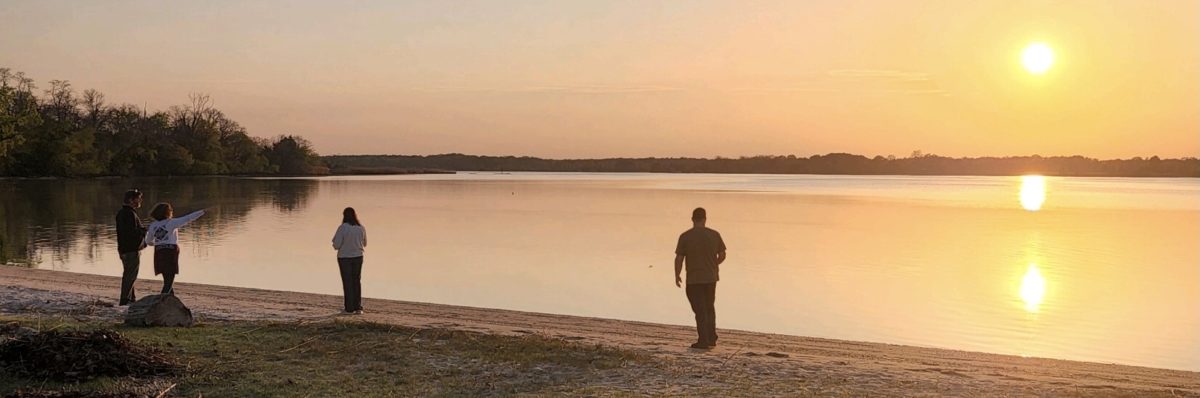
The 2025 Christ Church Easton/Diocese of Easton Mission Team in Wilmington, NC.

Let’s pray: Lord, you give us stories in Scripture for our learning, so that we can find you and find ourselves in them. Help us hear what your story is saying to each of our hearts. Let us locate where you are calling us, and how to amend our lives by your love and grace, so we can get there. And help us receive, experience, and share your gospel, your good news, in the world, with each other.

Amen.

There are no good Hallmark cards for aging

When I picture my grandparents, they are later in years. The picture I have of them in my head is younger than how I guess they would picture themselves.

When I think of my parents, the images I have in my head are younger than they are now. Probably because I still see them in some ways like I did growing up. Though there is a continuity, they are still the same people.

I don’t know what age the girls will ultimately picture me as when they think about me. Since we see each other so often, likely at my current age for now.

I can still picture them at a variety of ages.

This week’s section in the “Anam Cara” study we have going at Christ Church Easton is “Aging: the Beauty of the Inner Harvest.” One of the things we decided in our discussions is that author John O’Donohue wouldn’t have been great at writing greeting cards for aging–his sentiments are either too sappy or too bleak. And there is a lot in this section that he glosses over–the pain both of aging and failing health and of watching those we love go through these things. But there is a lot to glean from O’Donohue as well.

As a society we don’t want to talk about aging. If anything, we want to deny it, put it off, sweep it under the rug. We buy products to prevent the effects of aging, we have procedures done, we aren’t comfortable with the journey of aging. But in some cultures, old age was/is revered and respected and elders were looked to for wisdom and insight.

O’Donohue points out that since we come from the earth and are made up of earth/clay, that like the earth, the rhythm of the seasons that are outside in nature, are also present within us. Our hearts and our lives move through seasons–winter, spring, summer, autumn–and each of these seasons have characteristics and benefits and drawbacks. It is helpful to be mindful of the seasons we go through in our lives.

This is what he says about autumn:

“When it is autumn in your life, the things that happened in the past, or the experiences that were sown in the clay of your heart, almost unknown to you, now yield their fruit. Autumntime in a person’s life can be a time of great gathering. It is a time for harvesting the fruits of your experience.”

We go through seasons throughout our life, not just one of each. I can think of several autumns in my life already, where I have been able to discern meaning after an experience that didn’t make sense at the time I was living it. But there is also a real way that as we get older, we are presented with opportunities for stillness, for reflection, for memory, and for meaning. These can be some of the upsides of aging.

O’Donohue tells us that old age is a time for integration–we have had the experiences, but may have missed the meaning. It is time to put it all together.

He talks about how our mistakes are precious and invaluable: “Frequently, in a journey of a soul, the most precious moments are the mistakes. They have brought you to a place that you would otherwise always have avoided.” And one part of the integration he talks about is being able to forgive ourselves for those mistakes.

And he suggests a wonderful quote from Blaise Pascal, who advised:

“In difficult times carry something beautiful in your heart.”

A few beautiful images I carry in my heart–always hoping to add more.

A concept that O’Donohue talks about, thankfully lived out by a number of people I am fortunate to know, that can come with old age is what he calls “second innocence:”

“Old age is a time of second innocence… The second innocence comes later in your life, when you have lived deeply. You know the bleakness of life, you know its incredible capacity to disappoint and sometimes destroy. Yet notwithstanding that realistic recognition of life’s negative potential, you still maintain an outlook that is wholesome and hopeful and bright.”

I am grateful daily for those I know who are living and sharing their second innocence.

O’Donohue points to old age and integration as a time for gathering wisdom. And he has a wonderful way of looking at wisdom:

“Wisdom is the art of balancing the known with the unknown, the suffering with the joy; it is a way of linking the whole of life together in a new and deeper unity.”

As we age, may we find ways of linking the whole of life together in a new and deeper unity.

I want to finish this reflection thinking about time. There are different ways of looking at and experiencing time. There is the time that passes–the chronology of things–minutes, days, years, workdays, appointments–and there are those experiences where time passes differently.

Fr. Bill Ortt uses the terms ‘chronos’ and ‘kairos’ to talk about different kinds of time. In looking for the best quick definitions of these two terms, Unsettled popped up with this:

“Chronos is the forward propelling time that we measure with clocks, on watches, and by the evolutionary phases of the moon. But time does not end there. The Greeks’ second word for time is “kairos” — lesser known but no less important. “Kairos” is what many philosophers and mystics would refer to as “deep time.” This is the time we’re talking about where the world seems to stop entirely. It can be measured in deep exhales, a shared laugh, or by a colorful sunset.”

That says it so well. I hope in our lives, each of us have experienced kairos, deep time, those times when regular time wasn’t the same, it wasn’t there. And I hope we continue to have those experiences.

O’Donohue talks about eternal time, and says that our soul lives in eternal time. I think you could make the case that kairos moments are when eternal time mixes with chronological time–our souls inform our lives and we have these profound, deep, and beautiful moments. I hope as we age, we become more aware of these moments.

Let’s talk more about eternal time. We hear a lot of a kind of stereotypical Christian thinking that says we live our lives in time, now, as they happen, and then when we die we become part of eternity. Right now we are in time, but then when we die we are not subject to time.

But if it’s eternity, it isn’t just then, it is also NOW. We are also living in eternity now. It’s all around us, it doesn’t just start later. It’s not simply a place for later, it’s how we relate to it.

Jesus was known to have used the terms “kingdom of Heaven” or “kingdom of God.” The Gospel reading for this past weekend was from Luke’s Gospel (Luke 13:10-18) and was about a woman who had a spirit that had crippled her for 18 years. Jesus healed her on the Sabbath and caught grief from those at the temple who said he wasn’t supposed to do things like that on the Sabbath. And after schooling the temple folks in why it was right to heal this woman on the sabbath, Jesus asks, “What is the kingdom of God like? And to what shall I compare it?”

On Saturday evening at Christ Church Easton, Rev. Susie Leight preached and led our worship service. It was her daughter’s last time singing in the contemporary choir before leaving for college for the fall, and the first service at the church since learning that Rev. Carol Callaghan, a dear friend and mentor of Susie’s had died the night before.

In Susie’s sermon, she pointed out how Jesus fused the world we are living in, the world the woman in the reading was living in and experiencing, with the kingdom of God, in the here and now.

These are some of Susie’s words, excerpts from her sermon:

Jesus sees this unnamed woman and he recognizes her…
There is no coming back tomorrow. 
There is no delay. 
His actions say:
Mercy now, Compassion now, Grace now. 
You are free, now.

What is the kingdom of God like? 
The kingdom of God…
is like this right here. 
It was 2000 years ago and it is right here, right now. 
Look around you. 
We don’t have to imagine it. 

The unnamed woman is each of us sitting in this room. 
Jesus calls us too and waits to give us a drink. 

Maybe you know this and you’ve heard him calling your name, or maybe like the woman experienced, 
it’s taking you a long time to find him 
and healing seems to be far off. 

Maybe your view is all dust and dirt right now, 
and you are twisting and straining to find a way forward. 

Or maybe, by the mercy, compassion and grace of God, 
you are standing up straight and in the light. 
Rejoicing at all the wonderful things 
that Jesus is doing, 
And you are fully hydrated. 

Or perhaps you are somewhere in the middle. 

God’s time is strange. 
And I know it can feel like sometimes God is saying, 
come back tomorrow (I’ve been there), 
or often healing comes in ways 
that we might never choose for ourselves (been there too). 

But this startling work of God is often out of place, 
out of time and often directed towards people 
we might otherwise cast aside or condemn, 
people we may not even see. 

This startling work of God is meant for all, 
even those synagogue leaders, 
and right now I am imagining their red faces 
as Jesus set them straight. 
And I can hear Jesus declaring, 
Mercy now, Compassion now, Grace now. 

What is the kingdom of God like? 
And to what should I compare it? 
The Kingdom of God is like each of us sharing our water 
with someone who is thirsty and dying for a drink. 

Can you see it? Do you believe it? Will you receive it? 
Will you share it? 
Look around you.

Can you feel the fire?

Right here. Right now.   Amen.

Eternal time. The kingdom of God. The same 2,000 years ago as now. Right now. Things like mercy, forgiveness, compassion. We experience them in our souls and in our lives. They change time. The healing of our souls, of our bodies; love for God and for one another moves us from chronos to kairos, to the eternal.

These acts of healing, kindness, compassion, right here, right now, bring us into the kingdom of God; help us glimpse eternity, from our souls into our lives.

John O’Donohue tells us that “wisdom is the art of balancing the known with the unknown, the suffering with the joy; it is a way of linking the whole of life together in a new and deeper unity.”

As we age, may we be wise. May we experience a new and deeper unity. May eternal time become more evident during our chronological lives. May the kingdom of God be ever more present and a part of our lives.

Right here. Right now.