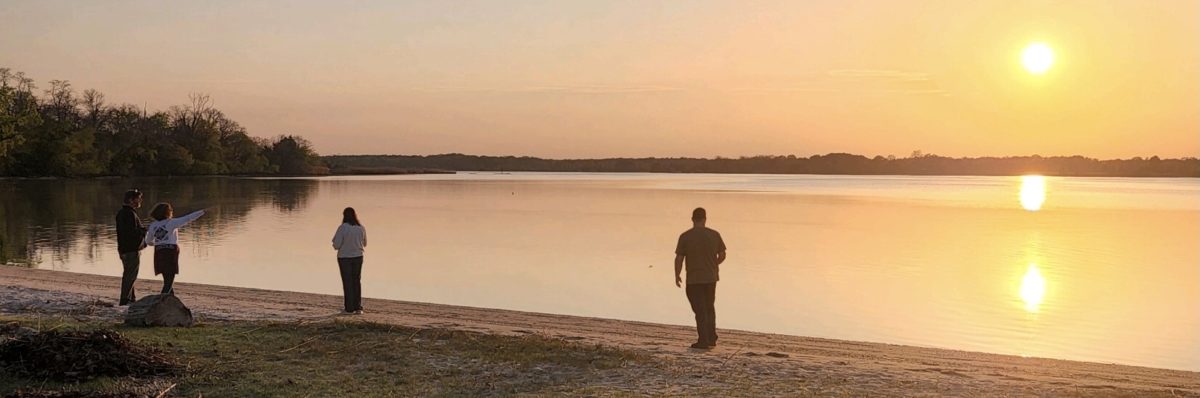
Holly and I have been together for eight and a half years. Today, June 7, 2026, we have been married for one year. The Rev. Jessica Stehle, a mutual and long-time friend of us both, and with whom I graduated from both Washington College and seminary, was the officiant at our wedding, which was held on a dock in Chincoteague, Virginia.
During the ceremony, Rev. Jess gave a short homily. As an anniversary gift, she handwrote her sermon out in a bound notebook that says, “Love Heals” on the cover and gave it to us, to continue writing love letters to each other.
Sitting on the porch of a cabin in the same camp ground where we were married, a place we have been staying on the same weekend in June for three years now, Holly and I read Jess’s words aloud and were wonderfully overwhelmed.
I am sharing her homily here, with her permission.
June 7, 2025
Welcome friends, to this blessed day! It is an honor to share God with you here, surrounded by God’s beautiful creation—living water and open sky.
Thank you, Michael and Holly, for inviting me to stand here for you today.
Almost eight years ago in the sanctuary and in the Parish Hall of Christ Church Easton, many people with a spiritual hunger and a longing for a community in which to belong, assembled regularly for a series titled “Alpha,” a word that means beginning.
They gathered in small groups, in faith formation, relationship building, trust, and expressions of Divine Love. They went away on retreat with time for stillness, prayer, and the invitation of the Holy Spirit. And among all of that holy belonging, among the presence of the Holy Spirit, two people were noticing each other.
First photo taken together, January 2018Alpha Retreat, a year after the first, October 2018
A short time later, the two lingered in the narthex of Christ Church, talking about writing, life, and sharing stories.
In church architecture, the narthex is situated inside the entrance of the church and serves as a transitional space between the outside world and the sacred place of worship—the sanctuary. It is a place for reflection and preparation for communion with God in the church. It is also a place of hospitality where newcomers are greeted by welcoming ushers into the shared experience of the love of Christ.
In essence, this architectural space in which Michael and Holly lingered symbolizes the move from ordinary to sacred. This was the beginning of their love story, two ordinary people, whose union is today and forever, sacred.
Their relationship began and has remained grounded in God. And when relationships begin with God at the center, they continue to grow exponentially. God is the source of love, and that love is limitless.
In our Gospel reading, Jesus instructs us to abide in his love and to love one another as he loves us, so that our joy may be complete.
Michael and Holly are living expressions of this commandment.
They told me of their desire to honor one another for who they are, to allow one another to BE.
That is grace-filled love. It is why they are able to, in their words, “feel more free together than they do by themselves.”
Michael and Holly, may you always abide in the completeness of your love for one another, through the freedom that exists in the love of our Savior Jesus Christ.
And now witnesses, in the style of Rev. Michael Valliant, who so often captures and shares images of his bride standing in contemplation of a beautiful landscape, and in which we can imagine him, watching her watch the world, I invite you all into stillness.
To fully enter into stillness is not to empty your thoughts, but rather to allow yourself to be filled. Stillness invites complete awareness of the reality that is happening in this present moment.
So please breathe in this moment. We are surrounded by the constant movement of the Chincoteague Bay, whose ripples run like the boundless breadth of God’s goodness. As they reach the shore, the earth offers them back out into the water.
Feel the wind that moves the Bay. Hear the birds that respond. Focus on the couple and the lives on either side of them that now exist together as a wider family. Call upon memories and images that you have already witnessed in your walk alongside this love story. Allow them to wash over you and receive their gift of sharing their wedding day with you.
Michael and Holly, turn and receive the blessing of your loved ones’ presence. Soak it in.
Abide in this sacramental moment and carry it with you always.
When I picture my grandparents, they are later in years. The picture I have of them in my head is younger than how I guess they would picture themselves.
When I think of my parents, the images I have in my head are younger than they are now. Probably because I still see them in some ways like I did growing up. Though there is a continuity, they are still the same people.
I don’t know what age the girls will ultimately picture me as when they think about me. Since we see each other so often, likely at my current age for now.
I can still picture them at a variety of ages.
This week’s section in the “Anam Cara” study we have going at Christ Church Easton is “Aging: the Beauty of the Inner Harvest.” One of the things we decided in our discussions is that author John O’Donohue wouldn’t have been great at writing greeting cards for aging–his sentiments are either too sappy or too bleak. And there is a lot in this section that he glosses over–the pain both of aging and failing health and of watching those we love go through these things. But there is a lot to glean from O’Donohue as well.
As a society we don’t want to talk about aging. If anything, we want to deny it, put it off, sweep it under the rug. We buy products to prevent the effects of aging, we have procedures done, we aren’t comfortable with the journey of aging. But in some cultures, old age was/is revered and respected and elders were looked to for wisdom and insight.
O’Donohue points out that since we come from the earth and are made up of earth/clay, that like the earth, the rhythm of the seasons that are outside in nature, are also present within us. Our hearts and our lives move through seasons–winter, spring, summer, autumn–and each of these seasons have characteristics and benefits and drawbacks. It is helpful to be mindful of the seasons we go through in our lives.
This is what he says about autumn:
“When it is autumn in your life, the things that happened in the past, or the experiences that were sown in the clay of your heart, almost unknown to you, now yield their fruit. Autumntime in a person’s life can be a time of great gathering. It is a time for harvesting the fruits of your experience.”
We go through seasons throughout our life, not just one of each. I can think of several autumns in my life already, where I have been able to discern meaning after an experience that didn’t make sense at the time I was living it. But there is also a real way that as we get older, we are presented with opportunities for stillness, for reflection, for memory, and for meaning. These can be some of the upsides of aging.
O’Donohue tells us that old age is a time for integration–we have had the experiences, but may have missed the meaning. It is time to put it all together.
He talks about how our mistakes are precious and invaluable: “Frequently, in a journey of a soul, the most precious moments are the mistakes. They have brought you to a place that you would otherwise always have avoided.” And one part of the integration he talks about is being able to forgive ourselves for those mistakes.
And he suggests a wonderful quote from Blaise Pascal, who advised:
“In difficult times carry something beautiful in your heart.”
A few beautiful images I carry in my heart–always hoping to add more.
A concept that O’Donohue talks about, thankfully lived out by a number of people I am fortunate to know, that can come with old age is what he calls “second innocence:”
“Old age is a time of second innocence… The second innocence comes later in your life, when you have lived deeply. You know the bleakness of life, you know its incredible capacity to disappoint and sometimes destroy. Yet notwithstanding that realistic recognition of life’s negative potential, you still maintain an outlook that is wholesome and hopeful and bright.”
I am grateful daily for those I know who are living and sharing their second innocence.
O’Donohue points to old age and integration as a time for gathering wisdom. And he has a wonderful way of looking at wisdom:
“Wisdom is the art of balancing the known with the unknown, the suffering with the joy; it is a way of linking the whole of life together in a new and deeper unity.”
As we age, may we find ways of linking the whole of life together in a new and deeper unity.
I want to finish this reflection thinking about time. There are different ways of looking at and experiencing time. There is the time that passes–the chronology of things–minutes, days, years, workdays, appointments–and there are those experiences where time passes differently.
Fr. Bill Ortt uses the terms ‘chronos’ and ‘kairos’ to talk about different kinds of time. In looking for the best quick definitions of these two terms, Unsettled popped up with this:
“Chronos is the forward propelling time that we measure with clocks, on watches, and by the evolutionary phases of the moon. But time does not end there. The Greeks’ second word for time is “kairos” — lesser known but no less important. “Kairos” is what many philosophers and mystics would refer to as “deep time.” This is the time we’re talking about where the world seems to stop entirely. It can be measured in deep exhales, a shared laugh, or by a colorful sunset.”
That says it so well. I hope in our lives, each of us have experienced kairos, deep time, those times when regular time wasn’t the same, it wasn’t there. And I hope we continue to have those experiences.
O’Donohue talks about eternal time, and says that our soul lives in eternal time. I think you could make the case that kairos moments are when eternal time mixes with chronological time–our souls inform our lives and we have these profound, deep, and beautiful moments. I hope as we age, we become more aware of these moments.
Let’s talk more about eternal time. We hear a lot of a kind of stereotypical Christian thinking that says we live our lives in time, now, as they happen, and then when we die we become part of eternity. Right now we are in time, but then when we die we are not subject to time.
But if it’s eternity, it isn’t just then, it is also NOW. We are also living in eternity now. It’s all around us, it doesn’t just start later. It’s not simply a place for later, it’s how we relate to it.
Jesus was known to have used the terms “kingdom of Heaven” or “kingdom of God.” The Gospel reading for this past weekend was from Luke’s Gospel (Luke 13:10-18) and was about a woman who had a spirit that had crippled her for 18 years. Jesus healed her on the Sabbath and caught grief from those at the temple who said he wasn’t supposed to do things like that on the Sabbath. And after schooling the temple folks in why it was right to heal this woman on the sabbath, Jesus asks, “What is the kingdom of God like? And to what shall I compare it?”
On Saturday evening at Christ Church Easton, Rev. Susie Leight preached and led our worship service. It was her daughter’s last time singing in the contemporary choir before leaving for college for the fall, and the first service at the church since learning that Rev. Carol Callaghan, a dear friend and mentor of Susie’s had died the night before.
In Susie’s sermon, she pointed out how Jesus fused the world we are living in, the world the woman in the reading was living in and experiencing, with the kingdom of God, in the here and now.
These are some of Susie’s words, excerpts from her sermon:
Jesus sees this unnamed woman and he recognizes her… There is no coming back tomorrow. There is no delay. His actions say: Mercy now, Compassion now, Grace now. You are free, now.
What is the kingdom of God like? The kingdom of God… is like this right here. It was 2000 years ago and it is right here, right now. Look around you. We don’t have to imagine it.
The unnamed woman is each of us sitting in this room. Jesus calls us too and waits to give us a drink.
Maybe you know this and you’ve heard him calling your name, or maybe like the woman experienced, it’s taking you a long time to find him and healing seems to be far off.
Maybe your view is all dust and dirt right now, and you are twisting and straining to find a way forward.
Or maybe, by the mercy, compassion and grace of God, you are standing up straight and in the light. Rejoicing at all the wonderful things that Jesus is doing, And you are fully hydrated.
Or perhaps you are somewhere in the middle.
God’s time is strange. And I know it can feel like sometimes God is saying, come back tomorrow (I’ve been there), or often healing comes in ways that we might never choose for ourselves (been there too).
But this startling work of God is often out of place, out of time and often directed towards people we might otherwise cast aside or condemn, people we may not even see.
This startling work of God is meant for all, even those synagogue leaders, and right now I am imagining their red faces as Jesus set them straight. And I can hear Jesus declaring, Mercy now, Compassion now, Grace now.
What is the kingdom of God like? And to what should I compare it? The Kingdom of God is like each of us sharing our water with someone who is thirsty and dying for a drink.
Can you see it? Do you believe it? Will you receive it? Will you share it? Look around you.
Can you feel the fire?
Right here. Right now. Amen.
Eternal time. The kingdom of God. The same 2,000 years ago as now. Right now. Things like mercy, forgiveness, compassion. We experience them in our souls and in our lives. They change time. The healing of our souls, of our bodies; love for God and for one another moves us from chronos to kairos, to the eternal.
These acts of healing, kindness, compassion, right here, right now, bring us into the kingdom of God; help us glimpse eternity, from our souls into our lives.
John O’Donohue tells us that “wisdom is the art of balancing the known with the unknown, the suffering with the joy; it is a way of linking the whole of life together in a new and deeper unity.”
As we age, may we be wise. May we experience a new and deeper unity. May eternal time become more evident during our chronological lives. May the kingdom of God be ever more present and a part of our lives.