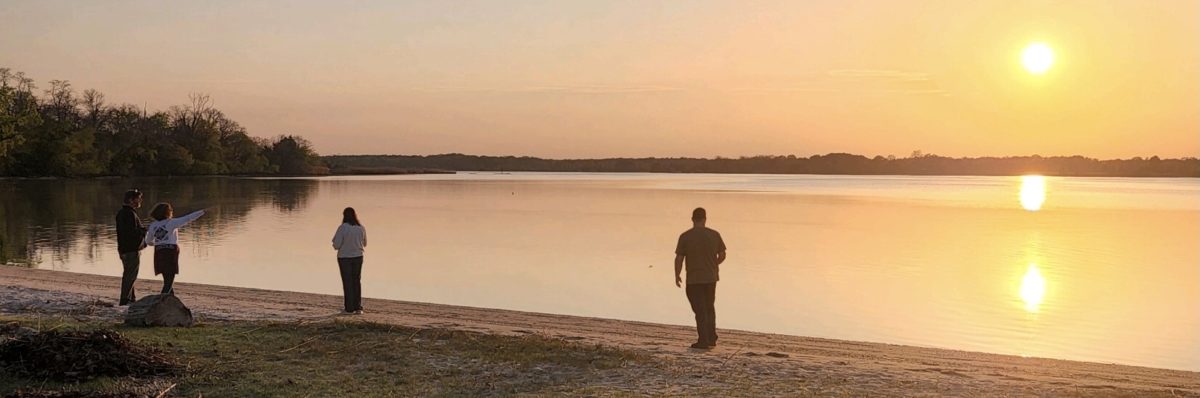
When I am open and receptive, I am not alone. Sitting outside sipping coffee, I am connected to all the hands and all the lives that were involved in picking the beans, making the coffee, and getting it here.
Listening to and watching birds opens me to a symphony of sounds, colors, and graceful movements.
I see the greens of summer above and around me and I feel the slight breeze of the morning.
In the background, I can hear vehicles heading more east than west on Route 50, starting a long holiday weekend. Though I can’t know the people driving by individually, it’s not hard to picture or remember the feeling of heading to the beach for the weekend.
When I allow myself to be open and receptive, perceptive, I don’t feel isolated. I feel connected. It’s a feeling that sets the tone for the day.
In “The Book of Awakening,” Mark Nepo writes, “The dearest things in life cannot be owned, but only shared.” Last Sunday afternoon and evening, Holly and I shared a show of God’s handiwork that was awe inspiring.
Outside to watch the sunset, we listened for birds using the Cornell Ornithology Lab Merlin app’s Sound ID. We heard Indigo Buntings, Purple Martins, Cardinals, American Goldfinches, Chipping Sparrows, Carolina Wrens, Red-Eyed Vireos, and Blue Grosbeaks.
Blue Grosbeaks were new to me and they were the noisiest and most active of the birds we were hearing. As we walked down the garden, Holly pointed out a nest in a bush and as we got near, the mother flew out and into a nearby tree. As she chirped her annoyance at us being there, Sound ID showed her to be a Blue Grosbeak. Looking up more about them, their nest is exactly as described. Hope to see some little Grosbeaks soon.
Next for our evening in the yard, despite very little rain, a rainbow appeared, developed, and thickened right over the house. It was an amazing light show.
There was a stretch in my life where I loathed rainbows—they carried some baggage I didn’t feel like unpacking, and I wrote them off as illusions of light, nothing substantial, nothing of substance. And that’s all true.
But how much of the beauty we find in life and in Creation is transient and fleeting? We know that and we can still appreciate it and marvel at it when it’s there. I live for sunrises and sunsets and they are also impermanent plays of light, which need to be enjoyed in the moment.
If I want to be available to the full spectrum and experience of God’s works in Creation, I need to be open to rainbows. It’s to my benefit and God’s glory.
The next part of the show for the evening was the sunset itself, which incorporated the clouds and the whole sky.
The Sunday evening show was on the last day of June. The month of July does not include vacation or travel for us, it’s about being open to rainbows and experiencing what is around us each day and every weekend. The idea is to “carpe” the month in every way we can. I am a list maker, here are some of the things on the radar screen:
Kayaking/paddleboarding
Parks (both new and known)
Birding
Sunrises and sunsets
Be out under the stars
Live music
Fire pit nights
Beach days
Cooking/grilling
Summer reading
Skateboarding
Gardening
Walks/hikes
If we do things on that list each day and every week, we should have a shot at carpe’ing July.
A skateboarding friend Landy Cook already put some of that into play when on July 2 he organized a social skate along Rails to Trails and at the pump track and skate park in Easton. It was a good first turn out and stellar evening, to be repeated weekly.
A number of author Annie Dillard’s words dance through my head regularly. One of the main quotes is this one:
“How we spend our days is, of course, how we spend our lives.”
There is no getting around that. If I daydream but never do anything, my days won’t reflect the life of my mind, and neither will my life.
Each day is an opportunity to do something. Beyond making a list of things I hope to do, what would a meaningful day, any day, look like?
What if every day included doing:
Something creative
Something prayerful/meditative
Something physical
Something practical
Something productive
Something peaceful/soothing
Something loving
Something selfless
Something outgoing
Something spontaneous
Something sensory/sensuous
If I can think about those kinds of things to do each day and look back at the end of the day to see how I did, how I spend my days might add up to a life I want to live.
I want to spend more time “oneing.” “Oneing” is a term the mystic Julian of Norwich used to describe the encounter between God and the soul. It’s a word and idea so meaningful to Franciscan Richard Rohr that he named the publication of his Center for Action and Contemplation “Oneing.”
It’s a feeling I get frequently when I sit quietly outside.
April 19
Skateboard, notebook, pen, binoculars, an issue of “Oneing,” reading an essay from Scott Avett of Avett Brothers fame about “Creating Faithfully.” On the shore of the river, purple flowers pull my attention until watching them and taking pictures and listening to the water, I just feel like an extension of the scene, part of it. A feeling of oneness.
Skating, gliding along pavement, has been a oneing experience for almost 30 years.
Around the Oxford Conservation Park, there are Eastern Bluebirds and I sit on a bench and watch a bluebird house where one flew out of and I read.
In addition to being a world famous singer, songwriter and musician, Scott Avett is a talented painter and a moving writer. His essay is on his faith and the creative process. He talks about contemplating Jesus’s identity and how Jesus knew exactly who he was, something most of us struggle with. Avett writes, “I think this truth alone, separates him from us. I can see how this knowing of who one is can be the most loving truth one can offer.”
He talks about going into the studio in solitude to create.
“This time alone is fertile ground where I cultivate my purpose. My contribution is my engagement in it. The studio is my cloister. To pray is to be drawn nearer to my existence. The only control I have is to show up and respond. I build from that simple idea… I long to create faithfully rather than successfully, productively, intelligently, or even truthfully. Creating faithfully is not knowing how to do it. It is believing that it is worth doing… With this, I replace the anxiety-ridden aspirations of arrival with peace in a true being. This is who I am in Christ and who Christ is in me… What a precious revelation. Simply put, to create faithfully is to be me.”
Avett arrives at this oneing through creating art. I read and sit with his words waiting on bluebirds, greeting walkers, dog walkers, and folks riding bikes as they loop the park.
April 20
It’s the last day of classes for our three-year Iona Eastern Shore seminary program, a day retreat at Old Trinity Church in Church Creek, which is about a mile down the road if you don’t turn left to go to Blackwater Wildlife Refuge. Seminary day retreats are the only reason I have been to Old Trinity, which is a beautiful church and campus. I smile that their parish hall is named “Valliant Hall.” I’ve now preached from the pulpit there twice in front of classmates and instructors, working on our homiletics.
On days when the weather is nice, I get there early so I can sit out on the dock or on a bench by the shoreline to pray, breathe, drink coffee. It’s another experience of oneing, of an encounter between my soul and God.
It’s the last time our class will be gathered together for the purpose of learning, when we are one in that way. We will graduate together on June 15.
April 21
Oneing is an encounter between God and the soul. But it can and does also include other people. According to Richard Rohr:
Julian of Norwich says, “The love of God creates in us such a oneing that when it is truly seen, no person can separate themselves from another person,” and “In the sight of God all humans are oned, and one person is all people and all people are in one person.”
We are connected to each other and we are connected to God and we can experience God in each other. In my experience, some people make us more aware of that connection, or more quickly and intuitively aware than other people do, and there are people who show and remind us of our own connection to God. Those are people to treasure and spend time with.
The first time I met Holly was on a retreat in late October 2017. Despite both living on the Eastern Shore for our whole lives, and having a number of mutual friends, we had never met. The first real conversation we had was a few weeks later at the Waterfowl Festival. We met for coffee a few times at Rise Up Coffee to continue our conversations.
In December we went for a five-mile hike together at Tuckahoe State Park, which we consider our anniversary. We walked in as two people and by the end of the hike, we were different, together. That was almost six-and-a-half years ago. Tuckahoe has been a holy, sacred, thin space for me since 2005, when I went trail running there. It is a place I called “church” long before I was going to church. Oxford and Tuckahoe are two places where oneing and walking are almost the same for me. Holly and I have hiked there a number of times since.
On April 21, we decided to hike our anniversary route.
Time passes differently with Holly. We can get lost in the backyard together, listening to and watching birds, lying under the stars; we lose track of time making dinner together, or sharing something we are excited about.
If you’ve taken time and put in work to get to know yourself, in the way that Scott Avett talks about, knowing who we are and being ourselves as the most loving truth we can offer, my experience with Holly is that you can be even more free and encouraged to be yourself by the presence of someone else. In oneing, in being together, you can be more than you were. And you can do and be that for someone else. That’s love and freedom together.
Tom Robbins, a favorite writer of mine in his book “Still Life with a Woodpecker” said, “There are only two mantras, yum and yuck, mine is yum.”
There are people who increase your yum exponentially, and you theirs. That has been our experience together. From our earliest conversations, talking about life, and dreaming about adventures, “Let’s” has always been our response to each other.
On this day, we walked into the woods together. We talked, we dreamed out loud, we watched and listened, we encountered friends along our Sunday walk who we hadn’t seen in a while.
And we said, “Let’s” to our next adventure together. Further experiences in oneing.
Two of the people I compare myself and my life with the most are my father (middle) and my grandfather (his father, left). These pictures were taken somewhere around 1905, 1950ish and 1976-7. Each of us grew up in Oxford, Maryland. It’s safe to say that there is no place in the world that any of us felt or feels more at home when it comes to a location.
Things I have learned from my father: it’s possible to be a lot like someone in character and disposition while also being very different in terms of the gifts you have and the passions you pursue; sports and a love of sports is absolutely a love language; the happiness of your children is a life goal and aspiration and a moving target that as a parent you can never hit; you can say a lot with very few words; time spent with family in any location is something to be treasured; there is grace in putting others before yourself that it is not possible to know any other way; the word “damnit” is a catch-all—tone means everything.
My Dad was born in Oxford in 1944 and lived on a small farm in the town of Oxford, which would be a trip to think of there now. My aunt lives in the house they grew up in. He went to school in the building that is now the Oxford Community Center, then to Easton High School, then to Severn High School, then to the University of Virginia. He met my Mom for the first time when they were about 14 and 13 years old.
He graduated from UVA in 1966. The Vietnam War was going on. He enlisted in the U.S. Army. He got lucky and was sent to Germany, where he lived for three years.
He came back to Oxford, he and my Mom bought the house where my sister and I grew up and where they lived until 2021 when the house burned down.
He got a job as an accountant working for Fall Casson for a few years until he and three others took a chance and went out on their own starting Beatty Satchell & Company, a CPA firm. My Dad was known as “Mr. & Company” because he thought it looked tacky to have too many names on a business and didn’t need his name listed. Of the four that started the firm, he is the only one who still works there.
My memories of him as I was growing up include tax season, fishing with he and my grandfather, his office softball team (he played first base, like Eddie Murray), cookouts on the water at the Tred Avon Yacht Club, haunted houses every year as part of the Kiwanis Club, and him being asked to be treasurer of every nonprofit organization he volunteered for.
Their parenting style has always been to let their kids find their own way, make mistakes, figure out what was important, and to be supportive in every step of the way, helping us up when we fell. I fell, and fall, a lot more than my sister did or does. I always cared less about getting in trouble and more about letting my Dad down.
I have been so incredibly lucky that from childhood to now that my Dad has always been the first person I call to share good news, the first person I turn to for advice, and the first person I look to for solace when life falls apart. And he still picks up the phone.
We’ve been to Baltimore Orioles playoff games and a World Series game, Baltimore Ravens games, including playoff wins and losses. Going to a game together when they win (playoff win pictured above) is an awesome feeling.
Yesterday, my Dad turned 80. I tear up with stuff like this because I am so full of gratitude to have him as a role model, a friend, a grandfather to the girls—for them to get to know and appreciate him like I do—as someone who our family gets to share the joys, sorrows, confusion, wonder, and all the best stuff of life with. One of my all-time and forever favorite sounds and experiences is him laughing.
Turning 80. What a gift. The person having the birthday is the one who gets gifts. But it’s those of us who know and love him that get the biggest gift here.
Happy birthday, Dad. I don’t have the words to say what I actually want to say so these will have to do. I love you. We all do.
Background: Last Saturday evening there was a wedding on Saturday evening at Christ Church Easton, so we moved our Alive @ 5 contemporary music service into the Parish Hall and served dinner at the end of the service. The band was in the style of MTV Unplugged and the Parish Hall was full of good food and fellowship. The Gospel from the lectionary last weekend was Matthew 18:15-20, where Jesus outlines how to deal with conflict/sin between people in the community. With our Rector/Pastor officiating the wedding, I preached at our Saturday evening service.
“Bearing With Each Other”
“Christian conflict resolution” is not a class that would have a waiting list to get into. It comes off a bit like a root canal—necessary, but not something to look forward to.
But when you look around society and how we deal with feeling wronged, we do need some guidance. These days there are a lot of passive-aggressive outlets out there. What are some notable passive-aggressive ways to not actually deal with conflict?
If your neighbor has done something to you, you might go through the neighborhood association, or contact the town. When a friend makes us angry, we might defriend or block them on social media, or write huffy, angry comments under something we disagree with. Politicallythese days, when someone slights or disagrees with someone, the goal is to discredit, belittle, shame, and have others pile on. Nothing is resolved. And resentment becomes more deeply rooted.
When someone wrongs us, when someone sins against us, we want things to be made right, for us. Our self-righteousness demands satisfaction.
That’s not what’s going on in today’s reading. Jesus is looking at this earliest church community, not society at large. And he is giving instructions for the benefit of the sinner, whose actions are pulling him/her/them outside of the community. Jesus is giving the disciples steps to restore that person, to keep the community together.
What an unmodern concept—to care about the sinner, and about the community, more than our own sense of justice.
This is a teaching about reconciliation, and it’s reconciliation based on love and forgiveness.
It’s not easy. It’s counter-cultural. It doesn’t make sense with how our laws are written.
But community can’t be built on the law. Legalism won’t save us. If you look at most laws, including those in Scripture, they’re drawn up around doing no harm. And that’s not bad—those kinds of laws help keep us safe.
When it comes to a faith community, safety isn’t enough.
Jesus doesn’t summarize the commandments by saying, “don’t harm God and don’t harm your neighbors.”
We’re called to love.
God doesn’t want us to coexist (though the sentiment on those blue bumper stickers is better than the alternative of wiping each other completely out of existence).
God wants us to thrive. To help one another. To be there for each other. To love one another.
Both Paul, writing today’s New Testament reading, and Jesus, speaking in today’s Gospel, want to make sure we get the message loud and clear.
When we love, we more than fulfill the law. And Jesus looks at conflict within the church community through love.
When there is conflict, where someone is going astray: deal with it, fix it, work it out. This is where things get hard for us, especially in a church. Historically, churches have publicly fallen on their faces with conflict resolution on big issues. Look at how many scandals and atrocities have been dealt with by the church, by transferring an offending clergyperson somewhere else—out of sight, out of mind, not our problem. That’s conflict, that’s crime, and that’s reconciliation on a different scale, but it’s real and something the church has to deal with in order to be the example it needs to be in the world.
As parishioners, on a much lesser scale, when it comes to having an issue with someone in the congregation, we might find it easier to find another church rather than work through something difficult when someone has wronged us.
Avoidance is an easier path than reconciling. And there is a cost to that.
Best-selling author, theologian and Bishop N.T. Wright says:
“Reconciliation is a huge issue today. We can see the results of not doing it: suicide bombs, campaigns of terror, heavy-handed repression by occupying forces. That’s on the large scale. On the small scale, we see broken marriages, shattered families, feuds between neighbors, divided churches.”
Jesus knows how hard it is going to be for the early church to stick together in community, especially once he is gone. And he goes straight at things, right up front.
He says, first, try to work it out between the two of you. If that doesn’t work, take a couple people with you. Expand that circle slowly. Allow the person to save face as much as possible.
Jesus doesn’t say—talk about that person, gossip, try to get everyone on your side. Instead, deal with it quickly and between the two of you.
Let’s remember the goal: bringing the sinner back into the fold, keeping the community together. All while dealing with what happened.
Here is N.T. Wright again:
“Forgiveness doesn’t mean saying “it didn’t really happen” or “it didn’t really matter.” Forgiveness is when it did happen and it did matter, and you’re going to deal with it and end up loving and accepting one another again anyway.”
We are sinners, all of us. We all mess up. We all fall off the path we are trying to walk. Forgiveness, grace, love—how God deals with us, is how we are to deal with each other.
What does the church need? Reconciliation (that’s our word of the night). The mission of the church is to reconcile the world to God. To do that, we have to model it in our midst. Not in some abstract way, but right down into the details of our lives and how we treat each other.
There’s a part of this reading that is easy to miss. Jesus tells the disciples that when an offender refuses to listen even to the church, “let such a one be to you as a Gentile and a tax collector.”
Let them go, as outsiders.
What do we know about Matthew from the text a few weeks ago? He’s a tax collector. And Jesus still loved and restored him. Even in continued disagreement and going separate ways, the goal is still restoration.
Dietrich Bonhoeffer has a little book called “Life Together,” where he looks at Christian community. He says that when it comes to ministry in a community, listening, active helpfulness, and bearing with others are foundational. He says it is hard to bear the sin of another person because it breaks fellowship with God and with his brother.
“It is only in bearing with him that the great grace of God becomes wholly plain. To cherish no contempt for the sinner but rather to prize the privilege of bearing him means not to have to give him up as lost, to be able to accept him, to preserve fellowship with him through forgiveness… As Christ bore and received us as sinners so we in fellowship may bear and receive sinners into the fellowship of Jesus Christ through the forgiving of sins.”
And Bonhoeffer ties it together saying that “where ministry of listening, active helpfulness, and bearing with others is faithfully performed, the ultimate and highest service can also be rendered, namely, the ministry of the Word of God.”
If as a community, we aren’t oriented towards listening, actively helping, and bearing with others, we are going to have a hard time ministering the Word of God to others. Because where would it be found in our lives and our community?
And then we get to these incredible last lines of the reading: “For where two or three are gathered in my name, I am there among them.”
How many people have heard that line before? How many have used it in the context of gathering together? And how many realized that Matthew includes those words from Jesus, here, when he is talking about sin, disagreement, and reconciliation—not at the Last Supper, or the Sermon on the Mount, or some hopeful healing or miracle. It’s here, where or when we are struggling, maybe even divided, that we need to remember and call on his presence among us.
If we as the church are going to reconcile the world to God, we aren’t going to do it on our own. We need God’s help. Thankfully, God has already done the work, in and through Jesus, who is with us, always.
And if we are going to call on his name, and continue his work, we’ve got to work through the tough stuff, not brush it under the rug and pretend it didn’t happen.
We’ve got to listen, we’ve got to help, we’ve got to bear with each other. That’s what love and forgiveness look like.
Amen.
Bonus quote, which we used in our Zoom discussion about the Gospel reading on Sunday morning. The quote comes from Padraig O’Tuama’s book, “Daily Prayer With the Corrymeela Community”–
“Listening is a sacrament when the topic is important, and when strife divides people in small places, the sacrament of listening is vital. So many people and so many places in the world have difficult relationships with difference. We seek to practice the art of hospitality in the places of hostility, and in so doing practice kindness in places the most in need of kindness.”
Sometimes I’m drawn forward and sometimes I am turned to circle back, usually so I can pick something up I need to go forward. That’s an eyebrow-raising, quizzical-look statement, I know. Let’s try this:
This past weekend, I went for a run–my first run since early April. It was slow, but it didn’t matter–the smile on my face running through John Ford Park, saying good morning to folks I encountered, feeling air in my lungs and my feet in motion, even if stumbling slowly, was something I have been missing.
Running, skateboarding, and writing are three life-giving activities I discovered in my early teens that sustain and stoke me in my early 50s. There is a thread that connects them.
“There’s a thread you follow. It goes among things that change. But it doesn’t change. People wonder about what you are pursuing. You have to explain about the thread. But it is hard for others to see. While you hold it you can’t get lost. Tragedies happen; people get hurt or die; and you suffer and get old. Nothing you do can stop time’s unfolding. You don’t ever let go of the thread.“
Nepo writes, “To discover the thread that goes through everything is the main reason to listen, express, and write… I began to realize that listening, expressing, and writing are the means by which we stay clear, the inner practices by which we realize our connection to other souls and a living Universe.” Then he invites us to think about, write about, and try to discern what that thread is for us, individually. What is the constant that is with you, through joy, pain, sadness, lows, highs, that makes you, you?
As I sat there, coffee, sunlight, and summer-breeze-fueled, scratching out a few notes, the thing that hit me was: a sense of wonder. That’s the thread. From marveling at honeysuckle and marsh grasses in the neighborhood as a kid, to Morning Glories and Great Blue Herons as an adult, a childlike sense of wonder has underpinned it all.
Nepo is a writer I’ve just found. He circled me back to Stafford and a poem I’ve been reading for years–something I needed to pick back up to move forward with new eyes.
Running, skateboarding, and writing have been wonder-stokers for me all along. Somehow they have distilled over time to where the wonder is there now as soon as I step on a board, pick up a pen, or put running shoe to pavement.
Yesterday morning, Landy Cook and I met at the Oxford Conservation Park to start the week off with a sunrise longboarding adventure. The sun was smiling with us and lent its rays to every moment and every photo. It was a morning to catch up, to laugh, to skate, to enjoy the moments, to breathe in the day. It’s a place we skate frequently, it’s not new scenery, but every morning is its own, there is always something new or different to catch, to appreciate, to be grateful for.
For me, part of those experiences, those moments, of being given a gift, is wanting to communicate it, to share it, maybe if I am lucky to wake something up for someone else, to connect in some way.
Nepo says it: “listening, expressing, and writing are the means by which we stay clear, the inner practices by which we realize our connection to other souls and a living Universe.” That’s what writing brings to my aesthetic and Spirit-filled table. Even rolling on a skateboard, I make sure to have a pocket notebook and pen to try to catch something of the wonder of the experience.
A couple weeks ago I was sent back to another favorite writer, John O’Donohue. Last summer we led a small group discussing his book, “Anam Cara.” A friend from church continues to read and reflect on it regularly and he wanted to pass along a copy to someone who is going through profound loss, hoping it might give them something to latch onto–perspective, compassion, care, connection, hope.
The class last summer was right around this time of year and a memory, a quote from “Anam Cara” circled its way back in front of me. It’s a thought that struck me as something Holly has been working through after coming back from a 12-day mission trip to Amazon river villages in Peru, where the life of the villagers was deliberate, present, and connected to the days and nights, the land, and each other. O’Donohue wrote:
“It is a strange and magical fact to be here, walking around in a body, to have a whole world within you and a world at your fingertips outside you. It is an immense privilege, and it is incredible that humans manage to forget the miracle of being here.”
The miracle, the wonder, of being here. That’s our connection to each other, other living souls, to God, to the living Universe; whether we are in Peru, the backyard, or skateboarding with the sunrise.
“Unabashed” is a word we might get to know better. It’s defined different places as “not embarrassed, disconcerted, or ashamed,” and “undisguised, unapologetic.” It’s a word that is tough to live into for thoughtful, humble people who are concerned how people might take what they think or feel. Unfortunately, the flipside is that there are plenty of thoughtless people for whom being unabashed comes easily.
I am grateful when I get reminders to pick up favorite books of my shelf and re-read them. Dorchester County Public Library gave me my most recent reminder when they promoted a program for Ross Gay’s book “Catalog of Unabashed Gratitude” (really such a great title, without even reading the book).
“Catalog of Unabashed Gratitude is a sustained meditation on that which goes away—loved ones, the seasons, the earth as we know it—that tries to find solace in the processes of the garden and the orchard. That is, this is a book that studies the wisdom of the garden and orchard, those places where all—death, sorrow, loss—is converted into what might, with patience, nourish us.”
A community orchard in Bloomington, Indiana, informs Gay’s take on gratitude, together with his experience gardening.
“…In this neck of the woods you have to prune a peach tree if you don’t want the fruit to rot, if you don’t want all that fragrant grandstanding to be for naught.”
He mourns the life cycle and necessary work to a tree in his poem “the opening” and continues:
“…This is how, every spring, I promise the fruit will swell with sugar: by bringing in the air and light– until, like the old-timers say, the tree is open enough for a bird to fly through.”
And he talks about two cardinals and a blue jay flying through and a little grayish bird that sings a song “half dirge, half disco.” There is maybe one of the best and most memorable descriptions for a life fully felt and fully lived, “half dirge, half disco.”
I’m a fan of sunrises and sunsets. I will stop what I am doing, turn away from a conversation (though generally I am still listening) to take in those fleeting moments. The fact that they are only there for a few minutes is what makes them beautiful. You have to catch them as they happen–you can’t tell a sunset you’ll get back to it, or ask it to hold on. You’ve got to give it your full attention. Appreciate the whole scene and everything going on around it. Drink it in.
Life is that way. It is full of moments and if we want to live it to the fullest, we have to pay attention to all the moments we can.
In the title poem, “Catalog of Unabashed Gratitude,” Gay says:
“Thank you to the woman barefoot in a gaudy dress for stopping her car in the middle of the road and the tractor trailer behind her, and the van behind it, whisking a turtle off the road.”
And I think of so many of my friends who do that and fill the social media feed with turtle rescue photos and every single one of them gives me a little hope for humanity. Even though after we stopped to move a turtle on the way to Hoopers Island a couple weeks ago, the truck going by didn’t much appreciate the effort. It’s all part of it.
I have so many lines and parts and images from Gay’s catalog underlined and tucked into my heart, I hardly know what to share. But I like this notion of community:
“we dreamt an orchard that way, furrowing our brows, and hauling our wheelbarrows, and sweating through our shirts, and less than a year later there was a party at which trees were sunk into the well-fed earth”
Dreaming together, thinking together, cultivating together, working together, celebrating together. I just finished re-reading Gay’s catalog. If you want to get a different, deeper, more inclusive picture of what we can be grateful for, give it a read. DCPL can help you to that end. And maybe come out for the program at the Dorchester Center for the Arts–I have found that my appreciation and perspective for every book I have read and been moved by has deepened from discussing and sharing and listening to what others have taken from the same book.
In the meantime, I am going to pick back up Gay’s “Book of Delights,” his record of small joys that are so easy for us to overlook. And I’m going to continue to try to bring gratitude to each day, unabashedly, sharing as much as I can, one sunset, one moment, at a time.
Some prayers move, they wander, they surf like a skateboard, they stop to look at birds or sit under a tree. Some prayers stop to pick up a six pack. Some prayers start while reading and writing next to the river and keep going sitting in a salon where my daughter is getting box braids in her hair to get ready for surgery on Monday.
U2’s “Still Haven’t Found What I’m Looking For” plays from the speakers, which makes me smile because a couple days ago Ava mentioned having that song on her playlist.
My prayer reads Brenda Miller’s “The Shape of Emptiness “ where a creative writing student whose mother had just died passes out Playdough to the class and has them squeeze it in their hands and then puts all their “hands” on a table at the front of the classroom. Miller says, “He made visible the air we never see.” And then:
“When he finishes reading he gathers our hands and gives them back to us one by one. We take them from him carefully so we can carry our emptiness into the day. We compare them, showing off the shape of our grasping. Curved like prayers. Like anger. Like love.”
God, maybe our prayers are like those hands, our grasping to fill emptiness, trying to bridge the distance between us. Sometimes that distance is wide and tough to cross. Other days we are sitting next to each other by the river smiling the same smile, thinking the same thoughts.
Lord, my prayer is written on my heart and it is for Ava on Monday and the next couple weeks, that all goes well and the surgeons and neurologists and medical team find what they need to know and that their knowledge brings hope.
Some prayers last for a couple days and have more silence in them than words. I know you appreciate the silence, Lord, because sometimes the world is too noisy. And silence speaks louder.
My prayer, God, is about love and right now love is sitting in a salon and being so full that words either pour out or nothing will come. Right now, love looks like box braids and someone taking the time and care to help my daughter so she doesn’t have to have her head shaved.
Some prayers take weeks, months, years. Some prayers run out of ink as I write them, run out of words as I speak them, and take an entire life to say what I need to say and listen for what I need to hear.
Some prayers are to be continued. Just like our love. Just like your love. And all of them are written on our hearts and with our lives, which belong to you.
There is something about this time of year. As Fr. Bill Ortt points out, the word “Lent” comes from an Old English word that means “lengthen”—for the days getting longer. It’s not the spring is here yet, but we are moving in that direction. The magnolia tree in our front yard attests to that (as do the neighbors saying, “there he is in the yard staring at and taking pictures of the tree again…”).
This week we end a long study of Paul’s Letter to the Romans. And we start both Zoom and in-person studies of Debie Thomas’s “Into the Mess & Other Jesus Stories.”
Talking about Romans, Rev. Jay Sidebotham in his book, “Conversations with Scripture: Romans” writes:
“Paul offers specific examples of what a community transformed by grace looks like. It is a community of righteousness, a matter of being in right relationship with each other. That community will be marked by a willingness to forgo one’s own agenda for the better of another, most definitely a countercultural thing to do… The Christian community is to be marked by a spirit that honors the other.”
For Paul, it was the impossible task of unifying the Jewish believers in Christ with the Gentiles–something that had never been done. It’s telling that we have had more than 2,000 years to work at this, but we seem to have taken steps backwards at welcoming and honoring the outsider, the other. That is something to think about and pray on during Lent (and beyond).
In society today, we’ve decided that faith is a personal/individual thing, it’s between us and God. But I wonder what happens if we poke our individual faith with a stick.
In the first essay in “Into the Mess,” Thomas looks at Luke’s Gospel, (1:26-38) where the angel Gabriel tells Mary what’s going on with her and how God is calling her. Thomas talks about what a shocking and impossible reality was being opened up for Mary. And after the angel leaves:
“(Mary) has to consent to evolve. To wonder. To stretch. She has to learn that faith and doubt are not opposites–that beyond all easy platitudes and pieties of religion, we serve a God who dwells in mystery. If we agree to embark on a journey with this God, we will face periods of bewilderment… (leading to) it’s when our inherited beliefs collide with the messy circumstances of our lives that we go from a two-dimensional faith to one that is vibrant and textured.”
For both Mary and Paul, when they said yes to their callings/journeys with God, their lives got more difficult, harder to bear, not easier. For some of us, that kind of poking may be uncomfortable. It’s meant to be.
Thomas goes on to talk about the cost of loving, “to love anyone in this broken world takes tenacity and grit, long-suffering and great strength.” She goes from talking about Mary, to talking about us:
“The particularities of our own stories might differ from Mary’s, but the weight and cost of ‘bearing’ remain the same–and so does the grace. When we consent to bear the unbearable, we learn a new kind of hope. A hope set free from expectation and frenzy. A resurrected hope that doesn’t need or want easy answers. A hope that accepts the grayness of things and leaves room for mystery.”
Bearing the love for another in the world has its cost and its grace. Bearing the love of Christ in the world–being those who love God, welcome and love the outsider/other, those who feed the poor, heal the sick, or simply those who try to understand and love those who are difficult for us to understand or love–has its cost and its grace.
Faith isn’t an individual matter of being rescued from the mess, it is a choice to meet God in the mess, where He is, and we are, needed.
At Christ Church Easton, Fr. Bill has declared this Lent to be a season of healing, a time of sharing our stories and listening to others; of helping to find and spark hope for each other.
Tell us your story about where God entered your life and did something unexpected and remarkable. Share your story of healing.
The days are getting longer. We have a season where creation around us is going green and things are starting to blossom. We can use this season to draw closer to God and to encourage each other. We can bear the love of Christ into the world and in the process expand our faith into something vibrant and textured that embraces the messiness and mystery of life.
Sitting by the river with a strong breeze moving the water and blowing against one side of my face while the sun warms the other.
I woke up in a warm house, while it was still dark and made coffee. Made a to-go breakfast for my older daughter for her drive to work. I laughed with my younger daughter taking her to school.
Now I am sitting in the sun and the wind by the water praying, reading, writing, listening, smiling.
Behind me is a cemetery where my grandparents, family members, and friends rest peacefully. Memories and love dance between us and connect us.
The books in front of me are titled “Pilgrim” and “Gold.”
Talking to God, Rumi writes:
“Today you arrived beaming with laughter– that swinging key that unlocks prison doors.
You are hope’s beating heart. You are a doorway to the sun. You are the one I seek and the one who seeks me. Beginning and end.
You greet need with generous hands. You flood us with spirit,
ringing from the heart, lifting thought.”
Reading this, he and I say it together. I like to think God smiles in the sunlight.
Across the cove the sun and the wind dress a weeping willow tree. Geese float tucked away from the tide.
When I am fully here, in this moment, with a full heart and an open mind, and time alone with God, what more can I ask for? I am not alone.
Thank you for this view. Thank you for this day. Thank you for this life. Thank you for your love.
Amen.
* My practice/devotion for Lent this year is to write a “proem” (prayer-poem-prose) in the spirit of Brian Doyle each day of the season. I will share some of them.This is day #3.
Life has felt large and open and raw of late, where prayers, feelings, experiences and thoughts are all super charged.
There are plenty of reasons: Ava’s stereotactic neurosurgery is on Monday; Anna turns 21 on Tuesday and Ava turns 18 in mid-February; we’ve past the half-way point in our Romans Bible studies; seminary is stirring good things up and Kelsey Spiker and I just became postulants, the next designation in the path to ordination to the priesthood; even occasional preaching is a full-body experience; gearing up for Lent small groups; and the girls had their first ever snow skiing experiences, which was a trip with Holly and her kids as well as many teen and twenty-something friends.
Life has an open feeling, which is both filling and fulfilling and taxing and shaky sometimes.
Studying for a Saturday seminary day retreat, Rev. Susie Leight has us reading and thinking about the spirituality of the priesthood, which included excerpts from Barbara Brown Taylor’s “The Preaching Life” and Gordon W. Lathrop’s “The Pastor: A Spirituality.” Lathrop recalls an experience in a Swiss airport where he read a quote on a poster from Antoine de Saint-Exupery, written in French. Lathrop translated it literally to say:
“As a profound thirst: the desire to be a human being among human beings.”
A deep and profound desire to be a human being–someone who lives and feels, who is flawed and who needs others–among human beings. To be in community and to be allowed to be fully ourselves. This is what it is to be open, to be honest, to be vulnerable, which is not instantly a comfortable place to be.
Thursday we had a class discussing Tracy K. Smith’s Pulitzer Prize-winning book, “Life on Mars,” which is one of my favorite books. The discussion was about space and time, love, loss, grief, dancing, intimacy, language–it was flung like stars around the minds and hearts of those there. The last poem read was titled, “The Weather in Space”–
Is God being or pure force? The wind
Or what commands it? When our lives slow
And we can hold all that we love, it sprawls
In our laps like a gangly doll. When the storm
Kicks up and nothing is ours, we go chasing
After all we’re certain to lose, so alive–
Faces radiant with panic.
That is part of the challenge of being human, loss and fear are always in the mix with us. It’s a lot and sometimes we want to–I want to–shut the faucet off. But that’s not why we’re here. That’s not why I am here.
On Tuesday morning, I was thinking ahead to this weekend’s Gospel reading, which is Matthew 5:1-12, commonly known as the Beatitudes:
When Jesus saw the crowds, he went up the mountain, and after he sat down, his disciples came to him. And he began to speak and taught them, saying:
“Blessed are the poor in spirit, for theirs is the kingdom of heaven. “Blessed are those who mourn, for they will be comforted. “Blessed are the meek, for they will inherit the earth. “Blessed are those who hunger and thirst for righteousness, for they will be filled. “Blessed are the merciful, for they will receive mercy. “Blessed are the pure in heart, for they will see God. “Blessed are the peacemakers, for they will be called children of God. “Blessed are those who are persecuted for the sake of righteousness, for theirs is the kingdom of heaven. “Blessed are you when people revile you and persecute you and utter all kinds of evil against you falsely on my account. Rejoice and be glad, for your reward is great in heaven, for in the same way they persecuted the prophets who were before you.“
I’ve been in a habit of looking to see if Debie Thomas has anything to say about a particular Bible passage in her book “Into the Mess & Other Jesus Stories.” And reading her take on the Beatitudes, it hit me that her book would make an incredible Lent study, looking at and discussing different aspects of Jesus’s life. Here is a bit of her take on the reading:
“What Jesus bears witness to in the Beatitudes is God’s unwavering proximity to pain, suffering, sorrow, and loss. God is nearest to those who are lowly, oppressed, unwanted and broken. God isn’t obsessed with the shiny and the impressive; God is too busy sticking close to what’s messy, chaotic, unruly, and unattractive.”
She goes further:
“I think what Jesus is saying in the Beatitudes is that I have something to learn about discipleship that my privileged life circumstances will not teach me. Something to grasp about the beauty, glory, and freedom of the Christian life that I will never grasp until God becomes my all, my go-to, my starting and ending place. Something to recognize about the radical counter-intuitiveness of God’s priorities and promises. Something to notice about the obfuscating power of plenty to blind me to my own emptiness. Something to gain from the humility that says, ‘The people I think I am superior to have everything to teach me. Maybe it’s time to pay attention.'”
If I want to be a human being among human beings, I have to be open to, to learn from, to love, those whom God loves: everyone. More than that, if as followers of Christ, we look to do God’s work in the world, we have to be, we have to show, we have to act out in faith the love that God makes real here and now, especially to those who feel alienated or shut off from it.
In teaching the Beatitudes, Jesus is turning the world and what we think we know about it, on its head. This is something he does frequently in his teachings and his parables. We should ask why.
Next week we will discuss poet Joy Harjo’s book “Conflict Resolution for Holy Beings.” In “Talking with the Sun,” she writes:
After dancing all night in a circle we realize that we are a part of a larger sense of stars and planets dancing with us overhead. When the sun rises at the apex of the ceremony, we are renewed. There is no mistaking this connection, though Walmart might be just down the road. Humans are vulnerable and rely on the kindnesses of the earth and the sun; we exist together in a sacred field of meaning.
To be a human being among human beings is also to be human in and as a part of God’s Creation. Which He asks us to be stewards of, to take care of.
Humans are vulnerable and rely on kindnesses. When I try to live with my heart open, I have a greater sense of, and gratitude for these kindnesses–kindnesses that can come from anywhere and anyone. Any one of us. Even me.