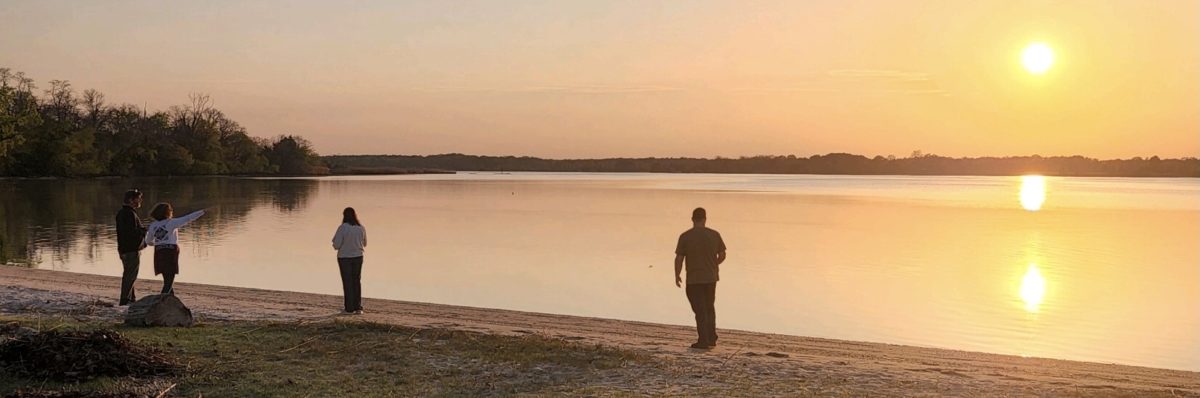
When I walked to the shoreline, there was a Kingfisher just down the bank.
Across the creek, a Great Blue Heron plodded.
This morning I got a note from a friend who has cancer and is struggling through treatment. He was flown to Hopkins and is in the ICU. He asked for prayer.
I prayed. I wrote and sent him a prayer. I am praying. I will be praying. I haven’t stopped. It never feels like enough.
What I want for him is a miracle. A return to health and home and family and worship and all the things he loves and that love him back.
How about a miracle, God? Have you seen the world lately? Have you seen how we behave? How we treat one another? Most of us don’t deserve miracles. But you still give them. I can’t always figure out why or where, but it’s not on me to do that. Miracles are you, God.
I can hear Bob Weir singing, “I need a miracle every day”–and I get that.
I feel it in my soul–the miracles of morning coffee and a hug in the kitchen, and making breakfast for my daughters, of a world where the seasons change and there are Kingfishers and Herons on the shoreline.
I think of the ICU. Where miracles are breath. And modern medicine. Doctors and nurses. Love of family. Technology. Communication. Patience. Time. Prayer. Hope.
I sit on the shoreline praying for my friend. I feel your presence all around me.
A jet flies over with its landing gear down; it’s a majestic sound and sight. It’s a miracle you’ve given us through the minds, reason, and intellect you created in us.
I pray now with tears in my eyes for multiple friends with cancer who love you and who share your love with others.
We all need miracles every day. Send some extras to those with cancer and to their families. Keep them connected to your love, your peace, your healing.
From Ash Wednesday to Easter. A journey, a transformation, and one of the most intentional and richest parts of our liturgical calendar.
Our Lenten e-mail prompt and discussion of John O’Donohue’s book, “To Bless the Space Between Us,” was rich, meaningful, and eye-opening. It was a continuing and deepening conversation with 20 people which included the Eastern Shore, Vermont, and even photos and stories sent from Finland.
One of the purposes of the book for O’Donohue was/is to get us thinking about “blessing” differently, and that blessings can take many forms, not always something that we would wish, ask for, or even want. Sometimes blessings can be the sun and sometimes the silver lining.
The last section of the book is “To Retrieve the Lost Art of Blessing.” It is an intentional walk through a way of seeing. Here are a few early quotes:
“Something deep in the human soul seems to depend on the presence of kindness; something instinctive in us expects it, and once we sense it, we are able to trust and open ourselves.”
“Kindness has gracious eyes; it is not small-minded or competitive; it wants nothing back for itself. Kindness strikes a resonance with the depths of your own heart; it also suggests that your vulnerability, though somehow exposed, is not taken advantage of; rather it has become an occasion for dignity and empathy.
“Despite all the darkness, human hope is based on the instinct that at the deepest level of reality some intimate kindness holds sway. This is the heart of blessing. To believe in blessing is to believe that our being here, our very presence in the world, is itself the first gift, the primal blessing.”
That last paragraph especially: to see life itself as the first gift, the most basic blessing. Despite all the darkness.
We’ve just gone through an entire liturgical season that sees light overcome what seemed like the ultimate darkness. When faced with what seemed like the end, death, God shows us more, that new life overcomes death. That hope is not in vain, but intrinsic and ever-present, if we will see it.
Over the course of our group discussion, participants responded with pictures of the Northern Lights in Finland and an Assateague camping sunrise.
The Resurrection is nuanced and layered in its meanings. One of the things it did was give credibility to Jesus being who he said he was. And it made the disciples for the next few generations, reflect back on what Jesus said and did, to the point of writing it down so that it could be passed down.
Many writers and theologians point out that Jesus’s words to his disciples were “follow me,” not “worship me.” It’s really a both-and situation, we can do both; and worship is a perfect response to God. But a problem over the years has been and continues to be that many Christians are content with worshipping ( and “believing” without living or living into any of that belief) and have dropped the following aspect of our faith.
Following Jesus means living like he did, loving like he did, doing our best to emulate his example. In John’s Gospel, Jesus gives the disciples (and us) the new commandment of “loving each other as I have loved you.” which he says knowing he is about to be arrested and put to death. That’s what his love looks like–sacrificing himself for the love of his friends and for humanity.
When we look at kindness through the example and eyes of Jesus, we have a sense of what we are called to do and who we are called to be.
O’Donohue closes his book with the poem, “The Eyes of Jesus”–
I imagine the eyes of Jesus Were harvest brown, The light of their gazing Suffused with the seasons:
The shadow of winter. The mind of spring, The bues of summer, And amber of harvest.
A gaze that is perfect sister to the kindness that dwells In his beautiful hands.
The eyes of Jesus gaze on us, Stirring in the heart’s clay The confidence of seasons That never lose their way to harvest.
This gaze knows the signature Of our heartbeat, the first glimmer From the dawn that dreamed our minds,
The crevices where thoughts grow Long before the longing in the bone Sends them toward the mind’s eye,
The artistry of the emptiness That knows to slow the hunger Of outside things until they weave Into the twilight side of the heart.
A gaze full of all that is still future Looking out for us to glimpse The jeweled light in winter stone,
Quickening the eyes that look at us To see through to where words Are blind to say what we would love,
Forever falling softly on our faces, His first gaze plies the soul with light, Laying down a luminous layer
Beneath our brief and brittle days Until the appointed dawn comes Assured and harvest deft
To unravel the last black knot And we are back home in the house That we have never left.
The eyes of Jesus are a way of seeing and a way of being, in terms of how we see and treat each other. O’Donohue talks about the way Jesus sees us, his gaze, and describes it in a way that should make us feel like we are loved before we do or say anything. Our souls are loved, as well as our bodies and minds. Do we allow ourselves to feel seen and loved that way?
Following Jesus means to try to look at ourselves, each other, and Creation with these eyes and this love.
Why do we take a journey through Lent? Why do we try to take in, reflect on, pray on, the Passion/suffering of Jesus over Holy Week? Why do we celebrate Jesus’s Resurrection?
I hope that at least part of the reason is to allow ourselves to be transformed, to become more Christ-like, to live and love like Jesus, which is to experience the kingdom of God and to do our part to help bring that kingdom, that love, to others, and play whatever role we can in bringing the kingdom here.
May we feel the eyes of Jesus gazing on us. May we be the eyes of Jesus gazing on others.
May we know the love of Jesus, who became one of us, showed us how to live and how to love, gave his life for us, and then showed us that his love, God’s love, is greater than death, overcomes death and brings us to eternal life.
May we be the love of Jesus for everyone we encounter. And echoing Fr. Gregory Boyle, everyone: no exceptions.
“Coming Down the Mountain (We’re Not Finished Yet)”
This is our last reading before Lent; our last reading for the Season After Epiphany, and it really bookends how we started the season, with the magi searching for and acknowledging Jesus. The transfiguration on the mountaintop is the vision, the revelation to Jesus’s closest friends as to his true identity as the Messiah.
Let’s get ourselves into the scene a bit. Since our last couple readings out of Luke’s Gospel, Jesus has healed people, cast out demons, taught and told parables, calmed a storm, and brought back a girl thought to be dead.
He has called the Twelve together, given them power and authority over all demons and to cure diseases and sent them out to proclaim the Kingdom of God and to heal the sick. And they have gone out and done just as Jesus commanded. They came back to together and were excitedly telling Jesus about all they had done. As they were telling these stories, crowds gathered around Jesus and he welcomed them, taught them, healed them, and then working with the disciples and just a little bit of food, Jesus feeds 5,000 people.
Jesus then goes off by himself to pray, with only the disciples nearby and he asked them, “Who do the crowds say that I am?” And then he asks the disciples straight up, “Who do you say that I am?” And Peter says, “The Messiah of God.”
Hearing Peter’s answer, Jesus says don’t tell anyone. “The Son of Man must undergo great suffering and be rejected and killed and on the third day be raised.” He gives them some more mind-blowing, scandalous sounding teaching, which they can’t possibly make sense of, and then eight days later, Luke tells us, Jesus takes his closest friends, Peter, James, and John, and they go up the mountain to pray.
While Jesus is praying, his three friends have the ultimate epiphany. This isn’t just Peter saying “You are the Messiah,”—this is Jesus with his face changing and his clothes becoming as bright as lightning; Moses and Elijah appearing and talking to Jesus. There is a big difference between saying something and seeing it in miraculous form in front of you.
Peter, James, and John are weighed down with sleep, not sure if this is a dream or really happening. And Peter gives the line that we can all relate to, “Master, it’s good for us to be here; let’s set up three tents.”
A cloud overcomes them and out of the cloud they hear God’s voice saying, “This is my Son, my Chosen, listen to him!”
I feel Peter here. Let’s stay in this moment. What else do we need. We’ve got the law, the prophets, and the Messiah, everything has been revealed, what else can there be? This is the ultimate!
Mountaintop moments. Have you ever had moments like that, where everything makes sense, everything is lined up, all the most amazing feelings—awe and wonder so much that you can barely contain it.
We’ve seen Holy Spirit moments at Alpha Retreats we’ve taken into the hills of the Claggett Center outside DC. Joy, laughter, the good kind of tears overflowing, a sense of community and connection to where no one wants to leave and go back home. We all wanted to stop time and stay in those mountaintop moments.
Wow, do we need those moments. We need those moments, those epiphanies, where we feel connected to God, where our doubts are erased, where darkness and pain are left behind and God’s love in the person of Jesus is as bright as lightning.
But we can’t stay there yet. Just as Jesus had been talking to Moses and Elijah, he had work to do—his exodus, which would be achieved in Jerusalem—was still ahead of him.
It’s back down the mountain. We’re not finished yet.
And no time is wasted, the very next day, a big crowd meets Jesus. A man shouts, “Teacher, I beg you to look at my son. Suddenly a spirit seizes him and all at once he shrieks. It convulses him until he foams at the mouth. It mauls him and will scarcely leave him.”
In all the synoptic accounts of the Transfiguration—in Matthew, Mark, and Luke—coming down the mountain is each timefollowed by the encounter with the father and his child who is seized by demons. In Matthew’s account, the father says instead, “Lord, have mercy on my son, for he has epilepsy and suffers terribly.”
As the father of a daughter with epilepsy, who has seizures, I can tell you exactly what that looks like and how helpless you feel. Something happens to her and it’s not her there in front of me for a while. I don’t mind calling it seized by a demon, though we have a better understanding of it now.
The father tells Jesus that he brought his son to the disciples and they couldn’t cure him. Jesus gets miffed and says, “Bring him here to me,” and he casts the demon out, cures the boy, and gives him back to his father.
It’s interesting to think about: the disciples, who had been sent out to proclaim the kingdom and heal the sick, but couldn’t help the boy—they didn’t go up the mountain with Jesus. They weren’t there for his transfiguration and to hear God confirm his identity. They weren’t there for the mountaintop experience.
Something happened up there that came back down the mountain withJesus and his three friends. This is how former Episcopal Bishop of Alaska, Steven Charleston puts it:
“The Spirit’s vision always takes us down from the mountaintop and out into the world. Our personal relationship with the Spirit opens us up to engage with others. In doing that, we begin with the one thing we all share in common: HOPE. Hope is the catalyst, the tipping point where what we believe becomes what we do.”
They came down the mountain with hope. And when we have our mountaintop experiences, our moments of certainty, our epiphanies—they give us hope that we can hold onto. Hope that lasts through the valleys, through the dark stretches we go through.
Jesus comes back down the mountain because he isn’t finished—there is work to be done. He gives us hope and the Holy Spirit because we are PART of that work. The hope we feel in our hearts is part of the way that His hope gets spread out into the world.
I wish with everything that life were all mountaintop moments. That we could dwell in them, build our tents with Peter and stretch them out. But the Kingdom isn’t the Kingdom until everyone is in it, until it fills the hearts of the poor, the sick, the confused, the outcast. All of us.
Jesus isn’t finished. And so neither are we. We come back down the mountain because the world needs that hope, that epiphany, that encouragement.
We can make the hope of the mountaintop our home on the ground.
Steven Charleston continues:
“When we claim hope for our home—when we make it the guiding energy of our faith—we transition from being scattered individuals who wish things would get better into being active partners with the Spirit, reshaping the balance of life toward mercy, justice, and peace. Hope becomes our goal. Once that hope has been released in the human heart, it cannot be forced back into the darkness. It is spiritually incandescent. The faith which we see penetrates the shadows around us like a searchlight seeking the future. Hope becomes a force that will not be denied.”
Incandescent. Like a searchlight. In the Old Testament reading, Moses came down the mountain with his skin shining because he had been talking to God. With Jesus it was more than that: Jesus’s face BECAME light. He was and is the light.
When we open ourselves to the Spirit, we allowthat same light to shine in us. We can take that light into the world. What a privilege, what an opportunity, and what a challenge when life feels dark.
How do we keep in touch with the light? How can we find it when it seems distant?
We remember. Remember those mountaintop moments. Keep them in your heart.
We pray. We get vulnerable with God and open ourselves so that we can be filled with God’s love and light.
We share our stories, we share our hope, we come together in community.
My story as a father doesn’t have the healing in it that the father in today’s reading has. Yet. The demon of epilepsy is still in my daughter, and it breaks my heart at times.
But I’ve been on the mountaintop. I’ve seen and known that light, that incandescence, bright as lightning. I have hope and the Spirit.
And Jesus is coming down the mountain. He’s not finished yet. And neither are we.
08/06/15 was the date of Ava’s first seizure and the beginning of our lives with epilepsy. She hopes to get a second tattoo of the date where she knows it is behind her.
Jim Harrison writes like he is reckoning with life, death, love, God–you name it. He writes like his life is on the line, his soul is trying to come out through language–that’s how much is at stake.
His “Essential Poems” book frequently travels with me. This morning it was:
“The stillness of this earth which we pass through with the precise speed of our dreams.”
that washed over me, from Harrison’s poem, “Returning to Earth.”
“I Believe” is a manifesto of things in the world that he puts faith in.
Steep drop-offs, empty swimming pools, raw garlic, used tires, abandoned farmhouses, leaky wooden boats, turbulent rivers, the primrose growing out of a cow skull. What a list! These are things I know I believe in as I read his list because each thing comes powerfully to mind–smells, pictures, feelings. This is a list of beliefs that come from experience and hard-nosed reflection. Everything on it has passed the test.
Reading Harrison calls me to write things that absolutely have to be said–something relevant, something that is working on me and that has to come out or risk burning my soul, not an academic or intellectual game, not something that sounds nice or clever–something that comes out of an ongoing wrestling match or dance or conversation with the Spirit.
This a Mark year for the prescribed church readings–most of the Gospel readings this year come from Mark’s account of the good news. For Palm Sunday our in-person services did a dramatic reading of Mark’s account of the Passion (Last Supper, betrayal, arrest, crucifixion, death and burial–the suffering) of Jesus, with readers playing different parts. On our Zoom service, we divided up the reading between a few of us. Mark’s Gospel is the shortest of the four, the writer doesn’t add fluff or niceties, there is no birth narrative, no Christmas, and the account ends with women running bewildered from an empty tomb. Reading Mark’s Passion account, he doesn’t stop to answer questions, he leaves those up to us to ask, wrestle with, and answer.
I think the writer of Mark and Jim Harrison would get along. Both of them had stories they had to tell. Holy Week, the week leading up to Easter, is full of those kind of Jesus stories. It moves me more than any other week of the church calendar. This Friday evening, Good Friday, we will have a service built around the seven different last words/phrases attributed to Jesus in the different Gospel accounts of his death. Then someone will respond–something spoken, read, sung–hopefully pulling those in attendance into the story.
The Gospel writers chose to write down a story that was being told orally, for fear of losing it. They knew it was too big to risk letting it go. And each of them went about it a bit differently, each giving something of themselves and their reckoning with the good news and the Spirit.
When I read Harrison’s poetry, I know that what he is saying is vital to who he was. It conveys what he loved, what he struggled with, what he laughed at, what he cried over, and what lit up his sense of wonder; the curiosity that was in his bones. He was a rough outdoorsman who lived on a farm in Michigan near where he was born. He fished, he ate, he drank, he traveled–he lived.
I hope I can find the words, the pictures, the moments in my life where I connect to love, to wonder, to Creation, to God and to the story of God and humanity that is unfolding through all of us and transform and transmute it all through the right words.
I hope you find your own moments and experiences and transform them into your own art–whether dance, song, painting, poem, carving, or your life itself as a work of art. God is a creator and we, in God’s image, are also meant to create.
One of my favorite lines of writing comes from the beginning of a Harrison poem called “Tomorrow,” where he talks about being blindsided by a new kind of wonder, the kind we haven’t experienced before. He writes:
“I’m hoping to be astonished tomorrow by I don’t know what”
The stars or the sunrise or sunset reflecting off the river; the smell and feeling of earned sweat; how excited your dog is when you walk in the door; a book you can’t put down or stop thinking about; the first sip of coffee or tea in the morning; jumping in the river, lake, or ocean when it’s colder than you expect; the memory of someone who shaped you; a conversation with someone you love when you don’t know what either of you will say next; an answered prayer; exploring somewhere you’ve never been; sacrificing something important for someone else–someone else sacrificing something important for you; knowing in your heart, soul, and bones that you are loved.
I’m hoping to be astonished tomorrow by I don’t. know. what. And I believe.
Every Wednesday at Christ Church Easton, there is a small healing service. On December 6, using the lectionary readings for the second Sunday of Advent (Mark 1:1-8) I gave this homily, combining the Gospel reading and some of Kate Bowler’s Advent daily devotional we are using this season.
“Prepare the Way”
Does anyone know what the last book in the Old Testament is? Malachi. And does anyone know what thoughts or prophesy Malachi closes out his book with?
“See, I am sending my messenger to prepare the way before me…“
“Lo, I will send you the prophet Elijah before the great and terrible day of the Lord comes… so that he can change the hearts of the parents to their children and children to their parents so that I will not come and strike the land with a curse.”
With no Gospels yet written, Mark picks up the final promise of the Old Testament and its being fulfilled in this new good news he is sharing.
What else does Mark do for us as he starts his account? He kicks it off:
“The beginning of the good news of Jesus Christ, the son of God.”
Where do we famously hear, “the beginning” in the Bible? At the beginning: Genesis, “In the beginning when God created the heavens and the earth.”
So in his opening lines, Mark connects us to the beginning of Scripture and echoes and continues the most recent thread of Scripture they had.
In doing this, he introduces us to John the Baptist.
In his book, “Mark: The Gospel of Passion,” Michael Card writes:
“When we meet him in Mark, John is standing in the Jordan with his camel-hair coat, preaching repentance. Repentance—it is the only way the people would be prepared to meet the one who was coming to forgive their sins. That is how John ‘prepares the way’ for Jesus.”
“John is all that is old and everything that is new. He stands with one foot in the Old Testament and the other firmly planted in the New. It is impossible to overstate his significance.”
In every Gospel account, Jesus’s ministry begins with and carries on from John the Baptist’s ministry (sometimes in talking New Testament it’s helpful to differentiate John the Baptist from John the apostle/Gospel writer). Mark, the shortest of the Gospels, known for giving us, the readers everything we need and not one thing we don’t, doesn’t even give us a birth narrative—that wasn’t important—Mark starts with John the Baptist.
John became hugely popular; he had a huge following and his own disciples. Mark tells us, “People from the whole Judean countryside and all the people from Jerusalem were going out to him and were baptized by him.”
That would be enough to blow your ego up, make you feel important. And yet, listen to John in just these few short verses:
“The one who is more powerful than I is coming after me; I am not worthy to stoop down and untie the thong of his sandals. I have baptized you with water, but he will baptize you with the Holy Spirit.”
The humility of John the Baptist. He is not “The Way” (which is what they would call the early followers of Jesus)—John has come to prepare the way. He understands his job and his purpose, and he doesn’t try to hog the spotlight or make it all about him. He might dress funny and eat strange foods, but John is humble. And John is making a clear, straight path to Jesus. He is preparing the way.
Our first Advent reading, from this past Sunday, is where Jesus told his disciples, and us, to “keep awake.” Anticipation. Our second Advent reading, and the focus is preparation.
Maybe we can understand John’s role in preparing the people for Jesus. But what does it look like for us to prepare as we begin our walk through the season of Advent?
In these first four days of the season, Bowler has reminded us to see:
Hope As Protest – in world where we expect things to go wrong, hope in God, hope in Christ is a protest against the ways of the world (as opposed to the ways of God)
God Is With Us – on the great days and the impossible days, God is with us, that’s why Jesus is called “Emmanuel” and a big part of why he becomes incarnate, to assure us we aren’t alone
Teach Us to Pray – prayer as preparation.
This hit me. Bowler says:
“When we cry out to God just as Jesus did in the Garden of Gethsemane—“God take this cup from me”—our voice joins the chorus of the fellowship of the afflicted… I take comfort in knowing I don’t cry out alone. And my cries don’t fall on unlistening ears. So if today is not your day of wholeness or hope… let’s look around at others and see where God is working in their lives. Maybe see where we can make their loads a little lighter. Together may we become people who look for signs of hope and act in hope while we wait.”
One of the points of Bowler’s devotional is that even as we wait in hope, we have difficult days. And even on those days, when we are low, there is still hope. If we can’t find anything in our lives at a particular moment, we can remember that we are connected to others who are going through things, including Jesus, and when we look around, maybe we can ease our burdens together.
Compressed Hope – is her theme for today (December 6). Can we find those moments, those stories, those friendships, that connect us to hope? What are the ways we can package this expansive hope in God into something we can carry with us in our daily lives?
When I think about John the Baptist, he had seen no huge change in the world when he started his ministry. Israel was enslaved to Rome, the state of the world was bleak, and he trusted God, trusted Jesus who was to come, and powerfully proclaimed the need for people to repent. We know things did not turn out great for John in any worldly sense. But he was a man on a mission, and he was full of hope.
As Bowler was going through cancer treatment, she came to this reminder:
“How easy it is to forget. Forget there is someone turning on and off the stars. Forget that the sun rises and sets without us having to remind it to. Forget there is someone who makes each snowflake unique… These tiny miracles can be reminders that God holds the world together, not us.
Hope is found in knowing that even though it feels like the world is coming undone in my time and maybe in my life situation, the truth is that the sun keeps shining every day and the stars will still shine at night. The whole world shines hope upon us every day.”
God is bigger than we are. The universe is bigger than we are. God takes care of the biggest parts of our world, like the sun rising and setting, the planets in their orbits, and we are a part of that ride. But as small as we might be in the big picture, he has a part for us. Like he did for John, God has a role for us to play, preparing the way, preparing our lives, for something bigger to follow.
This Advent, as we are intentional in our waiting, in our hopefulness, in our preparation, we know that God’s love in the form of the incarnation and coming of Jesus, is what’s coming, is who is coming. And that’s worth the wait. Let’s do our part to prepare the way and prepare our hearts and lives.
Lead in: I just finished my second year of seminary through the Iona Eastern Shore program, which allows our cohort to continue working while we are going to school.June 17 and 18 was a preaching weekend for me at Christ Church Easton. This is the text of the sermon I gave.
Churches/denominations that use the Revised Common Lectionary have prescribed readings for each day and Gospel readings for each Sunday. So we don’t get to pick what Gospel we preach on.
The Gospel reading for June 18 wasMatthew 9:25-10:23, where Jesus calls his 12 apostles and sends them out to further the work that he has been doing: curing the sick, raising the dead, cleansing lepers, and casting out demons, with warnings about what will happen to them.
“Send Us Out”
In January 2017, I had just started working at the church and I remember sitting down with Fr. Bill Ortt. It was time to start Bible studies and kick off The Alpha Course and he asked how I felt about everything. I said, “it’s daunting. And exciting.”
I was starting things I hadn’t done before. Anticipation and anxiety were in the water together. And all I could do was jump in.
Saying that, I can’t imagine what was going through the minds of the 12 disciples when Jesus calls them in today’s reading. So far in Matthew’s Gospel, they have seen Jesus teach, heal, and cure diseases; they have heard him give his Sermon on the Mount. They watched Jesus make a leper clean and were afraid for their lives on a boat as he commanded a storm to stop. When they got off the boat, he drove demons out of man everyone was afraid of; and we heard last week how he cured a woman who had been hemorrhaging for 12 years and then he raised a leader from the synagogue’s daughter from the dead.
Now he calls the 12 together and says, okay, your turn. Now you do it. “Proclaim the good news, the kingdom of heaven has come near, cure the sick, raise the dead, cleanse the lepers, cast out demons.” Wow. No nerves or pressure there.
The disciples have been riding the bus that Jesus was driving, but he was making all the stops and doing all the work. They were just along for the ride. They probably didn’t realize what “Follow me” entailed.
Let’s look at today’s text just before Jesus sends them out to see what prompts him to do this. He’s going about to all the cities and all the villages teaching and proclaiming the good news and curing every disease.
And then Matthew tells us: “When he saw the crowds, he had compassion for them, because they were harassed and helpless, like sheep without a shepherd. Then he said to his disciples, “The harvest is plentiful, but the laborers are few; therefore, ask the Lord of the harvest to send out laborers into his harvest.” And Jesus calls his 12.
The time is now. The harvest is ready. People are lost, hurting, sick. And Jesus needs those he has called to help him, to be the laborers.
This is the first time in Matthew’s Gospel that he refers to them as “apostles,” which means those who are sent out.
What are they sent out to do? Help people. Cure the sick, raise the dead, cleanse lepers, cast out demons. Do what Jesus has been doing. They are to share in and further his calling, his mission, under his authority. Go to where people are hurting. Care for them, give them hope. The things you do when you love someone.
As Matthew was making the point to get these things across to his readers then, they are still intended to speak to us now. Michael Green was an international evangelist, pastor, and author. In his book, “The Message of Matthew,” he gives us a way of thinking about Jesus’s mission charge to the apostles by summarizing it in five words: see, care, pray, receive, go.
SEE: “When Jesus SAW the crowds”—this is first and foremost, the apostles had to SEE the needs of those who were suffering or in trouble. We need to do the same.
CARE: “When Jesus saw the crowds, he had compassion on them.” Green points out that the word Matthew used for having compassion means “he was moved in his guts,” he was stirred deep inside. For the first apostles, or for us, when we see people suffering, we are called to care deeply.
PRAY: “Ask the Lord of the harvest to send workers into his harvest.” We are not the Lord of the harvest, that’s God, and we need to ask for his help and guidance. Stay connected to Him.
RECEIVE: And what Green says here is that the apostles, and we, need to receive training from Jesus, which they do both in watching him, in being with him, and in being sent out by him; and that they also need to receive authority. “It will not be you speaking but the Spirit of the Father speaking through you.” We need to allow ourselves to be open to, and filled with God’s Spirit. It’s not about us, it is about what God can do through us.
GO: Jesus commands, “Go,” and “As you go”… that’s the thing about being sent out. They and we actually have to go out. In preparing them for what’s to come, Jesus doesn’t lecture them about weekly church attendance. He sends them out and warns them that it is going to be dangerous.
Jesus and apostles. Fresco in Cappadocia
Jesus spends some time on this warning. He goes over the rough things that are on the horizon for the apostles. It’s going to be difficult, and it is going to be costly. “But the one who endures to the end will be saved.”
Debie Thomas in her book, “Into the Mess,” says when it comes to faith, “Discomfort is what success looks like.”
“If our overriding priority as Christians is to secure our own comfort, then we cannot follow Jesus. The discipleship Jesus describes will disorient and disrupt us. It will make us the neighborhood weirdos. It will shake things up in our families, our friendship circles, our churches, our communities.”
Caring is costly. As a society now, we are flooded with images and stories of worldwide suffering, violence, sickness—and what is the most common response? Change the channel. Close the laptop. Don’t think about it. Or better yet these days, find someone or a group of people who don’t agree with us and blame them. If we make it a point to care for the marginalized and cast out, we risk becoming marginalized or cast out ourselves. Jesus asks us to step out and take that risk.
When we care about those around us, we open ourselves to getting hurt. When we open our heart to love someone, sooner or later, pain is a part of that love. Love in this life also has loss lingering behind it.
The apostle Paul has a sense of that loss, of that cost, when he writes today’s reading from Romans. He finds something in this suffering:
“We boast in our hope of sharing the glory of God. And not only that, but we also boast in our sufferings, knowing that suffering produces endurance, and endurance produces character, and character produces hope, and hope does not disappoint us, because God’s love has been poured into our hearts through the Holy Spirit that has been given to us.” (Romans 5:2-5)
Jesus didn’t send the apostles out alone. He was with them. He cared about them. And he doesn’t send us out alone. He cares about us. And when we go through the pain and suffering that loving God and each other can bring, Jesus shows us that suffering can point ultimately to hope, and hope in God does not disappoint us.
If we are doing the work that God has given us to do, loving like Jesus, in a world that pushes back against it, we are going to struggle. I will tell you something that is amazing to me: we have so many people in our church community, who have used the struggles, the suffering, the loss they have experienced as a launching point either for ministries that they have helped start, or who are showing up for people in new and deeper ways because of what they have been through. They don’t want others to go through the same struggles alone.
That’s part of what being sent out looks like. Seeing, Caring, Praying, Receiving, Going.
A number of years go in Fr. Bill’s 30-week Kerygma Class, he drew two circles on a white board, one that had arrows pointing inward, and one with arrows pointing out. He talked about the circles as churches, inward facing and outward facing, and asked which one looked more like Jesus’s idea of love and caring? Barbara Coleman, now the Reverend Barbara, put her hands on top of her head with her fingers facing up to show the arrows facing out. And that has been her apostolic antler reminder ever since. We don’t see Barbara as much here anymore because she discerned a call to become a Deacon. She was ordained here in this church in October 2020, and now serves multiple parishes in Dorchester County, and heads up the food pantry. She calls herself the “Deacon of Dorchester.” She’s been sent out.
“Apostolic Antlers” from Rev. Barbara, Fr. Bill, and our Kerygma Class
Another part of today’s reading that keeps stirring me up is how the apostles learned from Jesus. He didn’t ask them to do anything he wasn’t already doing. Beyond his teaching, I bet they learned as much from watching him, from being around him, and from trying to do what he did.
It’s Father’s Day weekend. Happy Father’s Day to all the dads here. I’m convinced that we learn more from watching our fathers, our parents, and who they are, than from anything they might tell us. At least I hope that is the case, as neither of my daughters seem to listen to anything I say… The story about watching who someone is that that comes to my heart happened leading up to Halloween many years ago. So you get a quick Halloween story in June. Sorry, I’ve got the microphone.
From the late 1970s to the mid-80s, Easton had an annual haunted house that was unparalleled and unrivaled. In terms of scariness, creativity, and ingenuity, Disney World fell short of the haunted houses that the Easton Kiwanis Club put on. My father was a part of the Kiwanis Club and our whole family jumped into helping, for a good chunk of September and all of October each year.
They moved from place to place—from an old house on Dutchman’s Lane, to the old Idlewild Elementary School, when it was left empty in Idlewild Park. There were spot-built hydraulic floors, an illusion where a man changed into a werewolf on stage; swinging rope bridges, chainsaws, and even a flamethrower. The last two years of the haunted house, it was on a property in the woods off Manadier Road, at the end of Dutchman’s Lane. People had to park in front of what is now Auto Zone on Dover Road, and ride buses to the haunted woods.
The last year they held it, my friends and I as teenagers were given our own area along the wooded trail, a rundown old farm building, to create our scene to scare people. It was right next to where the buses pulled in.
One night a crowd got off the buses, a big crowd, most were in their 20s, and after riding the buses out there to this dark, deserted woods, they were scared, freaked out, didn’t want to go in and started screaming and shoving, not listening to anyone—it was the beginning of a riot. No one could calm them down and things were elevating past a boiling point.
From where I was standing, I could see my Dad come out of the woods, walk right up to the guys in the front of the crowd, who no one wanted any part of dealing with, and he stepped right into the mess, right where someone was needed. He diffused the whole situation. The entire crowd calmed down, made peace, and the evening, and the show, went on.
My Dad, 1980s era
That night was more than 35 years ago and I have never forgotten it, watching my dad help restore order out of short-fused chaos. Talking about it later, he said, “I have no idea what I would have done if it turned violent.” He didn’t think, he acted—not just sent out, he seemed shot out, going to where the critical need was. There have been times when I have called on his example in chaotic situations and tried to live into that, diffusing things, and trying to bring peace.
God connects us to people we can learn from; we are always being shaped.
I have to imagine that as Peter, John, and Matthew the tax collector were sent out, and their ministries expanded, that they had their own experiences of watching and learning from Jesus as he healed, cared, loved, and brought peace. They could call on their experiences of watching him. And as we read and discuss the stories of Jesus in the Gospels, we learn how to model ourselves after him. What would Jesus see? What would he care about? How would he love? Who would he send?
How about us? Are we ready to see, care, pray, receive, and go?
The expression, “It takes a village to raise a child” is incomplete. The thing is, as we go through life, it never doesn’t take a village. The more I have opened myself up, welcomed friendships, been with family, worked at the church–there is never an age we don’t need a village around us. We lose people we love, we go through illnesses, life gives us things we don’t expect and aren’t ready for, and we need people. And we can be there for people.
One of the places I have seen that most clearly in my life is with our daughter Ava. I have written about her story here and there (this Tidewater Times story is maybe the best summary), Ava developing epilepsy at age 10 after brain swelling has become a defining part of her life in a way no one wants.
The village around us has included people from the Oxford Community Center and Oxford Fire Department, people from Christ Church Easton, people from Caroline and Talbot County Schools, family, friends, churches, social media, prayer lists, and goes further than I came name or be grateful enough for.
As we enter into a next phase of Ava’s care and world, I want to give an update and background for those newer to the village.
Since 2014, a range of medications have not been able to control her seizures in a way that doctors, Ava, or any of us are good with. But since moving her care to Nemours A.I. DuPont Hospital a few years back, there has been progress and some hope.
Late this past fall, we found out that Ava is a strong candidate for epilepsy ( resective brain) surgery. It comes down to what part of her brain is causing her seizures and what other cognitive functions that part of the brain is responsible for. After a number of tests, it seems likely that the seizures are coming from her left temporal lobe. They were originally worried that they were coming from her frontal lobe, which would have ruled out surgery.
The goal is for her not to have seizures any more, or total seizure freedom as the neurologists like to say. Given Ava’s case and how things have progressed, resective surgery is the best chance for her not to have any more seizures. But there are other options if that isn’t a possibility. Her neurosurgeon told us that from where Ava is right now based on test results, studies, etc., 95 percent of patients have some form of surgery available to them.
In December and January she had a contrast MRI and an angiogram, both of which are to help map where important things are so that on January 30 they can do a “stereotactic implantation of depth electrodes” to then do a long-term monitor of her seizures. Simply put, they are going to drill small holes through her skull and put monitors on her brain, then pull back her medicine and watch her having seizures.
Her neurosurgeon gave a solid analogy: when they monitor seizures on the outside of her skull, it’s like listening to a conversation through a wall; they need to step into the same room to really hear what’s being said. Because they need to know exactly where her seizures are happening and what part of her brain it is to know whether they can remove it.
This is incredibly exciting and hopeful news. It is not experimental surgery, it is something neurologists have been doing and feel is her best chance to live without seizures. And we know a young man in our community who has had the surgery and has been seizure free and thriving since.
It’s also a lot to take in, process, and sit with, both as a parent and for Ava. Excited, hopeful, nervous, and scared are all words that are tossed around regularly.
For Ava’s part, she is a rock star. She knows what she wants and she sits through medical procedures like she is eating lunch. This past year, a tattoo artist friend was ready to do a big cherry blossom tattoo on her shoulder. He asked how she did with pain/needles. She didn’t flinch or seem at all bothered through two-plus hours of drawing, coloring, and shading.
As a parent, and as a family, there are small things that make you sad. We will be in the hospital for Anna’s 21st birthday, and depending on how long they keep her (one to two weeks), Ava may be in the hospital for her 18th birthday.
If she is a candidate for resective surgery, recovery would be three to six months. Ava is scheduled to graduate from high school in the spring and is especially looking forward to senior week after graduation. So surgery would be in the middle of the summer.
But one procedure at a time, one day at a time. January 30 and the stereotactic testing is coming up. Before that, and before having to be in the hospital for two weeks, both Ava and Anna will try skiing for the first time. There are experiences to be had and memories to be made every day.
“Thank you” isn’t enough for all the love, all the prayers, all the reaching out, all the positive energy, all the good vibes and thoughts, that have come from so many people. I am, we are, so grateful.
At no point in life does it ever not take a village surrounding any of us to get us through.
Spring and hope are tight. I think they go hiking together, kayaking, catch sunrises and sunsets, listen to the birds, share dreams at happy hour. And they reunite this time of year.
If you have any doubt about that, take a walk and look for the first flowers coming through. Look at color coming into the world after a dark winter. Throw on a short-sleeve t-shirt and sit outside in the sun on the first days that break 60 degrees. There is a shift going on. Even if we dive back into a cold snap, the hope is there. It reminds us. And if we make a point to look for it, to notice it, to share it with others, it might even pull us along to show us more of what it has coming up.
I think God is a fan of spring days as well. They are a chance for us to notice purple–hello to Alice Walker–they are a chance to reach us where we are, in the details of our lives and whatever we have going on. We have a Lent small group going right now, reading Frederick Buechner’s “The Magnificent Defeat.” In an essay called “Message in the Stars,” Buechner writes:
“…there is a God right here in the thick of our day-t0-day lives… trying to get messages through our blindness as we move around down here knee-deep in the fragrant muck and misery and marvel of the world. It is not objective proof of God’s existence that we want but, whether we use religious language for it or not, the experience of his presence…
“His message is not written out in starlight… rather it is written out for each of us in the humdrum, helter-skelter events of each day…
“Who knows what he will say to me today or to you today or in the midst of what kind of unlikely moment he will choose to say it. Not knowing is what makes today a holy mystery as every day is a holy mystery.”
In the winter of the year, or in the winter of our souls, it can be tough to remember to look. Spring gives us a taste of warmth, first glimpses of color, a ray of hope.
If I want to see it, I have to look. I have to open my eyes. I have to look at my life and the world around me.
I like that Buechner uses muck, misery, and marvel together. We each get all those things wrapped up and included in this thing called life. Sometimes the marvel comes out of the other two. It’s not always in the places or the times when we expect it.
But that’s the thing about hope–it’s not something we know for sure, it’s something ahead; something we look forward to. And maybe we think, well, sure, sounds nice, but there is no guarantee. And that’s why spring and hope are tight. We don’t have to live for long to know that spring is coming. It’s going to happen. It’s on the way. We’ve lived through winters, we recognize spring, we know what it looks and feels like. We look for the signs.
And so we have color. And so we have warmth. And so we have spring. And so we have hope.
I have two kinds of reading: work/church reading and other/personal reading, though they almost always overlap.
Work/church reading is reading that goes toward discussion groups and Bible studies. Over the past few years, we have done chapter by chapter group studies of the Gospels of Matthew, Luke, and John, and Paul’s Letter to the Philippians; shorter survey’s of Mark and Matthew’s Gospels, book studies of two Bob Goff books, one Brene Brown book, Henri Nouwen’s “The Return of the Prodigal Son,” and a deep-dive into The Lord’s Prayer. We have groups that have become like family, who have been meeting for multiple years now and when one study is done, they ask, “what’s next?” And it’s awesome.
When we could no longer gather together as groups this spring, Zoom meetings became our way of getting together. And for the past several weeks, on Tuesdays and Wednesdays, we have had folks on screen together, live from their homes in Wittman, Sherwood, outside Cambridge, all around Easton, and it has helped–both with the stir crazy, cooped up feelings, but also staying connected to each other and connected to God.
As we finished our long studies of John’s Gospel and our Lent survey of Matthew’s Gospel, we kicked around some options of what to explore next. The thought of Paul’s prison letters resonated, as we quarantine in place. A reliable, accessible commentary can be hugely illuminating for Bible study, and we have loved N.T. Wright’s New Testament for Everyone books. His “Paul for Everyone: The Prison Letters” is what we used for our Philippians study a couple years ago and we are heading back there to start with Paul’s Letter to the Ephesians.
From Wright’s introduction:
“This book includes the four short letters Paul wrote from prison: Ephesians, Philippians, Colossians, and Philemon. His own personal circumstances make these especially poignant, and give us a portrait of a man facing huge difficulties and hardships and coming through with his faith and hope unscathed. But what he has to say to young churches–and in the case of Philemon, to one man facing a hugely difficult moral dilemna–is even more impressive. Already, within 30 years of Jesus’ death and resurrection, Paul has worked out a wonderful, many-colored picture of what Jesus achieved, of God’s worldwide plan, and how it all works out in the lives of ordinary people.”
Paul’s letters from prison give us plenty to think, pray, and reflect on, and something to work towards. I always recall the line from Ephesians about putting on the “full armor of God.”
Something has happened in the shift from being able to come together at church, or anywhere, to now being distanced. Maybe we realize how much we need each other, how much we miss each other. And creating content to engage, inspire, and give hope, as well as creating interactive opportunities and experiences is more important than ever. So as we start with Ephesians and go through the prison letters, I want to throw out there for anyone who wants to, to do the same. I’ll be blogging and trying to find some creative writing opportunities with it; I will look to have some video conversations with Fr. Bill Ortt, Fr. Charlie Barton, and others to get their thoughts on issues and chapters that come up; possible podcasts with staff members and others; I will see if I can find some special guest stars to weigh in; and we can open up some Zoom meetings during the week where people can drop in and share and discuss their thoughts. The more the merrier–and has always been the case for our small groups, you don’t have to be a member of the church or any church to be a part of what’s going on. If it sounds interesting, give it a shot. With Zoom, Facebook, Instagram and the like, you can be in Florida, California, Maine, or in a different country.
In January 2017, I had started working at Christ Church Easton part-time in addition to my job as director of the Oxford Community Center. Our rector/pastor, Fr. Bill Ortt, asked me to put together a short (5-6 week) Bible study, whatever I picked to study, find 10 or so people to be a part of it, and he and I would co-lead the group. I had led small groups before, but this would be my first Bible study. I picked Ephesians. Many of the guinea pigs…er… willing participants, have become close friends, and are still both involved in and leading small groups at the church, with one woman finishing up her work to become a deacon. It’s been a wonderful journey together.
I was reminded recently (by Wright, in our John study) of lines from T.S. Eliot’s “Four Quartets,” which is one of my absolute favorite poems/books ever written. Eliot says:
“We shall not cease from exploration And the end of all our exploring Will be to arrive where we started And know the place for the first time.”
T.S. Eliot
I feel like that is the case for me with Ephesians. It’s maybe the case with small groups. It’s maybe the case with church and communities, who are having to re-examine what’s important and how to do things.
Fair warning though: it seems the longer you study with and work with someone, the more likely you are to dress alike.
We all bring something to the table. And what each person brings is necessarily different from what anyone else brings. And if you subscribe to the notion of life taking a village, a community, part of what makes everything work is each of us adding our own gifts.
This week in our Lent small group, we read Matthew 25 in N.T. Wright’s “Lent for Everyone,” which includes the parable of the talents. In the story Jesus tells, the master goes on a journey and leaves a sum of money (talents) with three different slaves. He gives the first slave five talents, the slave turns it into 10; he gives the second two talents, he turns it into four. The master is pleased and rewards them. The last slave is given one talent, is scared, buries the talent, and just gives it back to the master when he gets back. The master is not happy and wants him thrown out into the dark where bad stuff goes down.
The things about parables, about stories, if they aren’t memorable, they aren’t worth much. Some of them are harsh, and each of the stories Jesus tells are meant to get a message across. Whereas a talent in the story is currency or money, it is a word that works for us in our time as well: talking about our own talents.
Wright breaks it down for us in his commentary after the reading:
“…each of us has been put here with a particular purpose and calling, which only we can do. Our task is to find out what that is and to do it. That remains true whether the purpose is playing the trumpet, cooking meals, planting trees, performing heart transplants, or even preaching sermons. Sometimes, of course, it’s a struggle to discover what our calling is.”
N.T. Wright
We could stand to listen to Jesus, and to Wright, during this time of pandemic with COVID-19 calling for so many different responses from all of us. Some of the shining talents that have come to light at Christ Church Easton during this time, are the musical and video editing skills of members of the church’s music ministers, bands, and choirs. “Hold Us Together,” “Stand in Your Love / Chain Breaker,” and “Be Still My Soul,” have each become Facebook phenomena going far beyond anything the church has recorded or media that it has created. The comments about the hope and connection people are feeling from them have had hearts overflowing all over. I still have a hard time getting through any one of the videos without breaking down.
None of this happens if contemporary music minister Ray Remesch doesn’t step up and say he can direct, record, and edit videos; if Alive @ 5 music minister Bruce Strazza isn’t using his technical expertise, above and beyond his musical talent, to make sure the staff and the band have the systems and equipment they need to work remotely; if the musicians and singers don’t make the time to bring their skills to the table; and Tracy Kollinger doesn’t research and figure out the best ways to upload and stream live videos. We’ve had different staff and volunteers who have stepped up and into different hats in both subtle and profound ways.
Obviously these aren’t front-line jobs. The talents of doctors, first responders, school systems and community volunteers working to make sure kids and families are fed; grocery store and restaurant workers coming up with new ways to stay open and feed people; there are so many people offering and stretching their talents in so many ways, that it is nothing short of remarkable. People are stepping up with the gifts they have been given and are increasing their talents, not burying them.
There are also those of us that are waiting, maybe unsure what gifts we bring to the table, and unsure about the timing and way we might use them. In his commentary on the parable of the talents, Wright has some thoughts:
“…each of us is called to exercise the primary, underlying gifts of living as a wise, loving human being, celebrating God’s love, forgiving, praying, seeking justice, acting prudently and courageously, waiting patiently for God’s will to be done.”
Wright
In this case, God’s will has nothing to do with the pandemic virus sweeping the world, but everything to do with how God’s people are called to respond. It’s up to us, to use the talents God has given us to give back to the community, our neighbors, and thereby the world.
It could be praying; it could be reaching out to a friend or family member; it could be supporting local businesses who are going through an unprecedented time; it could be feeding people; it could be staying home and being available when ready; it could be giving hope and humor and peace to someone who needs it.
What’s asked of us is not to bury our talents, but to be open, to increase them, and to share them. There is hope there.