Living the Gospel: vulnerable, dependent, together

Background: Last weekend was a preaching weekend for me at Christ Church Easton. The Gospel reading for the lectionary was Luke 10:1-11, 16-20, where Jesus sends 70 followers out ahead of him to towns and place he will go, with specific instructions as to how they are to interact with people. Following is the transcript of my sermon.

“Living the Gospel: vulnerable, dependent, together”

In last week’s reading, we saw Jesus set his face toward Jerusalem and send people ahead to get things ready for him. The disciples were not well received when they got to a village of Samaritans. This made John and James furious and they wanted to send fire from heaven to consume the Samaritans. Not a very neighborly thing to do.

Jesus rebuked them; he told James and John, this is not how we do things and he gave a series of teachings about how the disciples needed to set their priorities if they were going to follow him.

Last week’s reading was a bit of precursor to this reading, as now Jesus gets 70 people together, he’s not just talking to the 12. And now he’s giving specific instructions to this larger group as he sends them out ahead of him to the towns and places he is going.

No more of this raining down fire from heaven, here’s what I want you all to do:

First of all, “the harvest is plentiful, but the laborers are few.” So we need laborers. What a great place to start. It’s out there, there is abundance—this work you are doing is needed. Given the reception in the last village, that might not be a foregone conclusion to some of Jesus’s disciples, but he sees abundance where others might see scarcity.

“Go on your way. See, I am sending you out like lambs into the midst of wolves. Carry no purse, no bag, no sandals; and greet no one on the road.”

Whenever I hear “sending you out like lambs into the midst of wolves,” I am waiting for that qualifying line, “so be as wise as serpents, but as innocent as doves.” But that’s from Matthew’s Gospel, we don’t get that spelled out in Luke. The disciples just go out like lambs.

Jesus is sending these 70 followers out into a hostile world that may not receive them well, and instead of arming them for battle, he points out their vulnerability. Not only will we not call down fire from heaven, you all are going out like lambs. No purse, or bag, or sandals.

Sending them out as lambs, he is sending them intentionally vulnerable, vulnerable by design. Why would he do that?

If you Google vulnerability today, it’s a guarantee that you will find a slew of quotes from social worker and storyteller Brene Brown. And here is a quote of hers from a book study we did that speaks to what Jesus may have had in mind:

“Vulnerability is the birthplace of love, belonging, joy, courage, empathy, and creativity. It is the source of hope, empathy, accountability, and authenticity. If we want greater clarity in our purpose or deeper and more meaningful spiritual lives, vulnerability is the path.” (Brene Brown, “Daring Greatly”)

Alright, Jesus. We’re getting vulnerable. Now what?

Go to their homes. Offer them peace. If they share in the peace you offer, it will rest on that person, if not it comes back to you. You are going to depend on the people in that house, eating and drinking whatever they give you.

Whenever you enter a town and they welcome you, eat what they give you, cure the sick and tell them the kingdom of God has come near to you.

If a town doesn’t welcome you, it’s the same message, the kingdom of God has come near.

One of the things that strikes me about this reading, Jesus isn’t teaching them theology, he isn’t giving them Scripture 101, he is instructing them in how to interact with people. How to go about their work, dependent on those in the towns and places the disciples are sent to.

In thinking about this, Franciscan Richard Rohr writes:

“All of Jesus’ rules of ministry here, his ‘tips for the road,’ are very interpersonal. They are based on putting people in touch with people. Person-to-person is the way the gospel was originally communicated. Person-in-love-with-person, person-respecting-person, person-forgiving-person, person-touching-person, person-crying-with-person, person-hugging-person: that’s where the Spirit is so beautifully present.” (Richard Rohr, “The Good News According to Luke”)

In fact, Rohr goes so far as to say, “The gospel happens between two or more people.”

Fr. Richard Rohr and Brene Brown

Now, this is something to kick around a bit. Say I am sitting at home in the morning, having my coffee and prayer time, reading my Bible or doing a devotional, and I have a Holy Spirit moment. I feel touched by God; my heart is on fire; I see the interconnectedness of all people; I see how God’s love flows back and forth between us all; I am sure in my heart that I am a child of God.

Then I cut the grass. And I go to the grocery store. And I go about my business. And that realization I had in the morning has no apparent impact on my life. It doesn’t translate into how I love, how I treat other people, how I live.

Have I been true to the realization? If all I do is go to church services and read my Bible, and listen to sermons and music: has love, has grace transformed my life?

Here is one of Rohr’s most impactful thoughts for me. He says:

“The most a preacher does is entice you, attract you, and call you out of yourself to live a new kind of life. But the gospel cannot happen in your head alone. You never think yourself into a new way of living. You invariably “live” yourself into a new way of thinking.”

You don’t THINK yourself into a new way of LIVING. You LIVE yourself into a new way of THINKING.

I wonder if that’s what Jesus has in mind sending his disciples out: that you are going to learn and experience things on the road that I can’t simply teach you here, no matter how brilliant and deep the parable is.

You’ve got to get out there and take this peace, this good news, to others. That’s where the gospel is, that’s where love is, in our interactions with people. That’s where Jesus, that’s where Scripture, and that’s where the Holy Spirit sends us. Out.

When we open ourselves to this interpersonal gospel, this gospel that happens between two or more people, that’s where lasting transformation can happen. I know we are in an era of self-love, and self-love is hugely important—we get ourselves into trouble if we try to love our neighbor as ourselves, but we loathe ourselves, rather than love ourselves. Love yourself for sure.

But love ultimately calls us outside ourselves. Love is bigger than us. And if love is the most powerful force in the world… if God is love and we belong to God… it’s living out this love and experiencing what happens when it is shared and multiplied, that then changes our lives, and the world, in meaningful ways.

Jesus gives his 70 disciples his “tips for the road” and sends them out. And they come back filled with joy saying, Jesus! You were right! In your name even the demons submit to us!”

And Jesus says, “Right??” I’ve seen all this happen and I’ve given you this authority and it will keep you safe.

“Nevertheless, do not rejoice at this, that the spirits submit to you, but rejoice that your names are written in heaven.”

How do we make sense of that? David Lose, writing in “Feasting on the Word” says:

“Jesus declares there is something even more significant than the triumph of the 70… what matters more than the earthly and spiritual successes of Jesus’ followers is the eternal relationship with God they enjoy through him. This relationship is theirs by grace, for they are simultaneously recipients of, and heralds to, the grace and mercy of God embodied in Jesus.”

Jesus knew they were going to have success in the towns and places he sent them. He wanted them to experience that and that was exactly what they needed. And it’s exactly what we need from time to time.

But not all days are going to be like that and not all our encounters with people are going to be infused with love and leave us feeling love. What’s more important than the success of our ministries or our evangelism, is our relationship with God, which we experience through Jesus.

This relationship is theirs, and ours, by grace. And I love this: we are simultaneously RECIPIENTS OF, and HERALDS TO the grace and mercy of God embodied in Jesus.

Let’s go back to our morning coffee revelation, the one we experience by ourselves. There we have the realization: we are the recipients of God’s grace and love. Let’s think of it as light in a frequently dark world.

If we keep that light to ourselves, it doesn’t do much to spread the light that the world needs to get out of the darkness. So we take that light and we become heralds TO it, this grace and love that we are shown in Jesus.

Jesus sends the 70 disciples, and us, out with this light. He sends us out to others, in humility and vulnerability, asking us to be dependent on him and on those who we encounter.

But don’t lose focus. There will be great days. There will be crappy days. There will be in-between days. And sometimes all three in one day.

We can’t control those things. What we can do is rejoice and be grateful for our relationship with God. That we get to do this work, that we get to experience and share this light, this grace; that God is with us, and that this good news, this gospel of love that we share, is exactly what the world needs right now.

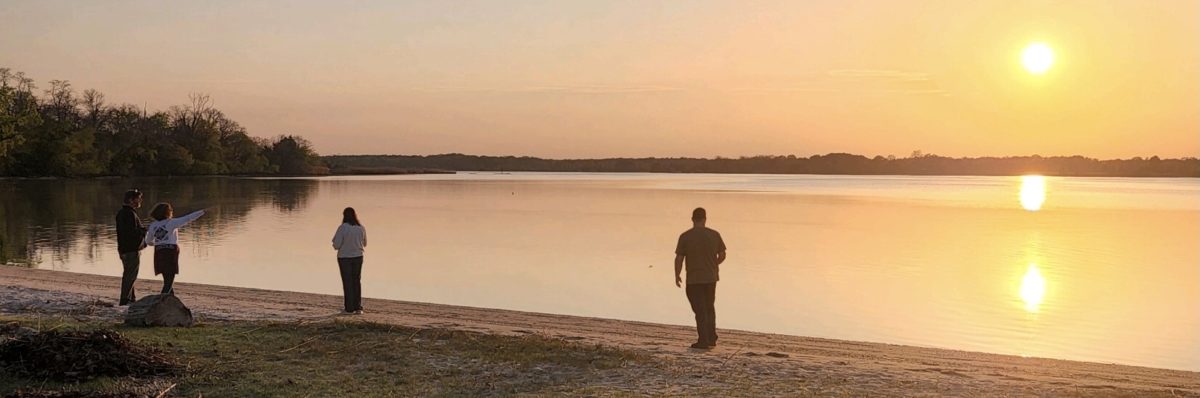
The 2025 Christ Church Easton/Diocese of Easton Mission Team in Wilmington, NC.

Let’s pray: Lord, you give us stories in Scripture for our learning, so that we can find you and find ourselves in them. Help us hear what your story is saying to each of our hearts. Let us locate where you are calling us, and how to amend our lives by your love and grace, so we can get there. And help us receive, experience, and share your gospel, your good news, in the world, with each other.

Amen.

Why Ascend? And then what?

Context: The first Sunday in June was a preaching weekend for me at Christ Church Easton. We celebrated and talked about Jesus’s Ascension into heaven, marking the end of the Easter season, moving the church calendar to Pentecost and the coming of the Holy Spirit. This is the text of the sermon I gave.

Why Ascend? And then what?

A couple years ago, I saw a comic strip about Jesus’s Ascension that sticks with me.

It’s Jesus and three disciples standing around. Jesus says, “Gotta go guys. Don’t forget what I taught you.” And then it shows Jesus’s feet as he ascends out off the page and the disciples say, “Bye, boss.”

They are standing around together and one asks, “So what have we learned?”

“Pretty much it’s love God and love your neighbor.”

“Well, that seems pretty simple, I don’t see how we can mess this…”

It shows a group is coming over the hill in their vestments and robes, with their hats and staffs, books, and scrolls. And the disciple says, “Uh-oh… Here come the theologians.”

And it sticks with me both because it strikes me as funny and that it’s on to something.

Jesus didn’t come to confuse us or complicate us. He came to set things right, so that we could get off the hamster wheel of sin and that instead we might have life in all its abundance.

We don’t have these stories and teachings in Scripture to vex us, but to help us.

In today’s reading, as he is about to leave the disciples, Jesus says:

“These are my words that I spoke to you while I was still with you– that everything written about me in the law of Moses, the prophets, and the psalms must be fulfilled… Thus it is written, that the Messiah is to suffer and to rise from the dead on the third day, and that repentance and forgiveness of sins is to be proclaimed in his name to all nations, beginning from Jerusalem. You are witnesses of these things.”

Jesus has done what he came to do. The Word became flesh, lived among us, taught us, performed signs, died for us, conquered death, came back and showed us and told us all about it. As he is leaving, he is connecting all the dots and making sure the disciples get it.

He’s not giving them new information or teaching, he’s just recapping, reminding them. This is all part of the plan.

Jesus has to go so that he can send the Holy Spirit to do things that he couldn’t do in his bodily form. He could only be in one place at a time. There is more to do.

Jesus becoming incarnate: good news.
Jesus dying for us: tragic and horrible, but still part of the good news.
Jesus overcoming death: good news.
Jesus ascending and sending the Holy Spirit: all part of the same good news.

We talked a bit last week on Zoom and at the Healing Service about how things are going in the world with the Holy Spirit and the church and whether we might not prefer to have Jesus back in the flesh. Sometimes it might be nice to be able to ask Jesus something directly and have him settle the debate right then and there.

Two things come to mind with that: Jesus has already given us everything we need, to know what he would do, how he would answer questions, what we are supposed to do. Those answers aren’t going to change.

The fact that we, as people, aren’t loving God and loving our neighbor, the fact that we aren’t loving each other as Jesus loved us, isn’t because we don’t understand or we don’t know how.

It’s because we don’t want to.

It’s because it’s hard. It’s because it costs us—we have to sacrifice in order to do it. It’s because while we are living in the ways of the world, it’s not popular—people might think we’re weird or soft or whatever word you want to use.

There are stories that have been written that suppose that Jesus comes back just as he was before, preaching the same love, doing the same good works, and what ends up happening is that either the church or the government kills him because his message is a threat to their power.

Does that sound familiar? We just read that story a month or so ago.

Our world hasn’t changed so much since then. But it’s supposed to. And that’s up to us.

Jesus ascended into heaven because his work was done, and he was giving the ball back to his followers to move things forward.

I’ve shown you everything. Now it’s your turn.

The Ascension of Jesus Christ, gold mosaic; in Neamt Monastery, Rom.

If we look at the disciples during the two or three years Jesus was with them, Jesus did all the work. He was teaching them and showing them what to do, but they depended on him to do everything.

Here is what the SALT Project says about Jesus having to go away in their commentary:

“The fact that Jesus departs at all is worthy of reflection. Many founders of movements — or companies or political parties — stay around as long as they can (often staying too long!), and according to the Gospels, the risen Jesus is presumably impervious to death, and so could have remained indefinitely. From this angle, the fact that he leaves reveals what sort of movement he has in mind: a community not standing around admiring him (“Why do you stand looking up toward heaven?—as we heard in Acts), but rather active and present in the world, carrying on his work of kindness, justice, humility, and proclaiming the dawn of God’s joyous Jubilee. In the end, the Ascension itself is meant to invite and empower the church to be all the more down-to-earth. Into the world, for the love of the world!

For Jesus, it wasn’t about his ego, his pride, or any accolades. He leaves so that even more amazing things can happen with the Holy Spirit dwelling with and within us.

This is what spiritual maturity asks of us and looks like. Peter and the other apostles do not look and sound the same in the Book of Acts as they sound in the gospels. They carry on. They put in the work. They wait for the Holy Spirit, just as Jesus told them to. And after Pentecost, they are lit on fire with the Spirit and the early church is born.

The apostles accept that they are Jesus’s “witnesses in Jerusalem, in all Judea and Samaria, and to the ends of the earth.”

There are no “thoughts and prayers” in the apostles action plan, their response to Jesus, as ours is in our Baptismal Covenant, was:

“We will, with God’s help.”

As we remember and celebrate Jesus’s Ascension; as we look to Pentecost next week and the coming of the Holy Spirit; and as we move into Ordinary Time, the Season After Pentecost—it’s the same Holy Spirit with and within us now as came to Peter and the apostles. It’s the same Holy Spirit that has inspired and guided the community of saints over the ages. It’s the same Holy Spirit that has used ordinary people and their ordinary lives to do extraordinary things for God’s kingdom.

The church has moved in fits and starts and stalls and sputters over the last couple thousand years. There have been miracles and signs and there have been tragedies and disgrace. When the church falls away from the Holy Spirit and from Jesus, it loses its way.

It’s during those times that we need to regroup, refocus, remember who we are and WHOSE we are and allow the Spirit to move through us to be the body of Christ, the church, Jesus’s hands and feet and love in the world.

This is our time. We can’t look around and expect someone else to do it. WE are why Jesus came. WE are why Jesus died. WE are why Jesus overcame death. And WE are why Jesus ascended and gave the world the gift of the Holy Spirit.

What will we do with it? What does it look like to have the Spirit in us?

Here is the SALT Project:

(changed to present tense)

“It looks like Jesus, and at the same time, it looks like us — that is, it looks like us being true to ourselves, the people God made us to be. In a word, it looks like love: incarnate, tangible, down-to-earth love. And from another angle, it looks like peace: not just any peace, but what Jesus calls “my peace,” the shalom of God, a buzzing, blooming, fruitful community, coming and going, alive with the Spirit, healthy and whole.”

We look to the characters in the Bible for our answers, as if their lives were more spiritually significant than ours. Here’s the thing:

When they were living out all these experiences, their stories hadn’t been written down. They were figuring it out, reading the stories they had, just like we are.

We have Scripture for our learning, so that we can continue these stories, live spiritually significant lives, be a part of God’s love story in its unfolding.

We have a chance to write the next chapters—to inspire, connect, and allow God to use us just as he used the first apostles. That’s what “apostolic” is all about—being sent out.

Jesus wants our stories and our time to matter just as much as the apostles in Acts. We have same Holy Spirit and we are proclaiming the same good news.

WE can be that community. That’s who we are called to be. It’s who we were made to be.

Will we? Our best answer:

We will, with God’s help.

Conversion of St. Paul: Embracing Change

January 25 is the day the lectionary celebrates the Conversion of St. Paul. For our Wednesday Healing Services at Christ Church Easton, I have been using feast days that occur during a given week as a chance to do something along the lines of a homily to recognize them. This is what I put together for this week.

“The Conversion of St. Paul: Embracing Change”

Saul was not an atheist. He wasn’t a morally questionable person. He was a faithful and devoted Jew, who thought he was doing God’s work. And he was a persecutor of Christians. He approved the stoning of St. Stephen, the first Christian martyr in the Book of Acts.

There is no way in the world he was going to be even supportive of this movement, these followers of Jesus.

Until he was. This was not a change-by-degrees situation; this was being struck blind on the road to Damascus and having to come face-to-face with not just the risen Christ, but with the idea that the things you were devoted to, committed to, SURE OF, turned out to be wrong.

This was not an unlikely conversion. It was an impossible conversion. It made no sense. Saul had to come into it and not only that, if you were one of the early followers of Jesus, you knew who Saul was and there was no way you were going to trust him.

From the account in Acts, Saul was blind for three days and didn’t eat or drink for that time.

The Lord called out to a disciple in Damascus named Ananias, and told him where to go to find Saul and lay hands on him so that Saul could regain his sight.

And Ananias said:

“Lord, I have heard from many about this man, how much evil he has done to your saints in Jerusalem, and here he has authority to bind all who invoke your name.”

In other words, “Lord, I don’t think this is such a good idea.”

The Lord said to him, “Go for he is an instrument whom I have chosen to bring my name before gentiles and kings and before the people of Israel. I myself will show him how much he must suffer for the sake of my name.”

Even after his conversion, regaining his sight and becoming an incredibly powerful and persuasive preacher—so much so that now the Jews wanted to kill him; when Saul came to Jerusalem to join the disciples, they were all afraid of him and didn’t believe he had really changed.

Paul’s life got significantly more difficult after his conversion. Many of his letters were written from prison, which he found himself in and out of.

Now in terms of hand-picking apostles, Jesus hit the jackpot with Paul. Paul was Jewish, a pharisee. He was a Roman citizen, he spoke multiple languages, he was literate and educated, and passionate—he was actually the perfect combination of skills, upbringing, and knowledge to take this movement to the next level.

Let’s talk about change. Paul had to completely change his life, to repent, to turn around and go a different direction. And he is well documented in his own words for doing so.

Has your own path of following Jesus asked you to change or make changes in your life? What kind?

Our changes aren’t going to be a severe as Paul’s—I don’t think any of us were persecuting or killing Christians. Changes in our lives might look very different.

I’ll show you what I mean. I make this point a fair amount: over the past eight years, I have cried more than any other period of my life. Following Jesus has opened my heart and caused me to care about more people and more things, to take them into my heart—it’s a much more difficult way to walk through life. But it’s also richer and more rewarding.


Following Jesus with our whole hearts should make us care more about the world and be heartbroken by things we might have ignored before.

Following Jesus asked me to give up a temper that I had been developing over the years.

Following Jesus asked me to let go of judging people and situations. On the Meyers Briggs personality test that people take, I used to test as INFJ—introverted, intuitive, feeling, judging—over the past five years, anytime I have taken the test and been totally honest, I am INFP—judging changed to perceiving.

Change was necessary for Paul and it’s necessary for us. Transformation is a word that is not to be taken lightly.

Another thing we might learn from Paul is the difference between righteousness and self-righteousness. Saul, the pharisee who persecuted Christians was sure he was right. Jesus had a different opinion.

It makes me think of a more modern-day hero of mine. Verna Dozier was an African-American woman who was an English teacher at Dunbar High School. When she retired, became one of the lay (non-ordained) leaders of the Episcopal Church. I keep a copy of her book “The Dream of God” on a shelf near my desk. We did a small group study of that book, and I loved everything about this quote:

“We always see through a glass darkly, and that is what faith is about. I will live by the best I can discern today. Tomorrow I may find out I was wrong. Since I do not live by being right, I am not destroyed by being wrong.”

It is a powerful and humbling thing to live knowing I (or we) don’t and can’t know everything. I do my best to figure things out and have the courage and grace to keep learning and I realize that because something seemed right yesterday, it doesn’t mean it can’t be proved wrong today or tomorrow. If that happens, then I need to be willing to change. Just like Paul did.

So maybe humility becomes important, to realize I am not always right, no matter how passionate I might feel about something. I could have a realization—an epiphany—that I was wrong. Then I need the courage to admit it and think and live differently.

What else can we learn from Paul’s conversion? How about don’t write off your enemies. Saul wasn’t just disliked by the early Christians—he was public enemy number one. They were scared and skeptical of bringing him into the fold.

I apologize for bringing sports analogies into a discussion of such important things, but it’s still football season and we can make a couple points here.

There was a defensive back who played for the Pittsburgh Steelers named Rod Woodson, who is a Hall of Fame player, one of the best to play football at his position. The Steelers and the Baltimore Ravens are big rivals, they don’t like each other on the field very much. Rod Woodson ended up becoming a Raven, helped them win a Super Bowl, and now he is one of their radio broadcast announcers. Loved in both cities, he has dual citizenship.

If you follow the Philadelphia Eagles, running back Saquon Barkley was the franchise player of their division rival New York Giants. Philly fans booed him when the Giants came to town. This year he was traded to the Eagles, has been their best player, the most loved of the Eagles this year and one of the main reasons they are playing this coming weekend for a chance to go to the Super Bowl.

Sports are not life, but the point is, people who were once hated by entire cities and fanbases, become beloved and embraced.

Because someone was your enemy one day, or for a time, doesn’t mean they can’t become an ally, a friend, even beloved. Jesus wasn’t kidding when he said “love your enemies.” He showed the world with Paul, that your enemy is your brother or sister, and we and they are capable of change.


I have been reading Gregory Boyle’s book “Cherished Belonging” to get ready for our small groups that start next week. Boyle points out that on the day when Jesus entered Jerusalem on his way to be arrested and crucified, there were two parades that day.

On the one side, coming from the west on the main road, was Pilate and his show of military power and force. It was a display of power. Don’t mess with Pilate or you see what you’ll get. Boyle writes:

“Then there’s Jesus, on a small donkey, humbling entering the city from the east. Jesus’s trek and mission displays a way of life whose hallmarks are inclusion, nonviolence, unconditional loving kindness, and compassionate acceptance. The parade of warhorses announces the threat of violence, force, coercion, and the oppression of the poor. The “triumphant” entrance of Jesus is not an indictment but an invitation. Village transcending tribe. Jesus doesn’t draw lines (of division). He erases them.

Paul’s encounter with Jesus caused him to change his life completely. To become the thing that he despised. To embrace the other side.

Jesus invites us to do the same. To change. To be humble. To let go of our self-righteousness. To embrace his way of inclusion, even of our enemies, nonviolence, unconditional loving kindness, and compassionate acceptance.

Paul’s conversion changed everything. So can ours. So can anyone else’s.

Top image: “The Conversion of St. Paul” by Caravaggio, oil on cypress wood, 1600/1601.

Oneing Weekend: Let’s

I want to spend more time “oneing.” “Oneing” is a term the mystic Julian of Norwich used to describe the encounter between God and the soul. It’s a word and idea so meaningful to Franciscan Richard Rohr that he named the publication of his Center for Action and Contemplation “Oneing.”

It’s a feeling I get frequently when I sit quietly outside.

April 19

Skateboard, notebook, pen, binoculars, an issue of “Oneing,” reading an essay from Scott Avett of Avett Brothers fame about “Creating Faithfully.” On the shore of the river, purple flowers pull my attention until watching them and taking pictures and listening to the water, I just feel like an extension of the scene, part of it. A feeling of oneness.

Skating, gliding along pavement, has been a oneing experience for almost 30 years.

Around the Oxford Conservation Park, there are Eastern Bluebirds and I sit on a bench and watch a bluebird house where one flew out of and I read.


In addition to being a world famous singer, songwriter and musician, Scott Avett is a talented painter and a moving writer. His essay is on his faith and the creative process. He talks about contemplating Jesus’s identity and how Jesus knew exactly who he was, something most of us struggle with. Avett writes, “I think this truth alone, separates him from us. I can see how this knowing of who one is can be the most loving truth one can offer.”

He talks about going into the studio in solitude to create.

“This time alone is fertile ground where I cultivate my purpose. My contribution is my engagement in it. The studio is my cloister. To pray is to be drawn nearer to my existence. The only control I have is to show up and respond. I build from that simple idea… I long to create faithfully rather than successfully, productively, intelligently, or even truthfully. Creating faithfully is not knowing how to do it. It is believing that it is worth doing… With this, I replace the anxiety-ridden aspirations of arrival with peace in a true being. This is who I am in Christ and who Christ is in me… What a precious revelation. Simply put, to create faithfully is to be me.”

Avett arrives at this oneing through creating art. I read and sit with his words waiting on bluebirds, greeting walkers, dog walkers, and folks riding bikes as they loop the park.

April 20

It’s the last day of classes for our three-year Iona Eastern Shore seminary program, a day retreat at Old Trinity Church in Church Creek, which is about a mile down the road if you don’t turn left to go to Blackwater Wildlife Refuge. Seminary day retreats are the only reason I have been to Old Trinity, which is a beautiful church and campus. I smile that their parish hall is named “Valliant Hall.” I’ve now preached from the pulpit there twice in front of classmates and instructors, working on our homiletics.


On days when the weather is nice, I get there early so I can sit out on the dock or on a bench by the shoreline to pray, breathe, drink coffee. It’s another experience of oneing, of an encounter between my soul and God.

It’s the last time our class will be gathered together for the purpose of learning, when we are one in that way. We will graduate together on June 15.

April 21

Oneing is an encounter between God and the soul. But it can and does also include other people. According to Richard Rohr:

Julian of Norwich says, “The love of God creates in us such a oneing that when it is truly seen, no person can separate themselves from another person,” and “In the sight of God all humans are oned, and one person is all people and all people are in one person.”

We are connected to each other and we are connected to God and we can experience God in each other. In my experience, some people make us more aware of that connection, or more quickly and intuitively aware than other people do, and there are people who show and remind us of our own connection to God. Those are people to treasure and spend time with.

The first time I met Holly was on a retreat in late October 2017. Despite both living on the Eastern Shore for our whole lives, and having a number of mutual friends, we had never met. The first real conversation we had was a few weeks later at the Waterfowl Festival. We met for coffee a few times at Rise Up Coffee to continue our conversations.

In December we went for a five-mile hike together at Tuckahoe State Park, which we consider our anniversary. We walked in as two people and by the end of the hike, we were different, together. That was almost six-and-a-half years ago. Tuckahoe has been a holy, sacred, thin space for me since 2005, when I went trail running there. It is a place I called “church” long before I was going to church. Oxford and Tuckahoe are two places where oneing and walking are almost the same for me. Holly and I have hiked there a number of times since.

On April 21, we decided to hike our anniversary route.


Time passes differently with Holly. We can get lost in the backyard together, listening to and watching birds, lying under the stars; we lose track of time making dinner together, or sharing something we are excited about.

If you’ve taken time and put in work to get to know yourself, in the way that Scott Avett talks about, knowing who we are and being ourselves as the most loving truth we can offer, my experience with Holly is that you can be even more free and encouraged to be yourself by the presence of someone else. In oneing, in being together, you can be more than you were. And you can do and be that for someone else. That’s love and freedom together.

Tom Robbins, a favorite writer of mine in his book “Still Life with a Woodpecker” said, “There are only two mantras, yum and yuck, mine is yum.”

There are people who increase your yum exponentially, and you theirs. That has been our experience together. From our earliest conversations, talking about life, and dreaming about adventures, “Let’s” has always been our response to each other.

On this day, we walked into the woods together. We talked, we dreamed out loud, we watched and listened, we encountered friends along our Sunday walk who we hadn’t seen in a while.

And we said, “Let’s” to our next adventure together. Further experiences in oneing.

Writing as reckoning

Jim Harrison writes like he is reckoning with life, death, love, God–you name it. He writes like his life is on the line, his soul is trying to come out through language–that’s how much is at stake.

His “Essential Poems” book frequently travels with me. This morning it was:

“The stillness of this earth
which we pass through
with the precise speed of our dreams.”

that washed over me, from Harrison’s poem, “Returning to Earth.”

“I Believe” is a manifesto of things in the world that he puts faith in.


Steep drop-offs, empty swimming pools, raw garlic, used tires, abandoned farmhouses, leaky wooden boats, turbulent rivers, the primrose growing out of a cow skull. What a list! These are things I know I believe in as I read his list because each thing comes powerfully to mind–smells, pictures, feelings. This is a list of beliefs that come from experience and hard-nosed reflection. Everything on it has passed the test.

Reading Harrison calls me to write things that absolutely have to be said–something relevant, something that is working on me and that has to come out or risk burning my soul, not an academic or intellectual game, not something that sounds nice or clever–something that comes out of an ongoing wrestling match or dance or conversation with the Spirit.

This a Mark year for the prescribed church readings–most of the Gospel readings this year come from Mark’s account of the good news. For Palm Sunday our in-person services did a dramatic reading of Mark’s account of the Passion (Last Supper, betrayal, arrest, crucifixion, death and burial–the suffering) of Jesus, with readers playing different parts. On our Zoom service, we divided up the reading between a few of us. Mark’s Gospel is the shortest of the four, the writer doesn’t add fluff or niceties, there is no birth narrative, no Christmas, and the account ends with women running bewildered from an empty tomb. Reading Mark’s Passion account, he doesn’t stop to answer questions, he leaves those up to us to ask, wrestle with, and answer.

I think the writer of Mark and Jim Harrison would get along. Both of them had stories they had to tell. Holy Week, the week leading up to Easter, is full of those kind of Jesus stories. It moves me more than any other week of the church calendar. This Friday evening, Good Friday, we will have a service built around the seven different last words/phrases attributed to Jesus in the different Gospel accounts of his death. Then someone will respond–something spoken, read, sung–hopefully pulling those in attendance into the story.

The Gospel writers chose to write down a story that was being told orally, for fear of losing it. They knew it was too big to risk letting it go. And each of them went about it a bit differently, each giving something of themselves and their reckoning with the good news and the Spirit.

When I read Harrison’s poetry, I know that what he is saying is vital to who he was. It conveys what he loved, what he struggled with, what he laughed at, what he cried over, and what lit up his sense of wonder; the curiosity that was in his bones. He was a rough outdoorsman who lived on a farm in Michigan near where he was born. He fished, he ate, he drank, he traveled–he lived.

I hope I can find the words, the pictures, the moments in my life where I connect to love, to wonder, to Creation, to God and to the story of God and humanity that is unfolding through all of us and transform and transmute it all through the right words.

I hope you find your own moments and experiences and transform them into your own art–whether dance, song, painting, poem, carving, or your life itself as a work of art. God is a creator and we, in God’s image, are also meant to create.

One of my favorite lines of writing comes from the beginning of a Harrison poem called “Tomorrow,” where he talks about being blindsided by a new kind of wonder, the kind we haven’t experienced before. He writes:

“I’m hoping to be astonished tomorrow
by I don’t know what”

The stars or the sunrise or sunset reflecting off the river; the smell and feeling of earned sweat; how excited your dog is when you walk in the door; a book you can’t put down or stop thinking about; the first sip of coffee or tea in the morning; jumping in the river, lake, or ocean when it’s colder than you expect; the memory of someone who shaped you; a conversation with someone you love when you don’t know what either of you will say next; an answered prayer; exploring somewhere you’ve never been; sacrificing something important for someone else–someone else sacrificing something important for you; knowing in your heart, soul, and bones that you are loved.

I’m hoping to be astonished tomorrow by I don’t. know. what. And I believe.

Listen to the Overlooked

Background: Last Sunday’s Gospel reading was Matthew 21:33-46, known as The Parable of the Wicked Tenants. It’s the second of three parables Jesus presents to the Temple priests, elders, and Pharisees, painting a harsh picture of how Israel is not living up to their name in their disobedience to God. This is the text of a homily I presented to the Christ Church Easton Zoom prayer service. Since our time with the Gospel is also a discussion, questions and answers people had changed and shaped things somewhat differently than what is written here.

“Listen to the Overlooked”

This conversation between Jesus and the chief priests and Pharisees began last week for us, when Jesus entered the Temple and was grilled by the priests and the elders about who he thought he was and where he gets his authority. And Jesus gave them a parable about a father asking two sons to go work in the vineyard, the first said he wouldn’t go, but then did, the second said that he would go and then didn’t. And Jesus made sure they caught onto the chief priests and the Temple leadership being the second son, who talks a big game, but then doesn’t do what they said they would.

And now Jesus takes it further. He relates the parable of the wicked tenants to them. This isn’t about saying one thing and then failing to deliver. This reaches another level. It’s outright disobedience and being self-serving despite all they’ve been given.

Michael Green in his book, “The Message of Matthew,” says:

“This parable unveils the flagrant disloyalty of the leaders of Israel. God had given them a wonderful vineyard to cultivate; he had given them all the necessary equipment to do the job (a winepress, a watchtower for shelter and burglar patrol, a wall to keep out the wild pigs and other trespassers). He had put his trust in them. And what did they do? The history of Israel tells the story starkly. In brief, they appropriated his goods, rejected his prophets, denied his rightful claims on them and killed his Son. They were given freedom as well as trust, but the day of reckoning is at hand: they will be held accountable for the way they have exercised that freedom.”

This is helpful to know how Jesus felt about the priests and Pharisees. In a reading we haven’t discussed in this part of the lectionary, the start of Jesus entering the Temple here is him driving out all who were selling and buying and overturning the tables of the money changers. This is the time of table-flipping Jesus. And now he is telling it like it is.

Jesus is calling out those who have been charged with doing God’s work, but who instead are looking after their own assumed power. But let’s not tell ourselves that what we are reading is simply supposed to point out and remind us of the disobedience of past people and generations—is it possible that church today, that we might also sometimes be the wicked tenants who tried to act like the vineyard was theirs and ignore the will of the owner?

Jesus then goes into quoting Psalm 118 verbatim when he says:

“The stone that the builders rejected
has become the chief cornerstone.
This is the Lord’s doing;
it is marvelous in our eyes.”

In this case, the SON and the STONE can be thought of as the same. Where they are ignoring and casting off John and Jesus, a new movement will begin that will have them as the main cornerstone, the foundation.

Let’s take a step back and look at some reasons why Jesus might be so upset with the chief priests and the Pharisees. What do you think?

  • They are putting the letter of the law over the intent.
  • They have ignored John the Baptist and now Jesus.
  • They are more worried about maintaining their own power than they are about the welfare of their people.
  • They are being exclusive rather than inclusive.
  • They are ignoring their responsibility to the poor, the sick, the downcast.

And what is it that Jesus is doing that is different? What do we see when we look at Jesus’s ministry?

  • He includes those who have been excluded—tax collectors, prostitutes, sinners, and when called upon, Gentiles.
  • He is healing the sick and caring for the poor.
  • He isn’t concerned about status or worldly power.
  • When it comes to things like the Sabbath, Jesus is following the intent of the law, not the letter of the law when it comes to helping people who are hurting.
  • Jesus views himself as a servant first, he is there to help, and to lead by serving.

Let’s fast forward to our time. Even though we wear his logo and worship his name, are we still ignoring Jesus? What would it look like for the church to be obedient, to follow him and live as he did now?

Talking about the rejected stone, the rejected Son, Fr. James Martin, a Jesuit priest and writer who we are studying, says:

“Jesus reminds us that sometimes it is the overlooked person who is the one we need to pay attention to.”

Who are the overlooked people now who we might want to pay attention to?


I doubt anyone can hear the things that Jesus taught and look at the life he lived and say, “no, that’s just a bad idea.” I wonder if part of what happened to the Pharisees and to the world today is that our hearts are out of step with God and that gets in the way of our following.

I’ve been reading Meister Eckhart lately, who lived from 1260 to 1328. He was a German Catholic theologian, mystic, and a part of the Dominican Order of Preachers. He is someone who seems to help me get out of my own way and do a better job of being open and listening for what God might want to say to me.

Let’s try a couple of his sayings and see if there is something helpful:

“Breaking Through”

Too often I decide what my
life should be and whether

there is from in it for You
while You sit in a deeper

place within me, wondering
what it will take for me to

make more of all the things
in my life—the good and

the bad—and so to learn to
break through to find You

in all that is and let You
take form in me in all that

I was and am and will be.

I wonder if too often our own ideas of what we should do push out any room in our hearts for God to operate. Did the Pharisees and chief priests have such fixed ideas of who God was and how he would speak to them, that it prevented them from stepping out in faith to trust the new direction John and Jesus offered?

On top of that, I wonder if what Jesus was modeling, what he was showing those in power was too radical, too much of a change for them when they came to enjoy so much the power and the status they had.

Here is one more from Meister Eckhart on what it looks like to follow Jesus:


“You Rise by Stooping Down”

With You everything
is upside down

and inside out,
for You rise by

stooping down,
and call me

to follow in
the footsteps

of your descent,
where I find

that You and
I are one

In being and
even in power.

Jesus rises by stooping down. He became incarnate, he humbled himself, and he called and showed himself to be a servant. Where we are in Matthew’s Gospel is Jesus on his way to the cross, to his death. He is trying to get everything he can across to his disciples, as well as being critical of the Pharisees, giving them another chance to repent and obey.

We have seven Sundays left in the lectionary year. Something to consider in the way these readings are presented to us. We read and reflected on Matthew’s telling of Jesus being arrested, crucified, and resurrected earlier this year, in Lent, Holy Week, and Easter.

We finish the church’s year with this series of teachings, warnings, and parables, and then November 26 is “Christ the King” Sunday, and the last reading we will get from Matthew before moving into Advent and the new year for the church, will be Matthew 25:31-46. Those will be the words we hear and reflect on to close this Gospel and then begin our Mark year.

Does anyone know the story?

Here is a key takeaway:

“Truly I tell you, just as you did (or did not do) it to one of the least of these brothers and sisters of mine, you did (or did not do) it to me.”

Bearing With Each Other

Background: Last Saturday evening there was a wedding on Saturday evening at Christ Church Easton, so we moved our Alive @ 5 contemporary music service into the Parish Hall and served dinner at the end of the service. The band was in the style of MTV Unplugged and the Parish Hall was full of good food and fellowship. The Gospel from the lectionary last weekend was Matthew 18:15-20, where Jesus outlines how to deal with conflict/sin between people in the community. With our Rector/Pastor officiating the wedding, I preached at our Saturday evening service.

“Bearing With Each Other”

“Christian conflict resolution” is not a class that would have a waiting list to get into. It comes off a bit like a root canal—necessary, but not something to look forward to.

But when you look around society and how we deal with feeling wronged, we do need some guidance. These days there are a lot of passive-aggressive outlets out there. What are some notable passive-aggressive ways to not actually deal with conflict?

If your neighbor has done something to you, you might go through the neighborhood association, or contact the town. When a friend makes us angry, we might defriend or block them on social media, or write huffy, angry comments under something we disagree with. Politically these days, when someone slights or disagrees with someone, the goal is to discredit, belittle, shame, and have others pile on. Nothing is resolved. And resentment becomes more deeply rooted.

When someone wrongs us, when someone sins against us, we want things to be made right, for us. Our self-righteousness demands satisfaction.

That’s not what’s going on in today’s reading. Jesus is looking at this earliest church community, not society at large. And he is giving instructions for the benefit of the sinner, whose actions are pulling him/her/them outside of the community. Jesus is giving the disciples steps to restore that person, to keep the community together.

What an unmodern concept—to care about the sinner, and about the community, more than our own sense of justice.

This is a teaching about reconciliation, and it’s reconciliation based on love and forgiveness.

It’s not easy. It’s counter-cultural. It doesn’t make sense with how our laws are written.

But community can’t be built on the law. Legalism won’t save us. If you look at most laws, including those in Scripture, they’re drawn up around doing no harm. And that’s not bad—those kinds of laws help keep us safe.

When it comes to a faith community, safety isn’t enough.

Jesus doesn’t summarize the commandments by saying, “don’t harm God and don’t harm your neighbors.”

We’re called to love.


God doesn’t want us to coexist (though the sentiment on those blue bumper stickers is better than the alternative of wiping each other completely out of existence).

God wants us to thrive. To help one another. To be there for each other. To love one another.

Both Paul, writing today’s New Testament reading, and Jesus, speaking in today’s Gospel, want to make sure we get the message loud and clear.

When we love, we more than fulfill the law. And Jesus looks at conflict within the church community through love.

When there is conflict, where someone is going astray: deal with it, fix it, work it out. This is where things get hard for us, especially in a church. Historically, churches have publicly fallen on their faces with conflict resolution on big issues. Look at how many scandals and atrocities have been dealt with by the church, by transferring an offending clergyperson somewhere else—out of sight, out of mind, not our problem. That’s conflict, that’s crime, and that’s reconciliation on a different scale, but it’s real and something the church has to deal with in order to be the example it needs to be in the world.

As parishioners, on a much lesser scale, when it comes to having an issue with someone in the congregation, we might find it easier to find another church rather than work through something difficult when someone has wronged us.

Avoidance is an easier path than reconciling. And there is a cost to that.

Best-selling author, theologian and Bishop N.T. Wright says:

“Reconciliation is a huge issue today. We can see the results of not doing it: suicide bombs, campaigns of terror, heavy-handed repression by occupying forces. That’s on the large scale. On the small scale, we see broken marriages, shattered families, feuds between neighbors, divided churches.”

Jesus knows how hard it is going to be for the early church to stick together in community, especially once he is gone. And he goes straight at things, right up front.

He says, first, try to work it out between the two of you. If that doesn’t work, take a couple people with you. Expand that circle slowly. Allow the person to save face as much as possible.

Jesus doesn’t say—talk about that person, gossip, try to get everyone on your side. Instead, deal with it quickly and between the two of you.

Let’s remember the goal: bringing the sinner back into the fold, keeping the community together. All while dealing with what happened.

Here is N.T. Wright again:

“Forgiveness doesn’t mean saying “it didn’t really happen” or “it didn’t really matter.” Forgiveness is when it did happen and it did matter, and you’re going to deal with it and end up loving and accepting one another again anyway.”

We are sinners, all of us. We all mess up. We all fall off the path we are trying to walk. Forgiveness, grace, love—how God deals with us, is how we are to deal with each other.

What does the church need? Reconciliation (that’s our word of the night). The mission of the church is to reconcile the world to God. To do that, we have to model it in our midst. Not in some abstract way, but right down into the details of our lives and how we treat each other.

There’s a part of this reading that is easy to miss. Jesus tells the disciples that when an offender refuses to listen even to the church, “let such a one be to you as a Gentile and a tax collector.”

Let them go, as outsiders.

What do we know about Matthew from the text a few weeks ago? He’s a tax collector. And Jesus still loved and restored him. Even in continued disagreement and going separate ways, the goal is still restoration.


Dietrich Bonhoeffer has a little book called “Life Together,” where he looks at Christian community. He says that when it comes to ministry in a community, listening, active helpfulness, and bearing with others are foundational. He says it is hard to bear the sin of another person because it breaks fellowship with God and with his brother.

“It is only in bearing with him that the great grace of God becomes wholly plain. To cherish no contempt for the sinner but rather to prize the privilege of bearing him means not to have to give him up as lost, to be able to accept him, to preserve fellowship with him through forgiveness… As Christ bore and received us as sinners so we in fellowship may bear and receive sinners into the fellowship of Jesus Christ through the forgiving of sins.”

And Bonhoeffer ties it together saying that “where ministry of listening, active helpfulness, and bearing with others is faithfully performed, the ultimate and highest service can also be rendered, namely, the ministry of the Word of God.”

If as a community, we aren’t oriented towards listening, actively helping, and bearing with others, we are going to have a hard time ministering the Word of God to others. Because where would it be found in our lives and our community?

And then we get to these incredible last lines of the reading: “For where two or three are gathered in my name, I am there among them.”

How many people have heard that line before? How many have used it in the context of gathering together? And how many realized that Matthew includes those words from Jesus, here, when he is talking about sin, disagreement, and reconciliation—not at the Last Supper, or the Sermon on the Mount, or some hopeful healing or miracle. It’s here, where or when we are struggling, maybe even divided, that we need to remember and call on his presence among us.

If we as the church are going to reconcile the world to God, we aren’t going to do it on our own. We need God’s help. Thankfully, God has already done the work, in and through Jesus, who is with us, always.

And if we are going to call on his name, and continue his work, we’ve got to work through the tough stuff, not brush it under the rug and pretend it didn’t happen.

We’ve got to listen, we’ve got to help, we’ve got to bear with each other. That’s what love and forgiveness look like.

Amen.

Bonus quote, which we used in our Zoom discussion about the Gospel reading on Sunday morning. The quote comes from Padraig O’Tuama’s book, “Daily Prayer With the Corrymeela Community”–

“Listening is a sacrament when the topic is important, and when strife divides people in small places, the sacrament of listening is vital. So many people and so many places in the world have difficult relationships with difference. We seek to practice the art of hospitality in the places of hostility, and in so doing practice kindness in places the most in need of kindness.”

Beware of Mustard Seeds

Background: this is the text of the sermon I gave on July 29 and 30 in response to the reading in Matthew’s Gospel of the parable of the mustard seed and other parables that are grouped together and more so in response to Fr. Bill Ortt, the rector/priest at Christ Church Easton for the last 24 years announcing that he will be retiring later this year. He then left for an already-scheduled vacation.

“Beware of Mustard Seeds”

Looking at a mustard seed, there is nothing that tells you or hints at the growth it is capable of. The tiniest of seeds, it can grow to a height of eight to ten feet. But you wouldn’t know it at first sight.

I came to Christ Church in August 2016, looking for a church home. I walked in to the 9:15am contemporary service, sat about halfway up the pews (on the left side when entering the church) on the window side. The greeters that day were Matt and Kelsey Spiker, who I’d never met. I came here because I was going through a kind of spiritual awakening, I had been attending Real Life Chapel across town for a year, had started studying and writing about the Bible—I was getting stirred up and I wasn’t sure what to do with it all. I knew A.K. and Susie Leight were members here, and I had always thought highly of them, so I gave it a try.

I could tell from that first service that I had found my home. Then I went over to Rise Up Coffee afterwards and got in line right behind Kelsey and Matt and got talking to them.

I think I can speak for the Spikers when I say that none of us came to Christ Church thinking this was going to be somewhere we were going to work or that both Kelsey and I would discern calls to the priesthood.

Those things came from a combination of Fr. Bill Ortt and the Holy Spirit, both waking up something we had that was latent inside us. Something probably about the size of a mustard seed.

Beware of mustard seeds.

Neither of us felt a call to work at “a” church or for “the” church, we felt called to work for THIS church, and at the chance to work for Fr. Bill. We weren’t the first or the last to feel that. Carol Callaghan became a deacon while working here; Barbara Coleman was ordained a deacon here in 2020 after being a part of our congregation; Susie Leight discerned her call to the priesthood during her 20 years here; along with Kelsey and I—Joanne Fisher and Jessica Stehle are fellow postulants and seminarians working toward the priesthood who have come through Christ Church and Fr. Bill; and Kimberly Cox leaves for Virginia Theological Seminary four days after she gets back from the Peru Mission Trip.


That’s more than a notion. That’s the Holy Spirit coming through this place in waves, and Fr. Bill has been casually handing out surfboards, with a smile.

And that doesn’t even begin to touch on the music ministries or the lay ministries that have sprung up and the people along the way who have blossomed in their callings and become instrumental to the life and community of this church and the broader community. We could be here for a couple hours if we started listing names.

Beware of mustard seeds.

This is not a church for the casual observer. If you open yourself to it, you are likely to get caught up in a call. And for 24 years, Fr. Bill has helped create those opportunities and encouraged people on their paths.

There is a common thread to the parables in today’s reading:

  • The mustard seed that someone took and sowed in a field
  • The yeast that a woman took and mixed in
  • A treasure hidden in a field that someone found and hid and sold everything he owned and went and bought the field
  • A merchant finds a pearl of great value, sold everything he had and bought it
  • A net that was thrown into the sea, drawn ashore full of fish and sorted.

Every one of these things involves taking action. It asks the person in the story to do something. God doesn’t just do it for us, He wants us to be active participants in His work. In another well-known Gospel story, when it comes to feeding the 5,000, Jesus doesn’t do it all by himself, he uses the disciples to help.

If you’ve been around Fr. Bill, you know he likes things to be done to a certain high standard. He jokes around that that standard is mediocrity. We all know better. The thing about it though, if you look at the different ministries that have grown during his time here—Stephen Ministry, Food Ministry, Outreach ministries, Youth Ministry, Adult Education, Contemporary Music, the list goes on—none of them have his fingerprints heavily on them. In those ministries you will find the hands, and the sweat, and the tears, and the joy of those who have done the work, with his encouragement.

You’ll hear him say that life, and faith, are about the questions we ask—and that we should try to ask the right questions. I can’t count the number of times I’ve been in a meeting with Fr. Bill, thinking I have a good idea, and he’ll ask a few questions, that will send me back to the drawing board, to either scrap something, or to help it go from being a good idea, to a great idea.

His questions can serve as both sunshine and rain to seeds looking to grow.

Beware of mustard seeds.

I think about the phrase, “going to church.” Do you go to church?—someone may ask us or we might ask someone else. That sounds very nice. Something you do for an hour a week and it sounds like a fine thing to tell other people. “Yes, I go to church.”

One of the reasons I was drawn further and further into Christ Church is that there are so many opportunities to do so much more than “going to church.” Anyone who wants to can jump in with two feet—Bible studies, small groups, bands, choirs, youth ministry, hospitality. All it takes is the willingness to try. But like in our parables today, it may change everything.

Dietrich Bonhoeffer distinguishes between cheap grace and costly grace. He says:

“Costly grace is the treasure hidden in the field; for the sake of it a man will go and sell all that he has. It is the pearl of great price for which the merchant will sell all his goods… it is the call of Jesus Christ at which the disciple leaves his nets and follows him.”

“Costly grace is the gospel which must be sought again and again and again, the gift which must be asked for, the door at which a person must knock. Such grace is costly because it calls us to follow, and it is grace because it calls us to follow Jesus Christ. It is costly because it costs a [person] their life, and it is grace because it gives a [person] the only true life.

For 24 years, Fr. Bill has talked about and tried to model costly grace for Christ Church. The kind of grace that changes lives. That can change our lives. What a gift that is.

Last week when he told the staff he was retiring, after the stun-gun effect wore off, we all asked how we could walk beside him through these next few months, how we could support him. I think as a congregation, we have an opportunity to make these next few months an incredibly special time in the life of the congregation, and in the life of the Ortt family.


This is part of the gift that Fr. Bill has given us, and it is in character and in keeping with how he has always done things. We are entering into a process that this church hasn’t gone through in a quarter century. The majority of the congregation who are here now have only known Fr. Bill as the rector.

The process of sending him off with our gratitude, of finding an interim clergyperson or people to come in for the next year, of putting together a search committee, and finding the next rector of St. Peter’s Parish is something that can bring us together and connect us in ways we can’t even imagine yet.

We’ve had a number of small groups read Fr. Gregory Boyle’s book, “Tattoos on the Heart.” It’s an incredible story about a Jesuit priest’s calling to help love and rehabilitate Los Angeles gang members and it has changed the world there. And it has grown into a community that will continue after Fr. Greg is gone.

That’s a bit of the gift Fr. Bill is giving us. Now it’s our turn. Now it’s our time.

We are a community who puts our trust in God. I am going to drop a couple of Frederick Buechner quotes on you here. Buechner wrote:

“Wherever people love each other and are true to each other and take risks for each other, God is with them and they are doing God’s will.”

I believe that describes who we are as a community and how God has been and continues to be with us.

We are entering into a time of prayer and of gratitude, which really is an amazing way to spend all our time. In this case, it is gratitude for the gifts, the time, the friendship, and the leadership that we’ve been given. And for what is to come. And the hope is that prayer and gratitude will lead us into discernment for the way forward.

Today, and every day is unique. This time we find ourselves in, “for the time that we have,”—as Fr. Bill likes to quote Tolkien’s Gandalf—is a time we can bring special attention to relationships; to who and what we are grateful for; and who and how we want to be both individually and collectively.

As we walk forward together, I’ll let Buechner touch on how special this is:

“In the entire history of the universe, let alone in your own history, there has never been another day just like today, and there will never be another just like it again. Today is the point to which all your yesterdays have been leading since the hour of your birth. It is the point from which all your tomorrows will proceed until the hour of your death. If you were aware of how precious today is, you could hardly live through it. Unless you are aware of how precious it is, you can hardly be said to be living at all.”

Today is precious. This time–these next few months are precious. And we get to live it and be grateful for it, together.

Believe

Lead in: I am in my second year of seminary through the Iona Eastern Shore program, which allows our cohort to continue working while we are going to school. April 15-16, with a last minute switch, was a preaching weekend for me at Christ Church Easton. This is the text of the sermon I gave.

Churches/denominations that use the Revised Common Lectionary have prescribed readings for each day and Gospel readings for each Sunday. So we don’t get to pick what Gospel we preach on.

The Gospel reading for April 16 was John 20:19-31, which most people know for “Doubting Thomas,” the disciple who won’t believe that Jesus has been resurrected until he touches Jesus’s wounds for himself. We are all a bit like Thomas. The reading is where Jesus appears to the disciples for the first time after his death.

“Do Not Doubt, But Believe”

I’m a big fan of John’s Gospel. On the one hand, he’s a bit like the Rodney Dangerfield of the gospels—not enough respect to get his own lectionary year like the synoptic Gospels; on the other hand, every lectionary year is made better because we have John peppered throughout them.

For John, “believing” is a big deal. He uses the word “believe” 98 times in his Gospel, always as a verb, as something active and dynamic. He tells us at the end of today’s reading that these stories are written that we might believe that Jesus is the Messiah and through believing have life in his name.

Today’s reading is John’s version of Jesus giving the Holy Spirit to the disciples. Remember, John didn’t write Acts, that was Luke, so we don’t get the Pentecost telling of the story here.

There are scholars who say that John’s Gospel is the one most likely to have originated with an eyewitness account. We read the author describing himself as being there at the crucifixion and later, on the beach with Peter and the others. There are details in John that we don’t find in the others.

Let’s look at two stories of the giving of the Holy Spirit. At the beginning of Luke’s Gospel, he says that after investigating everything he wants to write an orderly account of all that went on, talking to everyone he can. Each Gospel sets out its witness to the good news of Jesus Christ, and I love Luke (he gives us the prodigal son, the Road to Emmaus, etc). But when I think humorously about the way stories get passed down over time, there is some part of me that thinks about Luke asking everyone for their recollection of Pentecost:

“And there was FIRE! Fire? Yeah, FIRE! It was intense! And then people were speaking in tongues, remember that? And people thought we were drunk, and Peter was like, noooo waaaayy, it’s only 9:00 in the morning…”

In Luke’s telling of the story in Acts, it is a public event, a spectacle.

In contrast, listen to John’s account:

“Jesus said to them again, ‘Peace be with you. As the Father has sent me, so I send you.’ When he had said this, he breathed on them and said to them, “Receive the Holy Spirit. If you forgive the sins of any, they are forgiven them; if you retain the sins of any, they are retained.’”

Maybe it’s because I tend prefer being understated, but I love the simple, straightforward, intimate and understated way John gives us the Holy Spirit. No crowds, no fire, no speaking in tongues. Jesus breathed on them and gave them a new Spirit. A new life in Him. A life that has overcome death.

Does that sound familiar? This is from Genesis, Chapter 2, Verse 7:

“then the Lord God formed man from the dust of the ground, and breathed into his nostrils the breath of life; and the man became a living being.”

I love that John sees what Jesus is doing and connects it back to the beginning (remember he starts his whole Gospel account with “In the beginning was the Word, and the Word was with God, and the Word was God.”) John wants to make sure we don’t miss what’s happening. This is new life, that comes through Jesus, which is giving us a direct connection to God.

I get excited about the Holy Spirit.

But let’s backtrack to where the disciples are in the reading and what’s going on.

Jesus has been arrested, crucified, and was buried in a tomb. The disciples scattered, afraid for their lives. Just before today’s reading, Mary Magdalene went to the tomb and found the stone rolled away, she ran and got Peter and the one whom Jesus loved (who we think of as John, the author) and they went in and found the tomb empty. And then the men left and went home. All Peter and John saw was the empty tomb.

Mary Magdalene stuck around, talked to angels, then encountered Jesus, who told her to go and tell the disciples, which she did. But none of them have seen Jesus for themselves yet. They might dismiss her story as being unbelievable story, saying she was overly excited at finding the tomb empty—she could have been hallucinating.

Now, they were hiding out together in a locked room, hoping not to be found or found out. As writer and pastor Frederick Buechner describes it:

“They had bolted the door and were listening for the dreaded sound of footsteps on the stair when suddenly Jesus was among them. He stood in their midst—always in their midst, this man, turning up when they least expected him—and told them to breathe his breath, his holy breath and spirit, so that they could go out into the world again and perform his holy work.”

6th century mosaic in the Church of Sant’Apollinare Nuovo, Ravenna

Knowing that they are going to be scared out of their wits, Jesus’s first words to them are “Peace be with you.”

He reassures them. He shows them his hands and his side, so that they know it’s him and that this is real. And the disciples rejoiced. Of course they did. If there are scenes out of Scripture that you would want to be there for—this has to be one of them! This is massive. It’s transformative. It’s life changing. It’s death conquering.

Jesus gives the disciples what they need to believe. And then he gives them his Spirit and gives them work to do.

But Thomas isn’t there. The other disciples tell him what happened, but he isn’t having it. “Unless I see the mark of the nails in his hand and put my finger in the mark of the nails and my hand in his side, I will not believe.”

On the one hand, we can say, sure, everyone talks a big game when Jesus isn’t standing there, just you wait… But I think this is true to life. How many of us, when hearing friends tell us an unbelievable story, decide, “I’ll believe it when I see it.” Even if it comes from people we trust, we still want proof. Thomas wants the same experience the others had.

So what does Jesus do? He comes back. He shows up again, just for Thomas. He gives Thomas what he needs to believe. Jesus doesn’t scold him, he is there for him and tells Thomas, “Do not doubt, but believe.”

Notice, Thomas doesn’t get kicked out of the club for doubting. That is one of the wonderful aspects of this reading—there is room in our faith for doubt. It is okay to want to see for ourselves. It’s okay not to believe just because everyone else tells you to. Jesus works with Thomas.

And Thomas believes; seeing is believing as they say. Jesus then delivers the showstopper of lines, a line so important to faith: “Have you believed because you have seen me? Blessed are those who have not seen and yet have come to believe.”

That’s us. I don’t know about you—I haven’t encountered the bodily resurrected Jesus in the flesh. But I have come to believe. How?

Think of the work Jesus is asking the disciples to take on. To help people believe, when they haven’t seen him for themselves.

Here is Frederick Buechner again:

“The risen Christ is risen in his glory, but he is also Christ risen in the hearts of those, who although they have never touched the mark of the nails, have been themselves so touched by him, that they believe anyway. However faded and threadbare, what they have seen of him is at least enough to get their bearings by.”

Believe. What does that mean here? Is that an intellectual affirmation? Is it convincing ourselves and never doubting? Is this just a box we have to check off? I don’t think so.

For the disciples, their belief was foundational to the mission Jesus gave them. If they didn’t believe, what kind of witnesses would they be? If they don’t believe, why would anyone they meet want to believe?

Jesus’s life and love and good news are dependent on the disciples to continue to spread it out into the world. He was inviting them into an intimate, dynamic relationship with him.

And the same thing is true of us now. If people are going to come to believe in Jesus, it probably won’t be because they have had a bodily encounter with the resurrected Christ; it will be through the Holy Spirit, which is carried and passed on by the NEW body of Christ, the church, US.

The former Archbishop of Canterbury, Rowan Williams, in his book, “Tokens of Trust: An Introduction to Christian Belief,” talks about a young Jewish woman named Etty Hillesum. She was in her 20s when the Germans occupied Holland. She watched her world turn into an utter nightmare. She was sent to a concentration camp at Westerbork before being shipped to the gas chambers at Auschwitz.

She wrote in her diary: “There must be someone to live through it all and bear witness to the fact that God lived, even in these times. And why should I not be that witness?”

Williams describes her attitude and commitment like this:

“She decided to occupy a certain place in the world, a place where others could somehow connect with God through her. She took responsibility for making God credible in the world. She took responsibility for God’s believability.

What if THAT is what believing in God, believing in Jesus, means. That with and through our lives, we take responsibility for God’s believability. How many of us would say that we believe if that were the standard?

That’s what Jesus is asking of his disciples. But he doesn’t leave them on their own to do it, he doesn’t abandon them. He shows up. He brings them peace. He breathes his Holy Spirit into them.

The fact that we are gathered here in a church worshipping and loving Jesus, trying to understand his life and example, and bearing witness to the good news of his Resurrection says that the early disciples, with God’s help and the Holy Spirit, were up for the task.

I wonder: are we?

Let me give a brief witness. Over the past month, my daughter Ava has been in and out of A.I. DuPont Hospital, three times, first for surgery, then with multiple ambulance rides for seizures she couldn’t come out of. She’s home now and we’re hopeful she’ll be back in school this week and going to her senior prom next weekend. But epilepsy is challenging at times, and it’s been a rough, slow, frustrating go of things.

Not once going through it, have we, or I felt alone. Through so many text messages, phone calls, people checking in before or after classes, the school systems offering help, prayers, hugs, you name it–I have felt the Holy Spirit and God’s love at work through friends, through this congregation, through family, sometimes through strangers–volunteers at the Ronald McDonald House or, nurses, doctors, and people working at the Einstein Brother’s Bagels at the hospital, who can tell you are beyond tired this morning.

My experience is not unique. One of the things that touches my heart the most is to hear how people have shown up, how people have been there, how people have been LOVE in the lives of others. The way we love one another, even as Jesus loves us, can help make God believable for others.

We can see the Holy Spirit being God’s love in the world. We can be the Holy Spirit being God’s love in the world.

In the dark and confusing times that we are in the middle of in the world right now, can our belief, can our lives, can our love, be a witness for God’s believability in the world?

Yes, we can be that witness. Yes, God’s love, moving through us, through our belief, and our lives, can be credible in the world. That’s how the Holy Spirit works. No fire required.

Amen.

Our Iona Eastern Shore seminary class with professor, Fr. Dan Dunlap and guest presenter, Dr. Tom Long, one of the United States foremost preachers. That is how we started Saturday.

Let Love Become a Reality

This week, I was asked to lead our Wednesday morning healing prayer service. It’s a small, wonderful, heartfelt and Spirit-led service, which is held every Wednesday at 10:00am. The Gospel reading for the morning was Matthew 22:34-40, which is Jesus answering the question, which is the greatest commandment. I’m including the reading below and then the homily I gave in response to it:

Matthew 22:34-40 NRSV

When the Pharisees heard that he had silenced the Sadducees, they gathered together, and one of them, a lawyer, asked him a question to test him. “Teacher, which commandment in the law is the greatest?” He said to him, “ ‘You shall love the Lord your God with all your heart, and with all your soul, and with all your mind.’ This is the greatest and first commandment. And a second is like it: ‘You shall love your neighbor as yourself.’ On these two commandments hang all the law and the prophets.”

“Let Love Become a Reality”

I love when people asked Jesus questions. Depending on who was asking, they didn’t always love his responses, or the questions he asked back to them.

But I think Jesus also had in mind the spirit in which the questions were asked. Thinking of John’s Gospel—both Nikodemus and the woman at the well were trying to understand. And Jesus encouraged them. Here and elsewhere, when the Pharisees, Sadducees, and lawyers asked questions, it was often to try to trip him up, to trick him into saying the wrong thing so they could discredit him or have him arrested.

Here we have an expert in the law asking him which commandment is the greatest?

So Jesus goes to Scripture, he pulls from Deuteronomy 6:5, part of the Shema, the creed of Judaism, for “Love the Lord your God,” and to Leviticus 19:18 for “Love your neighbor as yourself.”

On these two commandments, hang all the Law and the Prophets. He’s given a perfect legal answer. And he’s done something even more to confound the law expert.

Michael Green in his book “The Message of Matthew,” points out that “For people who, like this expert in the law, were strong on ethics and weak on relationships, this strongly relational teaching was a revealing mirror of the heart.”

Strong on ethics, weak on relationships. A mirror of the heart. When I think about a lot of people today—we are strong on ideas, maybe strong on convictions, but not so great on relationships. We want to label people as different from us and say therefore they are wrong. Our tendency is to distance ourselves rather than drawing closer, rather than trying to understand or to love.

When we think of God and our neighbors in terms of relationships, in terms of beings who we are called to love, we have to get off of our high horses. If we try to love God with everything we have, we also have to love his creation, and the people he created.

Green writes:

“If there is real love for God, there will inevitably be real love for neighbor; God’s overflowing love is infectious. The criterion of whether love for God is real is whether or not it is reflected in our relationships with others. And it will not do to say, as many do, ‘I don’t do any harm to anyone.’ That is not only negative, but it neglects the first and great commandment, to put God as number one in our lives. With God first and neighbor second, all else in the law is commentary.”

To make a go at loving, we have to have softer hearts, our hearts need to be renewed—we can’t just be following orders (the law).

How do we do this? It doesn’t happen all at once. It takes time.

Our friend and brother John Coleman points out that as a police officer, he responds differently to situations today than he did 25 years ago. He always did his job and responded according to law, but now his first response is based much more in love and understanding, then when he was newer at the job. He credits both God and time with working on him.

I can tell you from my own experience that I think and feel and respond differently now to things than I did five years ago. And that has been five years of studying Scripture, of prayer and worship, of spiritual friendships and encouragement. When we use the term Christian formation, we are hoping, working to be formed in a more Christ-like way.

I hope I continue to grow and learn and improve how I love God and love my neighbor.

Reflecting on this passage in Matthew, N.T. Wright (in his book “Matthew for Everyone”) says:

“The heart doesn’t seem to get renewed all in one go. Many, many bits of darkness and impurity still lurk in its depths, and sometimes take a lot of work, prayer, and counsel to dig out and replace with the love which we all agree should really be there.”

I’m thinking of Paul writing in Romans where he says, “I do not understand my own actions. For I do not do what I want, but I do the very thing that I hate.” I think we all can relate to Paul’s dilemma sometimes.

Given the fact that we are standing here together at a healing service on Wednesday morning, I think we all know it is right and a good thing to love God and love our neighbor. We can agree both that that is what we are supposed to do and that it is what we are commanded to do.

But it has to be more than a command, it has to be more than instructions to follow.

Wright says:

Commandments “come into their own when they are seen not as orders to be obeyed in our own strength, but as invitations and promises to a new way of life in which, bit by bit, hatred and pride can be left behind and love can become a reality.”

There it is: an invitation, a promise to a new way of life where we leave behind hatred and pride and love becomes our reality. Let’s make that our prayer, let’s make that our guiding star.

If we go back to the scene, this encounter that Matthew gives us: Jesus is answering the question posed to him by a legal expert, and he gives a brilliant answer.

If we love God with all our heart, mind, and soul—we’re not going to put idols above him, we’re not going to have other gods before him, we’re not going to take his name in vain, and on down the list.

And if we truly love our neighbor as ourselves, that should take care of murder, stealing, coveting, adultery, bearing false witness.

Jesus gives us the Cliff Notes, the summary, the thing we can memorize or a cheat sheet we can put in our pockets and refer to when we need it—you know, for when we don’t have our Bibles with us or don’t have the time to look up the answers about the law.

But it’s so much more than that. It can be a basis for a new way of life, a better way of life.

The poet Pablo Neruda wrote in his love sonnets:

“I love you without knowing how, or when, or from where. I love you simply, without problems or pride: I love you in this way because I do not know any other way of loving but this, in which there is no I or you, so intimate that your hand upon my chest is my hand, so intimate that when I fall asleep your eyes close.”

What if we think about knowing and loving God that intimately. What if we have God’s love so much in our hearts and in our lives that we become that love when we think, when we feel, when we pray, and when we act. What if we know no other way of loving, than as God loves.

What if it didn’t matter that love was a commandment, because love was simply our reality.

Amen.

*Graphic at the top from Scripture Type, Treasure the Word.