Nothing gold can stay

“Nature’s first green is gold, / Her hardest hue to hold.”

Robert Frost might have had a magnolia tree in his front yard. I’ve never seen anything like it. Over the past week, it’s been in different phases of bloom and I just go out and stand underneath it in complete awe. It will only last a week or two, but man, what a week.

“Her early leaf’s a flower; / But only for an hour.”

Spring is a time for rebirth, for taking root and for growth. But within that, there is also the notion that it doesn’t last, like the magnolia tree in bloom, so appreciate it while it’s here. Be present. Feel the growth. Take the moment.

W.S. Merwin in Hawaii at the Merwin Conservancy. Image from Stefan Schaefer.

W.S. Merwin, one of the brightest shining, most brilliant, and most venerable American poets died recently. I met him briefly in Washington, DC, after hearing him read. I’d made it a point to catch him after work when I worked in the city. He was one of the voices; one of the lives worth emulating, or using as a model to find your own.

In a great New Yorker article, Casey Cep writes about Merwin’s writing and his effort to preserve Hawaiian landscape, “The palm forest, like Merwin’s poetry, has become a kind of prophetic stance against contemporary life: bearing witness to individual, almost foolish acts of creativity while devastation abounds.” We do what we can in the time that we have.

Sometimes I can connect the dots, sometimes I lose the picture. My reading list of late has included large parts of Luke’s Gospel, Henri Nouwen’s “Return of the Prodigal Son,” and legendary and/or mind-bending graphic novels, including Brian Michael Bendis and Alex Maleev’s “Daredevil” run, Donny Cates’ “God Country,” and Jonathan Hickman’s “Fantastic Four.” I’ve never read Hickman, who is known for his epic story arcs for Marvel Comics. Marvel announced this past week that he is set to take over the X-Men this summer.

I’ve been thinking about the Faust/Faustus storyline a lot lately, where to gain unlimited knowledge, the seeker sells their soul to the devil. It has to deal with hubris, excessive pride, and pushing beyond the limits of where we should go. And Hickman plays that exact storyline out with Reed Richards in his Fantastic Four story. But when faced with the decision either come up with the answer to everything, to save the universe and feed his ego flashing his brilliance, or to be human, be with his family, Richards thinks back to the words of his father.

“All of my hopes and desires rest in you becoming what I am not. When you grow up, I expect more. Son, I expect better. I want you to be a better friend than I was. Be a better husband. Be a better father. Be a better man.”

Father-son, father-daughter messages hit me straight in the heart. And it makes me reflect on the prodigal son story, and how the father wants his sons to know his love, no matter what they’ve done. And that’s big.

For Lent this year, Fr. Bill Ortt at Christ Church Easton, has given out prayer stones during worship services. There are 11 different words and you choose without looking: love, peace, believe, remember, listen, forgive, hope, pray, heal, follow, grace. The idea is to use your word as a mantra during Lent. And to look up Scripture for your word that you connect with, and pray, reflect, and meditate on it for the season.

My stone is love. It’s not the one I expected or the one I would have picked. But it’s the one I needed. It’s what I need to remember and to focus on. I picked two verses.

John 13.34-35

I give you a new commandment, that you love one another. Just as I have loved you, you also should love one another. By this everyone will know that you are my disciples, if you have love for one another.’

And

Corinthians 13:4-8

Love is patient; love is kind; love is not envious or boastful or arrogant or rude. It does not insist on its own way; it is not irritable or resentful; it does not rejoice in wrongdoing, but rejoices in the truth. It bears all things, believes all things, hopes all things, endures all things.

Love never ends. 

Those are big for me. Because it is easy for me to look past, to get too busy, to be in my head or deep in thought too often.

Finishing up Robert Frost’s poem:

Then leaf subsides to leaf. / So Eden sank to grief, / So dawn goes down to day. /  Nothing gold can stay. 

Nothing gold can stay. And that’s true for spring. It’s true for knowledge and accomplishments. It’s true for the world. It’s true for almost everything we see around us.

But not for God. And not for love. “Love never ends.”

Prodigal in Flux

Two kids. One is out of control, squanders opportunities, messes up, fails repeatedly, doesn’t know which way is up, goes off track, loses track, what track? Tries to find their own way in so many ways they get lost. The other child doesn’t question, stays in line, is dutiful, doesn’t stray from home. And a father (or parent) who loves them both. That’s a set up of the parable of the prodigal son that Jesus lays out in chapter 15 of Luke’s Gospel. And it’s a story, and family dynamic that is familiar to a lot of us.

I have always been the first example; I am much more prodigal than prodigy. I’ve taken more wrong turns, wasted time and money, and been clueless enough to be dropkicked more times than I can count.

But a funny thing happens to the wayward, reckless prodigal son in Jesus’ parable. When he is lost and at his lowest, he humbles himself. He swallows his pride, casts off his son-ship, and looks to return home to his father to beg to be a servant or slave, no longer a son. The father is overjoyed, knows in his bones that his son was lost, but now is found, welcomes him home and celebrates.

Meanwhile, the other son, the one who was there all along, didn’t stray, stayed in line, is furious. And we get that, we recognize it, we see that tendency in ourselves. When Jesus told his parable, he used it as a way to talk about groups and types of people, but man, can we feel it personally and emotionally. It works both ways. We recently discussed it in our Luke studies and it is remarkable what it stirs up in us. It’s the parable in the Gospels that I most identify with.

Writer and theologian Henri Nouwen had an encounter with Rembrandt’s painting, “The Return of the Prodigal Son,” which changed Nouwen’s life. It started him on a long spiritual adventure, got him thinking about his own life and calling in terms of the parable, and sent him searching inside himself in new ways. He took his reflections and experiences and turned them into what he calls his favorite of the many books he has written.

“For many years I tried to get a glimpse of God by looking carefully at the varieties of human experience: loneliness and love, sorrow and joy, resentment and gratitude, war and peace. I sought to understand the ups and downs of the human soul, to discern there a hunger and thirst that only a God whose name is Love could satisfy.”

Rembrandt’s painting helped him find God’s home in Nouwen’s own heart, showed him to look inside himself as well.

“I have to kneel before the Father, put my ear against his chest and listen, without interruption, to the heartbeat of God… I know now that I have to speak from eternity into time, from the lasting joy into passing realities of our short existence on this world, from the house of love into the houses of fear, from God’s abode into the dwellings of human beings.”

Jesus invites us into his story and Nouwen invites us along for his journey of personal discovery. This March and April for five weeks, I am stoked that we are going to make it a group adventure. Wednesday evenings at 6:30pm, from March 20 through April 17 at Christ Church Easton. If it’s the kind of adventure that you are looking for, you can sign up here.

I like this from the back cover of the book, “For all who ask, ‘Where has my struggle led me?’ or for those ‘on the road’ who have the courage to embark on the journey but seek the illumination of a known way and safe passage, this book will inspire and guide each time its read.”

And I am a big fan of Charlie Mackey‘s bronzes and drawings of the prodigal son (below).

Ultimately, I wonder if we are each of the characters in the story–the prodigal when we are reckless, self-destructive, stray and feel lost. And when we humble ourselves and look for forgiveness. The other brother when we feel resentful of others, entitled to what we feel we deserve, and maybe when we go through the motions without putting our hearts and souls into things. And we are asked to be the father when we forgive, welcome back, and celebrate those who were lost, but now are found.

Weekly Reader: Luke, Linus, Fred and Gary

I hear Linus Van Pelt’s voice in my head. We are two chapters into our study of Luke’s Gospel at Christ Church Easton and there is Linus.

“And there were in the same country, shepherds abiding in the field, keeping watch over their flock by night. And, lo, the angel of the Lord came upon them, and the glory of the Lord shone round about them: and they were sore afraid. And the angel said unto them, “Fear not: for, behold, I bring you good tidings of great joy, which shall be to all people. For unto you is born this day in the city of David a Saviour, which is Christ the Lord. And this [shall be] a sign unto you; Ye shall find the babe wrapped in swaddling clothes, lying in a manger. And suddenly there was with the angel a multitude of the heavenly host praising God, and saying, “Glory to God in the highest, and on earth peace, good will toward men.” – Luke 2:8-14

That’s what Christmas is all about, Charlie Brown. – LVP

That last line might not be in the Bible. But it applies. I still well up a bit anytime I watch the Charlie Brown Christmas special and the feckless search for the meaning of Christmas leads to Luke and Linus. And I will say, just two chapters into Luke, it is beyond cool to get a deeper sense of Luke’s good news and what he is doing as essentially a journalist, making sure we don’t miss the story of Jesus.

Yesterday morning, I opened up Frederick Buechner’s quote of the day and found my mind in an upward spiral thinking about this:

“Some moment happens in your life that you say yes to right up to the roots of your hair, that makes it worth having been born just to have happen. Laughing with somebody till the tears run down your cheeks. Waking up to the first snow. Being in bed with someone you love.

“Whether you thank God for such a moment or thank your lucky stars, it is a moment that is trying to open up your whole life. If you turn your back on such a moment and hurry along to business as usual, it may lose you the ball game. If you throw your arms around such a moment and bless it, it may save your soul.”

Buechner’s context with salvation, love, and gratitude is key, but that is the part that spoke to me.

This morning I returned to Gary Snyder’s “Mountains and Rivers Without End,” a book/meditation it took him 40 years to write, and which I never keep far from reach.  I’m trying to read Snyder and Jim Harrison in the mornings with coffee, to stoke my sense of wonder and to remember to look at the world around me with eyes and a heart to take everything in. Snyder’s meditation goes throughout the world, history, into our minds and souls, and was begun looking at a scroll of a landscape.

I had a picture in my head this morning of Weekly Readers, a weekly newspaper/magazine we got in elementary school that told us what was going on the world that we might want to pay attention to.

The week is just starting, but I like the notion that this week, the things I am reading, that I want to pay attention to–Luke, Linus, Fred, and Gary–help keep my mind connected to God, nature, blessing everyday moments in our lives, creativity, incarnation, and love.

By the same spirit

There is freedom in getting away. There is friendship in breaking bread and eating together. There is awe in exploring Creation in the rolling hills in early fall. There is joy in worshiping together. There is peace in praying with and for each other. And when you bring close to 70 adults and youth together for a weekend away at The Claggett Center in Adamstown, Md., there is ever-present laughter waiting to bust loose.

This is the fourth consecutive season that Christ Church Easton has run The Alpha Course on Saturday evenings. Alpha is billed as an adventure to explore life, faith, and meaning. It’s also an opportunity to come together with like-minded people and build friendships. In the middle of the course is a weekend away, a chance to take a break from everyday life and create space and intention to shift your focus; a time to connect with each other and with God in Christ. God works in our lives and in our hearts through the Holy Spirit, and that’s what Alpha presents us with, a chance to better understand and personally connect with the Holy Spirit. That starts with making space:

“The greatest need in our time is to clear out the enormous mass of mental and emotional rubbish that clutters our mind.” – Thomas Merton

Stepping back from daily life to step more fully into it, centered and recharged. That’s the goal. It sounds high-minded, but it’s also frequently hilarious. Some of my deepest soul/belly laughs in recent years have come on these weekends. There is a lightness of being that emanates from everyone there.

“At the height of laughter, the universe is flung into a kaleidoscope of new possibilities.” – Jean Houston

That kind of laughter, the kind that floats from the soul out to others and out into the universe. The kind of laughter that when shared, connects people, binds them together.

There is something to the setting at Claggett, the chance to hike through the woods, or walk a labyrinth, or skateboard paved trails, that puts the adventure card on the table.

“Every day God invites us on the same kind of adventure. It’s not a trip where He sends us a rigid itinerary, He simply invites us. God asks what it is He’s made us to love, what it is that captures our attention, what feeds that indescribable need of our souls to experience the richness of the world He made. And then, leaning over us, He whispers, ‘Let’s go do that together.'” -Bob Goff


That is part of what the weekend is about. Finding our own way, our own passion, making the most out of our lives by connecting, or re-connecting to our particular passions and gifts, despite what the world may say. “Do not conform to the pattern of this world, but be transformed by the renewing of your mind,” Paul writes in his letter to the Romans. Renewing our minds and hearts.

But a funny thing happens, as we try to do that individually, as we follow our own hearts and passions: we realize we are connected to those around us.

“There are different kinds of gifts, but the same spirit distributes them. There are different kinds of service, but the same Lord. There are different kinds of working, but in all of them and in everyone it is the same God at work.” – 1 Corinthians, 4-6.

We are all of the same spirit. We are united by the love of God and through the Holy Spirit, a gift Christ left to all of us. The gift of time away together is the chance to realize that, to feel and see it in a community of people, who through worship, prayer, breaking bread, laughter, tears, shared experience, grace and the Holy Spirit, become the body of Christ, for a time.

Why Our Tribes Matter

Your people shape your reality. Who you spend time with and what you do together is a huge part of how we see life. Our worlds, our realities, are made up in part by those we spend our time with; those with whom we build and share experiences. This may seem like a no-duh realization, but let it sink in.

David Abram’s book “Spell of the Sensuous” is a book I’ve known for a while that I need to spend time with. It looks at our (humans’) place in the world as part of a wider community, people, animals, mountains, rivers–things that for most of history have been viewed as part of one big, living system, but which we are coming, at great costs to ourselves, to see as inanimate. It’s a slow read for me, but there are “a-ha” moments on just about every page. The following thread comes from Abram’s book.

Abrams goes back to Edmund Husserl, who is a guy at one point I was planning to spend a good part of graduate school for philosophy getting to know. Husserl grabbed the word “phenomenon” way before L.L. Cool J got a hold of it. Edmund said the goal of phenomenology  is to “describe as closely as possible the way the world makes itself evident to awareness, the way things first arise in our direct, sensorial experience.” And that without doing this first, all the fields of “objective” sciences had no context.

Another guy with a daunting name who peeled back the curtain of phenomenology is a guy named Maurice Merleau-Ponty:

“We must begin by reawakening the basic experience of the world, of which science is a second-order expression… To return to things themselves is to return to the world which precedes knowledge, of which knowledge always speaks…”

MM-P said you can only have a field like geography, “in relation to the countryside in which we have learnt beforehand what a forest, a prairie or a river is.”

Give me one more heady stretch here. When Husserl looked at the world he experienced, he had to account for the fact that there were other sensing beings with whom we interact with, and something like looking at a tree and clouds overheard, whatever the reality of it is, it’s “intersubjective,” experienced by multiple people. Hang on to your intersubjective hats:

“the very world our sciences strive to fathom… is rather an intertwined matrix of sensations and perceptions, a collective field of experience lived through from many different angles. The mutual inscription of others in my experience, and of myself in their experiences, effects the interweaving of our individual phenomenal fields into a single, ever-shifting fabric, a single phenomenal world or ‘reality.'”

Abram is skimming the surface of Husserl’s Emerald City:

“The encounter with other perceivers continually assures me that there is more to any thing, or to the world, than I myself can perceive at any moment… It is this informing of my perceptions by the evident perceptions and sensations of other bodily entities that establishes, for me, the relative solidity and stability of the world.”

Okay, now breathe. Grab a cup of coffee, put on some cartoons, or Shark Week. My apologies, no one likes to dig into the fabric of experienced reality without warning.

That’s an almost academic way to say, who we spend our time with becomes a part of our reality. We probably know that on some level, but when you dig into it, it carries even more weight.

I know my experience of the world, of life, is one of many, and I can’t get it all–there is way too much to take in. If I am honest and humble enough to admit that, I need other people to help me experience more, to understand more.

Like a lot of people, I drifted away from church somewhere through my 20s and 30s and early 40s, not seeing a relevance, not feeling connected to what I thought it meant to be a part of, or go to church. Over the course of the last few years, what I understand church to be, what that reality is for me, has been shaped, co-created in so many ways by the people at Christ Church Easton, particularly the Saturday “Alive at 5” service. Because that was where I saw, witnessed, experienced first-hand, people’s lives being transformed, by the honesty, love, and acceptance of the other people there; by the laughter, the tears, the joy, and the hope we found; by the Holy Spirit; by God’s love poured into people who shared it with each other, then went out, told others, and helped build a church family. I still like the word tribe.

When you have people who are willing to put themselves out there; people are searching for more out of life; people who are willing to step beyond the mistakes, missteps, and pain of their past in hope of being a part of something new, bigger than themselves, but of which they are a key, unique piece of the whole–the tribe you become a part of, build, invite others to, shapes your reality.

Let’s consider this post a preamble, an introduction. And let’s see what we can build from here.


Signs, Spirit, Connections

Love, joy, peace, patience, kindness, generosity, faithfulness, gentleness and self-control. Who wouldn’t want more of each of those in their lives? Those are the fruits of the Spirit as Paul describes them in his letter to the Galatians.

April 13-15, Christ Church Easton went to Camp Arrowhead in Lewes, Delaware, for an Alpha Weekend retreat. More than 40 people headed for the woods, the beach, cabins, bonfires, camaraderie, laughter, and discussions in small groups about our own journeys, struggles, questions, and where we are.

This is our third Alpha Retreat in the past year, running the Alpha Course in the spring and the fall, and I have been blown away each time with amazing and honest people and generous spirits. And the deep laughter that comes with spending a weekend with people in cool places, talking about stuff that matters.

When you ask questions like “How does God guide us?” and “How can I make the most out of the rest of my life?” and people get real with their stories and experiences, profound and unexpected things can happen.

It’s often the unscripted time that makes the weekend. Try showing up at a camp with cabins on the water on Friday the 13th and get ready for the Jason stories. Give people a beach, bonfire, marshmallows, hot dogs, and guitars, and you have an instant party. Break bread together on the beach and in the dining hall, gathered to talk and learn about faith, and in my experience, the Holy Spirit is present in those moments, with these people.

Some people think of worship as what happens at a church service. And it is. But worship is also much more than that. The entire weekend was a celebration, worship. Worship can connect us to God, to people, and to nature, creation. And Camp Arrowhead is a setting to allow all those things to happen. On Sunday morning, before breakfast, I wandered the camp, finding Egrets, Great Blue Herons, Cardinals, Blue Jays. I sat down to read and think about Galatians again after Saturday and read in Gary Snyder’s “Turtle Island,” which is a book I almost always carry.

the path is whatever passes–no
end in itself.

the end is,
grace–ease–

healing,
not saving.

singing
the proof

the proof of the power within.

Joining Snyder’s words, the path, the weekend was grace, ease, healing, singing–the proof of the power within.

After breakfast, and our last small group gathering for the weekend, we gather for a worship service proper, a celebration and culmination of the our time together. Jerrett Hansen, our interim pastor who joined us for the weekend points out, “When the church is in its proper place, we don’t have to go through this thing called life alone.”

He talks about the power of simple signs that we can see throughout our lives if we aren’t too busy looking for the big signs.

“We have been given the great gift in our community to be signs to each other.”

This morning (Monday), I woke up thinking about the Saturday night bonfire on the beach; of everyone coming up with the best way to roast marshmallows or hot dogs; the laughter and conversations. And I got this in a daily e-mail of Frederick Buechner’s  writing:

“In the pages of Scripture, fire is holiness, and perhaps never more hauntingly than in the little charcoal fire that Jesus of Nazareth, newly risen from the dead, kindles for cooking his friends’ breakfast on the beach at daybreak.”

And that’s maybe what a weekend like this is about, what a faith community, a church, is all about. During the Easter season, post-Resurrection: being signs to each other; helping one another along the way; staying connected to God, to the Holy Spirit, to each other, through Jesus Christ.

Matthew and the Rock Face

If you’d told me 15 years ago that I would find laughter, joy, friendships, tears, questions, answers, life, sorrow, challenges, confusion, exhaustion, and exhilaration, all in a Bible study, I am sure I would have dismissed it.

At the beginning of October 2017, two groups at Christ Church Easton started a journey through Matthew’s gospel, using N.T. Wright’s “Matthew for Everyone” as a touchstone. We weren’t sure whether to end at Christmas, part-way down the path, but both groups wanted to see it through. With three weeks left to go, Jesus has been arrested, and we know what’s coming.

Wright looks at where we are in the story and compares it to standing at the bottom of a huge rock face.

“That is how we should feel as we stand at the foot of the final ascent of St. Matthew’s gospel. We have walked at a steady pace through the hills and the valleys of the story. We have sat down to hear Jesus deliver another parable or discourse. We have marched with him along the road, enjoying the sunshine of the early days in Galilee, and the remarkable views as the disciples gradually realized more of what the kingdom was about. We have arrived in Jerusalem at watched dramatic events unfold. But we are now standing in front of a sheer wall of rock, and if we don’t find it both compelling and terrifying, we haven’t got the right spectacles on.”

I feel that. I feel it in my life and I feel it as we read and work through Matthew. I feel it as we approach both spring and Easter. With all the beauty and questions, there is death ahead. There is rebirth and renewal after, but it only comes after and because of a death. I think that is also true of our lives. It is of mine–some of the most beautiful and meaningful times come after loss, come after the low, come after the crap. And sometimes they only happen because of the painful experience that preceded it.

Wright goes on:

“The theories about why Jesus died–theories of the ‘atonement,’ as they are called–are like maps or old photographs, taken from a distance. They may be accurate in their way, and the’re helpful particularly when it’s cloudy and you can’t see too much for the moment. But they’re not the same thing as climbing to the top yourself, and perhaps, if you’re lucky, getting there on a clear day when you can see the view. When that happens, you will find you quickly run out of words to describe what you are looking at.”

It’s not the same thing as climbing to the top yourself. What we find in Scripture is a lot like what we find in life–we get out of it what we invest in it, what we live into it. And if we are going to understand Scripture, or life, it is going to help to have guides, and friends to share the journey with, and the views. We are going to stumble and we are going to need help.

We’ve got three classes left, finishing this ascent during Holy Week as we head into Easter. Our two groups of pilgrims are at the rock face. A journey that started together five months ago. When I look back, when I look around, and when I look forward, I “quickly run out of words to describe” it.

Distractions and Renewal

Stuff gets in the way. Stuff gets in the way of life happening the way it is supposed to. We get distracted, we lose focus, and before we know it, our lives have veered from where we thought they were supposed to go.

Maybe that’s where Lent comes in. As a season, it asks us to let go of some of those distractions. To let go of those things that keep us from living life as we were meant to live it. When people pick a trivial thing, even a happy thing, to give up for Lent, I think maybe it misses the mark.

I like the notion of Lent as a time for renewal and refocusing. Last week at Christ Church Easton, the Gospel reading was Mark’s account of Jesus’ transfiguration on the mountain. Interim pastor Jerrett Hansen, reflecting on this mountaintop experience, asked, “How are we connected to the story?”

He posited we need to live into the mystery of the story, the mystery of God and Christ, rather than try to intellectually analyze it.

“Jesus and God are to be experienced. We need to be open to these experiences… Experiencing God is essential to our journey.”

I think that is what life’s distractions prevent us from doing. They get in the way of our wonder; they get in the way of loving more fully; they get in the way of opening ourselves to possibilities and to each other. Distractions keep us from knowing ourselves more fully and from knowing God more fully.

Maybe instead of giving something up just to give something up, for Lent we can think about getting ourselves into spiritual shape. Building better habits to peel back the distractions. Jerrett introduced a notion that a friend of his, Michael Foss, spelled out as marks of discipleship:

1. Pray daily
2. Worship weekly
3. Read the Bible daily
4. Build spiritual friendships
5. Serve in the community
6. Be generous in all things

We’ll be spending time over the next weeks working through what some of those look like and what they mean. If you are up for it, maybe think of Lent as time to take on a discipline, or a devotional habit, to help get into shape a bit.

We all need help in our lives in some form or fashion. We can all be better people, for ourselves, our family, our friends, our community, our world.

I’m stoked to be helping lead groups this Lent and spring, which will be looking at Mark’s Gospel; which will be looking at how and why to pray and read the Bible. And the Alpha Course.

I love Mother Teresa’s notion that through prayer God guides us to do the things that need to be done in the world, that “prayer changes us and we change things.”

God invites us to come as we are, just as we are. But He also knows we are capable of being so much more. We can be better. We can do better. Maybe we can start now.

I’ll leave with a final though from Jerrett’s sermon this past Saturrday:

“God loves you the way you are, but He knows how much more you can be.”

Nostalgia and Home

It’s the green house that I think about the most. It was off the back of my grandparents’ house in Towson. It was full of flowers and plants and my grandmother would go around watering and studying things out there.

Nostalgia grabs us in strange ways. It can be a smell, a song, or a feeling. When I walk into the sun room in my house and see plants inside for the winter, my mind goes immediately to my grandmother’s green house. It makes me smile. To get to the green house, you would have to walk by my grandfather sitting at the dining room table, drinking coffee, and reading The Baltimore Sun sports section.

Lately I’ve been thinking that nostalgia isn’t longing for the past, it’s touching something missing. In his book, “Flesh: Bringing the Incarnation Down to Earth,” Hugh Halter goes with nostalgia meaning “to return or go back home:”

We all have nostalgia and memories of going back home. Some of us remember our fathers through old cars; some of us keep Christmas ornaments our mothers passed down. Maybe it’s old guns; maybe just a photo. But whatever the point of reference, we all know emotions of looking back to times that brought us great joy. Nostalgia is the answer to the why.

A question I love to ask people is, “Where/what do you picture when you hear or say the word ‘home?'” I think it’s something that gets to the core of us. For one person it could be a childhood home, or the house where they raised their kids, or where they’ve spent the most years. I don’t picture a house. For me, when I think of home, I think of the Eastern Shore, Oxford, the Tred Avon River, anywhere outside in nature. Christ Church Easton and the people there feel like home. Log cabins in the woods feel like home, though I’ve never lived in one.

Christmas is a heavy nostalgic time. In part because many of us have deep memories tied to Christmas growing up. As a holiday, it can stoke both joy and emptiness, missing time past. But there may be more to it than that. Personally, it can sometimes take hearing Linus explain to Charlie Brown what Christmas is all about before I get it right in my head. Funny how maybe it takes Charles Schulz to get kids to connect to Luke’s Gospel.

Let’s appreciate the forum here for a second: this is a blog, where I work out half-baked thoughts that should probably stay in the oven a while longer, or at least until after another cup of coffee. I don’t generally edit and things tumble out free form. That’s my disclaimer.

My memories don’t go back to the beginning of creation. There is a time before I was born. I think nostalgia reaches back further than our lifetimes. Maybe it’s a longing for a return to something in us that came before us. A Garden of Eden time that we can feel in our bones and hearts. We know there is something there, something to this longing, but we can’t put our minds around it quite right.

Halter points out that with the Incarnation, God wasn’t/isn’t trying to give us a ticket to get back to that perfect time–He’s bringing it to us. Christ brings the kingdom here and now. But it’s a process we have to open ourselves to. Christ gives us clue after clue; He shows us how to live, how to love, how to be in the world to help bring the kingdom/home both to ourselves and others. Halter goes into ways we can do a better job with this in our lives.

David Bailey’s book “Journeywork” found me via Outside Magazine. And it’s been a slow, wondrous walk since. Bailey describes home and coming home in a different way:

There’s a part of us already home
from the journey, resting by
the eternal fireside, and with us now
through the dark age and renaissance, through
every resurrection and
the great breaking-opens that feel like
endings. Storm lantern holding course
through every misadventure. Evergreen growing
through all seasons. It shines a halo of worth around
even our most irredeemable trials.

Feel that place now.

Returning home. But not as a journey to somewhere out there, but bringing home to us. Followers of Christ call it the Kingdom of Heaven. It’s a gift we can’t buy, it’s given to us by grace. It’s been brought forward to us, but we have to open the door. And we help bring it about through love.

Maybe that’s the connection: nostalgia is a longing for home, to be reconnected to it and to each other by love.

Buechner on Eternity

I spent late Sunday on a bike and under a tree. The morning and afternoon had been music, prayer and fellowship of worship services, then blessing of pets (several dogs, a hedgehog, two guinea pigs, and a horse) at Christ Church Easton.

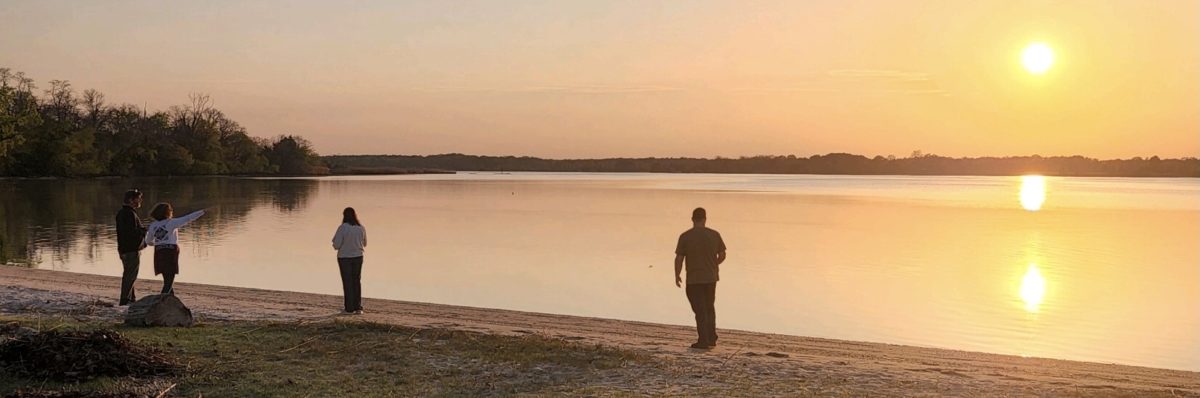
On a beautiful fall evening, I hopped on my bike and eased around Boone Creek and then found a tree on the shoreline of the Oxford Cemetery. I stretched my legs out and listened to geese in the cove, the breeze through the trees, conversations of boaters in Town Creek, and watched the sun dance on the water. I read David Bailey, Richard Rohr, and N.T. Wright. Mostly I sat, watched, listened, imbibed.

I was completely full. I didn’t try to give it words, just breath and feeling.

Yesterday I came across this passage from Frederick Buechner’s “Wishful Thinking,” and I realized Buechner had the words I was looking for:

ETERNITY IS NOT endless time or the opposite of time. It is the essence of time. 

If you spin a pinwheel fast enough, then all its colors blend into a single color—white—which is the essence of all the colors of the spectrum combined. 

If you spin time fast enough, then time-past, time-present, and time-to-come all blend into a single timelessness or eternity, which is the essence of all times combined. 

As human beings we know time as a passing of unrepeatable events in the course of which everything passes away including ourselves. As human beings, we also know occasions when we stand outside the passing of events and glimpse their meaning. Sometimes an event occurs in our lives (a birth, a death, a marriage—some event of unusual beauty, pain, joy) through which we catch a glimpse of what our lives are all about and maybe even what life itself is all about, and this glimpse of what “it’s all about” involves not just the present but the past and future too. 

Inhabitants of time that we are, we stand on such occasions with one foot in eternity. God, as Isaiah says (57:15) “inhabiteth eternity” but stands with one foot in time. The part of time where he stands most particularly is Christ, and thus in Christ we catch a glimpse of what eternity is all about, what God is all about, and what we ourselves are all about too.