Living the Gospel: vulnerable, dependent, together

Background: Last weekend was a preaching weekend for me at Christ Church Easton. The Gospel reading for the lectionary was Luke 10:1-11, 16-20, where Jesus sends 70 followers out ahead of him to towns and place he will go, with specific instructions as to how they are to interact with people. Following is the transcript of my sermon.

“Living the Gospel: vulnerable, dependent, together”

In last week’s reading, we saw Jesus set his face toward Jerusalem and send people ahead to get things ready for him. The disciples were not well received when they got to a village of Samaritans. This made John and James furious and they wanted to send fire from heaven to consume the Samaritans. Not a very neighborly thing to do.

Jesus rebuked them; he told James and John, this is not how we do things and he gave a series of teachings about how the disciples needed to set their priorities if they were going to follow him.

Last week’s reading was a bit of precursor to this reading, as now Jesus gets 70 people together, he’s not just talking to the 12. And now he’s giving specific instructions to this larger group as he sends them out ahead of him to the towns and places he is going.

No more of this raining down fire from heaven, here’s what I want you all to do:

First of all, “the harvest is plentiful, but the laborers are few.” So we need laborers. What a great place to start. It’s out there, there is abundance—this work you are doing is needed. Given the reception in the last village, that might not be a foregone conclusion to some of Jesus’s disciples, but he sees abundance where others might see scarcity.

“Go on your way. See, I am sending you out like lambs into the midst of wolves. Carry no purse, no bag, no sandals; and greet no one on the road.”

Whenever I hear “sending you out like lambs into the midst of wolves,” I am waiting for that qualifying line, “so be as wise as serpents, but as innocent as doves.” But that’s from Matthew’s Gospel, we don’t get that spelled out in Luke. The disciples just go out like lambs.

Jesus is sending these 70 followers out into a hostile world that may not receive them well, and instead of arming them for battle, he points out their vulnerability. Not only will we not call down fire from heaven, you all are going out like lambs. No purse, or bag, or sandals.

Sending them out as lambs, he is sending them intentionally vulnerable, vulnerable by design. Why would he do that?

If you Google vulnerability today, it’s a guarantee that you will find a slew of quotes from social worker and storyteller Brene Brown. And here is a quote of hers from a book study we did that speaks to what Jesus may have had in mind:

“Vulnerability is the birthplace of love, belonging, joy, courage, empathy, and creativity. It is the source of hope, empathy, accountability, and authenticity. If we want greater clarity in our purpose or deeper and more meaningful spiritual lives, vulnerability is the path.” (Brene Brown, “Daring Greatly”)

Alright, Jesus. We’re getting vulnerable. Now what?

Go to their homes. Offer them peace. If they share in the peace you offer, it will rest on that person, if not it comes back to you. You are going to depend on the people in that house, eating and drinking whatever they give you.

Whenever you enter a town and they welcome you, eat what they give you, cure the sick and tell them the kingdom of God has come near to you.

If a town doesn’t welcome you, it’s the same message, the kingdom of God has come near.

One of the things that strikes me about this reading, Jesus isn’t teaching them theology, he isn’t giving them Scripture 101, he is instructing them in how to interact with people. How to go about their work, dependent on those in the towns and places the disciples are sent to.

In thinking about this, Franciscan Richard Rohr writes:

“All of Jesus’ rules of ministry here, his ‘tips for the road,’ are very interpersonal. They are based on putting people in touch with people. Person-to-person is the way the gospel was originally communicated. Person-in-love-with-person, person-respecting-person, person-forgiving-person, person-touching-person, person-crying-with-person, person-hugging-person: that’s where the Spirit is so beautifully present.” (Richard Rohr, “The Good News According to Luke”)

In fact, Rohr goes so far as to say, “The gospel happens between two or more people.”

Fr. Richard Rohr and Brene Brown

Now, this is something to kick around a bit. Say I am sitting at home in the morning, having my coffee and prayer time, reading my Bible or doing a devotional, and I have a Holy Spirit moment. I feel touched by God; my heart is on fire; I see the interconnectedness of all people; I see how God’s love flows back and forth between us all; I am sure in my heart that I am a child of God.

Then I cut the grass. And I go to the grocery store. And I go about my business. And that realization I had in the morning has no apparent impact on my life. It doesn’t translate into how I love, how I treat other people, how I live.

Have I been true to the realization? If all I do is go to church services and read my Bible, and listen to sermons and music: has love, has grace transformed my life?

Here is one of Rohr’s most impactful thoughts for me. He says:

“The most a preacher does is entice you, attract you, and call you out of yourself to live a new kind of life. But the gospel cannot happen in your head alone. You never think yourself into a new way of living. You invariably “live” yourself into a new way of thinking.”

You don’t THINK yourself into a new way of LIVING. You LIVE yourself into a new way of THINKING.

I wonder if that’s what Jesus has in mind sending his disciples out: that you are going to learn and experience things on the road that I can’t simply teach you here, no matter how brilliant and deep the parable is.

You’ve got to get out there and take this peace, this good news, to others. That’s where the gospel is, that’s where love is, in our interactions with people. That’s where Jesus, that’s where Scripture, and that’s where the Holy Spirit sends us. Out.

When we open ourselves to this interpersonal gospel, this gospel that happens between two or more people, that’s where lasting transformation can happen. I know we are in an era of self-love, and self-love is hugely important—we get ourselves into trouble if we try to love our neighbor as ourselves, but we loathe ourselves, rather than love ourselves. Love yourself for sure.

But love ultimately calls us outside ourselves. Love is bigger than us. And if love is the most powerful force in the world… if God is love and we belong to God… it’s living out this love and experiencing what happens when it is shared and multiplied, that then changes our lives, and the world, in meaningful ways.

Jesus gives his 70 disciples his “tips for the road” and sends them out. And they come back filled with joy saying, Jesus! You were right! In your name even the demons submit to us!”

And Jesus says, “Right??” I’ve seen all this happen and I’ve given you this authority and it will keep you safe.

“Nevertheless, do not rejoice at this, that the spirits submit to you, but rejoice that your names are written in heaven.”

How do we make sense of that? David Lose, writing in “Feasting on the Word” says:

“Jesus declares there is something even more significant than the triumph of the 70… what matters more than the earthly and spiritual successes of Jesus’ followers is the eternal relationship with God they enjoy through him. This relationship is theirs by grace, for they are simultaneously recipients of, and heralds to, the grace and mercy of God embodied in Jesus.”

Jesus knew they were going to have success in the towns and places he sent them. He wanted them to experience that and that was exactly what they needed. And it’s exactly what we need from time to time.

But not all days are going to be like that and not all our encounters with people are going to be infused with love and leave us feeling love. What’s more important than the success of our ministries or our evangelism, is our relationship with God, which we experience through Jesus.

This relationship is theirs, and ours, by grace. And I love this: we are simultaneously RECIPIENTS OF, and HERALDS TO the grace and mercy of God embodied in Jesus.

Let’s go back to our morning coffee revelation, the one we experience by ourselves. There we have the realization: we are the recipients of God’s grace and love. Let’s think of it as light in a frequently dark world.

If we keep that light to ourselves, it doesn’t do much to spread the light that the world needs to get out of the darkness. So we take that light and we become heralds TO it, this grace and love that we are shown in Jesus.

Jesus sends the 70 disciples, and us, out with this light. He sends us out to others, in humility and vulnerability, asking us to be dependent on him and on those who we encounter.

But don’t lose focus. There will be great days. There will be crappy days. There will be in-between days. And sometimes all three in one day.

We can’t control those things. What we can do is rejoice and be grateful for our relationship with God. That we get to do this work, that we get to experience and share this light, this grace; that God is with us, and that this good news, this gospel of love that we share, is exactly what the world needs right now.

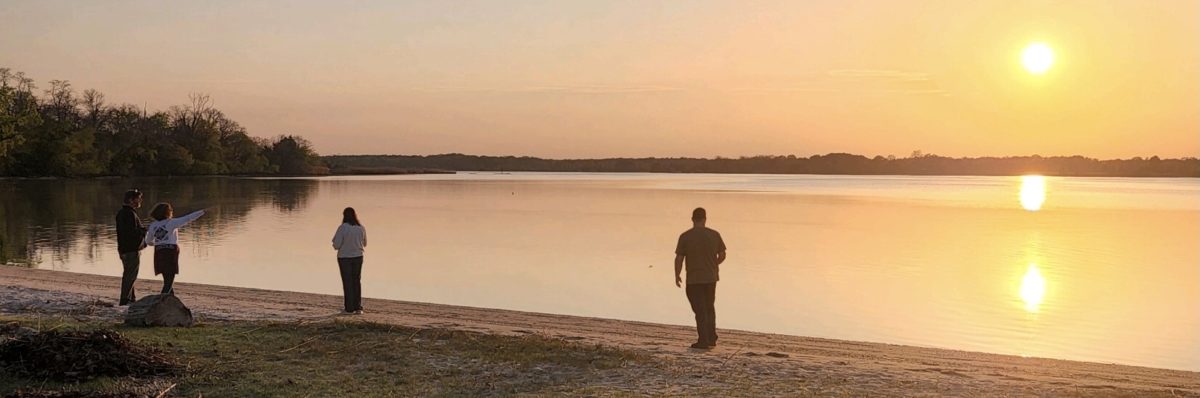
The 2025 Christ Church Easton/Diocese of Easton Mission Team in Wilmington, NC.

Let’s pray: Lord, you give us stories in Scripture for our learning, so that we can find you and find ourselves in them. Help us hear what your story is saying to each of our hearts. Let us locate where you are calling us, and how to amend our lives by your love and grace, so we can get there. And help us receive, experience, and share your gospel, your good news, in the world, with each other.

Amen.

Kindness, blessing, and the eyes of Jesus

From Ash Wednesday to Easter. A journey, a transformation, and one of the most intentional and richest parts of our liturgical calendar.

Our Lenten e-mail prompt and discussion of John O’Donohue’s book, “To Bless the Space Between Us,” was rich, meaningful, and eye-opening. It was a continuing and deepening conversation with 20 people which included the Eastern Shore, Vermont, and even photos and stories sent from Finland.

One of the purposes of the book for O’Donohue was/is to get us thinking about “blessing” differently, and that blessings can take many forms, not always something that we would wish, ask for, or even want. Sometimes blessings can be the sun and sometimes the silver lining.

The last section of the book is “To Retrieve the Lost Art of Blessing.” It is an intentional walk through a way of seeing. Here are a few early quotes:

“Something deep in the human soul seems to depend on the presence of kindness; something instinctive in us expects it, and once we sense it, we are able to trust and open ourselves.”

“Kindness has gracious eyes; it is not small-minded or competitive; it wants nothing back for itself. Kindness strikes a resonance with the depths of your own heart; it also suggests that your vulnerability, though somehow exposed, is not taken advantage of; rather it has become an occasion for dignity and empathy.

“Despite all the darkness, human hope is based on the instinct that at the deepest level of reality some intimate kindness holds sway. This is the heart of blessing. To believe in blessing is to believe that our being here, our very presence in the world, is itself the first gift, the primal blessing.”

That last paragraph especially: to see life itself as the first gift, the most basic blessing. Despite all the darkness.

We’ve just gone through an entire liturgical season that sees light overcome what seemed like the ultimate darkness. When faced with what seemed like the end, death, God shows us more, that new life overcomes death. That hope is not in vain, but intrinsic and ever-present, if we will see it.

Over the course of our group discussion, participants responded with pictures of the Northern Lights in Finland and an Assateague camping sunrise.


The Resurrection is nuanced and layered in its meanings. One of the things it did was give credibility to Jesus being who he said he was. And it made the disciples for the next few generations, reflect back on what Jesus said and did, to the point of writing it down so that it could be passed down.

Many writers and theologians point out that Jesus’s words to his disciples were “follow me,” not “worship me.” It’s really a both-and situation, we can do both; and worship is a perfect response to God. But a problem over the years has been and continues to be that many Christians are content with worshipping ( and “believing” without living or living into any of that belief) and have dropped the following aspect of our faith.

Following Jesus means living like he did, loving like he did, doing our best to emulate his example. In John’s Gospel, Jesus gives the disciples (and us) the new commandment of “loving each other as I have loved you.” which he says knowing he is about to be arrested and put to death. That’s what his love looks like–sacrificing himself for the love of his friends and for humanity.

When we look at kindness through the example and eyes of Jesus, we have a sense of what we are called to do and who we are called to be.

O’Donohue closes his book with the poem, “The Eyes of Jesus”–

I imagine the eyes of Jesus
Were harvest brown,
The light of their gazing
Suffused with the seasons:

The shadow of winter.
The mind of spring,
The bues of summer,
And amber of harvest.

A gaze that is perfect sister
to the kindness that dwells
In his beautiful hands.

The eyes of Jesus gaze on us,
Stirring in the heart’s clay
The confidence of seasons
That never lose their way to harvest.

This gaze knows the signature
Of our heartbeat, the first glimmer
From the dawn that dreamed our minds,

The crevices where thoughts grow
Long before the longing in the bone
Sends them toward the mind’s eye,

The artistry of the emptiness
That knows to slow the hunger
Of outside things until they weave
Into the twilight side of the heart.

A gaze full of all that is still future
Looking out for us to glimpse
The jeweled light in winter stone,

Quickening the eyes that look at us
To see through to where words
Are blind to say what we would love,

Forever falling softly on our faces,
His first gaze plies the soul with light,
Laying down a luminous layer

Beneath our brief and brittle days
Until the appointed dawn comes
Assured and harvest deft

To unravel the last black knot
And we are back home in the house
That we have never left.

The eyes of Jesus are a way of seeing and a way of being, in terms of how we see and treat each other. O’Donohue talks about the way Jesus sees us, his gaze, and describes it in a way that should make us feel like we are loved before we do or say anything. Our souls are loved, as well as our bodies and minds. Do we allow ourselves to feel seen and loved that way?

Following Jesus means to try to look at ourselves, each other, and Creation with these eyes and this love.

Why do we take a journey through Lent? Why do we try to take in, reflect on, pray on, the Passion/suffering of Jesus over Holy Week? Why do we celebrate Jesus’s Resurrection?

I hope that at least part of the reason is to allow ourselves to be transformed, to become more Christ-like, to live and love like Jesus, which is to experience the kingdom of God and to do our part to help bring that kingdom, that love, to others, and play whatever role we can in bringing the kingdom here.

May we feel the eyes of Jesus gazing on us.
May we be the eyes of Jesus gazing on others.

May we know the love of Jesus, who became one of us, showed us how to live and how to love, gave his life for us, and then showed us that his love, God’s love, is greater than death, overcomes death and brings us to eternal life.

May we be the love of Jesus for everyone we encounter. And echoing Fr. Gregory Boyle, everyone: no exceptions.

Conversion of St. Paul: Embracing Change

January 25 is the day the lectionary celebrates the Conversion of St. Paul. For our Wednesday Healing Services at Christ Church Easton, I have been using feast days that occur during a given week as a chance to do something along the lines of a homily to recognize them. This is what I put together for this week.

“The Conversion of St. Paul: Embracing Change”

Saul was not an atheist. He wasn’t a morally questionable person. He was a faithful and devoted Jew, who thought he was doing God’s work. And he was a persecutor of Christians. He approved the stoning of St. Stephen, the first Christian martyr in the Book of Acts.

There is no way in the world he was going to be even supportive of this movement, these followers of Jesus.

Until he was. This was not a change-by-degrees situation; this was being struck blind on the road to Damascus and having to come face-to-face with not just the risen Christ, but with the idea that the things you were devoted to, committed to, SURE OF, turned out to be wrong.

This was not an unlikely conversion. It was an impossible conversion. It made no sense. Saul had to come into it and not only that, if you were one of the early followers of Jesus, you knew who Saul was and there was no way you were going to trust him.

From the account in Acts, Saul was blind for three days and didn’t eat or drink for that time.

The Lord called out to a disciple in Damascus named Ananias, and told him where to go to find Saul and lay hands on him so that Saul could regain his sight.

And Ananias said:

“Lord, I have heard from many about this man, how much evil he has done to your saints in Jerusalem, and here he has authority to bind all who invoke your name.”

In other words, “Lord, I don’t think this is such a good idea.”

The Lord said to him, “Go for he is an instrument whom I have chosen to bring my name before gentiles and kings and before the people of Israel. I myself will show him how much he must suffer for the sake of my name.”

Even after his conversion, regaining his sight and becoming an incredibly powerful and persuasive preacher—so much so that now the Jews wanted to kill him; when Saul came to Jerusalem to join the disciples, they were all afraid of him and didn’t believe he had really changed.

Paul’s life got significantly more difficult after his conversion. Many of his letters were written from prison, which he found himself in and out of.

Now in terms of hand-picking apostles, Jesus hit the jackpot with Paul. Paul was Jewish, a pharisee. He was a Roman citizen, he spoke multiple languages, he was literate and educated, and passionate—he was actually the perfect combination of skills, upbringing, and knowledge to take this movement to the next level.

Let’s talk about change. Paul had to completely change his life, to repent, to turn around and go a different direction. And he is well documented in his own words for doing so.

Has your own path of following Jesus asked you to change or make changes in your life? What kind?

Our changes aren’t going to be a severe as Paul’s—I don’t think any of us were persecuting or killing Christians. Changes in our lives might look very different.

I’ll show you what I mean. I make this point a fair amount: over the past eight years, I have cried more than any other period of my life. Following Jesus has opened my heart and caused me to care about more people and more things, to take them into my heart—it’s a much more difficult way to walk through life. But it’s also richer and more rewarding.


Following Jesus with our whole hearts should make us care more about the world and be heartbroken by things we might have ignored before.

Following Jesus asked me to give up a temper that I had been developing over the years.

Following Jesus asked me to let go of judging people and situations. On the Meyers Briggs personality test that people take, I used to test as INFJ—introverted, intuitive, feeling, judging—over the past five years, anytime I have taken the test and been totally honest, I am INFP—judging changed to perceiving.

Change was necessary for Paul and it’s necessary for us. Transformation is a word that is not to be taken lightly.

Another thing we might learn from Paul is the difference between righteousness and self-righteousness. Saul, the pharisee who persecuted Christians was sure he was right. Jesus had a different opinion.

It makes me think of a more modern-day hero of mine. Verna Dozier was an African-American woman who was an English teacher at Dunbar High School. When she retired, became one of the lay (non-ordained) leaders of the Episcopal Church. I keep a copy of her book “The Dream of God” on a shelf near my desk. We did a small group study of that book, and I loved everything about this quote:

“We always see through a glass darkly, and that is what faith is about. I will live by the best I can discern today. Tomorrow I may find out I was wrong. Since I do not live by being right, I am not destroyed by being wrong.”

It is a powerful and humbling thing to live knowing I (or we) don’t and can’t know everything. I do my best to figure things out and have the courage and grace to keep learning and I realize that because something seemed right yesterday, it doesn’t mean it can’t be proved wrong today or tomorrow. If that happens, then I need to be willing to change. Just like Paul did.

So maybe humility becomes important, to realize I am not always right, no matter how passionate I might feel about something. I could have a realization—an epiphany—that I was wrong. Then I need the courage to admit it and think and live differently.

What else can we learn from Paul’s conversion? How about don’t write off your enemies. Saul wasn’t just disliked by the early Christians—he was public enemy number one. They were scared and skeptical of bringing him into the fold.

I apologize for bringing sports analogies into a discussion of such important things, but it’s still football season and we can make a couple points here.

There was a defensive back who played for the Pittsburgh Steelers named Rod Woodson, who is a Hall of Fame player, one of the best to play football at his position. The Steelers and the Baltimore Ravens are big rivals, they don’t like each other on the field very much. Rod Woodson ended up becoming a Raven, helped them win a Super Bowl, and now he is one of their radio broadcast announcers. Loved in both cities, he has dual citizenship.

If you follow the Philadelphia Eagles, running back Saquon Barkley was the franchise player of their division rival New York Giants. Philly fans booed him when the Giants came to town. This year he was traded to the Eagles, has been their best player, the most loved of the Eagles this year and one of the main reasons they are playing this coming weekend for a chance to go to the Super Bowl.

Sports are not life, but the point is, people who were once hated by entire cities and fanbases, become beloved and embraced.

Because someone was your enemy one day, or for a time, doesn’t mean they can’t become an ally, a friend, even beloved. Jesus wasn’t kidding when he said “love your enemies.” He showed the world with Paul, that your enemy is your brother or sister, and we and they are capable of change.


I have been reading Gregory Boyle’s book “Cherished Belonging” to get ready for our small groups that start next week. Boyle points out that on the day when Jesus entered Jerusalem on his way to be arrested and crucified, there were two parades that day.

On the one side, coming from the west on the main road, was Pilate and his show of military power and force. It was a display of power. Don’t mess with Pilate or you see what you’ll get. Boyle writes:

“Then there’s Jesus, on a small donkey, humbling entering the city from the east. Jesus’s trek and mission displays a way of life whose hallmarks are inclusion, nonviolence, unconditional loving kindness, and compassionate acceptance. The parade of warhorses announces the threat of violence, force, coercion, and the oppression of the poor. The “triumphant” entrance of Jesus is not an indictment but an invitation. Village transcending tribe. Jesus doesn’t draw lines (of division). He erases them.

Paul’s encounter with Jesus caused him to change his life completely. To become the thing that he despised. To embrace the other side.

Jesus invites us to do the same. To change. To be humble. To let go of our self-righteousness. To embrace his way of inclusion, even of our enemies, nonviolence, unconditional loving kindness, and compassionate acceptance.

Paul’s conversion changed everything. So can ours. So can anyone else’s.

Top image: “The Conversion of St. Paul” by Caravaggio, oil on cypress wood, 1600/1601.

On Being Born

The last five years have been off the map. If you’d sat down with me on this day in 2013 and told me what the view in 2018 would look like, I’d have backed away slowly. And yet, they are some of the most important and beautiful years in shaping who I am, for better or worse.

One thing I remember clearly, when summer came and the Coast Guard contract we were working on ended, I was out of a job and searching for a direction. And I remember reading Frederick Buechner and having this overwhelming feeling that I should go to seminary; that there was something about a journey of faith that was key. I look back at Buechner’s words that I found again recently:

“Listen to your life. Listen to what happens to you because it is through what happens to you that God speaks… It’s in language that’s not always easy to decipher, but it’s there powerfully, memorably, unforgettably.”

I talked to a long-time friend and mentor who is an Episcopal priest and looked into things and sat and prayed on it, and then let it go when another Washington, DC, job working for the Coast Guard presented itself. I simply couldn’t imagine what life would look like or what would have to happen to end up working for a church.

There is no way I can do justice to the events that have taken place or the unexpected cast of characters who have been a part of what has happened since. There have been so many unexpected and undeserved blessings, even while there has been confusion, frustration, and letting go. Looking with hindsight doesn’t show the heartbreak, missteps and mistakes, letting people down, the questions, or being lost in the woods for stretches. We each have to own our scars and those we cause others. And we each have to get up each day and ask and answer, “Now what?”

In his book, “The Heart of Christianity,” Marcus Borg talks about being what resurrection means in our lives:

“…the process of personal transformation at the center of the Christian life: to be born again involves death and resurrection. It means dying to an old way of being and being born into a new way of being, dying to an old identity and being born into a new identity–a way of being and an identity centered in the sacred, in spirit, in Christ, in God.”

There is so much there. So much to live into, live up to, and I don’t always to the best job of it. But trying to focus and center and find each day, something of a new life, centered in God and the sacred. That feels like what I have been trying to get to since I was a teenager and started uncovering pieces of life and the world that I love.

There is something new and at the same time, there are the parts and passions and wonders and curiosities that abide and make us who we are, each of us a piece of a larger puzzle. And how we see things and how we see ourselves, they are and we are. I have been reading John O’Donohue’s “Anam Cara,” which goes on my very short list of books I’d take with me anywhere.

“There is such an intimate connection between the way we look at things and what we actually discover. If you learn to look at yourself and your life in a gentle, creative, and adventurous way, you will be eternally surprised at what you find… Each of us needs to learn the unique language of our own soul. In that distinctive language, we will discover a lens of thought to brighten and illuminate our inner world.”

“Anam Cara” shows how creatively and actively our inner world, our bodies, and the landscapes around us are all sacred and interconnected.

Each of the last five or six years, I have picked myself up a pair of shoes and a book for my birthday. Sometimes they have been trail running shoes, sometimes running shoes, Sanuks, or Vans. The books are more varied and tangential than I could even account for. The purpose is to invite in new adventures for the year: physical adventures on foot as well as intellectual adventures. Both make for adventures of the soul. This year it is trail shoes and Huston Smith’s autobiography, “Tales of Wonder: Adventures Chasing the Divine.”

Who knows what adventures year number 46 holds? I’ve learned I don’t know much. But I’m trying to get better as I go on about listening to my life and to hearing God speak. I am trying to use life up to this point, scars and all, to invite transformation and embrace new life ahead, centered in the sacred, centered in Christ, centered in God.

And I find life is generally better when I remember to get outside, with the dog 🙂


Finding Meaning and Community

Life can be rough. That’s not even worth a bumper sticker, it’s just a given. Even the most positive people have dark nights of the soul. And we all run up against questions we can’t answer. I think Fr. Bill Ortt is on to something when he says it is our questions that define us. It’s also our questions that drive us.

“Is there more to life than this?” That’s one of the first ones we come across in the Alpha Course. Alpha is phenomenon that took off in London under the leadership and vision of Nicky Gumbel. The notion was and is to take people who aren’t church-goers, but who wonder about life’s big questions, bring them together, to eat a meal, to enjoy each other, to watch some short films and talk. No judgment, no pressure, but plenty of laughter, connection, and fun. And funny things begin to happen when you put like-minded seekers together, no matter how different they may seem.

Last winter and spring, something like 60 adults and 40 youth went through Alpha at Christ Church Easton. It was a transformative experience for just about all involved. I went from feeling like a newcomer to knowing I was a part of a community of people. And I saw the same thing happen to other people. It wasn’t about “church,” it was about relationships, conversations, and connections. The weekend away itself left me reeling and inspired.

It seems a rare thing today to make the time to sit down with people, to eat together, to have meaningful discussion about things that matter, to admit we don’t have all the answers, but we have plenty of questions, and to put that on the table. The humor, the honesty, the laughs that follow are amazing.

Christ Church is starting Alpha up again this coming Saturday, Sept. 9. There is a worship service called “Alive at 5,” that is one of the most laid back and Spirit-filled I have ever encountered. At about 6-6:15, everyone sits down in the Parish Hall to eat together. Right now there are 70 adults signed up, plenty of whom haven’t been a part of Christ Church, a number who have and who are looking to go on a journey of sorts, together. The church’s youth program (ages 10-18) has dinner with us. Daycare is provided, free. Then we go watch a short film and break into small groups to talk.

It’s fun, it’s free, and there is no pressure. There are folks this spring that found it to be pretty cool. I found it to be something totally unexpected that I had been waiting for for some time. So much so that I am signing on again, as are a number of other folks. If it sounds like something you would dig, you can find more information at Christ Church Easton’s website.

There are different ways to find meaning and community. Alpha is a great beginning.


A Tale of Two Buildings

Let’s be up front: this isn’t really a tale of two buildings. It’s more what they represent. They are buildings, but also emblems. The cabin and the church.

The Cabin

It is so easy for me to be a hermit. An active, outdoor hermit, mind you–wrangling sunrises with coffee, running, paddleboarding, looking for birds. I like to hermit in the John Muir, Edward Abbey, Thoreau style.

It’s the easiest thing in the world to daydream about finding a cabin like this one from Cabin Folk and holing up for a good stretch with books, notebook, trail running shoes, binoculars, backpack, you get the idea. And I would enjoy that and likely recharge a bit.

Solitude is a necessary condition for me. But I’ve come to realize it’s not enough. It’s just a beginning point, albeit one to return to. If you are one to ask life’s biggest questions and take the walk to find answers, there is a good chance that you are going to struggle at times. You are going to suffer, you are going to come up short, and sooner or later, you are going to need help. That can be a humbling experience. For me, being humbled is also a necessary condition.

It’s being humbled and needing help that sets us up for needing other people. Needing a community of sorts. Needing people who we can relate to; who understand our struggles; and who we can in turn help with theirs. In my experience, helping someone–whether it is moving furniture, listening, laughing, accomplishing a goal, or just being there–creates a feeling in me that I can’t replicate on my own, cabin in the woods or not.

The Church

The world is so empty if one thinks only of mountains, rivers and cities; but to know someone who thinks and feels with us, and who, though distant, is close to us in spirit, this makes the earth for us an inhabited garden. – Johann Wolfgang von Goethe

“Someone who thinks and feels with us,” Goethe is perhaps describing the beginning or foundation of community. In his sermon at Christ Church Easton on Sunday, Fr. Scott Albergate posited that “The reason to go to church is to be in the company of others,” and that while in a worship service, “Hopefully it will sink into your soul–through the sacraments, songs, Scripture–that life is beyond our control.”

If you spend time in nature, or if you are at all mindful of the passing of time, disease, death, the notion that life is beyond our control is almost self evident. And it can be a heavy truth to bear. As we try to carry that with us, it can weigh us down.

Fr. Scott also pointed out that the majority of what we know of Jesus through the Gospel, he is concerned with healing and transformation. Healing and transformation, through Christ, happen through love and grace. Love happens in the world, through people. We can’t experience it alone. And when we come together, a funny thing happens:

God brings his presence ‘into the house,’ and we are called to release it back out into the world. – Pete Greig, “Red Moon Rising”

Grace is only grace because God gives it to us, He shares it. We know it as a gift and show it by sharing it with each other and others. We know love and grace in the company of others.

Two Buildings

The cabin is the place to find ourselves in solitude. The church building is the place to come together with those “close to us in spirit.” We come together to know, to experience God’s grace through each other and to take it out into the world.

I need both buildings and what they represent. I think Thomas Merton gets it right when he says:

We do not exist for ourselves alone, and it only when we are fully convinced of this fact that we begin to love ourselves properly and thus also love others.