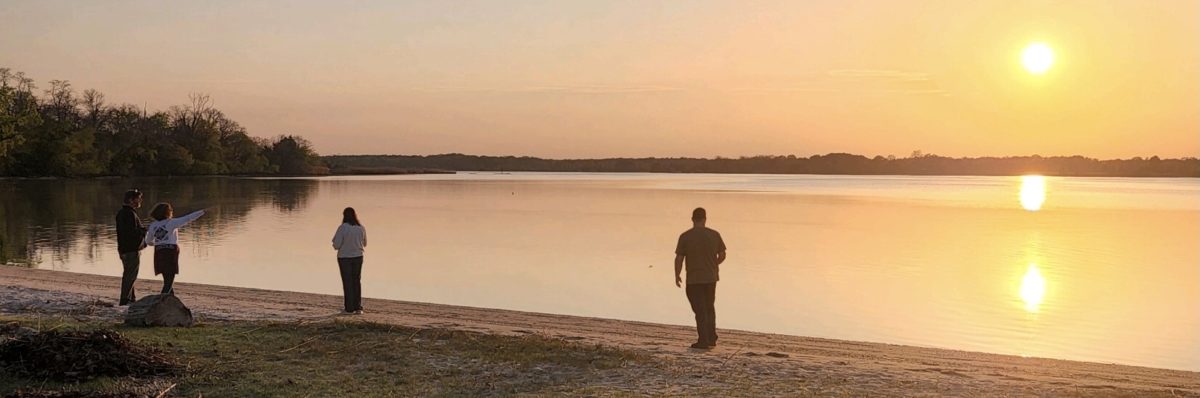
When I walked to the shoreline, there was a Kingfisher just down the bank.
Across the creek, a Great Blue Heron plodded.
This morning I got a note from a friend who has cancer and is struggling through treatment. He was flown to Hopkins and is in the ICU. He asked for prayer.
I prayed. I wrote and sent him a prayer. I am praying. I will be praying. I haven’t stopped. It never feels like enough.
What I want for him is a miracle. A return to health and home and family and worship and all the things he loves and that love him back.
How about a miracle, God? Have you seen the world lately? Have you seen how we behave? How we treat one another? Most of us don’t deserve miracles. But you still give them. I can’t always figure out why or where, but it’s not on me to do that. Miracles are you, God.
I can hear Bob Weir singing, “I need a miracle every day”–and I get that.
I feel it in my soul–the miracles of morning coffee and a hug in the kitchen, and making breakfast for my daughters, of a world where the seasons change and there are Kingfishers and Herons on the shoreline.
I think of the ICU. Where miracles are breath. And modern medicine. Doctors and nurses. Love of family. Technology. Communication. Patience. Time. Prayer. Hope.
I sit on the shoreline praying for my friend. I feel your presence all around me.
A jet flies over with its landing gear down; it’s a majestic sound and sight. It’s a miracle you’ve given us through the minds, reason, and intellect you created in us.
I pray now with tears in my eyes for multiple friends with cancer who love you and who share your love with others.
We all need miracles every day. Send some extras to those with cancer and to their families. Keep them connected to your love, your peace, your healing.
Background: Last weekend was a preaching weekend for me at Christ Church Easton. The Gospel reading for the lectionary was Luke 10:1-11, 16-20, where Jesus sends 70 followers out ahead of him to towns and place he will go, with specific instructions as to how they are to interact with people. Following is the transcript of my sermon.
“Living the Gospel: vulnerable, dependent, together”
In last week’s reading, we saw Jesus set his face toward Jerusalem and send people ahead to get things ready for him. The disciples were not well received when they got to a village of Samaritans. This made John and James furious and they wanted to send fire from heaven to consume the Samaritans. Not a very neighborly thing to do.
Jesus rebuked them; he told James and John, this is not how we do things and he gave a series of teachings about how the disciples needed to set their priorities if they were going to follow him.
Last week’s reading was a bit of precursor to this reading, as now Jesus gets 70 people together, he’s not just talking to the 12. And now he’s giving specific instructions to this larger group as he sends them out ahead of him to the towns and places he is going.
No more of this raining down fire from heaven, here’s what I want you all to do:
First of all, “the harvest is plentiful, but the laborers are few.” So we need laborers. What a great place to start. It’s out there, there is abundance—this work you are doing is needed. Given the reception in the last village, that might not be a foregone conclusion to some of Jesus’s disciples, but he sees abundance where others might see scarcity.
“Go on your way. See, I am sending you out like lambs into the midst of wolves. Carry no purse, no bag, no sandals; and greet no one on the road.”
Whenever I hear “sending you out like lambs into the midst of wolves,” I am waiting for that qualifying line, “so be as wise as serpents, but as innocent as doves.” But that’s from Matthew’s Gospel, we don’t get that spelled out in Luke. The disciples just go out like lambs.
Jesus is sending these 70 followers out into a hostile world that may not receive them well, and instead of arming them for battle, he points out their vulnerability. Not only will we not call down fire from heaven, you all are going out like lambs. No purse, or bag, or sandals.
Sending them out as lambs, he is sending them intentionally vulnerable, vulnerable by design. Why would he do that?
If you Google vulnerability today, it’s a guarantee that you will find a slew of quotes from social worker and storyteller Brene Brown. And here is a quote of hers from a book study we did that speaks to what Jesus may have had in mind:
“Vulnerability is the birthplace of love, belonging, joy, courage, empathy, and creativity. It is the source of hope, empathy, accountability, and authenticity. If we want greater clarity in our purpose or deeper and more meaningful spiritual lives, vulnerability is the path.” (Brene Brown, “Daring Greatly”)
Alright, Jesus. We’re getting vulnerable. Now what?
Go to their homes. Offer them peace. If they share in the peace you offer, it will rest on that person, if not it comes back to you. You are going to depend on the people in that house, eating and drinking whatever they give you.
Whenever you enter a town and they welcome you, eat what they give you, cure the sick and tell them the kingdom of God has come near to you.
If a town doesn’t welcome you, it’s the same message, the kingdom of God has come near.
One of the things that strikes me about this reading, Jesus isn’t teaching them theology, he isn’t giving them Scripture 101, he is instructing them in how to interact with people. How to go about their work, dependent on those in the towns and places the disciples are sent to.
In thinking about this, Franciscan Richard Rohr writes:
“All of Jesus’ rules of ministry here, his ‘tips for the road,’ are very interpersonal. They are based on putting people in touch with people. Person-to-person is the way the gospel was originally communicated. Person-in-love-with-person, person-respecting-person, person-forgiving-person, person-touching-person, person-crying-with-person, person-hugging-person: that’s where the Spirit is so beautifully present.” (Richard Rohr, “The Good News According to Luke”)
In fact, Rohr goes so far as to say, “The gospel happens between two or more people.”
Fr. Richard Rohr and Brene Brown
Now, this is something to kick around a bit. Say I am sitting at home in the morning, having my coffee and prayer time, reading my Bible or doing a devotional, and I have a Holy Spirit moment. I feel touched by God; my heart is on fire; I see the interconnectedness of all people; I see how God’s love flows back and forth between us all; I am sure in my heart that I am a child of God.
Then I cut the grass. And I go to the grocery store. And I go about my business. And that realization I had in the morning has no apparent impact on my life. It doesn’t translate into how I love, how I treat other people, how I live.
Have I been true to the realization? If all I do is go to church services and read my Bible, and listen to sermons and music: has love, has gracetransformed my life?
Here is one of Rohr’s most impactful thoughts for me. He says:
“The most a preacher does is entice you, attract you, and call you out of yourself to live a new kind of life. But the gospel cannot happen in your head alone. You never think yourself into a new way of living. You invariably “live” yourself into a new way of thinking.”
You don’t THINK yourself into a new way of LIVING. You LIVE yourself into a new way of THINKING.
I wonder if that’s what Jesus has in mind sending his disciples out: that you are going to learn and experience things on the road that I can’t simply teach you here, no matter how brilliant and deep the parable is.
You’ve got to get out there and take this peace, this good news, to others. That’s where the gospel is, that’s where love is, in our interactions with people. That’s where Jesus, that’s where Scripture, and that’s where the Holy Spirit sends us. Out.
When we open ourselves to this interpersonal gospel, this gospel that happens between two or more people, that’s where lasting transformation can happen. I know we are in an era of self-love, and self-love is hugely important—we get ourselves into trouble if we try to love our neighbor as ourselves, but we loathe ourselves, rather than love ourselves. Love yourself for sure.
But love ultimately calls us outside ourselves. Love is bigger than us. And if love is the most powerful force in the world… if God is love and we belong to God… it’s living out this love and experiencing what happens when it is shared and multiplied, that then changes our lives, and the world, in meaningful ways.
Jesus gives his 70 disciples his “tips for the road” and sends them out. And they come back filled with joy saying, Jesus! You were right! In your name even the demons submit to us!”
And Jesus says, “Right??” I’ve seen all this happen and I’ve given you this authority and it will keep you safe.
“Nevertheless, do not rejoice at this, that the spirits submit to you, but rejoice that your names are written in heaven.”
How do we make sense of that? David Lose, writing in “Feasting on the Word” says:
“Jesus declares there is something even more significant than the triumph of the 70… what matters more than the earthly and spiritual successes of Jesus’ followers is the eternal relationship with God they enjoy through him. This relationship is theirs by grace, for they are simultaneously recipients of, and heralds to, the grace and mercy of God embodied in Jesus.”
Jesus knew they were going to have success in the towns and places he sent them. He wanted them to experience that and that was exactly what they needed. And it’s exactly what we need from time to time.
But not all days are going to be like that and not all our encounters with people are going to be infused with love and leave us feeling love. What’s more important than the success of our ministries or our evangelism, is our relationship with God, which we experience through Jesus.
This relationship is theirs, and ours, by grace. And I love this: we are simultaneously RECIPIENTS OF, and HERALDS TO the grace and mercy of God embodied in Jesus.
Let’s go back to our morning coffee revelation, the one we experience by ourselves. There we have the realization: we are the recipients of God’s grace and love. Let’s think of it as light in a frequently dark world.
If we keep that light to ourselves, it doesn’t do much to spread the light that the world needs to get out of the darkness. So we take that light and we become heralds TO it, this grace and love that we are shown in Jesus.
Jesus sends the 70 disciples, and us, out with this light. He sends us out to others, in humility and vulnerability, asking us to be dependent on him and on those who we encounter.
But don’t lose focus. There will be great days. There will be crappy days. There will be in-between days. And sometimes all three in one day.
We can’t control those things. What we can do is rejoice and be grateful for our relationship with God. That we get to do this work, that we get to experience and share this light, this grace; that God is with us, and that this good news, this gospel of love that we share, is exactly what the world needs right now.
The 2025 Christ Church Easton/Diocese of Easton Mission Team in Wilmington, NC.
Let’s pray: Lord, you give us stories in Scripture for our learning, so that we can find you and find ourselves in them. Help us hear what your story is saying to each of our hearts. Let us locate where you are calling us, and how to amend our lives by your love and grace, so we can get there. And help us receive, experience, and share your gospel, your good news, in the world, with each other.
I am rarely without a notebook and pen. It would be fair for me to wear a sign on my back that says, “Will stop to write.” Mostly because otherwise I will forget. I will stop my longboard if a compelling thought jumps into my mind. And I frequently sit along a shoreline, in the woods, on a bench or wherever to take notes.
When it comes to church, for the readings and the sermon, I often just have pen and paper at the ready.
These are notes and thoughts after sermons and discussion last weekend at Christ Church Easton.
Last weekend’s lectionary readings were Isaiah 11:1-10 (The Peaceful Kingdom) and Matthew 3:1-12 (The Proclamation of John the Baptist). They will both speak to you if you let them.
A shoot shall come out from the stump of Jesse, and a branch shall grow out of his roots. The spirit of the Lord shall rest on him, the spirit of wisdom and understanding, the spirit of counsel and might, the spirit of knowledge and the fear of the Lord. His delight shall be in the fear of the Lord.
Isaiah 11:1-3
On our Sunday morning Zoom discussion, Fr. Bill Ortt unpacked the Isaiah reading.
Wisdom happens in the heart and soul. Understanding takes place in the mind.
Fr. Bill Ortt
That’s one to sit with. We comprehend things with our mind, but when something sinks into our soul, it changes us.
And as we got talking about how to take “the fear of the Lord,” Fr. Bill talked about the ocean–how it deserves reverence and respect; how it leaves us humbled and in awe when we think about its size and power.
My mind went to the stars. When I stare at a clear night sky and try to think about the distance and time that is between us and God’s artwork across the cosmos; if I see a shooting star or the recent eclipse, my sense of awe and wonder is beyond stoked.
In verses 6-10, Isaiah goes on to describe what the coming peaceful kingdom might be like:
The wolf shall live with the lamb; the leopard shall lie down with the kid; the calf and the lion will feed together, and a little child shall lead them. 7 The cow and the bear shall graze; their young shall lie down together; and the lion shall eat straw like the ox. 8 The nursing child shall play over the hole of the asp, and the weaned child shall put its hand on the adder’s den. 9 They will not hurt or destroy on all my holy mountain, for the earth will be full of the knowledge of the Lord as the waters cover the sea.
This whole section is filled with hope for a people that need it. Maybe with what the world we live in feels like, looking forward with hope for a time to come might do us some good.
In Matthew’s Gospel, John the Baptist appears in the wilderness. He looks crazy, wearing camel-hair clothing and a leather belt, eating locusts and wild honey. He tells people to change their lives, to live differently.
The kind of wilderness they talk about in the Bible is not a place we want to be. Wilderness experiences are those times we feel alone, lost, stripped down, exhausted, confused.
We talked about the need for recognizing those times in the wilderness, those times of desperation.
“Sometimes we go into the wilderness, but sometimes the wilderness comes to us.”
That was a comment made in our Zoom discussion. There is a lot of truth to that. Being aware of the wilderness, even if we don’t feel that’s where we are, can be a saving grace.
Wilderness changes us. It can make us wiser. It can help us understand what other people are going through. It can wake up our compassion. When we come out of the wilderness renewed, we want to be people who help others who are struggling to make it through.
Towards the end of Fr. Bill’s sermon in the church on Sunday morning, he tied it together:
“We need to know what it means to be people who have been healed, forgiven, and renewed.”
St. Francis was not in the movie “Stripes.” He’s not that (“my friends call me psycho”/lighten up) Francis. I think the first time I connected Francis of Assisi to words was the prayer that is attributed to him:
“Lord, make us instruments of your peace.
Where there is hatred, let us sow love;
where there is injury, pardon;
where there is discord, union;
where there is doubt, faith;
where there is despair, hope;
where there is darkness, light;
where there is sadness, joy.
Grant that we may not so much seek to be consoled as to console;
to be understood as to understand; to be loved as to love.
For it is in giving that we receive; it is in pardoning that we are pardoned; and it is in dying that we are born to eternal life. Amen.”
And I thought, I want what that guy has. I want to get to that place. It is not an easy road. And then I realized that St. Francis is the guy who is always pictured with animals, connected to nature, known as a hippy in some circles, patron saint of the environment. So more good stuff.
And as I’ve come to find writers and thinkers who resonate, open doors, help me name things, or get out of my own way, one of those folks is Richard Rohr, who is a Franciscan friar/monk.
Today (Oct. 4) is the “Feast of St. Francis,” which has given me a bunch to think on. Rohr’s book “Eager to Love,” outlines “the alternative way of Francis of Assisi.” In his preface, Rohr says:
“We are each loved by God in a particular and incomparable way, as in the case of a bride and bridegroom.” Francis and Clare knew that the love God has for each soul is unique and made to order… Divine intimacy is always and precisely particular and made to order–and thus ‘intimate.'”
If you dig into his life and teachings, Francis (1182-1286) is a fascinating friar. Son of a wealthy merchant who lived it up, was captured, got sick, had dreams and visions and transformed his life. He lived a life most of us couldn’t handle or live up to. He embraced and marveled in all of God’s creation. Again from Rohr:
“In Franciscan mysticism, there is no distinction between sacred and profane. All of the world is sacred… you can pray always and everything that happens is potentially sacred if you allow it to be. Our job as humans is to make admiration of others and adoration of God fully conscious and deliberate.”
All the world is sacred, pray always, everything that happens to you is a chance to find meaning and grace. Francis is often depicted in nature, praying with and spending time with animals. I think artist Sue Betanzos, who creates whimsical paintings of St. Francis, and whose painting is the featured image at the top of this post (used with the artist’s permission), gets his connection to nature.
On this Feast of St. Francis, I want to make it a point to study him more, his life, writing, and teachings. One of the things he seems to get is the idea that we are all connected to everything–God, each other, nature/creation, it’s all rolled into one. As Rohr puts it:
“The great irony of faith is that authentic God experience does indeed make you know that you are quite special, favorite, and chosen–but you realize others are too! That is the giveaway that your experience is authentic, although it may take a while to get there. You are indeed hurting–and others are too. Your only greatness is that you share the common greatness of the whole communion of saints. Your membership in the communion of sinners is a burden you can now carry patiently because others are also carrying it with you. You are finally inside what Thomas Merton calls ‘the general dance.’ You no longer need to be personally correct as much as you need to be connected.”
We don’t need to be correct, we need to be connected. And what St. Francis got, what Rohr gets, what Christ was making known to us, among so many other things, is that we are all connected, to God, each other, the Universe/Creation. Now we just need to start acting like it, both for the joy, the wonder, and the stewardship that is entrusted to us.
St. Francis connects all the dots in his “Canticle of Brother Sun,” quoted in part below the stained glass:
Praised be you, my Lord, with all your creatures, especially by Brother Sun, who is the day through whom you give us light. He is beautiful and radiant with great splendor, of You Most High, he bears the likeness.
Praised be You, My Lord through Sister Moon and the stars, In the heavens you have made them bright, precious and fair.
Praised be You, my Lord, through Brothers Wind and Air, And fair and stormy, all weather’s moods, by which You cherish all that You have made.
Praised be You, my Lord, through Sister Water, So useful, humble, precious and pure.
Praised be You, my Lord, through Brother Fire, through whom You light the night and he is beautiful and playful and robust and strong.
Praised be You, my Lord, through our Sister, Mother Earth who sustains and governs us, producing varied fruits with coloured flowers and herbs.