Meeting in the Mess and the Mystery

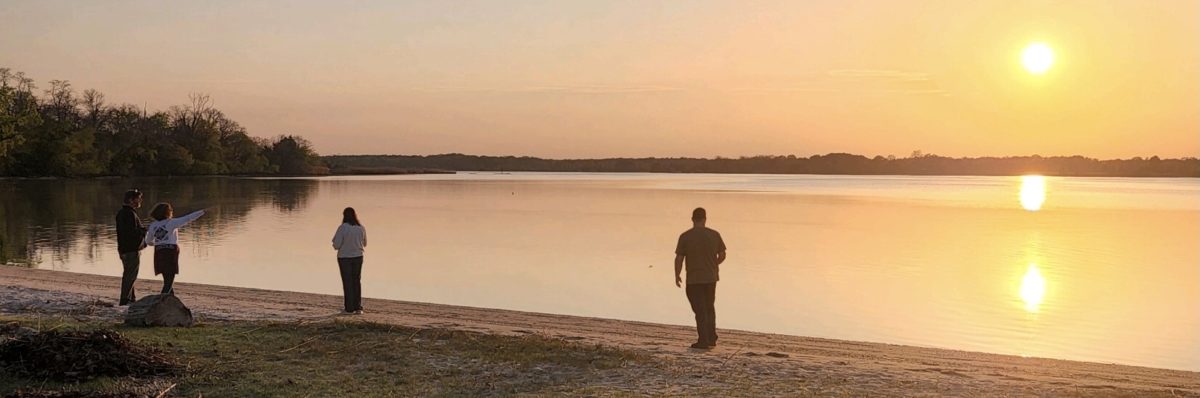
There is something about this time of year. As Fr. Bill Ortt points out, the word “Lent” comes from an Old English word that means “lengthen”—for the days getting longer. It’s not the spring is here yet, but we are moving in that direction. The magnolia tree in our front yard attests to that (as do the neighbors saying, “there he is in the yard staring at and taking pictures of the tree again…”).

This week we end a long study of Paul’s Letter to the Romans. And we start both Zoom and in-person studies of Debie Thomas’s “Into the Mess & Other Jesus Stories.”

Talking about Romans, Rev. Jay Sidebotham in his book, “Conversations with Scripture: Romans” writes:

“Paul offers specific examples of what a community transformed by grace looks like. It is a community of righteousness, a matter of being in right relationship with each other. That community will be marked by a willingness to forgo one’s own agenda for the better of another, most definitely a countercultural thing to do… The Christian community is to be marked by a spirit that honors the other.”

For Paul, it was the impossible task of unifying the Jewish believers in Christ with the Gentiles–something that had never been done. It’s telling that we have had more than 2,000 years to work at this, but we seem to have taken steps backwards at welcoming and honoring the outsider, the other. That is something to think about and pray on during Lent (and beyond).

In society today, we’ve decided that faith is a personal/individual thing, it’s between us and God. But I wonder what happens if we poke our individual faith with a stick.

In the first essay in “Into the Mess,” Thomas looks at Luke’s Gospel, (1:26-38) where the angel Gabriel tells Mary what’s going on with her and how God is calling her. Thomas talks about what a shocking and impossible reality was being opened up for Mary. And after the angel leaves:

“(Mary) has to consent to evolve. To wonder. To stretch. She has to learn that faith and doubt are not opposites–that beyond all easy platitudes and pieties of religion, we serve a God who dwells in mystery. If we agree to embark on a journey with this God, we will face periods of bewilderment… (leading to) it’s when our inherited beliefs collide with the messy circumstances of our lives that we go from a two-dimensional faith to one that is vibrant and textured.”

For both Mary and Paul, when they said yes to their callings/journeys with God, their lives got more difficult, harder to bear, not easier. For some of us, that kind of poking may be uncomfortable. It’s meant to be.

Thomas goes on to talk about the cost of loving, “to love anyone in this broken world takes tenacity and grit, long-suffering and great strength.” She goes from talking about Mary, to talking about us:

“The particularities of our own stories might differ from Mary’s, but the weight and cost of ‘bearing’ remain the same–and so does the grace. When we consent to bear the unbearable, we learn a new kind of hope. A hope set free from expectation and frenzy. A resurrected hope that doesn’t need or want easy answers. A hope that accepts the grayness of things and leaves room for mystery.”

Bearing the love for another in the world has its cost and its grace. Bearing the love of Christ in the world–being those who love God, welcome and love the outsider/other, those who feed the poor, heal the sick, or simply those who try to understand and love those who are difficult for us to understand or love–has its cost and its grace.

Faith isn’t an individual matter of being rescued from the mess, it is a choice to meet God in the mess, where He is, and we are, needed.

At Christ Church Easton, Fr. Bill has declared this Lent to be a season of healing, a time of sharing our stories and listening to others; of helping to find and spark hope for each other.

Tell us your story about where God entered your life and did something unexpected and remarkable. Share your story of healing.

The days are getting longer. We have a season where creation around us is going green and things are starting to blossom. We can use this season to draw closer to God and to encourage each other. We can bear the love of Christ into the world and in the process expand our faith into something vibrant and textured that embraces the messiness and mystery of life.

A Salty Reminder

Life is a pendulum swinging between remembering and forgetting. Often I find myself on the forgetting end of the swing.

The poet Rita Dove described something that goes on in my mind in her poem “Lucille, Post-Operative Years”–

Most often she couldn’t
think–which is to say she thought of
everything, and at once–


Then, sudden as a wince,
she couldn’t remember a thing.


What bothered her: the gaps
between.

(Those are connected excerpts from three different stanzas)

I can have what feels like so much spinning around in my head that I can’t think of the name of the person standing in front of me, who I’ve known for years and I can tell you everything about them, but their name is missing. Or I can be talking along towards a point and have it fly out of my head and leave me looking for a direction to catch up to it.

Meanwhile I have memories from the first 20 years of my life that are crystal clear and in context like they just happened. Oh, but the gaps in between. The mind is a marvelous thing, particularly when it cooperates or shows us things we had forgotten we knew.

Sometimes I wonder if our collective memory works like that as well. There are things we forget that are critical to who we are or who we are called to be.

That’s where my mind has wandered with this weekend’s lectionary Gospel reading, Matthew 5:13-20 (quoting 13-16, “Salt and Light”)


“You are the salt of the earth; but if salt has lost its taste, how can its saltiness be restored? It is no longer good for anything, but is thrown out and trampled under foot.

You are the light of the world. A city built on a hill cannot be hid.

No one after lighting a lamp puts it under the bushel basket, but on the lampstand, and it gives light to all in the house.

In the same way, let your light shine before others, so that they may see your good works and give glory to your Father in heaven.”

What if we forgot what it is to be salt and light? What if we lost what that means? Maybe being light in the darkness makes sense, but what is it to be salt?

I am going to stick with Debie Thomas, who I have quoted a good bit lately from her book “Into the Mess & Other Jesus Stories.” She says when Jesus calls his listeners ‘salt of the earth’ he is saying something profound that is easy for our to miss in our time:

“First of all, he is telling us who we are. We are salt. We are not ‘supposed to be’ salt, or ‘encouraged to become’ salt, or promised that ‘if we become’ salt, God will love us more. The language Jesus uses is 100 percent descriptive. It’s a statement of our identity. We are the salt of the earth. We are that which enhances or embitters, soothes or irritates, melts or stings, preserves or ruins. For better or worse, we are the salt of the earth, and what we do with our saltiness matters.

Salt by itself doesn’t do much. And too much of it can ruin things. But the right amount of salt (which was in Jesus’s time a precious commodity) can enhance and make things better. Salt’s value is in its being spread around, added to other things–but not in a way that dominates or takes over.

If we forget that we are salt of the earth and keep ourselves separate and distant or try to take things over, we are not being true to who we are called to be.

Thomas’s essay, “Salty” looks deeply at what is to be salt–something that was precious, something that “does its best work when it’s poured around”, something that doesn’t exist to preserve itself; a calling that is not meant “to make us proud; it’s meant to to humble and awe us.”

What an honor to be asked to help, to be of service. Thomas continues:

“Our vocation in these times and places is not to lose our saltiness. That’s the temptation–to retreat. To choose blandness over boldness and keep our love for Jesus an embarrassed secret… But that kind of salt, Jesus tells his listeners, is useless. It is untrue to its essence… Salt at its best sustains and enriches life. It pours itself out with discretion so that God’s kingdom might be known on the earth–a kingdom of spice and zest, a kingdom of health and wholeness, a kingdom of varied depth, flavor, and complexity.

I’m really looking forward to discussing Thomas’s reflections on the life of Christ. We’ll see how salty and balanced we can become during our Lent small groups .


These are some of the books that are pouring ideas and prayers and sentences and questions and wonder and inspiration into my heart and mind at the moment.

Next weekend (February 11-12), I preach at Christ Church Easton. What that looks like walking around and how to process it is a different kind of thing. Barbara Brown Taylor in her book, “The Preaching Life,” points towards it:

“I do not want to pass on knowledge from the pulpit; I want to take part in an experience of God’s living word, and that calls for a different kind of research. It is time to tuck the text into the pocket of my heart and walk around with it inside me. It is time to turn its words and images loose on the events of my everyday life and see how they mix. It is time to daydream, whittle, whistle, pray.”

The more often I tuck God’s Word into the pocket of my heart and walk around with it inside me, the more it helps shape who I am and how I see the world. If I hope to take part in an experience of God’s living word, I need to remind myself that I am salt and light–my role is to enhance, sooth, melt, preserve, to add some flavor that might bring it into our world in a fresh way.

Back to Thomas:

“We are the salt of the earth. That is what we are, for better or for worse. May it be for the better. May your pouring out–and mine–be for the life of the world.”

To be a human being among human beings

Life has felt large and open and raw of late, where prayers, feelings, experiences and thoughts are all super charged.

There are plenty of reasons: Ava’s stereotactic neurosurgery is on Monday; Anna turns 21 on Tuesday and Ava turns 18 in mid-February; we’ve past the half-way point in our Romans Bible studies; seminary is stirring good things up and Kelsey Spiker and I just became postulants, the next designation in the path to ordination to the priesthood; even occasional preaching is a full-body experience; gearing up for Lent small groups; and the girls had their first ever snow skiing experiences, which was a trip with Holly and her kids as well as many teen and twenty-something friends.

Life has an open feeling, which is both filling and fulfilling and taxing and shaky sometimes.

Studying for a Saturday seminary day retreat, Rev. Susie Leight has us reading and thinking about the spirituality of the priesthood, which included excerpts from Barbara Brown Taylor’s “The Preaching Life” and Gordon W. Lathrop’s “The Pastor: A Spirituality.” Lathrop recalls an experience in a Swiss airport where he read a quote on a poster from Antoine de Saint-Exupery, written in French. Lathrop translated it literally to say:

“As a profound thirst: the desire to be a human being among human beings.”

A deep and profound desire to be a human being–someone who lives and feels, who is flawed and who needs others–among human beings. To be in community and to be allowed to be fully ourselves. This is what it is to be open, to be honest, to be vulnerable, which is not instantly a comfortable place to be.

Thursday we had a class discussing Tracy K. Smith’s Pulitzer Prize-winning book, “Life on Mars,” which is one of my favorite books. The discussion was about space and time, love, loss, grief, dancing, intimacy, language–it was flung like stars around the minds and hearts of those there. The last poem read was titled, “The Weather in Space”–

Is God being or pure force? The wind

Or what commands it? When our lives slow

And we can hold all that we love, it sprawls

In our laps like a gangly doll. When the storm

Kicks up and nothing is ours, we go chasing

After all we’re certain to lose, so alive–

Faces radiant with panic.

That is part of the challenge of being human, loss and fear are always in the mix with us. It’s a lot and sometimes we want to–I want to–shut the faucet off. But that’s not why we’re here. That’s not why I am here.

On Tuesday morning, I was thinking ahead to this weekend’s Gospel reading, which is Matthew 5:1-12, commonly known as the Beatitudes:

When Jesus saw the crowds, he went up the mountain, and after he sat down, his disciples came to him. And he began to speak and taught them, saying:

“Blessed are the poor in spirit, for theirs is the kingdom of heaven.
“Blessed are those who mourn, for they will be comforted.
“Blessed are the meek, for they will inherit the earth.
“Blessed are those who hunger and thirst for righteousness, for they will be filled.
“Blessed are the merciful, for they will receive mercy.
“Blessed are the pure in heart, for they will see God.
“Blessed are the peacemakers, for they will be called children of God.
“Blessed are those who are persecuted for the sake of righteousness, for theirs is the kingdom of heaven.
“Blessed are you when people revile you and persecute you and utter all kinds of evil against you falsely on my account. Rejoice and be glad, for your reward is great in heaven, for in the same way they persecuted the prophets who were before you.


I’ve been in a habit of looking to see if Debie Thomas has anything to say about a particular Bible passage in her book “Into the Mess & Other Jesus Stories.” And reading her take on the Beatitudes, it hit me that her book would make an incredible Lent study, looking at and discussing different aspects of Jesus’s life. Here is a bit of her take on the reading:

“What Jesus bears witness to in the Beatitudes is God’s unwavering proximity to pain, suffering, sorrow, and loss. God is nearest to those who are lowly, oppressed, unwanted and broken. God isn’t obsessed with the shiny and the impressive; God is too busy sticking close to what’s messy, chaotic, unruly, and unattractive.”

She goes further:

“I think what Jesus is saying in the Beatitudes is that I have something to learn about discipleship that my privileged life circumstances will not teach me. Something to grasp about the beauty, glory, and freedom of the Christian life that I will never grasp until God becomes my all, my go-to, my starting and ending place. Something to recognize about the radical counter-intuitiveness of God’s priorities and promises. Something to notice about the obfuscating power of plenty to blind me to my own emptiness. Something to gain from the humility that says, ‘The people I think I am superior to have everything to teach me. Maybe it’s time to pay attention.'”

If I want to be a human being among human beings, I have to be open to, to learn from, to love, those whom God loves: everyone. More than that, if as followers of Christ, we look to do God’s work in the world, we have to be, we have to show, we have to act out in faith the love that God makes real here and now, especially to those who feel alienated or shut off from it.

In teaching the Beatitudes, Jesus is turning the world and what we think we know about it, on its head. This is something he does frequently in his teachings and his parables. We should ask why.

Next week we will discuss poet Joy Harjo’s book “Conflict Resolution for Holy Beings.” In “Talking with the Sun,” she writes:

After dancing all night in a circle we realize that we are a
part of a larger sense of stars and planets dancing with us
overhead.
When the sun rises at the apex of the ceremony, we are
renewed.
There is no mistaking this connection, though Walmart
might be just down the road.
Humans are vulnerable and rely on the kindnesses of the
earth and the sun; we exist together in a sacred field of
meaning.

To be a human being among human beings is also to be human in and as a part of God’s Creation. Which He asks us to be stewards of, to take care of.

Humans are vulnerable and rely on kindnesses. When I try to live with my heart open, I have a greater sense of, and gratitude for these kindnesses–kindnesses that can come from anywhere and anyone. Any one of us. Even me.