Living the Gospel: vulnerable, dependent, together

Background: Last weekend was a preaching weekend for me at Christ Church Easton. The Gospel reading for the lectionary was Luke 10:1-11, 16-20, where Jesus sends 70 followers out ahead of him to towns and place he will go, with specific instructions as to how they are to interact with people. Following is the transcript of my sermon.

“Living the Gospel: vulnerable, dependent, together”

In last week’s reading, we saw Jesus set his face toward Jerusalem and send people ahead to get things ready for him. The disciples were not well received when they got to a village of Samaritans. This made John and James furious and they wanted to send fire from heaven to consume the Samaritans. Not a very neighborly thing to do.

Jesus rebuked them; he told James and John, this is not how we do things and he gave a series of teachings about how the disciples needed to set their priorities if they were going to follow him.

Last week’s reading was a bit of precursor to this reading, as now Jesus gets 70 people together, he’s not just talking to the 12. And now he’s giving specific instructions to this larger group as he sends them out ahead of him to the towns and places he is going.

No more of this raining down fire from heaven, here’s what I want you all to do:

First of all, “the harvest is plentiful, but the laborers are few.” So we need laborers. What a great place to start. It’s out there, there is abundance—this work you are doing is needed. Given the reception in the last village, that might not be a foregone conclusion to some of Jesus’s disciples, but he sees abundance where others might see scarcity.

“Go on your way. See, I am sending you out like lambs into the midst of wolves. Carry no purse, no bag, no sandals; and greet no one on the road.”

Whenever I hear “sending you out like lambs into the midst of wolves,” I am waiting for that qualifying line, “so be as wise as serpents, but as innocent as doves.” But that’s from Matthew’s Gospel, we don’t get that spelled out in Luke. The disciples just go out like lambs.

Jesus is sending these 70 followers out into a hostile world that may not receive them well, and instead of arming them for battle, he points out their vulnerability. Not only will we not call down fire from heaven, you all are going out like lambs. No purse, or bag, or sandals.

Sending them out as lambs, he is sending them intentionally vulnerable, vulnerable by design. Why would he do that?

If you Google vulnerability today, it’s a guarantee that you will find a slew of quotes from social worker and storyteller Brene Brown. And here is a quote of hers from a book study we did that speaks to what Jesus may have had in mind:

“Vulnerability is the birthplace of love, belonging, joy, courage, empathy, and creativity. It is the source of hope, empathy, accountability, and authenticity. If we want greater clarity in our purpose or deeper and more meaningful spiritual lives, vulnerability is the path.” (Brene Brown, “Daring Greatly”)

Alright, Jesus. We’re getting vulnerable. Now what?

Go to their homes. Offer them peace. If they share in the peace you offer, it will rest on that person, if not it comes back to you. You are going to depend on the people in that house, eating and drinking whatever they give you.

Whenever you enter a town and they welcome you, eat what they give you, cure the sick and tell them the kingdom of God has come near to you.

If a town doesn’t welcome you, it’s the same message, the kingdom of God has come near.

One of the things that strikes me about this reading, Jesus isn’t teaching them theology, he isn’t giving them Scripture 101, he is instructing them in how to interact with people. How to go about their work, dependent on those in the towns and places the disciples are sent to.

In thinking about this, Franciscan Richard Rohr writes:

“All of Jesus’ rules of ministry here, his ‘tips for the road,’ are very interpersonal. They are based on putting people in touch with people. Person-to-person is the way the gospel was originally communicated. Person-in-love-with-person, person-respecting-person, person-forgiving-person, person-touching-person, person-crying-with-person, person-hugging-person: that’s where the Spirit is so beautifully present.” (Richard Rohr, “The Good News According to Luke”)

In fact, Rohr goes so far as to say, “The gospel happens between two or more people.”

Fr. Richard Rohr and Brene Brown

Now, this is something to kick around a bit. Say I am sitting at home in the morning, having my coffee and prayer time, reading my Bible or doing a devotional, and I have a Holy Spirit moment. I feel touched by God; my heart is on fire; I see the interconnectedness of all people; I see how God’s love flows back and forth between us all; I am sure in my heart that I am a child of God.

Then I cut the grass. And I go to the grocery store. And I go about my business. And that realization I had in the morning has no apparent impact on my life. It doesn’t translate into how I love, how I treat other people, how I live.

Have I been true to the realization? If all I do is go to church services and read my Bible, and listen to sermons and music: has love, has grace transformed my life?

Here is one of Rohr’s most impactful thoughts for me. He says:

“The most a preacher does is entice you, attract you, and call you out of yourself to live a new kind of life. But the gospel cannot happen in your head alone. You never think yourself into a new way of living. You invariably “live” yourself into a new way of thinking.”

You don’t THINK yourself into a new way of LIVING. You LIVE yourself into a new way of THINKING.

I wonder if that’s what Jesus has in mind sending his disciples out: that you are going to learn and experience things on the road that I can’t simply teach you here, no matter how brilliant and deep the parable is.

You’ve got to get out there and take this peace, this good news, to others. That’s where the gospel is, that’s where love is, in our interactions with people. That’s where Jesus, that’s where Scripture, and that’s where the Holy Spirit sends us. Out.

When we open ourselves to this interpersonal gospel, this gospel that happens between two or more people, that’s where lasting transformation can happen. I know we are in an era of self-love, and self-love is hugely important—we get ourselves into trouble if we try to love our neighbor as ourselves, but we loathe ourselves, rather than love ourselves. Love yourself for sure.

But love ultimately calls us outside ourselves. Love is bigger than us. And if love is the most powerful force in the world… if God is love and we belong to God… it’s living out this love and experiencing what happens when it is shared and multiplied, that then changes our lives, and the world, in meaningful ways.

Jesus gives his 70 disciples his “tips for the road” and sends them out. And they come back filled with joy saying, Jesus! You were right! In your name even the demons submit to us!”

And Jesus says, “Right??” I’ve seen all this happen and I’ve given you this authority and it will keep you safe.

“Nevertheless, do not rejoice at this, that the spirits submit to you, but rejoice that your names are written in heaven.”

How do we make sense of that? David Lose, writing in “Feasting on the Word” says:

“Jesus declares there is something even more significant than the triumph of the 70… what matters more than the earthly and spiritual successes of Jesus’ followers is the eternal relationship with God they enjoy through him. This relationship is theirs by grace, for they are simultaneously recipients of, and heralds to, the grace and mercy of God embodied in Jesus.”

Jesus knew they were going to have success in the towns and places he sent them. He wanted them to experience that and that was exactly what they needed. And it’s exactly what we need from time to time.

But not all days are going to be like that and not all our encounters with people are going to be infused with love and leave us feeling love. What’s more important than the success of our ministries or our evangelism, is our relationship with God, which we experience through Jesus.

This relationship is theirs, and ours, by grace. And I love this: we are simultaneously RECIPIENTS OF, and HERALDS TO the grace and mercy of God embodied in Jesus.

Let’s go back to our morning coffee revelation, the one we experience by ourselves. There we have the realization: we are the recipients of God’s grace and love. Let’s think of it as light in a frequently dark world.

If we keep that light to ourselves, it doesn’t do much to spread the light that the world needs to get out of the darkness. So we take that light and we become heralds TO it, this grace and love that we are shown in Jesus.

Jesus sends the 70 disciples, and us, out with this light. He sends us out to others, in humility and vulnerability, asking us to be dependent on him and on those who we encounter.

But don’t lose focus. There will be great days. There will be crappy days. There will be in-between days. And sometimes all three in one day.

We can’t control those things. What we can do is rejoice and be grateful for our relationship with God. That we get to do this work, that we get to experience and share this light, this grace; that God is with us, and that this good news, this gospel of love that we share, is exactly what the world needs right now.

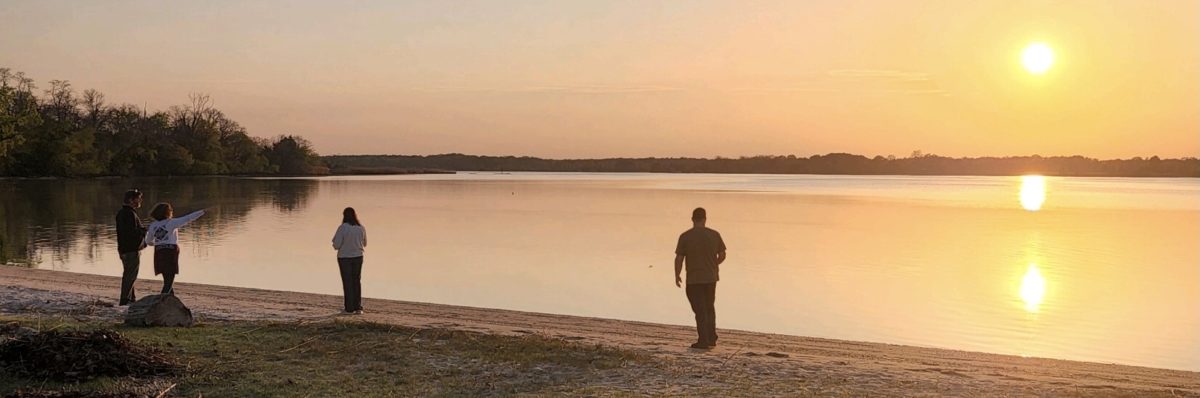
The 2025 Christ Church Easton/Diocese of Easton Mission Team in Wilmington, NC.

Let’s pray: Lord, you give us stories in Scripture for our learning, so that we can find you and find ourselves in them. Help us hear what your story is saying to each of our hearts. Let us locate where you are calling us, and how to amend our lives by your love and grace, so we can get there. And help us receive, experience, and share your gospel, your good news, in the world, with each other.

Amen.

Harper’s House

I agree with writer Jim Harrison when he wrote:

“Barring love I’ll take my life in large doses alone–rivers, forests, fish, grouse, mountains. Dogs.”

People can be difficult. Dogs are different. Dogs bring love to our lives unconditionally and with no questions asked.

Earlier this week, we had to say goodbye to our dog Harper. She was spring-loaded with love and energy; she bounded and leaped in place like Tigger from Winnie the Pooh when her people came to the door.

A growth in her stomach changed her over the last couple weeks, which we hoped might be pancreatitis and tried to treat with our fingers crossed. It wasn’t. When we got home Wednesday night, she couldn’t get off the couch. She was shaking and panting and suffering in constant pain. She let us know it was time.

Harper changed our lives. When life hit the restart button in 2014, I moved into a guest house down a long winding road that had a no pets policy. The family pets stayed with the girls’ mom, and the girls spent equal time with each of us. This was the first time in my life, and theirs, that any of us had lived without pets.

After a year we moved to Oxford into another no pets house. A year later, the girls and I talked and decided our house needed a dog. We weren’t a family without one. Our landlord agreed to a dog, up to 35 pounds.

Through Operation Paws for Homes, we learned about an “Australian Shepherd Mix” who had been found on the streets of Columbia, SC, and who was now being fostered in York, PA. We knew from the picture that she was our dog.

Six-month-old Harper on the drive to her forever family.

I drove to pick her up on June 4, 2016. They guessed she was about six months old. My older daughter Anna wanted to name her Harper after her favorite baseball player, Bryce Harper—when he was still a “good guy” and played for the Washington Nationals 🙂 I told Anna that players don’t often stay with one team, so we need another namesake, which was writer Harper Lee, of “To Kill a Mockingbird” fame.

Harper made our house a home instantly. She zoomed around the fenced in yard, loved walks around Oxford, and enthusiastically greeted dogs and people as they walked by the house. Two years later we moved to Easton and she patrolled the yard; learned to begrudgingly deal with cats, and kept our house safe from walkers and dog walkers in the neighborhood. Harper was a big fan of the pandemic lockdown in 2020–it meant we were always home.

Pandemic walks with the girls were a Harper favorite.

Walks around Tuckahoe State Park, Wye Island, and Easton’s Rails to Trails or Easton Point Park were Harper dreams turned reality. With her herding personality, she stuck close to her people, even in the house, or the writing shed out back, always lying next to one of us, always where the people were.

Seven years ago she met Holly’s black Lab puppy Luna and the two hit it off and loved to play at each other’s houses. We called Harper the “hall monitor,” as she didn’t tolerate off-hand behavior and would tell on Luna if she was trying to get food off the counter, get into the trash, or engage in any behavior that seemed suspicious.

Harper brought unconditional love and unbridled energy and enthusiasm to our lives. Every night, she slept against me, and every 0’Dark:30 alarm clock, she bounded out of bed ahead of me to go out and then curl up for morning coffee, reading, and writing.

I come back to this Milan Kundera quote frequently:

“Dogs are our link to paradise. They don’t know evil or jealousy or discontent. To sit with a dog on a hillside on a glorious afternoon is to be back in Eden, where doing nothing was not boring–it was peace.”

There is a stillness here now, a silence that is not peace, though Harper is at peace. We have loved and been privileged to share life with her. Her presence was her gift. She made us more of a family.

Wherever she was with us, it was Harper’s House.

Living with Mercy and Grace

Background: The lectionary readings for Sunday, February 23 include Genesis 45:3-11, 15, where Joseph is merciful to his brothers who threw him into a pit and sold him into slavery, and Luke 6:27-38, where Jesus tells his disciples to love your enemies, as part of his Sermon on the Plain. This is a quick homily I gave at the Wednesday Healing Service at Christ Church Easton, as these are both readings I think we need to discuss more.

Living with Mercy and Grace

Jesus’s teaching today is a continuation of the “Blessings and Woes” or Beatitudes that Patrick talked about last week. Let’s remember that Luke’s version of the Beatitudes is different than the one we find in Matthew’s Gospel, both in nuanced ways and in that Matthew shows Jesus going up a mountain to teach, whereas Luke has Jesus going down to a level place. Matthew’s version is often referred to as the Sermon on the Mount; this speech in Luke is often called the Sermon on the Plain. That’s an intentional setting for Luke, who shows Jesus among the people, not above them, lifting up the poor, and being visited by shepherds, not wise men.

After Jesus has bowled the disciples over by calling the poor, the hungry, and those who weep “blessed,” now he’s gone totally off his rocker telling them to love their enemies, do good to those who hate you, bless those who curse you, and pray for those who abuse you.

If we think Jesus is just speaking theoretically, no, he gives examples: if someone hits you on the cheek, give them the other one too; if someone takes your coat, give them your shirt as well; give to everyone who begs from you; and if anyone takes your stuff, don’t ask for it back.

Then Jesus drops a version of what we call the Golden Rule: “Do to others as you would have them do to you.”

How do you want to be treated? With love? With kindness? Then treat people that way. That’s a teaching we can get behind. We get something out of that, we think about how we want to be treated, which of course is to be treated well.

What about mercy? Hhhmmm… there is something to that. If only we had a case study, an example, something from the Old Testament maybe, to refer to…

Oh wait, we’ve got Joseph and his brothers from our Genesis reading. Joseph’s story is well known, even turned into a musical. Joseph was a dreamer and favored by his father; his brothers were jealous, decided to kill him, thought better of it, threw him into a pit; then got the bright idea to sell him into slavery; they took his robe or coat and put blood all over it and took it to their father, who assumed Joseph had been killed by wild animals.

From being a slave, Joseph works his way up to becoming the Pharoah’s top advisor in Egypt. He is able to see the tough times coming, store up food in times of famine; and in our reading today, his brothers come before him, in need. Joseph has all the power and can do with them whatever he wants. How many Hollywood movies would have this scene being sweet revenge, just retribution. But it’s not.

Joseph is merciful. And then some. The brothers don’t ask for forgiveness, they don’t fall down at his feet. It’s Joseph who initiates it:

“I am your brother, Joseph, whom you sold into Egypt. And now do not be distressed, or angry with yourselves, because you sold me here; for God sent me before you to preserve life… God sent me before you to preserve for you a remnant on earth, and to keep alive for you many survivors”… And he kissed all his brothers and wept upon them.”

It’s okay. You didn’t know what you were doing. But God did. This is where I was supposed to end up, so I could save us. It had nothing to do with how his brothers acted; it had everything to do with who Joseph was and how he acted.

Joseph was merciful. Even when he had every right to get back at them. And he showed mercy in a way that let his brothers save face.

Fr. Richard Rohr from the Center for Action and Contemplation website.

Franciscan and best-selling author Richard Rohr in talking about today’s Gospel reading gives us a thought that connects both readings. He says that Jesus doesn’t forgive in a way that makes him look good and sinners look bad. Jesus doesn’t say look how great I am and how sinful you are.

Rohr writes:

“Forgiveness is loyalty to the truth of who you are. To forgive someone is to recognize who they are, to admit and affirm who they are, and to know that their best selves will be brought out only in the presence of an accepting and believing person. Forgiveness is basically the act of believing in another person and not allowing that person to be destroyed by self-hatred. Forgiveness involves helping people uncover their self-worth, which is usually crusted over by their own self-hatred.

“This is a way of forgiving people that does not make you look goodbut makes them look good. That’s the way God forgives us. In the act of forgiveness, God gives us back our dignity and self-worth. God is loyal to the truth of who we are. God affirms that we are good persons who have sinned. God asserts that we aren’t bad.”

Joseph doesn’t wait for his brothers to grovel and plead. He jumps right out and says, don’t be angry with yourselves. This isn’t your fault. God needed me here to help.

Let’s move back to the Gospel. Jesus says, loving people that already love you? You want credit for that? Doing good to those who do good to you? Giving to those who you expect to get something back from? That’s not love, it’s business. We’ve got plenty of that going around.

“But love your enemies, do good, and lend, expecting nothing in return. Your reward will be great, and you will be children of the Most High; for he is kind to the ungrateful and the wicked. Be merciful, just as your Father is merciful.”

Jesus is a teacher whose actions back up his words. If the disciples, or if we think, yeah Jesus, that sounds great and all, but mercy isn’t how the world works. Jesus’s response, with his life, is to show mercy and to love those he encounters, to walk himself straight to Jerusalem, into the hands of those who will persecute and execute him and as he is dying on the cross, being mocked by the thieves on either side of him, as Luke tells it, one thief wises up and says, “Jesus remember me when you come into your kingdom.”

And Jesus replies, “Truly I tell you, today you will be with me in paradise.”

Mercy. Forgiveness. Right up to his death. And in his Resurrection, does Jesus ask for retribution? Does God want justice? No. Again, and again, and again, God shows mercy. Jesus forgives.

And it’s love that wins.

This is from The SALT Project’s weekly commentary, which brings it together beautifully:

“And what do we call this kind of love, this completely free, above-and-beyond, gratuitous giving? We call it “grace.” We may think of grace primarily as the unmerited, saving love of God — and well we should, Jesus says, for God “is kind to the ungrateful and the wicked.” But at the same time, this is exactly the love Jesus calls us to live out, not as gods or angels but as “children of the Most High,” human beings created in God’s image: “Be merciful, just as God is merciful” When we love this way, we embody the imago Dei (the image of God). This is the love we were made for.

Saying Yes and What Happens Next

Background: August 15 is the Feast of St. Mary the Virgin on the lectionary calendar. The Gospel reading used for the liturgy is Luke 1:46-55, a song Mary sings while pregnant, now referred to as The Magnificat. The following is the text of a homily I gave at the Christ Church Easton weekly healing service, where we used the St. Mary readings.

“Saying Yes and What Happens Next”

Mary said yes. She said yes to God. Today’s reading gives us Mary’s song of joy in what is happening with her; but the “yes” happened first. If we stick to Luke’s Gospel, the angel Gabriel comes to Mary and says, “Greetings, favored one! The Lord is with you. Do not be afraid, you have found favor with God.”

Gabriel explains what will happen, that she will bear a son and who he will be and what he will do and mean for the world. When she has questions, he explains that “the Holy Spirit will come upon her and the power of the Most High will overshadow her; therefore the child will be born holy; he will be called Son of God.”

Mary’s response was, “Here am I, the servant of the Lord; let it be with me according to your word.”

As far as we know, that is the last conversation Gabriel and Mary had. All it took was Mary’s consent. She said yes, when God called on her.

Mary goes to visit her cousin Elizabeth, who was barren, and became miraculously pregnant with John the Baptist. The two women come together and are overjoyed and anxious and excited, the baby in Elizabeth’s womb leaps at the presence of the pregnant Mary.

Caught up in this excitement, Mary gives us today’s reading, which we call, “The Magnificat,” which is used in Catholic, Lutheran, and Anglican/Episcopal Vespers (evening) services and sung or prayed as a canticle.

Mary’s song echoes older songs, including the Song or Prayer of Hannah, in 1 Samuel 2:1-10, which Hannah—who couldn’t conceive and prayed to God and who then had a son Samuel—sang to rejoice.

So this is the kind of joyous song someone is filled with when an incredible, overwhelming, and unexpected thing happens.

It’s the saying yes to God’s call, big or small, that opens us up to being filled with the Holy Spirit. And what that looks like can be big or small as well—it could look or feel like laughter, tears, joy; it can come over us as we do something we love or we feel called to do, it can feel like affirmation, it can feel like connection, it can feel like closeness—it’s a feeling inside us that comes from outside us, or that stirs something up in us that we didn’t know was there.

But here’s the thing: they are moments. They are gifts, but they don’t necessarily last. Here was this moment shared by Mary and Elizabeth, but it isn’t the moment or the Magnificat that we remember Mary for.

We remember her because she said yes to God. She said, “let it be with me according to your word.”

And what did saying yes then entail?

Mary then had to lean into Joseph’s understanding and compassion and bear an unexpected pregnancy in a culture that stoned women for what it seemed she had done.

Image: Giotto, The Arena Chapel Frescoes: The Boy Jesus in the Temple (1305-1306).

We learn later in Luke the story of Jesus going missing from Mary and Joseph and their having to return over days to come back and find their 12-year-old son teaching in the Temple. Imagine that prayer to God—”Hi, God, it’s me, Mary. I kind of lost your son…”

We’ve heard and recently talked about the story where Mary and Jesus’s later siblings come looking for him when they fear he has lost it, or gone too far, and he says, “Who is my mother? Who are my brothers and sisters?”

And Mary lives to see Jesus crucified in front of her.

These are bullet points, not going into any kind of detail. But pointing out that Mary’s life got more difficult, more confusing, and more heartbreaking after she said yes to God. We see similar storylines with John the Baptist, the Twelve disciples, and the apostle Paul.

We rightly celebrate and revere St. Mary the Virgin, not because she was unattainable and so far beyond human, but because she was human, scared, unsure at times, and she said yes and stepped up anyway, not even knowing what the cost might be.

Mary’s willingness might help us look at our own lives and see and seize opportunities to say yes, when we are called.

Debie Thomas, in her book “Into the Mess & Other Jesus stories” frames it like this:

“At its heart, Mary’s story is about what happens when a human being encounters the divine and decides of her own volition to lean into that encounter…

“In pondering Mary’s yes, we are invited to consider what our own might look like. What can we anticipate if we give our consent to God. What will happen within and around us if we agree to bear God into the world? Who will we become, and who will God become, in the long aftermath of our consent?”

A question I have for us this morning, can you think of an example, it could be from your life, or a friend or family member’s, or it can be an example that you have read about or know about that inspires you in some way, of a person who has said yes when called upon, and what that looked like?

I want to put it out there that if Mary’s life had been cushy or easy and she rode around in chariots and was carried everywhere she went, we wouldn’t think of her as a saint.

The United States Conference of Catholic Bishops says that “saints are persons in heaven (officially canonized or not), who lived heroically virtuous lives, offered their life for others, or were martyred for the faith, and who are worthy of imitation.”

That sounds like a tall order. None of us might aspire to be a saint—just living a good and commendable life seems like a plenty high bar to shoot for. But we are all called to be saints. When Paul used the word saints in his letters and when the earliest church talked about saints, it meant everyone, the whole body of the church, the Body of Christ.

If you look at the ending of the Apostle’s Creed, we say:

I believe in the Holy Spirit,
    the holy catholic Church,
    the communion of saints,
    the forgiveness of sins
    the resurrection of the body,
    and the life everlasting. Amen.

The Communion of Saints is all the faithful followers of Christ, living, dead, past, present, and future.

Rev. Katie Shockley, a Methodist minister, frames it like this:

“When we gather in worship, we praise God with believers we cannot see. When we celebrate Holy Communion, we feast with past, present and future disciples of Christ. We experience the communion of saints, the community of believers –– living and dead. This faith community stretches beyond space and time. We commune with Christians around the world, believers who came before us, and believers who will come after us. We believe that the church is the communion of saints, and as a believer, you belong to the communion of saints.”

We are bound together, lifted and carried by grace, with those who have come before us and those who will come after us. And we look to someone like Mary for inspiration, to remind us that we too can say yes, in our own ways, in our own lives.

When Mary said yes, I don’t think her thought process made her say, “hey, if I agree, maybe people will remember me as a saint someday!” Based on how Luke frames it, it was more along the lines of: God is asking for my help: “Here am I, the servant of the Lord; let it be with me according to your word.”


And she was willing to bear whatever came with that saying yes, though she knew not what that was.

Here is Debie Thomas one more time:

“The particularities of our own stories might differ from Mary’s but the weight and cost of ‘bearing’ remain the same—and so does the grace. When we consent to the unbearable, we learn a new kind of hope. A hope set free from expectation and frenzy. A resurrected hope that doesn’t need or want easy answers. A hope that accepts the grayness of things and leaves room for mystery.”

We don’t know what saying yes might mean. We don’t know exactly what comes next when we open and offer ourselves up. But we know that it brings us closer to God; we know that it allows us to be a part of God’s plans for the world; and we know that in God’s love for us, He invites us into richer, fuller lives, being a part of the Communion of Saints, and His holy mystery.

We can look to Mary as an example and for inspiration.

Rethinking Fairness

Background: On Sunday mornings at Christ Church Easton we have morning prayer and a discussion of the week’s lectionary Gospel reading on Zoom (in addition to three in-person services with Communion). Each Zoom discussion is different, depending on the reading and who is participating–in that way each discussion is organic and in places unscripted. So when I put together notes for a homily, some of it gets used, other parts don’t, and the key is to find the questions that are engaging people. This past Sunday, the Gospel reading was Matthew 20:1-16, in which Jesus tells the Parable of the Laborers in the Vineyard, where the landowner sends workers into his vineyard in waves from early morning right up until one hour to go in the evening. He then pays all of them the same usual daily wage. And the workers who had been there all day say it isn’t fair.

This is the homily I put together, though the discussion itself moved in different ways and there were parts that weren’t used and great questions and comments that aren’t written down.

(The image above is “Red Vineyards at Arles” by Vincent Van Gogh, 1888)

“Rethinking Fairness”

How many people are bothered by this parable? And what is it that rubs you the wrong way about it?

Our sense of fairness is disturbed. Even though those who worked from the early morning got exactly what they were promised, what they agreed to, which was a good wage for their work. And it was the landowner who offered them work in the first place.

The context of this reading, what we haven’t heard just before it, was Jesus and the rich young man, who kept all the commandments and was doing everything right, and he asked Jesus what else he had to do. And Jesus tells him to “sell all your possessions, give the money to the poor and you will have treasure in heaven; then come, follow me.” And the  young man goes away grieving, because he had many possessions.

Jesus tells his disciples that it’s really hard for a rich man to enter the kingdom of heaven. This goes against all the thinking of the day, where the rich were looked at is being in God’s good graces. That makes the disciples ask who can be saved? And Jesus tells them, “For mortals it’s impossible, but for God, all things are possible.”

And here is the line we are waiting for. Peter gets worked up and says, “Look, we have left everything and followed you. What then will we have?”

Jesus reassures them that when the time comes, they will be taken care of. But he can tell they are missing the point of everything. So we get the parable of the laborers in the vineyard.

Let’s look at the story. What can we say about the landowner? What do we notice about him and how he does things?

He is the one out finding the workers. It would have been more likely to see a manager or one of his employees, but it’s the landowner himself out there.

Michael Green in his book “The Message of Matthew” puts it like this—

“…he goes out himself. Indeed, he goes out repeatedly to seek them. They are hungry, unemployed, and as the day wears on, increasingly hopeless. He cares about that. He wants to give them a job to work and a reward.”

Then we get the payment. Everyone who works gets the same thing, a day’s wages. The order in which people are paid is a zinger, paying the last first, so that the early arrivers see what they are given.

“The Parable of the Laborers in the Vineyard,” by Rembrandt, oil on panel, 1637.

I love this perspective from Debie Thomas in her book, “Into the Mess & Other Jesus Stories.” She looks through a contemporary lens:

“The landowner in Jesus’s story doesn’t judge his workers by their hours. He doesn’t obsess over why some workers are able to start at dawn and others are not. Perhaps the late starters aren’t as literate, educated, or skilled as their competitors. Perhaps they have learning challenges, or a tough home life, or children to care for at home. Perhaps they’re refugees, or don’t own cars, or don’t speak the language, or can’t get green cards. Perhaps they struggle with chronic depression or anxiety. Perhaps they’ve hit a glass ceiling after years of effort, and they’re stuck. Perhaps employers refuse to hire them because they’re gay or trans or disabled or black or female.”

That’s the thing with Jesus’s parables—he gives us a story with just enough information to get our brain turning, but he doesn’t fill in all the details—that is for us to do. And often his parables disturb us and our sense of how things are.

Back to the parts of our story: we’ve got the landowner sending everyone into the vineyard, we’ve got payment being made, and then we have the reaction.

The last into the field are the first to get paid, and they get a day’s wages. As the first, the earlier workers approach, they are expecting more. And then they get upset.

“These last worked only one hour, and you have made them equal to us who have borne the burden of the day and the scorching heat.”

And the landowner says, didn’t I give you what I promised you, what we agreed to? Am I not allowed to give what belongs to me how I choose? Are you envious because I am generous?

What a question. I wonder, is it his generosity that offends or disturbs us here?

Here’s the thing. Part of why our sense of fairness is put off here is that we instantly identify with the laborers who went out at dawn, who have been out in the vineyard the longest.

Let’s move the parable into what it’s really addressing here: salvation. I have to tell you, when it comes to my life, to my faith—I am not one of the early arrivers. Like most things in life, I got there late.

What do the Gospels and Paul’s letters tell us over and over again: we are not saved by works, we are saved by grace, which is a gift from God. We can’t earn grace and it’s not a competition.

Here is Michael Green again:

“Grace, amazing grace, is the burden of this story. All are equally undeserving of so large a sum. All are given it by the generosity of the employer. All are on the same level. The poor disciples, fisherman and tax collectors as they are, are welcomed by God along with Abraham, Isaac, and Jacob. There are no rankings in the kingdom of God.”

If we fast forward to after Jesus’s death, resurrection, and ascension, into the Book of Acts, what happens at and after Pentecost—Peter and the disciples bring more and more into the fold, baptizing and teaching thousands. They didn’t have the attitude of, “Hey—where were these guys while Jesus was here—these new disciples have it so much easier.” Instead, Peter and company are thrilled to have more workers in the vineyard.

I wonder if the problem here is us and our small sense of fairness. Maybe God’s sense of fairness is bigger and more expansive than ours is, and that is a good thing.

Grace, like forgiveness which we’ve been talking about for the past couple weeks, depends on our receiving it and paying it forward. God’s plan is to include everyone.

Back to Thomas to bring it home:

“Could it be any more obvious that we are wholly dependent on each other for our survival and well-being? That the future of creation itself depends on human beings recognizing our fundamental interconnectedness and acting in concert for the good of all? That ‘what’s fair’ for me isn’t good enough if it leaves you in the wilderness to die? That my sense of ‘justice’ is not just if it mocks the tender heart of God? That the vineyards of this world thrive only when everyone has a place of dignity and purpose within them? That the time for all selfish and stingy notions of fairness is over?”

A question/thought that came up in our Zoom discussion today was, “How can people learn to be generous if they don’t experience it?” That’s so true. Those that were invited into the vineyard last experienced that kind of generosity. Let’s step into that.

Put yourself in the life of those that arrived at 5:00pm, for whatever reason. Imagine the joy you feel, imagine the gratitude, imagine going home and what you would say to your family. Imagine how you might be inclined to treat other people you encounter?

Maybe this is how we should think of fairness, the same way we think of grace and mercy and love.

Bearing With Each Other

Background: Last Saturday evening there was a wedding on Saturday evening at Christ Church Easton, so we moved our Alive @ 5 contemporary music service into the Parish Hall and served dinner at the end of the service. The band was in the style of MTV Unplugged and the Parish Hall was full of good food and fellowship. The Gospel from the lectionary last weekend was Matthew 18:15-20, where Jesus outlines how to deal with conflict/sin between people in the community. With our Rector/Pastor officiating the wedding, I preached at our Saturday evening service.

“Bearing With Each Other”

“Christian conflict resolution” is not a class that would have a waiting list to get into. It comes off a bit like a root canal—necessary, but not something to look forward to.

But when you look around society and how we deal with feeling wronged, we do need some guidance. These days there are a lot of passive-aggressive outlets out there. What are some notable passive-aggressive ways to not actually deal with conflict?

If your neighbor has done something to you, you might go through the neighborhood association, or contact the town. When a friend makes us angry, we might defriend or block them on social media, or write huffy, angry comments under something we disagree with. Politically these days, when someone slights or disagrees with someone, the goal is to discredit, belittle, shame, and have others pile on. Nothing is resolved. And resentment becomes more deeply rooted.

When someone wrongs us, when someone sins against us, we want things to be made right, for us. Our self-righteousness demands satisfaction.

That’s not what’s going on in today’s reading. Jesus is looking at this earliest church community, not society at large. And he is giving instructions for the benefit of the sinner, whose actions are pulling him/her/them outside of the community. Jesus is giving the disciples steps to restore that person, to keep the community together.

What an unmodern concept—to care about the sinner, and about the community, more than our own sense of justice.

This is a teaching about reconciliation, and it’s reconciliation based on love and forgiveness.

It’s not easy. It’s counter-cultural. It doesn’t make sense with how our laws are written.

But community can’t be built on the law. Legalism won’t save us. If you look at most laws, including those in Scripture, they’re drawn up around doing no harm. And that’s not bad—those kinds of laws help keep us safe.

When it comes to a faith community, safety isn’t enough.

Jesus doesn’t summarize the commandments by saying, “don’t harm God and don’t harm your neighbors.”

We’re called to love.


God doesn’t want us to coexist (though the sentiment on those blue bumper stickers is better than the alternative of wiping each other completely out of existence).

God wants us to thrive. To help one another. To be there for each other. To love one another.

Both Paul, writing today’s New Testament reading, and Jesus, speaking in today’s Gospel, want to make sure we get the message loud and clear.

When we love, we more than fulfill the law. And Jesus looks at conflict within the church community through love.

When there is conflict, where someone is going astray: deal with it, fix it, work it out. This is where things get hard for us, especially in a church. Historically, churches have publicly fallen on their faces with conflict resolution on big issues. Look at how many scandals and atrocities have been dealt with by the church, by transferring an offending clergyperson somewhere else—out of sight, out of mind, not our problem. That’s conflict, that’s crime, and that’s reconciliation on a different scale, but it’s real and something the church has to deal with in order to be the example it needs to be in the world.

As parishioners, on a much lesser scale, when it comes to having an issue with someone in the congregation, we might find it easier to find another church rather than work through something difficult when someone has wronged us.

Avoidance is an easier path than reconciling. And there is a cost to that.

Best-selling author, theologian and Bishop N.T. Wright says:

“Reconciliation is a huge issue today. We can see the results of not doing it: suicide bombs, campaigns of terror, heavy-handed repression by occupying forces. That’s on the large scale. On the small scale, we see broken marriages, shattered families, feuds between neighbors, divided churches.”

Jesus knows how hard it is going to be for the early church to stick together in community, especially once he is gone. And he goes straight at things, right up front.

He says, first, try to work it out between the two of you. If that doesn’t work, take a couple people with you. Expand that circle slowly. Allow the person to save face as much as possible.

Jesus doesn’t say—talk about that person, gossip, try to get everyone on your side. Instead, deal with it quickly and between the two of you.

Let’s remember the goal: bringing the sinner back into the fold, keeping the community together. All while dealing with what happened.

Here is N.T. Wright again:

“Forgiveness doesn’t mean saying “it didn’t really happen” or “it didn’t really matter.” Forgiveness is when it did happen and it did matter, and you’re going to deal with it and end up loving and accepting one another again anyway.”

We are sinners, all of us. We all mess up. We all fall off the path we are trying to walk. Forgiveness, grace, love—how God deals with us, is how we are to deal with each other.

What does the church need? Reconciliation (that’s our word of the night). The mission of the church is to reconcile the world to God. To do that, we have to model it in our midst. Not in some abstract way, but right down into the details of our lives and how we treat each other.

There’s a part of this reading that is easy to miss. Jesus tells the disciples that when an offender refuses to listen even to the church, “let such a one be to you as a Gentile and a tax collector.”

Let them go, as outsiders.

What do we know about Matthew from the text a few weeks ago? He’s a tax collector. And Jesus still loved and restored him. Even in continued disagreement and going separate ways, the goal is still restoration.


Dietrich Bonhoeffer has a little book called “Life Together,” where he looks at Christian community. He says that when it comes to ministry in a community, listening, active helpfulness, and bearing with others are foundational. He says it is hard to bear the sin of another person because it breaks fellowship with God and with his brother.

“It is only in bearing with him that the great grace of God becomes wholly plain. To cherish no contempt for the sinner but rather to prize the privilege of bearing him means not to have to give him up as lost, to be able to accept him, to preserve fellowship with him through forgiveness… As Christ bore and received us as sinners so we in fellowship may bear and receive sinners into the fellowship of Jesus Christ through the forgiving of sins.”

And Bonhoeffer ties it together saying that “where ministry of listening, active helpfulness, and bearing with others is faithfully performed, the ultimate and highest service can also be rendered, namely, the ministry of the Word of God.”

If as a community, we aren’t oriented towards listening, actively helping, and bearing with others, we are going to have a hard time ministering the Word of God to others. Because where would it be found in our lives and our community?

And then we get to these incredible last lines of the reading: “For where two or three are gathered in my name, I am there among them.”

How many people have heard that line before? How many have used it in the context of gathering together? And how many realized that Matthew includes those words from Jesus, here, when he is talking about sin, disagreement, and reconciliation—not at the Last Supper, or the Sermon on the Mount, or some hopeful healing or miracle. It’s here, where or when we are struggling, maybe even divided, that we need to remember and call on his presence among us.

If we as the church are going to reconcile the world to God, we aren’t going to do it on our own. We need God’s help. Thankfully, God has already done the work, in and through Jesus, who is with us, always.

And if we are going to call on his name, and continue his work, we’ve got to work through the tough stuff, not brush it under the rug and pretend it didn’t happen.

We’ve got to listen, we’ve got to help, we’ve got to bear with each other. That’s what love and forgiveness look like.

Amen.

Bonus quote, which we used in our Zoom discussion about the Gospel reading on Sunday morning. The quote comes from Padraig O’Tuama’s book, “Daily Prayer With the Corrymeela Community”–

“Listening is a sacrament when the topic is important, and when strife divides people in small places, the sacrament of listening is vital. So many people and so many places in the world have difficult relationships with difference. We seek to practice the art of hospitality in the places of hostility, and in so doing practice kindness in places the most in need of kindness.”

Beware of Mustard Seeds

Background: this is the text of the sermon I gave on July 29 and 30 in response to the reading in Matthew’s Gospel of the parable of the mustard seed and other parables that are grouped together and more so in response to Fr. Bill Ortt, the rector/priest at Christ Church Easton for the last 24 years announcing that he will be retiring later this year. He then left for an already-scheduled vacation.

“Beware of Mustard Seeds”

Looking at a mustard seed, there is nothing that tells you or hints at the growth it is capable of. The tiniest of seeds, it can grow to a height of eight to ten feet. But you wouldn’t know it at first sight.

I came to Christ Church in August 2016, looking for a church home. I walked in to the 9:15am contemporary service, sat about halfway up the pews (on the left side when entering the church) on the window side. The greeters that day were Matt and Kelsey Spiker, who I’d never met. I came here because I was going through a kind of spiritual awakening, I had been attending Real Life Chapel across town for a year, had started studying and writing about the Bible—I was getting stirred up and I wasn’t sure what to do with it all. I knew A.K. and Susie Leight were members here, and I had always thought highly of them, so I gave it a try.

I could tell from that first service that I had found my home. Then I went over to Rise Up Coffee afterwards and got in line right behind Kelsey and Matt and got talking to them.

I think I can speak for the Spikers when I say that none of us came to Christ Church thinking this was going to be somewhere we were going to work or that both Kelsey and I would discern calls to the priesthood.

Those things came from a combination of Fr. Bill Ortt and the Holy Spirit, both waking up something we had that was latent inside us. Something probably about the size of a mustard seed.

Beware of mustard seeds.

Neither of us felt a call to work at “a” church or for “the” church, we felt called to work for THIS church, and at the chance to work for Fr. Bill. We weren’t the first or the last to feel that. Carol Callaghan became a deacon while working here; Barbara Coleman was ordained a deacon here in 2020 after being a part of our congregation; Susie Leight discerned her call to the priesthood during her 20 years here; along with Kelsey and I—Joanne Fisher and Jessica Stehle are fellow postulants and seminarians working toward the priesthood who have come through Christ Church and Fr. Bill; and Kimberly Cox leaves for Virginia Theological Seminary four days after she gets back from the Peru Mission Trip.


That’s more than a notion. That’s the Holy Spirit coming through this place in waves, and Fr. Bill has been casually handing out surfboards, with a smile.

And that doesn’t even begin to touch on the music ministries or the lay ministries that have sprung up and the people along the way who have blossomed in their callings and become instrumental to the life and community of this church and the broader community. We could be here for a couple hours if we started listing names.

Beware of mustard seeds.

This is not a church for the casual observer. If you open yourself to it, you are likely to get caught up in a call. And for 24 years, Fr. Bill has helped create those opportunities and encouraged people on their paths.

There is a common thread to the parables in today’s reading:

  • The mustard seed that someone took and sowed in a field
  • The yeast that a woman took and mixed in
  • A treasure hidden in a field that someone found and hid and sold everything he owned and went and bought the field
  • A merchant finds a pearl of great value, sold everything he had and bought it
  • A net that was thrown into the sea, drawn ashore full of fish and sorted.

Every one of these things involves taking action. It asks the person in the story to do something. God doesn’t just do it for us, He wants us to be active participants in His work. In another well-known Gospel story, when it comes to feeding the 5,000, Jesus doesn’t do it all by himself, he uses the disciples to help.

If you’ve been around Fr. Bill, you know he likes things to be done to a certain high standard. He jokes around that that standard is mediocrity. We all know better. The thing about it though, if you look at the different ministries that have grown during his time here—Stephen Ministry, Food Ministry, Outreach ministries, Youth Ministry, Adult Education, Contemporary Music, the list goes on—none of them have his fingerprints heavily on them. In those ministries you will find the hands, and the sweat, and the tears, and the joy of those who have done the work, with his encouragement.

You’ll hear him say that life, and faith, are about the questions we ask—and that we should try to ask the right questions. I can’t count the number of times I’ve been in a meeting with Fr. Bill, thinking I have a good idea, and he’ll ask a few questions, that will send me back to the drawing board, to either scrap something, or to help it go from being a good idea, to a great idea.

His questions can serve as both sunshine and rain to seeds looking to grow.

Beware of mustard seeds.

I think about the phrase, “going to church.” Do you go to church?—someone may ask us or we might ask someone else. That sounds very nice. Something you do for an hour a week and it sounds like a fine thing to tell other people. “Yes, I go to church.”

One of the reasons I was drawn further and further into Christ Church is that there are so many opportunities to do so much more than “going to church.” Anyone who wants to can jump in with two feet—Bible studies, small groups, bands, choirs, youth ministry, hospitality. All it takes is the willingness to try. But like in our parables today, it may change everything.

Dietrich Bonhoeffer distinguishes between cheap grace and costly grace. He says:

“Costly grace is the treasure hidden in the field; for the sake of it a man will go and sell all that he has. It is the pearl of great price for which the merchant will sell all his goods… it is the call of Jesus Christ at which the disciple leaves his nets and follows him.”

“Costly grace is the gospel which must be sought again and again and again, the gift which must be asked for, the door at which a person must knock. Such grace is costly because it calls us to follow, and it is grace because it calls us to follow Jesus Christ. It is costly because it costs a [person] their life, and it is grace because it gives a [person] the only true life.

For 24 years, Fr. Bill has talked about and tried to model costly grace for Christ Church. The kind of grace that changes lives. That can change our lives. What a gift that is.

Last week when he told the staff he was retiring, after the stun-gun effect wore off, we all asked how we could walk beside him through these next few months, how we could support him. I think as a congregation, we have an opportunity to make these next few months an incredibly special time in the life of the congregation, and in the life of the Ortt family.


This is part of the gift that Fr. Bill has given us, and it is in character and in keeping with how he has always done things. We are entering into a process that this church hasn’t gone through in a quarter century. The majority of the congregation who are here now have only known Fr. Bill as the rector.

The process of sending him off with our gratitude, of finding an interim clergyperson or people to come in for the next year, of putting together a search committee, and finding the next rector of St. Peter’s Parish is something that can bring us together and connect us in ways we can’t even imagine yet.

We’ve had a number of small groups read Fr. Gregory Boyle’s book, “Tattoos on the Heart.” It’s an incredible story about a Jesuit priest’s calling to help love and rehabilitate Los Angeles gang members and it has changed the world there. And it has grown into a community that will continue after Fr. Greg is gone.

That’s a bit of the gift Fr. Bill is giving us. Now it’s our turn. Now it’s our time.

We are a community who puts our trust in God. I am going to drop a couple of Frederick Buechner quotes on you here. Buechner wrote:

“Wherever people love each other and are true to each other and take risks for each other, God is with them and they are doing God’s will.”

I believe that describes who we are as a community and how God has been and continues to be with us.

We are entering into a time of prayer and of gratitude, which really is an amazing way to spend all our time. In this case, it is gratitude for the gifts, the time, the friendship, and the leadership that we’ve been given. And for what is to come. And the hope is that prayer and gratitude will lead us into discernment for the way forward.

Today, and every day is unique. This time we find ourselves in, “for the time that we have,”—as Fr. Bill likes to quote Tolkien’s Gandalf—is a time we can bring special attention to relationships; to who and what we are grateful for; and who and how we want to be both individually and collectively.

As we walk forward together, I’ll let Buechner touch on how special this is:

“In the entire history of the universe, let alone in your own history, there has never been another day just like today, and there will never be another just like it again. Today is the point to which all your yesterdays have been leading since the hour of your birth. It is the point from which all your tomorrows will proceed until the hour of your death. If you were aware of how precious today is, you could hardly live through it. Unless you are aware of how precious it is, you can hardly be said to be living at all.”

Today is precious. This time–these next few months are precious. And we get to live it and be grateful for it, together.

Meeting in the Mess and the Mystery

There is something about this time of year. As Fr. Bill Ortt points out, the word “Lent” comes from an Old English word that means “lengthen”—for the days getting longer. It’s not the spring is here yet, but we are moving in that direction. The magnolia tree in our front yard attests to that (as do the neighbors saying, “there he is in the yard staring at and taking pictures of the tree again…”).

This week we end a long study of Paul’s Letter to the Romans. And we start both Zoom and in-person studies of Debie Thomas’s “Into the Mess & Other Jesus Stories.”

Talking about Romans, Rev. Jay Sidebotham in his book, “Conversations with Scripture: Romans” writes:

“Paul offers specific examples of what a community transformed by grace looks like. It is a community of righteousness, a matter of being in right relationship with each other. That community will be marked by a willingness to forgo one’s own agenda for the better of another, most definitely a countercultural thing to do… The Christian community is to be marked by a spirit that honors the other.”

For Paul, it was the impossible task of unifying the Jewish believers in Christ with the Gentiles–something that had never been done. It’s telling that we have had more than 2,000 years to work at this, but we seem to have taken steps backwards at welcoming and honoring the outsider, the other. That is something to think about and pray on during Lent (and beyond).

In society today, we’ve decided that faith is a personal/individual thing, it’s between us and God. But I wonder what happens if we poke our individual faith with a stick.

In the first essay in “Into the Mess,” Thomas looks at Luke’s Gospel, (1:26-38) where the angel Gabriel tells Mary what’s going on with her and how God is calling her. Thomas talks about what a shocking and impossible reality was being opened up for Mary. And after the angel leaves:

“(Mary) has to consent to evolve. To wonder. To stretch. She has to learn that faith and doubt are not opposites–that beyond all easy platitudes and pieties of religion, we serve a God who dwells in mystery. If we agree to embark on a journey with this God, we will face periods of bewilderment… (leading to) it’s when our inherited beliefs collide with the messy circumstances of our lives that we go from a two-dimensional faith to one that is vibrant and textured.”

For both Mary and Paul, when they said yes to their callings/journeys with God, their lives got more difficult, harder to bear, not easier. For some of us, that kind of poking may be uncomfortable. It’s meant to be.

Thomas goes on to talk about the cost of loving, “to love anyone in this broken world takes tenacity and grit, long-suffering and great strength.” She goes from talking about Mary, to talking about us:

“The particularities of our own stories might differ from Mary’s, but the weight and cost of ‘bearing’ remain the same–and so does the grace. When we consent to bear the unbearable, we learn a new kind of hope. A hope set free from expectation and frenzy. A resurrected hope that doesn’t need or want easy answers. A hope that accepts the grayness of things and leaves room for mystery.”

Bearing the love for another in the world has its cost and its grace. Bearing the love of Christ in the world–being those who love God, welcome and love the outsider/other, those who feed the poor, heal the sick, or simply those who try to understand and love those who are difficult for us to understand or love–has its cost and its grace.

Faith isn’t an individual matter of being rescued from the mess, it is a choice to meet God in the mess, where He is, and we are, needed.

At Christ Church Easton, Fr. Bill has declared this Lent to be a season of healing, a time of sharing our stories and listening to others; of helping to find and spark hope for each other.

Tell us your story about where God entered your life and did something unexpected and remarkable. Share your story of healing.

The days are getting longer. We have a season where creation around us is going green and things are starting to blossom. We can use this season to draw closer to God and to encourage each other. We can bear the love of Christ into the world and in the process expand our faith into something vibrant and textured that embraces the messiness and mystery of life.

Falling Forward

Fall is a time of change, a time of incredible colors, crisp air, clear skies, and fire-pit warmth. My bones know when fall hits. It’s also always been a time of renewal, energy, and new beginnings.

This year, fall is the beginning of year two of seminary through Iona Eastern Shore for seven of us aspirants and postulants. Our studies this year are focused on the history of the Christianity (what happened between the Acts of the Apostles and today) and heavily on homiletics–preaching. I’m especially appreciating lectures, essays, and books by Tom Long, who makes me think that preaching is something that can be taught, even to those of us to whom it doesn’t come naturally.

To borrow a few aspirational sentences from Long’s book “The Witness of Preaching”–

“To have our own lives, our own work, our own words, our own struggles and fears gathered up in some way into that event (preaching) is an occasion of rich and joyful grace… To be a preacher is to be a midwife of the word… we do not establish the time of its arriving; we cannot eliminate the labor pains that surround it; but we serve with gratitude at its coming and exclaim with joy at its birth.”

And:

“Faithful preaching requires such gifts as sensitivity to human need, a discerning eye for the connections between faith and life, an ear attuned to hearing the voice of Scripture, compassion, a growing personal faith, and the courage to tell the truth.”

I have such a long way to go, but I am inspired and encouraged and am becoming a student of the art and event of preaching.

I’ve also been helped along the way this fall by a discernment group who have gathered multiple times to help me discern, distill, and clarify my calling as part of the canonical process toward ordination. The way is each and every step and I am grateful beyond words for the questions, love, and encouragement from these friends.

Small Groups

At Christ Church Easton, new small groups are gathering to wrestle with Paul’s Letter to the Romans; a group of men are two weeks into discussing Richard Rohr’s “From Wild Man to Wise Man”; and we’re looking forward to our next newcomers class, where Brenda Wood and I will help orient folks to the ministries and work of our church, while looking at how baptism, Bible study, Communion, and prayer help define our faith in Rowan Williams’ book “Being Christian.”

Romans has given me a particular focus and opportunity for the fall/winter. In the same way that I wrote each week about our small group study of John O’Donohue’s book “Anam Cara,” I’ll be writing about Romans–thoughts from different scholars, snippets from our group discussions, and I am hoping to do some video segments and interviews with folks talking Romans.

I think for many church-goers, Paul’s Letter to the Romans is something experienced piecemeal, here and there, in lectionary readings. People know it’s a big deal, but they never take the time to read it and reckon with it. And that’s understandable–it’s daunting! But it’s also beautiful and potentially transformative. I love this thought by Rev. Jay Sidebotham, in “Conversations with Scripture: Romans,” when he says:

“The expression of trust in God’s grace, a theme of the Letter to the Romans, has the power to change individual lives. It also has the power to change communities, which is why it matters that we enter into this conversation. Such a conversation does not mean that we will like or understand everything in the letter… In the spirit of conversation, a word that suggests companionship on the journey, we hope that faithful attention to this ancient letter may open the door for new insights into the expansiveness of the grace of God.”

Romans has a history of changing lives and communities. Would that our studies might increase our trust in God’s grace.

To Live Prayerfully

Last weekend, Fr. Bill Ortt preached on Luke 18:1-8, the Parable of the Widow and the Unjust Judge. The text starts out by saying, “Jesus told his disciples a parable about their need to pray always and not to lose hope.” This is advice you give people who are going through tough times; people who might reach a point in their lives and their faith where they want to give up.

If we are going to be people for God, who is love, and so people for love, we need to lean in, not give up. We need to live prayerfully. Prayer is not simply asking for things–prayer is our connection to God. Prayer requires listening as much, if not more than talking.

That’s part of the reason why we use Rowan Williams’ book “Being Christian” in our newcomer class. It ends with prayer. And Williams describes three things that are essential for prayer:

  1. First, and most importantly, prayer is God’s work in us… It is the opening of our minds and hearts to the Father…
  2. Second, there is the deep connection… between praying and living justly in the world… Prayer is the life of Jesus coming alive in you, so it is hardly surprising if it is absolutely bound up with a certain way of being human which is about reconciliation, mercy, and freely extending the welcome and the love of God to others.
  3. Third, prayer from our point of view is about fidelity, faithfulness, sticking to it… Just stay there and if in doubt say, ‘O God, make speed to save me.’ Prayer is your promise and pledge to be there for the God who is there for you.

To live a prayerful life is to open our hearts, minds, and lives to God. It’s about praying and living in a way that shows reconciliation, mercy, welcome, and love. And it’s about sticking with it.

It’s a lot to take in. It’s a lot to try. We won’t always get it right. We will stumble and fall. And none of us can do it alone. But with God’s help, and with each other, we can get back up, try again, and keep forward on the way.

I come back to the Thomas Merton Prayer regularly. We prayed it together at the first meeting of our discernment group. And it feels like a good time to offer it here:

Gratitude and Grace

Maybe you have these moments. Sitting in the back yard by a fire. The night sky is clear and stark and full of stars, even with light pollution from the town. It’s the end of a long day and my birthday, so it’s a day where memories are ripe, just below the surface, and waiting to bubble up.

Deep breaths, easy smile, a moment of clarity. Sturgill Simpson plays at low volume on the bench next to me.

Moments and memories extend and swirl and I feel like every second of my life to this point, every person I have met, every setback, every success, every heartbreak, everyone and everything I have ever loved, every bit of pain felt, every joy, every experience, all add up to and come together in this one moment, the present moment, and all of it, every bit of it, is gratitude.

And what it looks like is tears running down my face, with no attempt to stop them, because I know I haven’t done anything to deserve any of it; that it’s a gift that I can never repay, all I can do is be in awe of it; all I can do is start to put my finger on it.

But I know what it is.

It is grace.

It’s grace that even though I mess up and do the wrong thing, even though I lose my temper, I can sit under this incredible sky and find solace and a reset button. I can try again.

It’s grace that getting lost in the enormity of the night sky, that I am here and that there is place for me in all of it.

It’s grace that the sun comes up and there is another day and a chance for something new–that I’ve never seen or thought about or encountered before.

Grace maybe begins when we remember. We remember and are grateful for this gift that we can’t earn, but which ought to shape who and how we are in the world. It’s a gift that isn’t for us to to keep to ourselves but to try to extend to someone else.

“Grace is when God is a source of wholeness, which makes up for my failings. My failings hurt me and others and even the planet, and God’s grace to me is that my brokenness is not the final word … it’s that God makes beautiful things out of even my own [stuff].

Nadia Bolz-Weber

I sit in the back yard, next to a fire, under an expansive night sky, and memories and people and life dance with the stars and the flames. Stories swim in my head and they all rise to the sky.

If “prayer is the raising of the heart and mind to God,” (Baltimore catechism), then this fireside chat is prayer, maybe the best kind.

I think of Meister Eckhart, who said, “If the only prayer you said was thank you, that would be enough.”

Thank you.

Maybe grace begins with gratitude.