Kindness, blessing, and the eyes of Jesus

From Ash Wednesday to Easter. A journey, a transformation, and one of the most intentional and richest parts of our liturgical calendar.

Our Lenten e-mail prompt and discussion of John O’Donohue’s book, “To Bless the Space Between Us,” was rich, meaningful, and eye-opening. It was a continuing and deepening conversation with 20 people which included the Eastern Shore, Vermont, and even photos and stories sent from Finland.

One of the purposes of the book for O’Donohue was/is to get us thinking about “blessing” differently, and that blessings can take many forms, not always something that we would wish, ask for, or even want. Sometimes blessings can be the sun and sometimes the silver lining.

The last section of the book is “To Retrieve the Lost Art of Blessing.” It is an intentional walk through a way of seeing. Here are a few early quotes:

“Something deep in the human soul seems to depend on the presence of kindness; something instinctive in us expects it, and once we sense it, we are able to trust and open ourselves.”

“Kindness has gracious eyes; it is not small-minded or competitive; it wants nothing back for itself. Kindness strikes a resonance with the depths of your own heart; it also suggests that your vulnerability, though somehow exposed, is not taken advantage of; rather it has become an occasion for dignity and empathy.

“Despite all the darkness, human hope is based on the instinct that at the deepest level of reality some intimate kindness holds sway. This is the heart of blessing. To believe in blessing is to believe that our being here, our very presence in the world, is itself the first gift, the primal blessing.”

That last paragraph especially: to see life itself as the first gift, the most basic blessing. Despite all the darkness.

We’ve just gone through an entire liturgical season that sees light overcome what seemed like the ultimate darkness. When faced with what seemed like the end, death, God shows us more, that new life overcomes death. That hope is not in vain, but intrinsic and ever-present, if we will see it.

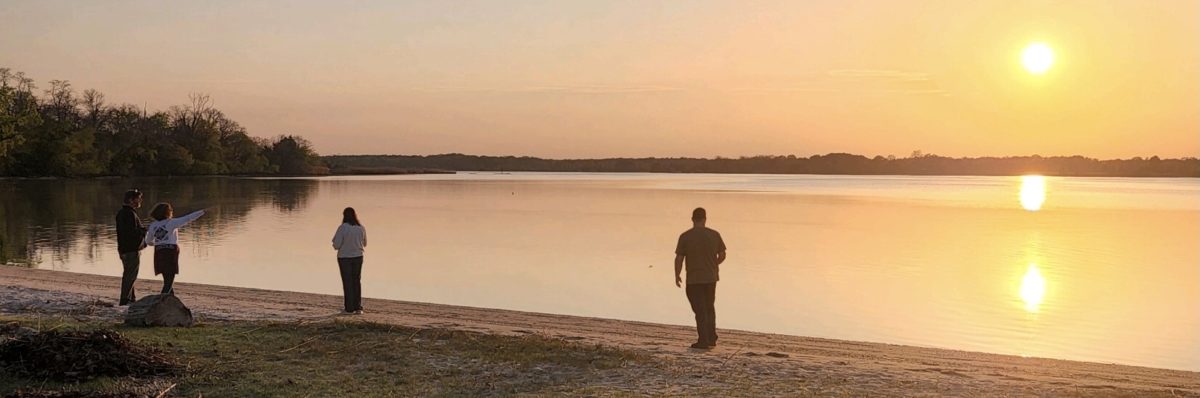
Over the course of our group discussion, participants responded with pictures of the Northern Lights in Finland and an Assateague camping sunrise.


The Resurrection is nuanced and layered in its meanings. One of the things it did was give credibility to Jesus being who he said he was. And it made the disciples for the next few generations, reflect back on what Jesus said and did, to the point of writing it down so that it could be passed down.

Many writers and theologians point out that Jesus’s words to his disciples were “follow me,” not “worship me.” It’s really a both-and situation, we can do both; and worship is a perfect response to God. But a problem over the years has been and continues to be that many Christians are content with worshipping ( and “believing” without living or living into any of that belief) and have dropped the following aspect of our faith.

Following Jesus means living like he did, loving like he did, doing our best to emulate his example. In John’s Gospel, Jesus gives the disciples (and us) the new commandment of “loving each other as I have loved you.” which he says knowing he is about to be arrested and put to death. That’s what his love looks like–sacrificing himself for the love of his friends and for humanity.

When we look at kindness through the example and eyes of Jesus, we have a sense of what we are called to do and who we are called to be.

O’Donohue closes his book with the poem, “The Eyes of Jesus”–

I imagine the eyes of Jesus
Were harvest brown,
The light of their gazing
Suffused with the seasons:

The shadow of winter.
The mind of spring,
The bues of summer,
And amber of harvest.

A gaze that is perfect sister
to the kindness that dwells
In his beautiful hands.

The eyes of Jesus gaze on us,
Stirring in the heart’s clay
The confidence of seasons
That never lose their way to harvest.

This gaze knows the signature
Of our heartbeat, the first glimmer
From the dawn that dreamed our minds,

The crevices where thoughts grow
Long before the longing in the bone
Sends them toward the mind’s eye,

The artistry of the emptiness
That knows to slow the hunger
Of outside things until they weave
Into the twilight side of the heart.

A gaze full of all that is still future
Looking out for us to glimpse
The jeweled light in winter stone,

Quickening the eyes that look at us
To see through to where words
Are blind to say what we would love,

Forever falling softly on our faces,
His first gaze plies the soul with light,
Laying down a luminous layer

Beneath our brief and brittle days
Until the appointed dawn comes
Assured and harvest deft

To unravel the last black knot
And we are back home in the house
That we have never left.

The eyes of Jesus are a way of seeing and a way of being, in terms of how we see and treat each other. O’Donohue talks about the way Jesus sees us, his gaze, and describes it in a way that should make us feel like we are loved before we do or say anything. Our souls are loved, as well as our bodies and minds. Do we allow ourselves to feel seen and loved that way?

Following Jesus means to try to look at ourselves, each other, and Creation with these eyes and this love.

Why do we take a journey through Lent? Why do we try to take in, reflect on, pray on, the Passion/suffering of Jesus over Holy Week? Why do we celebrate Jesus’s Resurrection?

I hope that at least part of the reason is to allow ourselves to be transformed, to become more Christ-like, to live and love like Jesus, which is to experience the kingdom of God and to do our part to help bring that kingdom, that love, to others, and play whatever role we can in bringing the kingdom here.

May we feel the eyes of Jesus gazing on us.
May we be the eyes of Jesus gazing on others.

May we know the love of Jesus, who became one of us, showed us how to live and how to love, gave his life for us, and then showed us that his love, God’s love, is greater than death, overcomes death and brings us to eternal life.

May we be the love of Jesus for everyone we encounter. And echoing Fr. Gregory Boyle, everyone: no exceptions.

Was Blind But Now I See

Background: Last weekend was a preaching weekend for me at Christ Church Easton. The Gospel story in the lectionary was Mark 10:46-52, the story of the blind beggar Bartimaeus and Jesus giving him his sight back. Following is the text of the sermon.

“Was Blind But Now I See”

This is a story that begins and ends in faith. Sometimes faith starts in the dark. And sometimes things go dark or at least get obscured without us losing our physical sight.

Faith is not about seeing. Faith is about trust. And trust can lead to vision.

Over the past several weeks, Mark has shown us the disciples failing to understand what Jesus is telling them, failing to understand his mission, and putting their needs and desires before his.

In contrast to that, Mark gives us Bartimaeus, a blind beggar, who shows all the characteristics of being a faithful disciple.

Profession of Faith

Bartimaeus is blind and an outsider and all Jesus has to do is come close to him for the beggar to know who Jesus is and what he can do.

He shouts out, “Jesus, Son of David, have mercy on me!” Doing this, Bartimaeus proclaims both Jesus’s identity and his own faith, his trust in Jesus’s power and what he can do.

Even as people try to silence him, Bartimaeus calls out again, louder, “Son of David, have mercy on me!”

This stops Jesus in his tracks. We’ve seen this before in Gospel stories, where someone’s extraordinary belief or faith in Jesus causes him to stop.

Jesus calls him over and in his response to being called, Bartimaeus throws off his cloak—everything he owns—and he leaps up to come to Jesus. Does that remind us of the rich, young ruler, who Jesus tells to give away everything he owns and follow me? Bartimaeus has already done what the rich man couldn’t, and he wasn’t even asked.

The Big Question

As Bartimaeus comes before him, Jesus asks the key question: “What is it you want me to do for you?”

I wonder if there are two questions that Jesus asks in Mark’s Gospel that are the primary questions of our faith:

  • Who do you say that I am?
  • What do you want me to do for you?

Jesus asked the disciples, “Who do you say that I am?” And Peter answered, “You are the Messiah.” And they’ve been working on what that means for the disciples and for Jesus ever since Peter’s answer.

Last week, Jesus asked his followers James and John, “What do you want me to do for you?” The same question he just asked the blind man. And their response was, “We want to sit at your right hand and at your left hand in glory.” They wanted glory, prestige, power. Jesus wasn’t going in that direction, and he told them they didn’t know what they were asking for. Their desires and Jesus’s mission were not aligned.

Now he asks Bartimaeus, a man who has been a beggar, who has been blind, who has figured out how to live his life on the charity of others, what do you want me to do for you?

Bartimaeus being blind, that may seem like a simple answer. But getting his sight will require him to try to live a completely different life, to leave everything he has known and learned, and to go in a new direction.

I wonder, if we are living lives we aren’t happy with… lives that feel empty, or broken, or even just less than we would like them to be; but lives that have become comfortable…. Would we ask for something miraculous that would give us new life, but also ask something of us in return, something that would require us to leave our current lives behind?

If Jesus asked you, what is it you want me to do for you, and you had every feeling that he would give you what you asked for, what would it be?

How We Answer

“The blind man said, ‘Teacher, I would like to see again.’”

He has cast off all he had, he has stepped out of his old life and is taking a risk. He is asking for sight, to go along with the faith he has already shown.

“Jesus said to him, ‘Go; your faith has made you well.’ (And) Immediately he regained his sight and followed him on the way.”

Bartimaeus expressed the faith that the crowds lacked. He gave up everything in a way that the rich young ruler wasn’t able to do. And he answered the question Jesus also asked the disciples, with humility and gratitude. This is what discipleship looks like.

Blind = lost

Last weekend we were in Shepherdstown, West Virginia, and I got up early to walk trails through meadows and along the woods to look for and listen to birds. It was a beautiful and quiet morning, and overnight, fog had settled in.

I went to bed with my full eyesight and woke up and my eyes still worked (at least after coffee) and yet, as I was walking around, fog had taken over and I couldn’t see as well as I could the night before.

We live in an area that has fog delays for schools, so I know you can all relate to trying to see through a foggy haze.

I wonder if you’ll take a step with me when I say that fog is also a helpful metaphor in our own lives for when our vision gets obscured, obstructed, and we can no longer see clearly.

I wonder if we can go blind without losing our physical eyesight.

It would be nice to dismiss the story of Bartimaeus by saying, hey, I’m not blind, this story doesn’t apply to me. But I think we are all blinded from time to time, often without realizing it.

Thinking about this reading during the week, I’ve had the lines from the song “Amazing Grace” in my mind:

“I once was lost, but now am found,
was blind, but now I see.”

I wonder if being lost is like being blind. Have you ever felt lost in your life in a way that you couldn’t see to find your way out?

From 2010 to 2014, I commuted across the Bay Bridge to Washington, DC, writing for the Coast Guard. It was a cool job and I met some great people. I never thought I would be able to stomach commuting like that every day and driving into the city.

The jobs I had before that were non-profit jobs here on the Shore. They kept me in touch with the community, they connected me to parts of my family history and opened new doors and new ways of seeing and being in the place where I grew up. And I felt like I was doing something for, and contributing to our shared community.

But it’s hard to make ends meet working for non-profits. My DC job more than doubled the salary I was making on the Shore. I remember driving one day—I don’t remember whether it was on the way to work or on the way home—and thinking, I’m stuck now. I am going to have to keep commuting, keep working in DC for the rest of my career, now that I’ve started this and found the proverbial pot of gold.

There was a slight pause in 2013, when the contract we were working on didn’t get renewed and I had to figure out what was next. I started interviewing for jobs on the Shore and out of nowhere, I had this uncanny and sure sense that I was supposed to go to seminary. Which made no sense, we weren’t even going to church. But that feeling was there.

During that time, I got a job offer on another contract for the Coast Guard, which solved all the financial concerns. It didn’t shake the sense that I was supposed to be doing something else; that I had become completely alienated from the community around me, that I had less time with my daughters for having to commute. But I convinced myself that this was the right decision for my family.

The fog was thick. I took the DC job. During that next year, my entire life fell apart. Family, job, sense of self and self-worth. I had become lost, even though I saw every step I was taking.


Last weekend, when I was walking in the fog, a cool thing happened. I was walking up the hill towards the B&B where we were staying and the fog was laid in, but the sun was also coming up. And as we know happens, the sun started to burn off the fog. If you can take the time to stand in one place, facing toward the sun, and watch as it overcomes the fog, and the fog begins to fade, clarity sets back in. It’s nothing short of miraculous to watch.

I don’t have 20/20 vision as my glasses attest to. But over the course of the last 10 years, I have gone from feeling lost, to being found. From being blinded, to regaining my sight.

And the question that helped me get there—though at first, I didn’t recognize that it was Jesus asking it—was, “What do you want me to do for you?” What do you want your life to become?

Following and Freedom

On my West Virginia morning, and really anywhere there is fog, it takes the sun to burn it off. There was nothing I could do on my own to see through it, it was the sun that had to do the work. In my life, in Bartimaeus’s life, and for many others, it took the S-o-n, Jesus, to give us back our sight, our vision.

Bartimaeus needed his sight to live the life he wanted to live. But he showed it wasn’t just about him. When he regained his sight, what did he do with it? He followed Jesus. In doing so, with his new life, I think it is fair to say that the seeing Bartimaeus was more truly who he was supposed to be than the blind version of himself ever was.

He used his sight in the service of God. Not because he was told to—all Jesus said was “Go.” Bartimaeus followed Jesus in act of gratitude and of realizing what his sight was for.

Author, pastor, and theologian Frederick Buechner put it wonderfully when he said, “The place God calls you to is the place where your deep gladness and the world’s deep hunger meet.”

It’s been my experience that when we put our trust in Jesus and start to follow, when we let the sun burn off the fog, that meeting place of our deep gladness and the world’s hunger becomes more and more clear.

Are you seeing clearly or do you feel lost? If you feel lost, when Jesus draws near to you, do you trust him enough to call his name? If he asks you what you want him to do for you, do you know what your answer will be? Will it be to ask for the sight to live your life to the fullest, to live the life that God has envisioned for you? To align your sight and your life in following the one who gives us both life and sight?

“I once was lost, but now am found.
Was blind but now I see.”