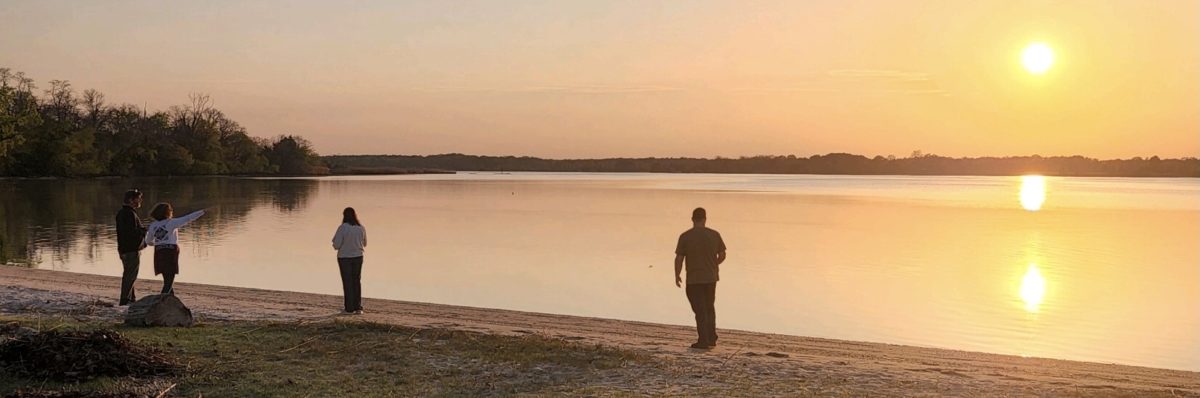
The ocean overpowers words, on the page or spoken. The sunrise defies fancy language, or maybe any language, but that doesn’t stop us from trying.
Words come for prayer, words and emotions well up in gratitude; questions can come like waves, and maybe waves are answers in themselves.
In three days at the beach, there have been more brown pelicans and porpoises than in other years combined. The sounds at sunrise are the same color as my soul.
If prayer felt like sunlight… if prayer felt like cool morning sand between our toes… if prayer tasted like coffee or brought us into the present moment like cold ocean water up to our knees before 7:00 am, I bet we’d do it more.
Sometimes the coolest ideas begin as a conversation. The kind where you talk about every subject under and above the sun, laugh your face off, and find yourself frequently running down paths of wonder. The kind of conversation where when it’s done, you wish you had recorded it, or at least written parts down.
I had one of those conversations with Gary Skirka this winter on our way to Third Eye Comics in Annapolis for a book signing with writer Jason Aaron (who writes the Avengers, Thor, Conan, has written Wolverine). Both of our imaginations have been and continue to be shaped by comic books; we both lead groups at different churches; we both have two quickly growing up daughters; we are both trying to read more, get ourselves back into shape. The discussion jumped from faith to favorite comics; from the Wu-Tang Clan to John’s Gospel; from cosmology to kung fu.
Jason Aaron signing books at Third Eye Comics for the release of his Conan book for Marvel Comics.
Gary mentioned that for a number of years now he’s wanted to do a podcast about comics, pop culture, faith and spirituality, with people you wouldn’t think of as the geek culture type.
Fast forward to earlier this week. Seven of us got together and laid out our own origin stories when it comes to faith and comics. We’ve got a few guys that work for churches, a couple police officers, a former Army medic. In one case, comic books had been an outlet during chemo and childhood cancer. In another comics were a bond between father and son; one found he could draw superheroes to pass the time or sell his art. In terms of faith, it was all over the map–from one-time adamant non-believers, to lifelong church goers; former philosophy students. It was a melting pot from a number of different churches and theologies, with maybe the constant being guys who wouldn’t be told what to think or do or what box they had to fit in, but who found their own path to God.
Grant Morrison is one of the most acclaimed comic book writers of all time. He’s written everything from Superman to Batman, the Justice League to Green Lantern, shaped the DC Universe, as well as creating new characters, universes, and books that transcend the medium. In his book “Supergods,” he looks at what superhero stories might say about our culture:
“We live in the stories we tell ourselves. In a secular, scientific, rational culture lacking in any convincing spiritual leadership, superhero stories speak loudly and boldly to our greatest fears, deepest longings, and highest aspirations. They’re not afraid to be hopeful, not embarrassed to be optimistic, and utterly fearless in the dark. They’re about as far from social realism as you can get, but the best superhero stories deal directly with mythic elements of human experience that we can all relate to, in ways that are imaginative, profound, funny, and provocative. They exist to solve problems of all kinds and can always be counted on to find a way to save the day. At their best, they help us to confront and resolve even the deepest existential crises. We should listen to what they have to tell us.”
Yeah, what he said 🙂 Add to that, graphic storytelling is currently doing some of the most creative and imaginative storytelling going, and are often just plain fun to read and experience as art at the same time.
Comics and dime detective and science fiction novels have their roots in pulp culture. Not the orange juice kind, the “Pulp Fiction” kind. Merriam Webster gives a definition of pulp as:
PULP (noun), a magazine or book printed on cheap paper (such as newsprint) and often dealing with sensational material.
Merriam Webster Dictionary
As we all got talking back and forth, we dug the ideas of podcasts, interviews with different guests, blogs, articles, videos, road trips, movie and book reviews on any and all things pop/pulp culture as well as faith, spirituality, theology, etc. And we wanted a name to go with the pulp idea. Something big, reaching, something that calls your imagination into action. And who knows, maybe something that calls “Young Guns” or Nate Dogg and Warren G. to mind.
Revelators. Why revelators? Why not! You could ask Blind Willie Johnson, or Son House, who both have stripped down, bare bones versions of the song “John the Revelator,” or you can go with the dressed up version the used in the show “Sons of Anarchy.” You get the idea.
With “Pulp Revelators,” we are starting a discussion. We hope you’ll follow along on different social media channels and look for a website to be up and running before long. We hope you’ll join in, ask questions, tell us what you think, and what topics, characters, or subjects you’d like to hear more about. We’ve got some fun adventures ahead. In a nutshell, what we hope to be doing is “surveying the sensational.” Stay tuned.
We choose what we give our time and energy to. We choose how we see situations. We choose what we will do with the time we have.
This is oversimplifying things, but if it rains on a day off when I hoped to be outside, I can throw up my hands and give my day away to disappointment, or I can change plans, change course, and even notice flowers and plants getting what they need from the rain. We can look for, or try to create, small moments of joy, even when things don’t go how we wanted them.
Life hurts. It is full of war, sickness, death, anger, jealousy, hatred, injustice, suffering, and so many crappy things that it is an entirely justifiable and sane reaction to say, it’s too much, what can I do, I am insignificant, what I say or do won’t matter anyway. But it matters in your life. And it can matter for others.
Joy is a choice. In his book “Return of the Prodigal Son,” Henri Nouwen writes:
“once you choose to claim the joy hidden in the midst of all suffering, life becomes celebration. Joy never denies the sadness, but transforms it to a fertile soil for more joy.”
Henri Nouwen, “Return of the Prodigal Son”
Nouwen talks about the parables of the prodigal son, the lost sheep, and others, where God goes out of his way to reach the one lost or wayward soul who chooses to return, and to celebrate their return, not because He doesn’t love those already in the fold, but because He loves each of us uniquely, and it is a reason for joy.
“If that is God’s way, then I am challenged to let go of all the voices of doom and damnation that drag me into depression and allow the “small” joys to reveal the truth about the world I live in.”
Henri Nouwen
Allowing the small joys. That’s a thought worth sitting with and trying to live into. It could be a spring breeze coming through the window in the morning. The first sip of coffee. A Red-Bellied Woodpecker at the feeder. The smell of cutting the grass. A thought or phrase spurred from reading that hadn’t occurred to me in just that way before. Watching the dog bound through the back yard. And that’s all without leaving home.
“There are only two mantras: yum and yuck. Mine is yum.”
Tom Robbins, “Still Life with Woodpecker”
It was more than 20 years ago when I read Thich Nhat Hanh’s book, “Peace is Every Step. Nhat Hanh is known as a Zen master, peace activist, teacher, community leader. There is a ton that has stuck with me from that book, much of it on interconnectedness, cultivating inner peace, and daily wonder and miracles. He has a great section on doing the dishes and household chores and how, done mindfully, they can be sources of joy and happiness:
“The secret to happiness is happiness itself. Wherever we are, any time, we have the capacity to enjoy the sunshine, the presence of each other, the wonder of our breathing. We don’t have to travel anywhere else to do so. We can be in touch with these things right now.”
It’s Monday evening. As I am at the desk, the dog lies on the stone path through the back yard, smelling the air, watching for birds or squirrels, or neighbor dogs to come to the fence. I’ve got box garden beds to weed, dinner to make, the work week to get into full swing and the girls back to school. There is some small joy in each of those things, but right now it is even more simple and immediate: the look on the dog’s face as she takes in the evening; pinwheels spinning in the breeze; birds carrying on conversations and being able to pick out one or two I recognize; and a grateful heart for just saying thank you for a moment.
In the scheme of things, all that’s wrong with the world, that is not much. But it matters for this moment. And it might help to make more moments like it. And it all starts with a choice.
“Nature’s first green is gold, / Her hardest hue to hold.”
Robert Frost might have had a magnolia tree in his front yard. I’ve never seen anything like it. Over the past week, it’s been in different phases of bloom and I just go out and stand underneath it in complete awe. It will only last a week or two, but man, what a week.
“Her early leaf’s a flower; / But only for an hour.”
Spring is a time for rebirth, for taking root and for growth. But within that, there is also the notion that it doesn’t last, like the magnolia tree in bloom, so appreciate it while it’s here. Be present. Feel the growth. Take the moment.
W.S. Merwin in Hawaii at the Merwin Conservancy. Image from Stefan Schaefer.
W.S. Merwin, one of the brightest shining, most brilliant, and most venerable American poets died recently. I met him briefly in Washington, DC, after hearing him read. I’d made it a point to catch him after work when I worked in the city. He was one of the voices; one of the lives worth emulating, or using as a model to find your own.
In a great New Yorker article, Casey Cep writes about Merwin’s writing and his effort to preserve Hawaiian landscape, “The palm forest, like Merwin’s poetry, has become a kind of prophetic stance against contemporary life: bearing witness to individual, almost foolish acts of creativity while devastation abounds.” We do what we can in the time that we have.
Sometimes I can connect the dots, sometimes I lose the picture. My reading list of late has included large parts of Luke’s Gospel, Henri Nouwen’s “Return of the Prodigal Son,” and legendary and/or mind-bending graphic novels, including Brian Michael Bendis and Alex Maleev’s “Daredevil” run, Donny Cates’ “God Country,” and Jonathan Hickman’s “Fantastic Four.” I’ve never read Hickman, who is known for his epic story arcs for Marvel Comics. Marvel announced this past week that he is set to take over the X-Men this summer.
I’ve been thinking about the Faust/Faustus storyline a lot lately, where to gain unlimited knowledge, the seeker sells their soul to the devil. It has to deal with hubris, excessive pride, and pushing beyond the limits of where we should go. And Hickman plays that exact storyline out with Reed Richards in his Fantastic Four story. But when faced with the decision either come up with the answer to everything, to save the universe and feed his ego flashing his brilliance, or to be human, be with his family, Richards thinks back to the words of his father.
“All of my hopes and desires rest in you becoming what I am not. When you grow up, I expect more. Son, I expect better. I want you to be a better friend than I was. Be a better husband. Be a better father. Be a better man.”
Father-son, father-daughter messages hit me straight in the heart. And it makes me reflect on the prodigal son story, and how the father wants his sons to know his love, no matter what they’ve done. And that’s big.
For Lent this year, Fr. Bill Ortt at Christ Church Easton, has given out prayer stones during worship services. There are 11 different words and you choose without looking: love, peace, believe, remember, listen, forgive, hope, pray, heal, follow, grace. The idea is to use your word as a mantra during Lent. And to look up Scripture for your word that you connect with, and pray, reflect, and meditate on it for the season.
My stone is love. It’s not the one I expected or the one I would have picked. But it’s the one I needed. It’s what I need to remember and to focus on. I picked two verses.
John 13.34-35
I give you a new commandment, that you love one another. Just as I have loved you, you also should love one another. By this everyone will know that you are my disciples, if you have love for one another.’
And
Corinthians 13:4-8
Love is patient; love is kind; love is not envious or boastful or arrogant or rude. It does not insist on its own way; it is not irritable or resentful; it does not rejoice in wrongdoing, but rejoices in the truth. It bears all things, believes all things, hopes all things, endures all things.
Love never ends.
Those are big for me. Because it is easy for me to look past, to get too busy, to be in my head or deep in thought too often.
Finishing up Robert Frost’s poem:
Then leaf subsides to leaf. / So Eden sank to grief, / So dawn goes down to day. / Nothing gold can stay.
Nothing gold can stay. And that’s true for spring. It’s true for knowledge and accomplishments. It’s true for the world. It’s true for almost everything we see around us.
But not for God. And not for love. “Love never ends.”
My mind is dancing, fickle like fire. It won’t stand still–it jumps, flicks tongues, wall rides, scattering darkness, but dives back down before illuminating. Can’t see what’s there.
I’m sitting in a cave. It’s me, the fire, others in the cave. The girls, probably wondering what we’re doing in a cave…
Can’t make out the cave walls. There are shadows. I need to stoke the fire. With what? Drugs bring smoke but no additional light. They are not the stoke. Prayer. Adventure. Creativity. Nature. God.
tucked up in clefts in the cliffs growing strict fields of corn and beans sinking deeper and deeper in the earth up to your hips in Gods your head all turned to eagle-down & lightning for knees and elbows your eyes full of pollen the smell of bats the flavor of sandstone grit on the tongue. women birthing at the food of ladders in the dark.
Gary Snyder chants. The flames dance higher. Figures on the wall…
Art. Poetry. Drawings. The child, surrounded by nature, is the one connected to the Universe… “whoever does not receive the kingdom of God as a little child will never enter it.” (Luke 18:17)… childhood wonder in the eyes of a child. I know these drawings. I’ve seen them. I’ve written about them, read about them. Snyder’s book “Turtle Island” is never far from my backpack.
Caves. Fire. Shelter. Food. Primal elements. Fire meant food, community. It still does. Fire pulls the tribe together. It is conversation, happy hour, camping, return from a trail run to crack a beer, sip soup and share stories. Fire lets us see in the dark.
The cave has more. Skateboarding. Future Primitive. A love that began at 13 and has continued through today at 46 and tomorrow at whatever age. The figures on the wall look like this…
Lance Mountain. The figures are also running. Tribal. More of the cave, the walls are showing now. Scenes, images, symbols from my life. The girls. Birds. A cross. Fish. Notebook and pen. Passions. Shared experiences. Spelled out on the walls of the cave. Plato would be pleased.
I get up and walk to further parts of the cave. The walls are bare. They are uncovered. Unwritten. Still to be written. The writing is from life. From love. From experience. What is the rest of the story? What symbols? What art?
What becomes paintings on the cave walls begins as dreams. Neil Gaiman knows dreams. He has written Dream’s story in epic and graphic fashion. He begins “The Sandman, Vol. 6: Fables & Reflections” with an artist, a playwright and director who is afraid of heights. In his dreams, he fears falling. He believes there are two possible outcomes to falling in a dream: either you wake up, or you die. No good outcome.
And the artist, the dreamer, finds himself in a dream, climbing. At the top of the mountain, he meets Dream. Dream points out that there is a third alternative. “Sometimes when you fall, you fly.”
The most unlikely scenario. It flies in the face of common sense. But we aren’t talking sense. We are talking dreams. Why would anything sensical wind up as a cave painting?
* Originally written and published on December 10, 2014, with some revisions now.
My girls aren’t growing up the way I did. Very few kids do these days. In our house, my dad worked (and still does), he was the provider; my mom stayed home and raised my sister and me. My girls know two working parents. And parents now generally play both provider and nurturer, the luxury of someone staying home to raise kids is largely gone.
I think my father might concede that he had the easier lot. He has always worked as hard as anyone I know, during tax season he was out of the house before we woke up and we were in bed before he got home. But he could generally see his troubles coming. I don’t think my mom had a clue what she was in for.
Maybe sons try to emulate their fathers more. I struggle to fill his shoes and ultimately I never will, but I’ve realized I wear my own shoes–his docksiders are my Sanuks, his cross-trainers are my trail-running shoes. Mothers and sons are a different matter.
Everything in this photo, besides the cat, dog, and carpet, may still be in my parents’ house 🙂
My mother saved me from drowning after I fell in the river before I could swim. I yelled at her for cheating me out of my chance to ride in the ambulance. At elementary school field days, she had a line backed up across the lawn for face painting (she is a Maryland Institute College of Art graduate). I never had a store-bought Halloween costume–from a Star Wars Jawa, to a Sand Person, to Boba Fett, to KISS’s Ace Frehley, my mom hand-made and assembled every costume and I won first prize in the fire department’s costume contest every year (during this same stretch my sister exhausted the Strawberry Shortcake character catalog and cleaned up equally well).
When it came to youth soccer, Little League Baseball, and youth lacrosse, my mom drove teammates and I to every away game. When I got into skateboarding, she endured Powell Peralta and Alva stickers all over her car, and carted us from Atlantic Skates and the Ocean Bowl in Ocean City to Island Dreams Surf and Skate shop in Towson where her parents lived. Thanks and praise is not often forthcoming from kids, I have come to realize, and it wasn’t for her then.
My mom was not a church-goer, but she and my dad decided that we should grow up going to church while we were young. So my mom took us and taught Sunday School. She has stacked up more than her share of good deeds and showing forgiveness. Some kids go through a rebellious phase. Some kids go through a complete-idiot-with-their-head-up-their-butt phase. I fell into the latter category. My oldest daughter just turned 17, and I am living through a bit of what my parents did; I have no idea why they didn’t leave me in a pit in the back yard for days or weeks at a time. My mom’s battles with my sister were of a different nature, but they were equally emotional. There is just no easy way to parent through adolescence.
My mom has had patience where most would falter. She made her kids’ passions and hobbies her own for many years–she can probably still rattle off the names of toys, dolls, or skateboarders from 30+ years ago. Our successes were hers, and our failures stung her worse than us. Talking to her on numerous occasions, she told me that her hope was that my sister and I “grow up to be good people.” That’s all any parent can ask for.
Now in her 70’s, she is active now in my daughters’ lives and my sister’s kids’, known now as “Grammy.” She everything from school and after school help, goes on field trips, attends awards assemblies, and on non-dog show weekends, can be found at field hockey, lacrosse, soccer, or baseball games for her grandchildren.
Trying to make a living, I think it has always been easier to appreciate what my father and grandfather did for their families, as providers. But once I became a parent, and as the girls have gotten older, it has become all the more clear what my mom gave us, as nurturer, cheerleader, nurse, chauffeur, homework helper, chef, household runner. You know, all the things that come into my mind when I say, “Mom.”
* This post was originally written on Mother’s Day of 2015, though has been updated and edited a bit.
Two kids. One is out of control, squanders opportunities, messes up, fails repeatedly, doesn’t know which way is up, goes off track, loses track, what track? Tries to find their own way in so many ways they get lost. The other child doesn’t question, stays in line, is dutiful, doesn’t stray from home. And a father (or parent) who loves them both. That’s a set up of the parable of the prodigal son that Jesus lays out in chapter 15 of Luke’s Gospel. And it’s a story, and family dynamic that is familiar to a lot of us.
I have always been the first example; I am much more prodigal than prodigy. I’ve taken more wrong turns, wasted time and money, and been clueless enough to be dropkicked more times than I can count.
But a funny thing happens to the wayward, reckless prodigal son in Jesus’ parable. When he is lost and at his lowest, he humbles himself. He swallows his pride, casts off his son-ship, and looks to return home to his father to beg to be a servant or slave, no longer a son. The father is overjoyed, knows in his bones that his son was lost, but now is found, welcomes him home and celebrates.
Meanwhile, the other son, the one who was there all along, didn’t stray, stayed in line, is furious. And we get that, we recognize it, we see that tendency in ourselves. When Jesus told his parable, he used it as a way to talk about groups and types of people, but man, can we feel it personally and emotionally. It works both ways. We recently discussed it in our Luke studies and it is remarkable what it stirs up in us. It’s the parable in the Gospels that I most identify with.
Writer and theologian Henri Nouwen had an encounter with Rembrandt’s painting, “The Return of the Prodigal Son,” which changed Nouwen’s life. It started him on a long spiritual adventure, got him thinking about his own life and calling in terms of the parable, and sent him searching inside himself in new ways. He took his reflections and experiences and turned them into what he calls his favorite of the many books he has written.
“For many years I tried to get a glimpse of God by looking carefully at the varieties of human experience: loneliness and love, sorrow and joy, resentment and gratitude, war and peace. I sought to understand the ups and downs of the human soul, to discern there a hunger and thirst that only a God whose name is Love could satisfy.”
Rembrandt’s painting helped him find God’s home in Nouwen’s own heart, showed him to look inside himself as well.
“I have to kneel before the Father, put my ear against his chest and listen, without interruption, to the heartbeat of God… I know now that I have to speak from eternity into time, from the lasting joy into passing realities of our short existence on this world, from the house of love into the houses of fear, from God’s abode into the dwellings of human beings.”
Jesus invites us into his story and Nouwen invites us along for his journey of personal discovery. This March and April for five weeks, I am stoked that we are going to make it a group adventure. Wednesday evenings at 6:30pm, from March 20 through April 17 at Christ Church Easton. If it’s the kind of adventure that you are looking for, you can sign up here.
I like this from the back cover of the book, “For all who ask, ‘Where has my struggle led me?’ or for those ‘on the road’ who have the courage to embark on the journey but seek the illumination of a known way and safe passage, this book will inspire and guide each time its read.”
And I am a big fan of Charlie Mackey‘s bronzes and drawings of the prodigal son (below).
Ultimately, I wonder if we are each of the characters in the story–the prodigal when we are reckless, self-destructive, stray and feel lost. And when we humble ourselves and look for forgiveness. The other brother when we feel resentful of others, entitled to what we feel we deserve, and maybe when we go through the motions without putting our hearts and souls into things. And we are asked to be the father when we forgive, welcome back, and celebrate those who were lost, but now are found.
On paper, my last semester at N.C. State was a failure. Ultimately it left me on the street, back in Maryland, getting in shape with designs of going into the Army and jumping out of planes. It got me back to running. Made me change my life’s direction. That is the good.
Not a lot of time was spent in classrooms. But I think I learned a lot that fall. The curriculum was organic, unstructured, self-guided. It included Jerry Garcia and David Grisman. It included chess and whiskey. It included Whitman and Emerson. It included Paul Newman and Robert Redford; Charlie Chaplan and Robert Downey Jr.; daily episodes of Northern Exposure re-runs; and deep discussions with a good friend, Lindsay Loflin, who was the only other English Literature (and in his case film) student that I knew well at a textiles and engineering school.
Northern Exposure is my favorite TV series of all time. It was made and aired within the parameters of prime time network television, before HBO changed the TV series rules forever (for the better) with shows such as The Wire, Sopranos, Game of Thrones, etc. Point being Northern Exposure had to play by the network rules. Let’s be honest, Maggie O’Connell (Janine Turner) could have been a fun character to have playing by HBO/Showtime standards.
For me, the series is full of life lessons, philosophy, humor, etc. It is a study on how life sometimes goes in directions you had no idea were coming, not directions you necessarily would want, but directions you need to get where you are going. Dr. Joel Fleischman (Rob Morrow) is a Jewish physician from NYC whose medical school at Columbia was financed by the state of Alaska. He is a city cat, but winds up in Cicely, Alaska, as part of a contract to repay/pay back the state for his education. It’s in the middle of nowhere, he hates it, is a salmon out of water, but starts to change. The place and people teach him, even when he doesn’t want them to or expect it. We get what we need, and what needs us.
Alaskan/Indian Ed Chigliak (Darren E. Burrows), film critic and aspiring director is a brilliantly conceived, quirky character. Adam Arkin’s “Adam,” the paranoid recluse who is a gourmet chef and wired into the inner-workings of global counter-intelligence is phenomenal. And Chris Stevens (John Corbett), radio DJ host of “Chris in the Morning” is perhaps my favorite character of all time, possibly in any media. Chris is an air waves philosopher, reading Walt Whitman to his listeners; sharing personal stories, groping life. The piano fling scene and speech (from season three) is one of the all-time great moments in television. To me that sums up art, philosophy, fun, being eccentric, being different, being alive.
They’ve since taken the video link to the scene down, but here is the text of Chris’s speech:
“I’ve been here now for some days, groping my way along, trying to realize my vision here. I started concentrating so hard on my vision that I lost sight. I’ve come to find out that it’s not the vision, it’s not the vision at all. It’s the groping. It’s the groping, it’s the yearning, it’s the moving forward. I was so fixated on that flying cow that when Ed told me Monty Python already painted that picture, I thought I was through. I had to let go of that cow so I could see all the other possibilities. Anyway, I want to thank Maurice for helping me to let go of that cow. Thank you Maurice for playing Apollo to my Dionysus in art’s Cartesian dialectic. And thanks to you, Ed, cause the truth shall set us free! And Maggie, thank you for sharing in the destruction of your house so that today we could have something to fling. I think Kierkegaard said it oh so well, “The self is only that which it’s in the process of becoming.” Art? Same thing. James Joyce had something to say about it too. “Welcome, Oh Life! I go to encounter for the millionth time the reality of experience and to forge the smythe of my soul the uncreated conscious of my race.” We’re here today to fling something that bubbled up from the collective unconsciousness of our community. Ed, you about ready? The thing I learned folks, this is absolutely key: It’s not the thing you fling. It’s the fling itself. Let’s fling something, Cicely!”
I am at such a loss for words here. Philosophy, art, existentialism, Monty Python, breaking stuff, the collective unconscious, James Joyce, Kierkegaard, catharsis, groping: these are a few of my favorite things.
A couple years ago, I scarfed up the whole series of Northern Exposure on DVD. I put it on this morning at 4-ish a.m., with a cup of coffee and began the series again from the pilot episode. There is so much there. It inspires me, makes me laugh, makes me think. And though it is a TV show about a place that doesn’t really exist, it rekindles my urge to go stand in Alaska, to hike there, to trail run there, to stay in a cabin, to drink beer in a tavern, to imbibe the spirit of the place.
It’s the groping. It’s the fling itself. Let’s fling something!
2019 is a blank page with a big box of Crayola crayons spread out around it. I dig the above photo that Caroline Phillips took on one of the last days of December, on assignment for Shore Monthly Magazine. It’s sunrise, with friends doing something we love, up and outside early that let us catch a crisp, clear morning to laugh, skate, and reconnect.
2019 is a year I don’t have a clue about in many ways. And part of that not knowing is that the past four-plus years have been foundation building.
Life has a way of pulling the rug out from under us when we get comfortable. I like to think that happens because we are getting comfortable in a way that is keeping us from where we need to be; where we could be going; what we could be doing. But that perspective likely only comes with some distance when we’re looking back.
When we get displaced, we try to get our footing–spiritually, mentally, and physically. We try to put our pieces back together in a meaningful way. We look for that place where we can breathe deeply and be ourselves. We look for somewhere we can build, and re-build our lives.
Over the past four years, I’ve lived in three different places and I’m in the first house where it feels like home, where the girls and I can be for a while, put some roots down and figure out where life goes as Anna gets closer to graduating high school and Ava finishes middle school.
The thing about building a foundation or putting down roots (choose your metaphor) is that that’s the beginning work, the base. For that to amount to anything, you’ve got to build something awesome, grow or bloom into something that no one else can–that’s what each of us has in us. And that’s what 2019 feels like it’s calling for–personally, professionally, physically, creatively–it’s time to stretch, to grow, to build, to do something more; something cool, fun, inspiring. The stuff the God puts each of us here to do.
Field guides, existing colors in the box of Crayolas that we get to color our lives with, to help show us what is possible, what’s been drawn, and what we can do.
Writing about Jorge Luis Borges, introducing Borges’ book, “Dreamtigers,” Miguel Enguidanos talks about dreams and song. That it is our capacity to dream and sing that “makes the world bearable, habitable; they make the dark places bright… Dreams and song. About the whole and the parts. About the universe and about each of its separate creatures.” And that “in spite of incompetence, stumblings, and disillusionment,” that our dreams, played out in the song we choose to sing with our lives can connect and resonate with others.
I guess that’s my hope for 2019. To feel our dreams and find and sing our song in new, surprising, inspiring, and wonder-filled ways. And in doing so, to help others do the same with theirs.
The unexpected voices stay in our heads. They speak lines, phrases, words, pictures that we didn’t see coming, but that we can’t forget. Denis Johnson planted a stop sign in my soul with, “I knew every raindrop by its name,” as I tried to get to know his heroin-addicted narrator in “Jesus’ Son,” a book of short stories, which has been called one of the best written in the last 50 years.
Johnson’s voice, his writing, was born from his experience with addiction. He was worried at first that sobriety would affect his creativity. But the distance, clear-headedness, and productivity of being clean let him more fully access his past and own his voice in a way only he could. My copy of “Jesus’ Son” (named from Lou Reed’s “Velvet Underground” lyric in the song “Heroin,”) is full of underlinings where Johnson knocked me off-guard, off-balance.
Mr. Johnson thought of himself as a Christian writer who wonders about the existence of God in a troubled world.
“I have a feeling God finds us pretty funny,” he told New York magazine. “But that’s all the speaking I should do for God–he doesn’t go around talking about me.”
Richard Sandomir, New York Times
Photo by R.N. Johnson
I’ve been thinking about and trying to read distinctive, original voices lately, gravitating toward short stories. Johnson is one of the first people I thought of. Another is Barry Hannah. Hannah begins his landmark book “Airships” like this:
“When I am run down and flocked around by the world, I go down to Farte Cove off the Yazoo River and take my beer to the end of the pier where the old liars are still snapping and wheezing at one another.”
Barry Hannah, “Water Liars”
In an appreciation of his writing, author Richard Ford says that Hannah, “recasts the world in the way obviously great writing does… Barry’s voice was the one many of us hear when we speak candidly to ourselves–subversive, inventive, unpredictable, funnier than we can be in public.”
Photo by Erika Larse.
Recasting the world. That’s what great writing should do for us. Help us see differently or think differently about something, or maybe see something we haven’t seen. Fantastic stories, well told.
I’ve had Tom Robbins lines and phrases typed into my subconscious for 20-plus years now. He can take something as mundane as mockingbirds and cast a slanted light on them:
“Mockingbirds are the true artists of the bird kingdom. Which is to say, although they are born with a song of their own, an innate riff that happens to be one of the most versatile of all the ornithological expressions, mockingbirds aren’t content to merely play the hand that is dealt them. Like all artists, they are out to rearrange reality. Innovative, willful, daring, not bound by the rules to which others may blindly adhere, the mockingbird collects snatches of birdsong from this tree and that field, appropriates them, places them in new and unexpected contexts, recreates the world from the world.”
Tom Robbins, “Skinny Legs and All”
But for all our disparate voices, it is not enough to recreate the world from the world, but to try to add some meaning, some connection, something universal within the personal.
Stories connect us in ways that nothing else does. Jesus told stories so he could be sure we would remember them, re-tell them, and talk about them. Hemingway and Twain are household names because we connect with Huck Finn and the Old Man and the Sea. And when Johnson’s narrator says he knew every raindrop by its name, I am transported back to being a kid, looking up into summer rain with my arms stretched out to the sides, trying to count raindrops and see if one looks different from another.