Signs, Spirit, Connections

Love, joy, peace, patience, kindness, generosity, faithfulness, gentleness and self-control. Who wouldn’t want more of each of those in their lives? Those are the fruits of the Spirit as Paul describes them in his letter to the Galatians.

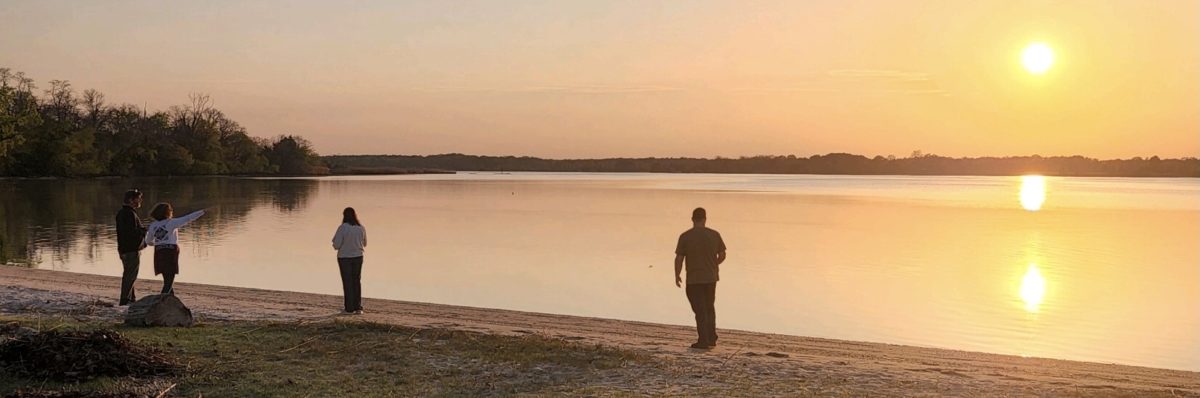
April 13-15, Christ Church Easton went to Camp Arrowhead in Lewes, Delaware, for an Alpha Weekend retreat. More than 40 people headed for the woods, the beach, cabins, bonfires, camaraderie, laughter, and discussions in small groups about our own journeys, struggles, questions, and where we are.

This is our third Alpha Retreat in the past year, running the Alpha Course in the spring and the fall, and I have been blown away each time with amazing and honest people and generous spirits. And the deep laughter that comes with spending a weekend with people in cool places, talking about stuff that matters.

When you ask questions like “How does God guide us?” and “How can I make the most out of the rest of my life?” and people get real with their stories and experiences, profound and unexpected things can happen.

It’s often the unscripted time that makes the weekend. Try showing up at a camp with cabins on the water on Friday the 13th and get ready for the Jason stories. Give people a beach, bonfire, marshmallows, hot dogs, and guitars, and you have an instant party. Break bread together on the beach and in the dining hall, gathered to talk and learn about faith, and in my experience, the Holy Spirit is present in those moments, with these people.

Some people think of worship as what happens at a church service. And it is. But worship is also much more than that. The entire weekend was a celebration, worship. Worship can connect us to God, to people, and to nature, creation. And Camp Arrowhead is a setting to allow all those things to happen. On Sunday morning, before breakfast, I wandered the camp, finding Egrets, Great Blue Herons, Cardinals, Blue Jays. I sat down to read and think about Galatians again after Saturday and read in Gary Snyder’s “Turtle Island,” which is a book I almost always carry.

the path is whatever passes–no
end in itself.

the end is,
grace–ease–

healing,
not saving.

singing
the proof

the proof of the power within.

Joining Snyder’s words, the path, the weekend was grace, ease, healing, singing–the proof of the power within.

After breakfast, and our last small group gathering for the weekend, we gather for a worship service proper, a celebration and culmination of the our time together. Jerrett Hansen, our interim pastor who joined us for the weekend points out, “When the church is in its proper place, we don’t have to go through this thing called life alone.”

He talks about the power of simple signs that we can see throughout our lives if we aren’t too busy looking for the big signs.

“We have been given the great gift in our community to be signs to each other.”

This morning (Monday), I woke up thinking about the Saturday night bonfire on the beach; of everyone coming up with the best way to roast marshmallows or hot dogs; the laughter and conversations. And I got this in a daily e-mail of Frederick Buechner’s  writing:

“In the pages of Scripture, fire is holiness, and perhaps never more hauntingly than in the little charcoal fire that Jesus of Nazareth, newly risen from the dead, kindles for cooking his friends’ breakfast on the beach at daybreak.”

And that’s maybe what a weekend like this is about, what a faith community, a church, is all about. During the Easter season, post-Resurrection: being signs to each other; helping one another along the way; staying connected to God, to the Holy Spirit, to each other, through Jesus Christ.

On Being Born

The last five years have been off the map. If you’d sat down with me on this day in 2013 and told me what the view in 2018 would look like, I’d have backed away slowly. And yet, they are some of the most important and beautiful years in shaping who I am, for better or worse.

One thing I remember clearly, when summer came and the Coast Guard contract we were working on ended, I was out of a job and searching for a direction. And I remember reading Frederick Buechner and having this overwhelming feeling that I should go to seminary; that there was something about a journey of faith that was key. I look back at Buechner’s words that I found again recently:

“Listen to your life. Listen to what happens to you because it is through what happens to you that God speaks… It’s in language that’s not always easy to decipher, but it’s there powerfully, memorably, unforgettably.”

I talked to a long-time friend and mentor who is an Episcopal priest and looked into things and sat and prayed on it, and then let it go when another Washington, DC, job working for the Coast Guard presented itself. I simply couldn’t imagine what life would look like or what would have to happen to end up working for a church.

There is no way I can do justice to the events that have taken place or the unexpected cast of characters who have been a part of what has happened since. There have been so many unexpected and undeserved blessings, even while there has been confusion, frustration, and letting go. Looking with hindsight doesn’t show the heartbreak, missteps and mistakes, letting people down, the questions, or being lost in the woods for stretches. We each have to own our scars and those we cause others. And we each have to get up each day and ask and answer, “Now what?”

In his book, “The Heart of Christianity,” Marcus Borg talks about being what resurrection means in our lives:

“…the process of personal transformation at the center of the Christian life: to be born again involves death and resurrection. It means dying to an old way of being and being born into a new way of being, dying to an old identity and being born into a new identity–a way of being and an identity centered in the sacred, in spirit, in Christ, in God.”

There is so much there. So much to live into, live up to, and I don’t always to the best job of it. But trying to focus and center and find each day, something of a new life, centered in God and the sacred. That feels like what I have been trying to get to since I was a teenager and started uncovering pieces of life and the world that I love.

There is something new and at the same time, there are the parts and passions and wonders and curiosities that abide and make us who we are, each of us a piece of a larger puzzle. And how we see things and how we see ourselves, they are and we are. I have been reading John O’Donohue’s “Anam Cara,” which goes on my very short list of books I’d take with me anywhere.

“There is such an intimate connection between the way we look at things and what we actually discover. If you learn to look at yourself and your life in a gentle, creative, and adventurous way, you will be eternally surprised at what you find… Each of us needs to learn the unique language of our own soul. In that distinctive language, we will discover a lens of thought to brighten and illuminate our inner world.”

“Anam Cara” shows how creatively and actively our inner world, our bodies, and the landscapes around us are all sacred and interconnected.

Each of the last five or six years, I have picked myself up a pair of shoes and a book for my birthday. Sometimes they have been trail running shoes, sometimes running shoes, Sanuks, or Vans. The books are more varied and tangential than I could even account for. The purpose is to invite in new adventures for the year: physical adventures on foot as well as intellectual adventures. Both make for adventures of the soul. This year it is trail shoes and Huston Smith’s autobiography, “Tales of Wonder: Adventures Chasing the Divine.”

Who knows what adventures year number 46 holds? I’ve learned I don’t know much. But I’m trying to get better as I go on about listening to my life and to hearing God speak. I am trying to use life up to this point, scars and all, to invite transformation and embrace new life ahead, centered in the sacred, centered in Christ, centered in God.

And I find life is generally better when I remember to get outside, with the dog 🙂


Matthew and the Rock Face

If you’d told me 15 years ago that I would find laughter, joy, friendships, tears, questions, answers, life, sorrow, challenges, confusion, exhaustion, and exhilaration, all in a Bible study, I am sure I would have dismissed it.

At the beginning of October 2017, two groups at Christ Church Easton started a journey through Matthew’s gospel, using N.T. Wright’s “Matthew for Everyone” as a touchstone. We weren’t sure whether to end at Christmas, part-way down the path, but both groups wanted to see it through. With three weeks left to go, Jesus has been arrested, and we know what’s coming.

Wright looks at where we are in the story and compares it to standing at the bottom of a huge rock face.

“That is how we should feel as we stand at the foot of the final ascent of St. Matthew’s gospel. We have walked at a steady pace through the hills and the valleys of the story. We have sat down to hear Jesus deliver another parable or discourse. We have marched with him along the road, enjoying the sunshine of the early days in Galilee, and the remarkable views as the disciples gradually realized more of what the kingdom was about. We have arrived in Jerusalem at watched dramatic events unfold. But we are now standing in front of a sheer wall of rock, and if we don’t find it both compelling and terrifying, we haven’t got the right spectacles on.”

I feel that. I feel it in my life and I feel it as we read and work through Matthew. I feel it as we approach both spring and Easter. With all the beauty and questions, there is death ahead. There is rebirth and renewal after, but it only comes after and because of a death. I think that is also true of our lives. It is of mine–some of the most beautiful and meaningful times come after loss, come after the low, come after the crap. And sometimes they only happen because of the painful experience that preceded it.

Wright goes on:

“The theories about why Jesus died–theories of the ‘atonement,’ as they are called–are like maps or old photographs, taken from a distance. They may be accurate in their way, and the’re helpful particularly when it’s cloudy and you can’t see too much for the moment. But they’re not the same thing as climbing to the top yourself, and perhaps, if you’re lucky, getting there on a clear day when you can see the view. When that happens, you will find you quickly run out of words to describe what you are looking at.”

It’s not the same thing as climbing to the top yourself. What we find in Scripture is a lot like what we find in life–we get out of it what we invest in it, what we live into it. And if we are going to understand Scripture, or life, it is going to help to have guides, and friends to share the journey with, and the views. We are going to stumble and we are going to need help.

We’ve got three classes left, finishing this ascent during Holy Week as we head into Easter. Our two groups of pilgrims are at the rock face. A journey that started together five months ago. When I look back, when I look around, and when I look forward, I “quickly run out of words to describe” it.

Distractions and Renewal

Stuff gets in the way. Stuff gets in the way of life happening the way it is supposed to. We get distracted, we lose focus, and before we know it, our lives have veered from where we thought they were supposed to go.

Maybe that’s where Lent comes in. As a season, it asks us to let go of some of those distractions. To let go of those things that keep us from living life as we were meant to live it. When people pick a trivial thing, even a happy thing, to give up for Lent, I think maybe it misses the mark.

I like the notion of Lent as a time for renewal and refocusing. Last week at Christ Church Easton, the Gospel reading was Mark’s account of Jesus’ transfiguration on the mountain. Interim pastor Jerrett Hansen, reflecting on this mountaintop experience, asked, “How are we connected to the story?”

He posited we need to live into the mystery of the story, the mystery of God and Christ, rather than try to intellectually analyze it.

“Jesus and God are to be experienced. We need to be open to these experiences… Experiencing God is essential to our journey.”

I think that is what life’s distractions prevent us from doing. They get in the way of our wonder; they get in the way of loving more fully; they get in the way of opening ourselves to possibilities and to each other. Distractions keep us from knowing ourselves more fully and from knowing God more fully.

Maybe instead of giving something up just to give something up, for Lent we can think about getting ourselves into spiritual shape. Building better habits to peel back the distractions. Jerrett introduced a notion that a friend of his, Michael Foss, spelled out as marks of discipleship:

1. Pray daily
2. Worship weekly
3. Read the Bible daily
4. Build spiritual friendships
5. Serve in the community
6. Be generous in all things

We’ll be spending time over the next weeks working through what some of those look like and what they mean. If you are up for it, maybe think of Lent as time to take on a discipline, or a devotional habit, to help get into shape a bit.

We all need help in our lives in some form or fashion. We can all be better people, for ourselves, our family, our friends, our community, our world.

I’m stoked to be helping lead groups this Lent and spring, which will be looking at Mark’s Gospel; which will be looking at how and why to pray and read the Bible. And the Alpha Course.

I love Mother Teresa’s notion that through prayer God guides us to do the things that need to be done in the world, that “prayer changes us and we change things.”

God invites us to come as we are, just as we are. But He also knows we are capable of being so much more. We can be better. We can do better. Maybe we can start now.

I’ll leave with a final though from Jerrett’s sermon this past Saturrday:

“God loves you the way you are, but He knows how much more you can be.”

Ava

Ava is a rock. She takes things in stride where her sister is all over the map. If she is upset, it means something is up.

Over the last couple years, I’ve had too many reasons to write about Ava and what she’s been through with her seizures. Yet, seizures are the furthest thing from defining her.

This is a year of parenting milestones. Anna turned 16 and now Ava turns 13, and we are head first into the teenage years.

Ava is the smart kid without much common sense. She’ll pick up on something five minutes after the conversation because she’s been thinking about her own thing. She makes honor roll effortlessly and organizes herself in ways her sister (and her father) may never figure out.

This year the younger sister by three years grew taller than the older. They like to stand next to each other and have people guess who is older. The guess is usually Ava.

She endures and carries on. Ava has taken more pills over the past two and a half years than I have taken in 45. She’s had to worry about things she can’t understand or control. And yet, while in the hospital for a month, her biggest complaint during that stretch was not being allowed to have a soda while she was in intensive care.

Ava finds humor in simple things. She laughs easily and often. She isn’t that worried about what other people think and doesn’t seem to need to be surrounded by friends all the time. She is nearly impossible to get out of bed in the morning or off the couch.

I love remembering her packing the 96-pack of Crayola crayons in her backpack so she was sure to have the right color to draw with. I love that when doctors said she probably wouldn’t be ready to play field hockey after getting out of the hospital, that Ava was named the team MVP for the season and was a force on the field. I love that she already knows the key things she wants to do when she visits Ocean City this summer, including her annual tradition of getting hair wraps.

Ava surprises me frequently. Her thoughts come out of left field. She has taught me more about taking life as it comes and about perseverance than I could have imagined. She taught me about prayer and about gratitude and about carpe’ing the diem.

When Ava was born, I remember thinking she and her sister will be 13 and 16 at the same time. Formidable parenting patience required.

I look at her attitude. I look at her humor and personality. I look at her quirkiness and kindness. And I know that she will live life on her own terms and at her own pace. But she’ll probably need someone to wake her up in the mornings 🙂


Sixteen

You are the ringleader. When I look up, you have cousins, kids, your sister, watching and following you around. You always make me laugh with what goofiness you come up with to run them through. From costumes to choreography, I don’t have a clue where you come up with it.

You are the curious one. Watching, listening atop the stairs, paying attention when no one realizes it.  You leash the dog and set out on foot. You are the sea glass explorer and the finder of odd things.

I rarely ever cried before you were born. Now I can’t watch movies with fathers and daughters in them; I am pretty well worthless in church if a sermon, song, or prayer hits the right note. That comes from being a father, which started with you. I guess the yelling comes from that too 🙂

I’m not sure how a father is supposed to feel about his oldest child turning 16. And I’m not sure how I feel about it, so I guess that’s about right. I feel like I remember turning 16 too well for you to be there already. My teenage years were full of bad decisions, adventures, opportunities, and dumb luck. You’ve avoided a lot of the bad decisions so far, for which I thank you.

My father knew a lot more about being a dad to a 16 year old than I do, or he didn’t let on otherwise. It’s a privileged place to look at my parents and how they did it and at my daughter and how she does it. I have a lot to learn.

I want to strangle you a fair amount of the time, but I recently learned it’s your amygdala I have to take it up with. I realize you are part of God’s way of teaching me patience at the same time you are teaching me about love and gratitude.

You care about people in ways that make me both humble and proud and make me worry, which is part of what parents do, especially with 16 year olds.

When you forget yourself, you do amazing things. I’ve seen it on the field hockey field, or stepping up to play goalie in lacrosse, or in a hospital with your sister. I hope you learn to trust that more.

Paddleboarding this past summer, just the two of us, brought out the kind of conversations, questions, laughter, that no one could have told me existed before I knew you.

You and others know this story, but it’s on my mind now: we were on our way into the Annapolis Mall, you were three and sitting backwards on Ava’s stroller looking at us, and out of nowhere, unprompted, you asked, “Why did God make us?” I didn’t know what to say. You caught me off guard. And then you answered, “Know why I think? I think because He was lonely.”

There is no amount of theology or learning that has ever said it better. And if we can know the love God felt and feels and how His loneliness disappeared, maybe you show me that.

Until it’s time to get ready for school in the morning 😉

When I look at you, turning 16, I see a lot of myself. But I see so much more, and someone totally different.

For your sixteenth birthday, I want things for you that I can’t possibly give you: happiness, love, friendship, wisdom, health, success, grace, hope, and laughter, to name a very few. I hope we can point you in the right direction to help you find those things and what they mean to you.

I have no idea where you will go in life or how you will decide to get there. That’s one of the coolest, most frightening, and beautiful things I have ever seen. You are growing up. And we get to be a part of it.


Nostalgia and Home

It’s the green house that I think about the most. It was off the back of my grandparents’ house in Towson. It was full of flowers and plants and my grandmother would go around watering and studying things out there.

Nostalgia grabs us in strange ways. It can be a smell, a song, or a feeling. When I walk into the sun room in my house and see plants inside for the winter, my mind goes immediately to my grandmother’s green house. It makes me smile. To get to the green house, you would have to walk by my grandfather sitting at the dining room table, drinking coffee, and reading The Baltimore Sun sports section.

Lately I’ve been thinking that nostalgia isn’t longing for the past, it’s touching something missing. In his book, “Flesh: Bringing the Incarnation Down to Earth,” Hugh Halter goes with nostalgia meaning “to return or go back home:”

We all have nostalgia and memories of going back home. Some of us remember our fathers through old cars; some of us keep Christmas ornaments our mothers passed down. Maybe it’s old guns; maybe just a photo. But whatever the point of reference, we all know emotions of looking back to times that brought us great joy. Nostalgia is the answer to the why.

A question I love to ask people is, “Where/what do you picture when you hear or say the word ‘home?'” I think it’s something that gets to the core of us. For one person it could be a childhood home, or the house where they raised their kids, or where they’ve spent the most years. I don’t picture a house. For me, when I think of home, I think of the Eastern Shore, Oxford, the Tred Avon River, anywhere outside in nature. Christ Church Easton and the people there feel like home. Log cabins in the woods feel like home, though I’ve never lived in one.

Christmas is a heavy nostalgic time. In part because many of us have deep memories tied to Christmas growing up. As a holiday, it can stoke both joy and emptiness, missing time past. But there may be more to it than that. Personally, it can sometimes take hearing Linus explain to Charlie Brown what Christmas is all about before I get it right in my head. Funny how maybe it takes Charles Schulz to get kids to connect to Luke’s Gospel.

Let’s appreciate the forum here for a second: this is a blog, where I work out half-baked thoughts that should probably stay in the oven a while longer, or at least until after another cup of coffee. I don’t generally edit and things tumble out free form. That’s my disclaimer.

My memories don’t go back to the beginning of creation. There is a time before I was born. I think nostalgia reaches back further than our lifetimes. Maybe it’s a longing for a return to something in us that came before us. A Garden of Eden time that we can feel in our bones and hearts. We know there is something there, something to this longing, but we can’t put our minds around it quite right.

Halter points out that with the Incarnation, God wasn’t/isn’t trying to give us a ticket to get back to that perfect time–He’s bringing it to us. Christ brings the kingdom here and now. But it’s a process we have to open ourselves to. Christ gives us clue after clue; He shows us how to live, how to love, how to be in the world to help bring the kingdom/home both to ourselves and others. Halter goes into ways we can do a better job with this in our lives.

David Bailey’s book “Journeywork” found me via Outside Magazine. And it’s been a slow, wondrous walk since. Bailey describes home and coming home in a different way:

There’s a part of us already home
from the journey, resting by
the eternal fireside, and with us now
through the dark age and renaissance, through
every resurrection and
the great breaking-opens that feel like
endings. Storm lantern holding course
through every misadventure. Evergreen growing
through all seasons. It shines a halo of worth around
even our most irredeemable trials.

Feel that place now.

Returning home. But not as a journey to somewhere out there, but bringing home to us. Followers of Christ call it the Kingdom of Heaven. It’s a gift we can’t buy, it’s given to us by grace. It’s been brought forward to us, but we have to open the door. And we help bring it about through love.

Maybe that’s the connection: nostalgia is a longing for home, to be reconnected to it and to each other by love.

Buechner on Eternity

I spent late Sunday on a bike and under a tree. The morning and afternoon had been music, prayer and fellowship of worship services, then blessing of pets (several dogs, a hedgehog, two guinea pigs, and a horse) at Christ Church Easton.

On a beautiful fall evening, I hopped on my bike and eased around Boone Creek and then found a tree on the shoreline of the Oxford Cemetery. I stretched my legs out and listened to geese in the cove, the breeze through the trees, conversations of boaters in Town Creek, and watched the sun dance on the water. I read David Bailey, Richard Rohr, and N.T. Wright. Mostly I sat, watched, listened, imbibed.

I was completely full. I didn’t try to give it words, just breath and feeling.

Yesterday I came across this passage from Frederick Buechner’s “Wishful Thinking,” and I realized Buechner had the words I was looking for:

ETERNITY IS NOT endless time or the opposite of time. It is the essence of time. 

If you spin a pinwheel fast enough, then all its colors blend into a single color—white—which is the essence of all the colors of the spectrum combined. 

If you spin time fast enough, then time-past, time-present, and time-to-come all blend into a single timelessness or eternity, which is the essence of all times combined. 

As human beings we know time as a passing of unrepeatable events in the course of which everything passes away including ourselves. As human beings, we also know occasions when we stand outside the passing of events and glimpse their meaning. Sometimes an event occurs in our lives (a birth, a death, a marriage—some event of unusual beauty, pain, joy) through which we catch a glimpse of what our lives are all about and maybe even what life itself is all about, and this glimpse of what “it’s all about” involves not just the present but the past and future too. 

Inhabitants of time that we are, we stand on such occasions with one foot in eternity. God, as Isaiah says (57:15) “inhabiteth eternity” but stands with one foot in time. The part of time where he stands most particularly is Christ, and thus in Christ we catch a glimpse of what eternity is all about, what God is all about, and what we ourselves are all about too. 

On Vocation Part II: Closer to the Heart

My path seems spiral-shaped sometimes. I come back to a familiar place or thought, but things are different. It’s like further unearthing something, brushing dirt away to reveal more of the picture or map.

When I graduated Washington College in 1998, I was set to go to graduate school with the goal of teaching philosophy and religion. Ultimately graduate school debt didn’t make sense and there was something to staying in this community that stuck. That fall I started working at the Academy Art Museum, overseeing public relations, marketing, and development. Almost 20 years later, my career and spiritual paths combine, right across the street from the Academy: on October 16, I will start working full-time at Christ Church Easton as Assistant for Adult Christian Education & Newcomers Ministry.

I’ve been working at Christ Church part-time since last November, listening to a calling to work with small groups and adult education. I go back to Frederick Buechner’s thought that, “the place God calls you to is where your deep gladness and the world’s deep hunger meet.” I knew right away that working with the church was the first time that my vocation lined up with the big questions that I’ve always asked, the things I wonder about, and how I want to spend my time.

I am humbled by and grateful for this opportunity. This summer I told friends that if I won the lottery, I’d focus more on working for the church, continuing my own education, and writing. This fall it seems I’ve won the lottery.

Since February 2015, I’ve had the privilege of being the Executive Director of the Oxford Community Center, in the town where I grew up. I don’t have the words to say how much that experience has meant to me and what an incredible time it has been developing programs and events and welcoming and building the community at OCC. It has given me back a town I had lost touch with and one I am excited to call home again.

There have been a few moments in my life where/when things have lined up and I have known in my heart and in my bones what I was supposed to do. To this point in my working life, I’ve had jobs that I’ve enjoyed, but not that called me from the deepest level. I’ve felt this calling time and time again–from studying and wanting to teach philosophy and religion; to wanting to go back to school for Christian theology in 2014; to last year, putting my hopes and intentions out into the world, which led me to the small groups position at Christ Church.

I’ve reached a place and time in life that feels like a new beginning. It’s a beginning that is the culmination of everything that’s happened up to this point: work, fatherhood, friendships, connections, questions, faith, joy, struggle, community, opportunity, study, passion, prayer.

In his book, “Desire,” John Eldredge spells out:

“To live life fully–that is to say, to live life as God meant for us to live–demands a full recovery of our heart. You need that wellspring flowing swift and clear and true… The adventure calls. The future awaits. How you handle your heart’s desire will in great measure determine what becomes of your life.”

To be a part of a community of faith. To help each other in our own walks, with our own questions. To study, to learn, to share, to write. To have the opportunity to follow a calling in vocation. To live life closer to the heart. To listen, to discern God’s will and find deep happiness in His Way and Word.

Those are things that get me out of bed in the morning, things that stir my heart watching the sunrise. They are thoughts and images that dance through my mind when I am running, skateboarding, hiking, reading, or paddleboarding.

It’s a coming together of life and experience to this point, my part and passion in God’s larger work and will. It’s coming to know God’s grace and love as lived out and given to and for us through Jesus Christ.

Here I am. I am grateful, humbled, excited, and so many other things.

Amen.

Wonder and Welcome

“We need to view the world as to combine an idea of wonder and an idea of welcome. We need to be happy in this wonderland without once being merely comfortable.” – G.K. Chesterton, “Orthodoxy.”

Watching the sun break the horizon, change the whole color of the sky and the landscape; watching fog dancing on still sleeping water on the cove–that conveys the sense of wonder we can find any given morning.

Smiling at the sunrise, laughing like it’s an inside joke, or on a morning with others running, skateboarding, or paddleboarding, realizing what a gift those moments are to share–that feeling, that recognition, that is welcome.

Maybe it is our job, with the time we have, to find both wonder and welcome. Maybe it’s our job, with the time we have, to be grateful for both wonder and welcome. Maybe it’s our job, with the time we have, to convey both wonder and welcome to others.

Part of that is finding what moves us. Part of it is staying after it, stoking our fire, our passion–what makes us who we are–and doing something with it, not settling, and not just being comfortable.

For me, that starts with waking up, wrestling the dog, smiling. Putting coffee on, grabbing a notebook and pen, a book. Praying. Reading. Reflecting. Maybe it’s a running or skateboarding morning. Maybe it’s watching hummingbirds light on the feeders next to the window.

Wonder and welcome are up to me to find. They are up to me to recognize. They are up to me to be grateful for. And they are up to me to pass along.