With This Thirst

Sitting on the bank of the cove, watching a Weeping Willow move in the wind and feeling the same breeze on my skin is worth waking up for. I’ve been looking for this solitude and this quiet. Ordination to the priesthood is this Saturday and I want to rest in the afternoon.

The current is coming to a head from opposite directions and swirling right in front of me. I’m sitting under my praying/thinking tree at the Oxford Cemetery, where family and friends are buried and over the past year I have officiated funerals. This is a place where past, present, and future dwell together.

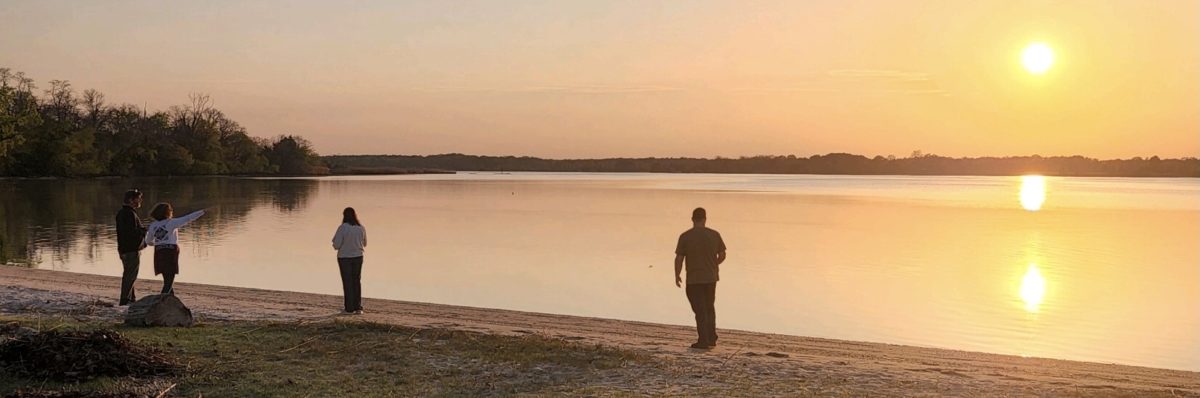
The cove itself is home if a body of water can be home: I’ve gotten boots stuck in the mud here at low tide as a kid, canoed, come and gone by Boston Whaler, kayaks, and paddleboards. That’s part of what draws me here to pray and listen, to read and write, and skateboard to get to the spot.

“Oh, feed me this day, Holy Spirit, with
the fragrance of the fields and the
freshness of the oceans which you have
made, and help me to hear and to hold
in all dearness those exacting and wonderful
words of our Lord Jesus Christ, saying:
Follow me.”

–Mary Oliver, from “Six Recognitions of the Lord”

Mary Oliver should be read outside. I have her book “Thirst” and Frederick Buechner’s “The Alphabet of Grace” with me. “Follow me.” That’s it in a hazel nut.

I get up and skate back to and around the conservation park. It’s lightly raining, the kind of rain that wakes your skin up. I stop when I see purple, per Alice Walker’s advice, which I follow meticulously. Then I head over to the Oxford Park.

Twelve years ago this month, I sat in the park reading this same copy of Buechner’s book. I look back over what I underlined then. This was at the end of a summer (2013) where I knew in my bones that I was supposed to go to seminary. It made no sense. I reached out to Fr. John Merchant, the chaplain at St. James School when I was there, and he told me it didn’t have to make sense. I read Buechner and Barbara Brown Taylor and Thomas Merton and I was stirred and moved and then laid all that aside, taking a job to head back to Washington, DC, to work as a technical writer.

I don’t have words to describe what the 12 years in between have been, except to say heels-over-head, upside down, life-changing; from profound heartbreak to indescribable joy, confusion and clarity, discernment, wonder, awe, gratitude, and everything in between, ultimately shedding some parts of myself and growing in others to where I feel alive in ways I wasn’t. Living now with my whole and open heart.

Here’s a bit of Buechner:

“You are alive. It needn’t have been so. It wasn’t so once, and it will not be so forever. But it is so now. And what is it like: to be alive in this maybe one place of all places where life is? Live a day of it and see. Take any day and be alive in it. Nobody claims that it will be painless, but no matter. It is your birthday, and there are many presents to open. The world is to open.”

Part of that I underlined 12 years ago, but it didn’t register. Each day is new, each day is a gift that we get to live and be alive in. Be grateful.

In the park, I often sit on a bench set off to the side at the edge. It’s in the shade. As I sit there, a child belly-laughs on the swing with her father; a workboat motors down to pull into the marina nearby; a man pulls his crabpots up on his dock; people and dogs come and go; the sun breaks through the clouds infrequently but unmistakably.

Today isn’t a day for revelations. It’s a day to rest and be glad in. It’s a day to breathe, a day to smile, a day to pray. I finish Mary Oliver’s book with the title poem, “Thirst,” which I have been reading a lot lately:

“Another morning and I wake with thirst
for the goodness I do not have. I walk
out to the pond and all the way God has
given us such beautiful lessons. Oh Lord,
I was never a quick scholar but sulked
and hunched over my books past the
hour and the bell; grant me, in your
mercy, a little more time. Love for the
earth and love for you are having such a
long conversation in my heart. Who
knows what will finally happen or
where I will be sent, yet already I have
given a great many things away, expect-
ing to be told to pack nothing, except the
prayers which, with this thirst, I am
slowly learning.”

With this thirst, I am slowly learning.

Morning Snapshots

Eastern Bluebirds are flying in front of and behind me as I skate onto the Oxford Conservation Park loop. I’ve had their shade of blue and orange in my head since I first saw a bluebird years ago and they still quicken my heart.

It is a Saturday with nothing on the morning calendar and temperatures looking to move into the mid-90s. This early though, there is a breeze and it’s perfect sitting outside weather.

Books frequently open my mind and expand my worldview. The path I am walking (or skating) I owe in part to a Trappist monk named Thomas Merton. Recently I’ve encountered another Trappist monk Thomas, Thomas Keating.

“Grace is a participation in the Divine nature, it’s not just something added on like an overcoat. It’s a radical transformation of the whole of human nature so that it can be a divine human being, meaning it can exercise freedom, compassion, love…”

Fr. Thomas Keating

From reading his books to watching the documentary, “A Rising Tide of Silence,” Keating and a former student of his, an Episcopal priest named Cynthia Bourgeault, have pointed me to the practice of centering prayer. I’ve made this type of silent prayer part of my mornings for the past month or so, and I hope to keep it in my daily routine.

This morning, I want to go outside, to make this time under my sitting tree. After my bluebird greeting, I have a deer run across the cemetery loop about 10 feet in front of me.

I’m traveling light, just a notebook, pen, and binoculars, and I sit on my skateboard on the shoreline looking out onto the cove.

For centering prayer, they recommend picking a word that can bring you back to the moment, Bourgeault describes the word as being like windshield wipers to wipe away the thoughts that always jump in the way for attention. The word I have been using is “rest.” In Matthew’s Gospel, Jesus says, “Come to me, all you who are weary and burdened, and I will give you rest.” (Matthew 11:28). Psalm 37:7 says “Rest in the Lord,” which can also be translated as “Be still in the Lord,” meaning be at peace. I find that to be the right approach and mindset for me.

Sitting by the water, I breathe and close my eyes. A breeze is across my skin and in my ears like a conversation and listening, there is a constant concert of songbird voices. I can hear a fish jump in front of me to the left, and I open my eyes to see the rings it left–a cardinal flies low over the water, like it’s his cue to go on. The ascending sun reflects off the water to the right.

I am new to centering prayer, but even with my limited experience, I find that when I let my passing thoughts go, it gives me an opportunity to be closer to God. Keating’s quote that grace is for us a chance to participate in the work God is doing in the world and the love He has for us and for creation. And I can feel that this morning. And sitting alongside a cemetery, where my grandparents, family, and friends are buried, remembering and feeling them, I feel re-connected over and through time, like we are all sharing these remarkable moments.

Keating writes:

“When the presence of God emerges from our inmost being into our faculties, whether we walk down the street or drink a cup of soup, divine life is pouring into the world.”

For most of my life, this kind of quiet prayer time, these morning moments and experiences have been solo endeavors, an introvert’s delight. And I still need plenty of those. But I also find that I can be around people and still be at peace; I can even delight in what other people are doing. Like Keating says, walking down the street, or having a cup of coffee (too early for soup), I want to take those moments with me into the world, to be a part of that divine life pouring into the world . And I am not ready for the next phase of the day to start, so I head to the Oxford Park.

I stop through Oxford Social, the cafe right next to the park, for the first time. A birding friend from my Oxford Community Center days gets in line and we talk birds a bit, and about Third Haven Quaker Meeting House, and about seminary. I walk down to a bench by the river and sit with coffee, the view, conversations off to my right, kids playing on the swings to my left, and a young boy running with his dog.

I pick up John O’Donohue‘s book “Anam Cara,” a favorite book, which Rev. Susie Leight and I will be leading a book study of starting in July, and I come across this:

“Love is absolutely vital for a human life. For love alone can awaken what is divine with in you. In love, you grow and come to your self. When you learn to love and to let yourself be loved, you come home to the hearth of your own spirit… Love begins with paying attention to others, with an act of gracious self-forgetting. This is the condition in which we grow.”

John O’Donohue, “Anam Cara”

And it’s this openness, this paying attention to others, this self-forgetting, letting go of ourselves, letting go of myself, where I seem to be spending a lot of my time of late. O’Donohue continues:

“Once the soul awakens, the search begins and you can never go back. From then on, you inflamed with a special longing that will never again let you linger in the lowlands of complacency and partial fulfillment. The eternal makes you urgent.”

Maybe this has been a slow build over the last 50 years. Maybe all those different moments I can look back on and feel sitting here now, have all been hints and flickers, breadcrumbs or candles of encouragement. And each epiphany adds to a longing, pushes further into the search. Maybe with the state of the world, the worry, the suffering, the confusion, the time is coming that we need to look at differently and help others do the same; we need to live differently and help others do the same.

Maybe when we have moments of sitting quietly and emptying ourselves out, what’s there that we connect to, is Love (God is Love). And what could be more important to share with each other?