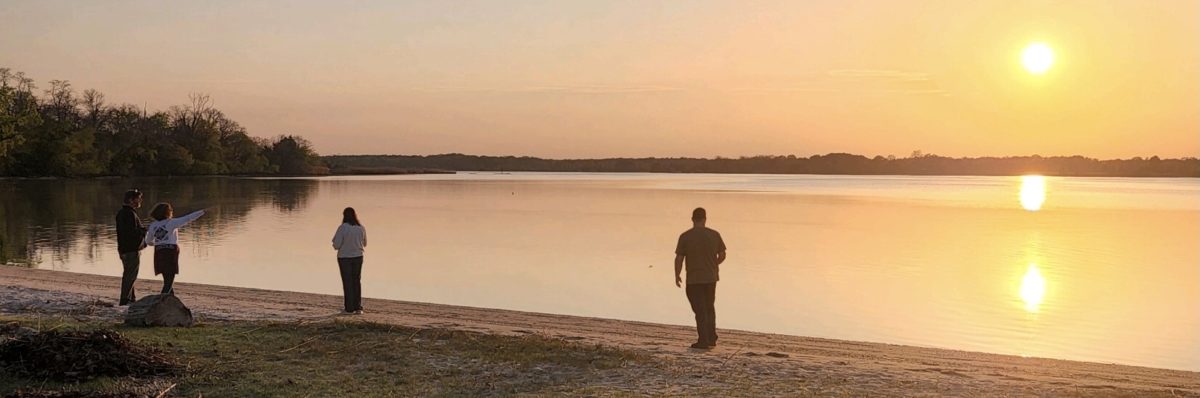
A few small stones

Most of us won’t get to everything on our bucket lists. There’s a good chance we won’t accomplish everything we hope to do in life. And some of that could be on us, but there are plenty of factors beyond our control. Does it make our lives less than?

Mary Oliver’s poem, “Praying” found me this week:

It doesn’t have to be
the blue iris, it could be
weeds in a vacant lot, or a few
small stones; just
pay attention, then patch

a few words together and don’t try
to make them elaborate, this isn’t
a contest, but the doorway
Into thanks, and a silence in which
another voice may speak.

Maybe we spend too much time waiting for the blue iris–the extraordinary to show up, when we could make more out of a few small stones.

Don’t get me wrong–I want to savor the blue iris moments when I have them, if I have them, but not at the cost of the stones all around me. Those moments, the ones we have right now, are all we know we will get.

Two friends have died in the past few weeks, unrelated to each other. Their deaths were unexpected and tragic and they left behind kids and families. I’m sure each had more they wanted to do, to say, decisions they’d love a do-over for. But when I think of each of them, I smile for how they made me feel; for each of their smiles; their stories; the way they approached each day during the time that I knew them.

We remember how people made us feel. I know I need to be more conscious of that. We remember the time we shared with someone, the stories we told. What I know of Chris and Mike is a small section of their lives, but an intersection I am grateful for. Each of them gave me a gift in knowing them and I am glad Christ Church Easton’s Alive @ 5 service connected and/or reconnected us.

As I think about friends dying, we are reading Chapter 11 in our study of John’s Gospel, which is where Jesus raises Lazarus from the dead. There is a scene where Mary, Lazarus’s sister comes out to see Jesus as he has arrived.

“When Mary came to where Jesus was and saw him, she knelt at his feet and said to him, ‘Lord, if you had been here, my brother would not have died.’ When Jesus saw her weeping, and the Jews who came with her also weeping, he was greatly disturbed and deeply moved. He said, ‘Where have you laid him?’ They said to him, ‘Lord, come and see.’ Jesus began to weep.” (John 11:32-35)

“Jesus Wept” by James Tissot

It’s a profound thing that Jesus weeps with us in our grief. Jesus knows that he is about to raise Lazarus, that things will be okay in the long run, but he cries with his friends in their shared grief. As we are reading John, we are using N.T. Wright’s commentary in “John for Everyone.” Wright talks about this moment of grief like this:

“It’s one of the most remarkable moments in the whole gospel story… Throughout the gospel, John is telling us… that when we look at Jesus, not least when we look at Jesus in tears, we are seeing not just a flesh-and-blood human being, but the Word made flesh. The Word, through whom the worlds were made, weeps like a baby at the grave of his friend. Only when we stop and ponder this will we understand the full mystery of John’s gospel. Only when we put away our high and dry pictures of who God is and replace them with pictures in which the Word who is God can cry with the world’s crying will we discover what the word ‘God’ really means.”

God is the creator of the Universe. He’s larger than life, the spinner of the cosmos, author of the Mystery, beyond comprehension. And at the same time, He becomes human and cries with his friends. And that is a part of who God is. And it is a way we can get to know Him and draw closer to Him.

In the raising of Lazarus–John doesn’t tell us it was because Lazarus had so much more to do with his life, he doesn’t tell us what he had done up to that point or what he goes and does after–that’s not the point. God just does it. As with so many stories in the Gospels, it’s a story of hope. And hope comes in so many ways at so many different, and unexpected times.

We don’t all get Lazarus moments that we can see in this life. Not all our outcomes are how we want them, nor are we on our time. But we can find hope.

And we aren’t guaranteed blue iris moments. But we are given this moment and a few small stones. And we can build something with them, in this life, with those around us, right now. If we are lucky, those moments, those few small stones we share with those we meet, maybe, as Mary Oliver says, they can be “the doorway into thanks, and a silence in which another voice may speak.”

Making Space for Hope

“In the beginning…” seems like a solid place to start. It’s how both Genesis and the Gospel According to John get going. Genesis opens with “In the beginning, God created the heavens and the earth,” and John with “In the beginning was the Word, and the Word was with God, and the Word was God.”

That’s not an accident or coincidence–John knew Genesis and sends the reader back to it in our minds, at the same time revealing something new to us.

A number of churches use a common lectionary, a common set of readings, so that the readings are prescribed and the same for a given day, and they change each year, rotating through a three-year cycle. This year, on Christmas Eve, we read/heard the birth story from Luke, the one that Linus used when explaining the meaning of Christmas to Charlie Brown. And on Sunday, Dec. 28, the first Sunday following Christmas, we read/heard the “In the beginning” prologue of John’s Gospel. If you are curious, here are the readings laid out for the Christmas season.

A number of years ago, I sat down to read the New Testament on my own, to see what the fuss was about. It was all fascinating (it must have done something, I work for a church now) but it was the beginning of John’s Gospel that gave me goose bumps–it sent me somewhere in the way that poetry and Scripture is designed to do. And as timing would have it, at Christ Church Easton, we currently have three classes in the middle of a chapter-by-chapter study of John’s Gospel. As we listened to yesterday’s reading, I found myself wishing everybody there had the perspective of a slow read and discussion of the Gospels, making them relevant, making them personal, giving you more to reflect on, and opening you up.

Scripture is one thing, inspired words meant to point us to something bigger–to God, to community, to each other. What we do with Scripture, how we relate it and relate to it is equally as important. In his sermons and discussions, Fr. Bill Ortt has been pointing us toward hope.

Earlier this month, Fr. Bill talked about how it getting dark so early in the evenings affects him, throws him into a funk, and that a slight, almost imperceptible turning point, the Winter Solstice, the shortest day of the year,is a game-changer for him. That after that day, he knew that each day after it was light out for just a little bit longer. The change is “imperceptible, but real,” he said.

“Learning to find the signs of hope is my spiritual discipline during this season. As long as there is any light in the world, there is hope.”

Fr. Bill Ortt

The Christmas season is a thin place, a place where the Holy Spirit is close and also a place where memories, heartache, pain, family, stress–you name it, are all right there. For me, it’s a time where my emotions and my psyche are on a roller coaster–from high highs to low lows and back again.

Yesterday, Fr. Bill walked us through connections from Genesis to John. He walked us through the creation narrative:

“…the earth was a formless void and darkness covered the face of the deep, while a wind from God swept over the face of the waters. Then God said, “Let there be light;” and there was light. And God saw that the light was good; and God separated the light from the darkness…” (Genesis 1:2-4)

The biblical Hebrew word for chaos, the formless void is “Tohu wa-bohu,” which is a word that has stuck with me since first hearing it a few years ago. So when dealing with this chaos, this formless void, this tohu wa-bohu, the first thing God does is shine light on it. The second thing He does is create space, separates light from darkness, day from night. This is key.

And it’s something we can do as well, when faced with chaos–we can shine a light on it, and create space around it. Fr. Bill points out that “chaos is the condition for new creation.” Shine a light, make space, create/start something new. God can help us use the chaos in our lives to begin something new.

“Allowing for this new creation that He will make in our hearts and our lives. It’s the same truth, the same love, the same hope for us today in our lives as it was then. It’s something we can see, feel, and know; that we might become what God intends us to be: just children on earth.”

Fr. Bill

This isn’t always easy. I saw friends on Christmas Eve who are going through their first holidays without a family member who was a huge light in their lives, and in the life of our community. Yesterday a friend was found dead in his car, who leaves behind a young son. There is pain and heartbreak everywhere we look. And sometimes it’s too much.

And at the same time, there are weddings, births, people in communities reaching out to help others. There are days getting longer. There are chances. There is light. There is hope. This morning, as I sat down to write about hope, there was an e-mail in my inbox with the subject, “The Wild Hope,” from the Frederick Buechner Center. As often happens with me, Buechner’s words give voice to my mind and my heart. So we will finish with him:

“TO LOOK AT THE last great self-portraits of Rembrandt or to read Pascal or hear Bach’s B-minor Mass is to know beyond the need for further evidence that if God is anywhere, he is with them, as he is also with the man behind the meat counter, the woman who scrubs floors at Roosevelt Memorial, the high-school math teacher who explains fractions to the bewildered child. And the step from “God with them” to Emmanuel, “God with us,” may not be as great as it seems. What keeps the wild hope of Christmas alive year after year in a world notorious for dashing all hopes is the haunting dream that the child who was born that day may yet be born again even in us and our own snowbound, snowblind longing for him.” – From “A Room Called Remember.”